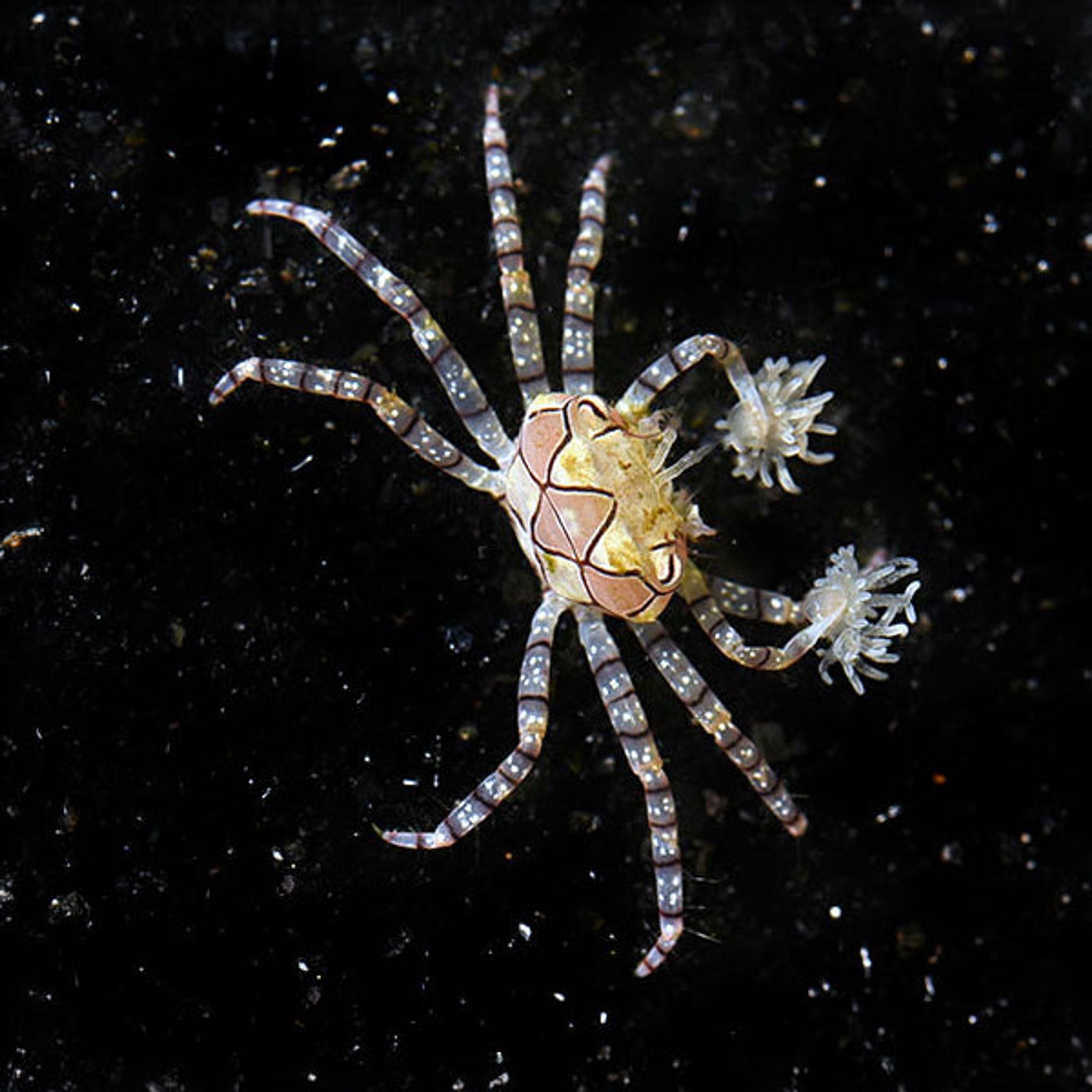

Pom-Pom Crab Care Guide: Tank Requirements, Feeding and Compatibility
The pom-pom crab is a pea-sized reef invertebrate best known for holding a stinging anemone in each claw and waving them like cheerleader pom-poms. This guide covers exactly what it needs in a nano or pico reef tank - water parameters, feeding, reef safety and which tankmates it will and won't tolerate - so you can decide if it fits your setup before you buy one.
What Is a Pom-Pom Crab?
The animal sold as a pom-pom crab or boxer crab belongs to the genus Lybia, with Lybia tesselata (the mosaic boxer crab) the species most commonly available in the aquarium trade. It is genuinely tiny: the carapace typically measures under 1 inch across, often closer to 0.5-1 inch (1.3-2.5 cm), so the whole animal fits comfortably on a fingertip.
Its defining trait is carrying a small anemone in each claw - usually a species from the genus Triactis or Bunodeopsis. The crab waves these anemones defensively, using their stinging tentacles to fend off predators, and also uses them passively to snag drifting food particles that it then eats. This is a true obligate mutualism: the anemones cannot survive long unattached from the crab, and the crab rarely thrives without them. If a crab loses an anemone, it isn't left empty-handed for long - it can steal one from a rival crab, or split a single anemone into two by tearing it, regrowing a matched pair over time.
Naming Confusion: Pom-Pom vs. Boxer vs. Strawberry Crab
Retail listings and general crab guides often blur several unrelated animals together. Here's a quick-reference breakdown:
| Common name | What it actually is | Lifestyle |
|---|---|---|
| Pom-pom crab / boxer crab | Lybia spp., most often L. tesselata | Free-living, hides in rock rubble, carries anemones in its claws |
| Mosaic boxer crab | Same animal as above (descriptive nickname for L. tesselata's patterned shell) | Same as pom-pom crab |
| "Strawberry crab" (as sold) | Usually refers to certain hermit crabs, or to Trapezia spp. relatives | Some live symbiotically inside the branches of specific corals like Acropora or Pocillopora, unlike the free-roaming Lybia |
The takeaway: if a listing calls something a "strawberry crab" and shows an animal living inside coral branches rather than holding anemones in its claws, it is a different species with different care needs - don't assume the same husbandry applies.
Tank Requirements
Tank Size and Maturity
A single pom-pom crab does well in a 10-gallon (38 L) tank as a comfortable minimum, and it's a natural fit for nano and pico reef setups. Some keepers successfully house one in a 5-gallon (19 L) pico tank, but that only works when the system is extremely well established and stable - a small volume leaves very little margin for error.
Maturity matters more than size. This crab depends on biofilm and microfauna that only build up over months, so the tank should be at least 4-6 months old with established live rock before it goes in. A brand-new tank simply doesn't have enough incidental food, and a crab dropped into one will spend most of its time hiding and slowly losing condition.
Water Parameters
Pom-pom crabs need standard reef-quality water, the same range you'd target for corals and reef fish:
| Parameter | Target Range |
|---|---|
| Temperature | 72-78°F (22-26°C) |
| pH | 8.1-8.4 |
| Specific gravity | 1.023-1.025 |
| Alkalinity | 8-12 dKH |
| Calcium | 380-450 ppm |
| Magnesium | 1250-1350 ppm |
| Ammonia / Nitrite | 0 ppm |
| Nitrate | Under 10-20 ppm |
Aquascaping and Flow
Provide plenty of live rock crevices and rubble - this is a shy, mostly nocturnal to crepuscular animal that spends the bulk of its time wedged into rockwork with only its claws and anemones visible. Sand or rubble substrate works fine; the rock structure matters far more than substrate type.
Because pom-pom crabs are usually kept in tiny water volumes, dissolved oxygen and flow deserve extra attention. Small crustaceans in nano tanks are vulnerable to overnight oxygen dips, which is a common and under-discussed cause of death in this size class. Moderate water movement and adequate surface agitation help keep oxygen levels stable through the night. Anyone assembling filtration for a nano reef can browse compatible options in FishyHub's marine invertebrates category alongside the crab itself.
Feeding: What Do Pom-Pom Crabs Eat?
In the wild, pom-pom crabs are opportunistic omnivore-scavengers. Their natural diet includes biofilm, detritus, microalgae, and zooplankton, much of the latter captured passively when their anemone "pom-poms" snag particles drifting through the water column.
In captivity, they lean heavily on incidental food - leftovers from fish and coral feedings - but a mature reef tank should still receive deliberate supplemental feeding:
- Particulate or liquid foods: a phytoplankton blend or a fine reef particulate food broadcast into the water column
- Minced frozen meaty foods: finely chopped mysis or brine shrimp, small enough for the claws to handle
- Nori: a small piece tucked into the rockwork near where the crab hides
Feed roughly every 1-2 days in an established system. Because the crab relies so much on ambient food, it won't compete well for meals in a very sparse tank or one with few other feeding fish or corals - it's easy to assume it's "self-sufficient" and skip target feeding altogether, but in an especially clean, heavily skimmed, low-nutrient reef, that assumption can lead to slow starvation. It scavenges what's already floating around rather than needing large, deliberate meals of its own.
Is a Pom-Pom Crab Reef Safe?
Yes, with one caveat worth stating plainly. Some retail listings hedge with a "reef safe with caution" label, largely out of general uncertainty, while care-focused sources tend to call it unambiguously reef safe. The practical answer sits in between: a pom-pom crab will not harm corals, clams, or healthy fish - it's too small and too passive to be a predation threat to anything of normal size. The mild caveat applies to very tiny or already weak/dying ornamental shrimp or snails, which it may scavenge on opportunistically rather than actively hunt.
The other caveat is intraspecific: multiple Lybia crabs housed together without enough space and enough small anemones to go around will fight over anemone "ownership." Keeping more than one is possible in a roomy tank with abundant hiding spots and anemone resources, but crowding a small nano tank with several crabs is a recipe for stress and territorial disputes.
Compatibility and Tankmates
Pom-pom crabs are peaceful toward everything outside their own species context and pair well with other calm, small reef inhabitants.
Good tankmates:
- Peaceful gobies
- Small, non-aggressive wrasses
- Clownfish
- Peaceful cleaner or skunk shrimp
- Snails and hermit crabs
Avoid:
- Large or aggressive crab species
- Oversized hermit crabs that may compete for or damage its anemones
- Large predatory fish - triggers, larger wrasses, lionfish, and puffers can all eat something this small
- Multiple unpaired Lybia crabs in a cramped space
Behaviorally, expect to see very little of it. It's shy and spends most of its time tucked into rockwork, occasionally waving its anemones when foraging or when it senses a threat. That boxing motion is defensive and food-gathering behavior, not an attack - there's no reason to remove a crab because it "boxes" at passing fish or at your hand during maintenance.
Acclimation and Ongoing Care
Like most small reef crustaceans, pom-pom crabs are sensitive to sudden shifts in salinity, pH, and temperature. Use a slow drip acclimation over at least an hour rather than a quick float-and-dump method; sudden parameter swings from bag water are one of the more common causes of early death in small crustaceans.
A few other care notes:
- Never use copper-based medication in a display tank housing a pom-pom crab - copper is lethal to it and to all crustaceans and inverts. Treat sick fish in a separate quarantine tank instead.
- Escape-proof the tank. Given its small size, a pom-pom crab can slip through minor gaps in a canopy, overflow cover, or equipment cutout.
- Quarantine transfers should use a net or cup rather than anything that risks a hyposalinity dip, and quarantine water should stay copper-free for the same reason as the display tank.
- Lifespan runs multiple years in a stable, consistently maintained reef system, though exact captive lifespan data is limited and largely anecdotal in hobby literature.
- Breeding in home aquaria is rare; most specimens available in the trade are wild-collected, which is a minor sustainability consideration worth keeping in mind when sourcing one.
Frequently Asked Questions
Is a pom-pom crab reef safe?
Yes, it's considered reef safe - it won't eat corals or healthy fish. The only minor risk is to extremely tiny or already weak invertebrate tankmates, which it may scavenge on opportunistically.
What size tank does a pom-pom crab need?
A mature 10-gallon (38 L) or larger reef tank is a comfortable minimum for one crab. Smaller 5-gallon (19 L) pico setups can work, but only if the system is exceptionally stable and well established.
What do pom-pom crabs eat?
In nature they eat biofilm, detritus, and zooplankton captured via their anemone claws. In a tank, supplement with a phytoplankton or particulate food, finely minced frozen mysis or brine shrimp, and small pieces of nori every 1-2 days.
Can you keep more than one pom-pom crab together?
Yes, but only in a roomy tank with plenty of hiding spots and enough small anemones for each crab to carry its own pair. Crowding several crabs into a tight nano space leads to territorial fighting over anemone ownership.
Do pom-pom crabs harm their anemones?
No. The relationship is a true mutualism - the crab protects the anemones and can even propagate them by splitting one into two, rather than damaging them.
What happens if a pom-pom crab loses its anemone pom-poms?
It can either steal an anemone from another crab or split an existing one in half, regrowing two from the one original over time.
What are good tankmates for a pom-pom crab?
Peaceful gobies, small wrasses, clownfish, cleaner or skunk shrimp, and snails all work well. Avoid large or aggressive crabs, oversized hermit crabs, and predatory fish like triggers, larger wrasses, lionfish, or puffers that could eat it.
Why is my pom-pom crab always hiding?
That's completely normal. It's a shy, mostly nocturnal species that spends most of its time wedged into rock crevices, and this behavior isn't a sign of illness or a stressed tank.
Ready to add one to a mature reef setup? Browse available specimens and compatible tankmates in FishyHub's marine invertebrates and crabs selection.


