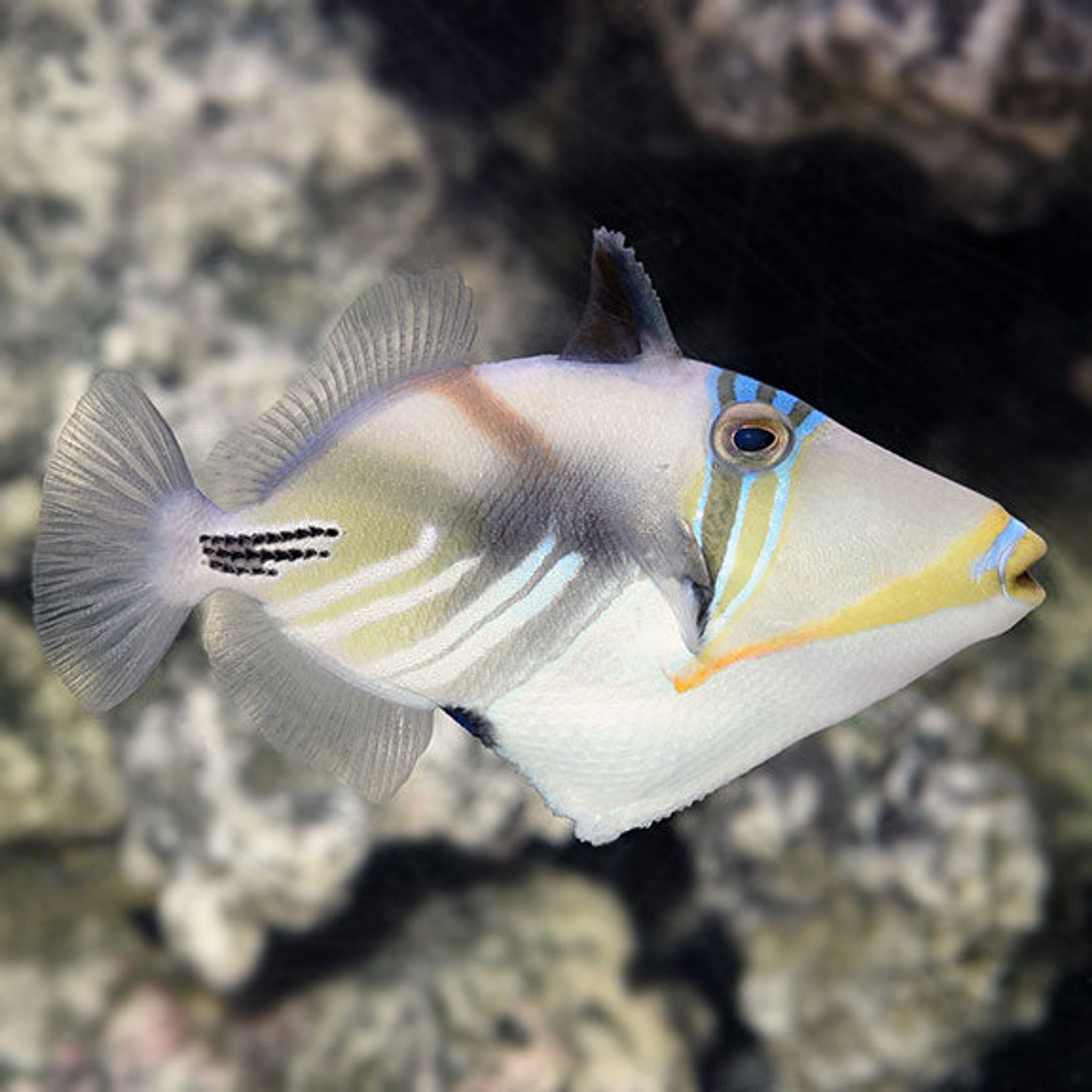
Picasso Triggerfish Care Guide: Tank Size, Diet, Compatibility and Reef Safety
The Picasso triggerfish is a bold, intelligent fish that outgrows most starter setups and produces far more waste than its size suggests. This guide gives straight answers on minimum tank size, diet, reef safety, and which tankmates can actually hold their own, so you can decide whether this is the right fish for your system before you buy one.
Species Snapshot
The Picasso triggerfish (Rhinecanthus aculeatus) is also known as the Blackbar or Lagoon triggerfish, and in Hawaii as the humuhumunukunukuapua'a — roughly "fish that grunts like a pig." It's native to Indo-Pacific reef flats and lagoons, including Hawaii, Polynesia, and the Philippines, where it forages over shallow sand and rubble.
| Trait | Detail |
|---|---|
| Adult size | 10–12 inches |
| Lifespan | ~10 years with stable conditions |
| Diet | Carnivore (meaty, shelled invertebrates) |
| Reef safe | No |
| Temperament | Territorial, intelligent, curious |
| Sexual dimorphism | None reliably visible to hobbyists |
Males and females look essentially identical, so sex isn't something you can determine by appearance in a home aquarium.
Tank Size: How Big Is Big Enough
Sources vary here, and it's worth being direct about why. Some list 100 gallons (379 L) as workable; others recommend 120–150 gallons. Treat 100 gallons as an absolute floor for a single juvenile-to-adult specimen — not a comfortable target. A more realistic, responsible minimum is 120+ gallons (450+ L) for one Picasso, and 150+ gallons (568+ L) once you add tankmates.
This fish is a constant, active swimmer that patrols the entire footprint of the tank, so a long, wide tank matters more than a tall one. A 6-foot-long tank with modest height will suit it better than a taller cube of the same volume.
For hobbyists who want a ready-built system rather than a custom drilled tank and sump, premium all-in-one (AIO) cabinet setups with built-in filtration compartments and rimless glass are a legitimate shortcut to hitting the 120+ gallon minimum without designing plumbing from scratch. Standard drilled tank-and-sump combinations remain the other common path, and both can be browsed under Marine Livestock alongside the fish itself once your system is ready.
Water Parameters
| Parameter | Target range |
|---|---|
| Temperature | 76–80°F (24–27°C) safe target; tolerant up to 82°F (28°C) |
| pH | 8.1–8.4 |
| Specific gravity | 1.021–1.025 (1.020–1.025 acceptable) |
| dKH (alkalinity) | 8–12 |
Sources disagree slightly on temperature — most cite 76–82°F, one lists a cooler 72–78°F. Splitting the difference, 76–80°F is the safe middle, with normal tropical marine tolerance extending toward 82°F. Run strong filtration and good water circulation, and consider a crushed coral or aragonite substrate, which helps buffer alkalinity as the tank matures.
Diet: A True Carnivore With a Dental Requirement
Picasso triggerfish need meaty, hard-shelled prey — not just protein, but food they have to crunch. Their teeth grow continuously, and gnawing through shells wears them down naturally. A soft-only diet of pellets and thawed mysis risks overgrown teeth that eventually interfere with feeding, occasionally severe enough to need a vet trim.
Feed 2–3 small meals daily, built around:
- Whole shrimp, crab, clams, and snails (in-shell where possible)
- Squid, silversides, and other fresh or frozen seafood
- Mysis and brine shrimp as supplements, not the whole diet
Avoid any food that lists vegetable matter as a primary ingredient; this species has no meaningful herbivorous component to its diet. Wild-caught adults sometimes refuse prepared or frozen foods at first and need live or very fresh offerings to start eating. Increasingly, captive-bred or aquacultured Picassos are available and tend to transition to prepared foods faster than wild-caught individuals — worth asking about when sourcing a fish.
Watch for tooth overgrowth: signs include difficulty picking up food, a visibly protruding or misaligned beak, or a fish that seems hungry but struggles to actually eat. Increasing hard-shelled prey frequency usually resolves mild cases; a fish that can no longer feed effectively needs professional evaluation.
Bioload and Water Quality
Picasso triggerfish are consistently flagged as heavy ammonia and waste producers relative to their body size. Filtration sized for "a 10-inch fish" in the generic sense will fall short. Oversize your filtration and biological media capacity, and run a maintenance schedule tighter than you would for a similarly sized, calmer fish.
Water Changes: Frequency Matters More Than Volume
Regular partial water changes export nitrate and phosphate, replenish calcium, magnesium, and alkalinity, and dilute waste your filter doesn't process. The old rule of thumb — 25–35% weekly — is often more than a well-filtered modern tank needs, and an oversized change can actually swing parameters and stress fish. For most tanks, 10% weekly or 15–25% biweekly is sufficient. Given a Picasso's outsized ammonia output, lean toward the more frequent end of that range rather than the sparse end.
Troubleshooting Cloudy Water
A trigger that digs through substrate looking for food will kick up occasional mechanical cloudiness — this typically clears within 1–2 days as mechanical filtration catches up and isn't a cause for concern. A bacterial bloom, by contrast, usually signals cycling or a bioload spike and should resolve as the tank stabilizes. Other causes include micro-bubbles, algae blooms, high-flow sandstorms, and calcium/alkalinity precipitation. Test ammonia and nitrite before assuming cloudiness is harmless — a digging trigger makes it easy to write off a real spike as "just the fish being messy."
Reef Safety: The Short Answer Is No
Picasso triggerfish are not reef safe. They will eat, crush, or uproot corals, clams, feather dusters, snails, and most sessile invertebrates while foraging, and they disturb rockwork and substrate in the process. Be skeptical of any claim that a Picasso can be trusted in a mixed reef — it will find and dismantle vulnerable invertebrates over time even if it seems to ignore them at first. Keep this species in a fish-only-with-live-rock (FOWLR) setup, not a reef tank.
Compatibility and Tankmates
Picasso triggers do best with fish large and robust enough to hold their own:
- Large tangs (powder blue, hippo/blue)
- Large wrasses
- Lionfish
- Dogface and other large pufferfish
- Snowflake eels
- Large angelfish
- Damselfish
Avoid anything small, slow, or passive, and anything that fits in its mouth — it will be eaten or relentlessly harassed. As a general rule, keep one Picasso per tank. Two juveniles raised together from a small size occasionally coexist, but this is a gamble, not a reliable plan, and outcomes shift as they mature and become more territorial.
Stocking Order Matters
Add the Picasso last, after other semi-aggressive tankmates are already established. Introducing it into an empty or newly cycled tank lets it claim the whole space as its own territory before other fish arrive, which tends to intensify aggression toward anything added afterward.
Don't Skip Quarantine
Because triggerfish are tough and hardy, quarantine is often skipped for them — but ich and other parasites are still a real risk, and introducing disease into a tank with an already-established aggressive resident raises the stakes further. Quarantine new arrivals for roughly 2–4 weeks before adding them to the display.
Temperament and Behavior
Picasso triggers are territorial, intelligent, and genuinely curious — many will recognize their keeper over time and investigate hands or tools that enter the tank. That curiosity comes with a real risk: their bites can break skin and are considered genuinely painful. Use tools and nets for tank maintenance, not bare hands, once a Picasso is established.
Relative to other trigger species — clown or undulate triggers, for example — Picassos are often described as the more approachable option. That's a comparison, not a green light: this is still "the most approachable trigger species, but still a trigger," and real caution is warranted rather than treating it as a docile community fish.
A grunting or grinding sound during feeding or territorial displays is normal vocalization behavior, not a sign of distress or a problem — new owners sometimes mistake it for something wrong when it's simply how the fish communicates.
Breeding
Breeding Picasso triggerfish in a home aquarium is essentially not achievable. Spawning requires large sand-bed nesting areas and extreme territorial aggression, with females guarding and attacking anything that approaches the nest. Even large commercial or public aquarium systems report only rare success.
Setup and Logistics for a Large FOWLR System
RO/DI Flood Prevention
Mixing saltwater or topping off a 120+ gallon system means handling large volumes of water. Use an auto shut-off — a float valve or an electronic flood-stop device — on your RO/DI reservoir. Mechanical float valves can stick or fail over time, so an electronic dual-sensor shutoff is a worthwhile upgrade for a tank this size.
Acclimating New Fish
Salinity and pH shifts are more stressful to marine fish than to freshwater fish, so acclimation deserves care:
- Float the sealed bag for 15–20 minutes to equalize temperature.
- Open the bag and swap out roughly 25% of the bag water for tank water.
- Add about a cup of tank water every 5–10 minutes over 30–60+ minutes (drip acclimation).
- Release the fish into the display — or, better, into quarantine first.
Moving a Saltwater Aquarium
A trigger's rockwork and aquascape tend to be heavy and awkward to relocate, so plan ahead: mix and store replacement saltwater in advance, keep spare nitrifying bacteria or bio-media on hand to reseed the system, and don't forget plumbing spares. Move the tank and stand first, replumb, replace sand and rock, refill with saltwater, and restart equipment — then add corals and inverts before fish, minimizing the total time animals spend out of water.
General Reef Maintenance Tools
Even in a fish-only system with rockwork, a few dedicated tools help: soft brushes reserved only for tank use, and airtight storage for dry goods kept near the tank. Lower priority than the points above, but a useful aside for anyone maintaining an aquascape.
Common Mistakes to Avoid
- Undersizing the tank using generic "large fish" charts instead of trigger-specific sizing — leads to stress and aggression spikes.
- Assuming a reef-safe claim applies — it doesn't for this species.
- Feeding an all-soft diet — causes overgrown teeth over time.
- Underestimating bioload — sizing filtration for "a 10-inch fish" instead of its actual waste output.
- Handling the tank barehanded once the trigger is established.
- Adding small or timid tankmates hoping the trigger will leave them alone.
- Skipping quarantine on new tankmates added to an existing trigger tank.
- Doing one large infrequent water change instead of smaller, more frequent ones.
Frequently Asked Questions
Is a Picasso triggerfish reef safe?
No. It will eat or damage corals, clams, and most invertebrates while foraging, so it should be kept fish-only with live rock rather than in a mixed reef tank.
What is the minimum tank size for a Picasso triggerfish?
100 gallons (379 L) is a bare floor for a single adult, but 120+ gallons (450+ L) is the responsible target given its size and activity level, rising to 150+ gallons (568+ L) once tankmates are added.
What do Picasso triggerfish eat?
Meaty, shelled invertebrates such as shrimp, crab, clams, and snails, plus squid and fresh or frozen seafood, fed 2–3 times daily. Hard shells are essential for wearing down teeth that grow continuously.
Do Picasso triggerfish bite?
Yes. They're intelligent and curious and will investigate hands with their mouths; bites can draw blood, so use tools rather than bare hands for tank maintenance once the fish is established.
Can you keep two Picasso triggerfish together?
Generally no — keep one per tank. Small juveniles raised together sometimes coexist, but this becomes riskier as they mature and their territoriality increases.
What fish are good tankmates for a Picasso triggerfish?
Large, robust species such as tangs, big wrasses, lionfish, other large pufferfish, and snowflake eels. Avoid anything small or passive, since it will likely be eaten or harassed.
How long do Picasso triggerfish live?
Roughly 10 years in captivity, assuming stable water quality and a proper diet that includes regular hard-shelled prey.
Can Picasso triggerfish be bred in a home aquarium?
Practically no. Breeding requires large sand-bed nesting areas and extreme guarding aggression that typical home systems can't replicate.
If you're building out a FOWLR system for a Picasso triggerfish, browse compatible large tankmates and marine stock under Marine Fish on FishyHub, including the Triggerfish category directly, to plan your stocking list before you buy.


