
Pearl Gourami Care Guide: Tank Size, Diet, Water Parameters and Temperament
The pearl gourami is one of the calmest centerpiece fish available for a planted community tank, provided it gets a long, densely planted footprint and steady water quality. This guide covers the exact tank size, temperature, pH and feeding routine that keep them healthy, plus which tankmates to trust and which to skip.
Quick Reference
| Parameter | Ideal range | Notes |
|---|---|---|
| Scientific name | Trichopodus leerii | Older literature calls it Trichogaster leeri |
| Adult size | 4–5 in (10–12 cm) | A few individuals pass 5 in |
| Lifespan | About 5 years | 8 years possible with excellent care |
| Minimum tank | 30 gal (114 L) | 20 gal long only for a single fish |
| Temperature | 77–82°F (25–28°C) | Tolerates 75–86°F |
| pH | 6.0–7.5 | Captive-bred stock handles 5.5–8.0 |
| Hardness | 5–15 dGH | Wider range tolerated |
| Diet | Omnivore, protein-forward | Pellets plus frozen or live meaty foods |
| Temperament | Peaceful | Males spar with each other |
Identification and Natural History
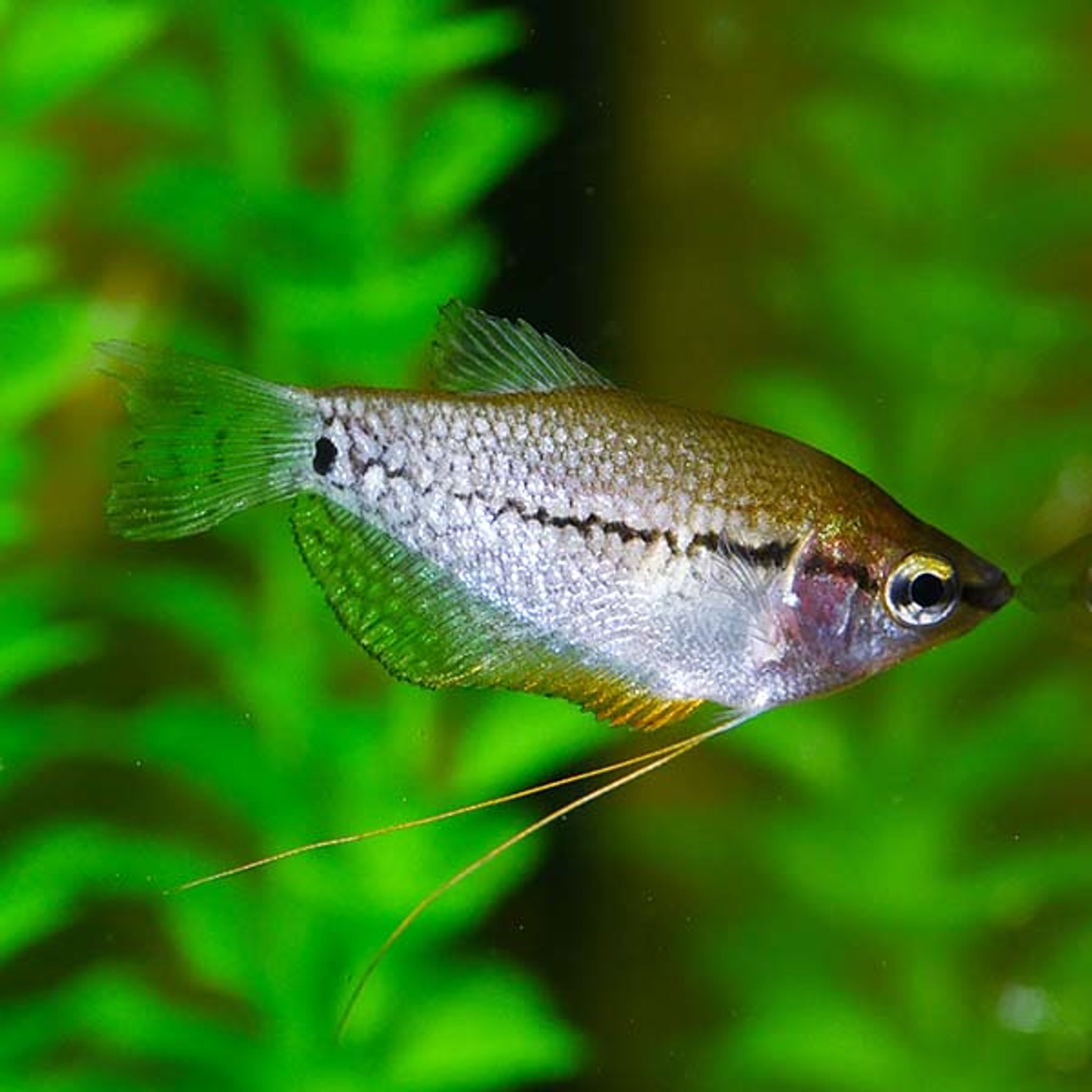
The pearl (or mosaic, lace, leeri) gourami carries a silvery-lavender body dusted in white pearl-like dots, with a dark horizontal stripe running from snout to tail and thread-like ventral fins it uses like feelers to probe its surroundings. It's a labyrinth fish, meaning it has an accessory breathing organ that lets it gulp air at the surface.
In the wild, pearl gouramis live in slow, tannin-stained peat swamps and blackwater streams across Thailand, peninsular Malaysia, Sumatra and Borneo. Habitat loss has pushed the species to a Near Threatened conservation status, though this matters less at the store counter than it sounds: nearly all pearl gouramis sold in the US are farm-bred, not wild-caught, so choosing captive-bred stock (the default in most cases) supports the fish without further pressuring wild populations.
Tank Size and Setup
A 30-gallon (114 L) tank is the practical minimum for a single pearl gourami or a small group of one male and two to three females. A 20-gallon long can work, but only for one fish on its own — anything more crowds them. Budget roughly 5–10 extra gallons per additional fish, and favor a long, low footprint over a tall one; pearl gouramis are surface-oriented swimmers that use horizontal space far more than vertical.
Recreate the blackwater feel with:
- Dense planting along the back and sides, leaving open swimming lanes
- Floating plants to dim overhead light and give the male a place to anchor a bubble nest
- Driftwood and a dark or sand substrate to mimic natural tannin-stained water
- Gentle flow — strong filter current stresses a fish built for slow swamps
- A tight-fitting lid with an air gap, since the labyrinth organ needs access to warm, humid air above the waterline; cold or dry room air can damage it
Sample Stocking Plans
| Tank | Pearl gouramis | Suggested tankmates |
|---|---|---|
| 30 gal (114 L) | 1 male + 2 females | 8–10 rummy-nose tetras, 5 corydoras |
| 40 gal breeder (151 L) | 1 male + 3 females | 10 harlequin rasboras, 6 corydoras, a small group of amano shrimp |
Acclimation
Pearl gouramis are naturally shy, and a rushed introduction makes it worse. Drip acclimate new arrivals over 30–60 minutes rather than just floating and dumping the bag, and keep the tank lights off for the first day so the fish can settle without added stress. Expect a few days of hiding as normal; a fish still hiding a week or more in should be checked for a bully tankmate or a water quality issue.
Water Parameters
Keep temperature at 77–82°F (25–28°C) for daily care; the species tolerates a broader 75–86°F swing, but stability matters more than chasing a specific number. A heater is necessary in nearly every US home, since ambient room temperature rarely holds steady in that range year-round.
Target pH 6.0–7.5, with captive-bred fish generally adapting to anywhere from 5.5 to 8.0. Hardness of 5–15 dGH is a safe middle ground, though tolerance runs wider. If you're in a hard-tap-water region such as Texas or the broader Southwest, don't chase a lower pH with additives — captive-bred pearl gouramis acclimate fine to moderately hard, higher-pH tap water as long as it's stable.
Non-negotiables regardless of exact numbers:
- Ammonia and nitrite: always 0
- Nitrate: under 20–40 ppm
- Water changes: 20–30% weekly
- Only add fish once the tank has fully cycled
Diet
Pearl gouramis are omnivores that lean toward animal protein — not strict carnivores, but they do best when meaty foods make up the bulk of the diet. Base feeding on a quality micro-pellet or flake, and supplement several times a week with frozen or live bloodworms, brine shrimp and daphnia. Offer occasional blanched vegetables like zucchini or peas for variety.
Feed 1–2 small meals a day (3 at most), offering only what disappears in about two minutes. Overfeeding is the most common cause of bloating in this species.
Temperament and Tankmates
Pearl gouramis rank among the most peaceful gourami species, though individual males vary — some stay mellow, others get territorial, especially around spawning time. Plan an exit route (a spare tank, or a return to the store) in case a male turns out to be a bully. They occupy the upper and middle water column and tend to be shy for the first week or two after introduction.
Good tankmates:
- Tetras (neon, rummy-nose, black skirt)
- Harlequin and other rasboras
- Corydoras
- Kuhli loaches
- Bristlenose plecos
- Peaceful barbs such as cherry barbs
- Platies and mollies (safer livebearer choices than guppies, whose long fins can invite nipping)
- Larger shrimp such as amanos
Avoid:
- Fin-nippers such as tiger barbs and some serpae tetras
- Large or aggressive cichlids
- Bettas — both are territorial, surface-dwelling labyrinth fish, and the combination rarely works
- Other large Trichopodus gouramis (see comparison below)
- Tiny shrimp species, since adult pearls will pick at cherry shrimp and their young
You can browse compatible community fish, including tetras and corydoras, on FishyHub.
Sexing
| Trait | Male | Female |
|---|---|---|
| Dorsal fin | Long and pointed | Short and rounded |
| Throat/breast color | Orange-red, deepens when breeding | Silvery, no red coloring |
| Body shape | Slimmer | Rounder |
Other Gouramis Compared
Pearls belong to a genus with a wide size range. Mixing them with the wrong relative causes more conflict than any other stocking mistake in this group.
| Species | Adult size | Minimum tank | Temperament |
|---|---|---|---|
| Pearl gourami | 4–5 in (10–12 cm) | 30 gal (114 L) | Peaceful |
| Moonlight gourami (T. microlepis) | 5–6 in (13–15 cm) | 30–40 gal | Calmer than three-spots, similar care |
| Three-spot / blue / gold / opaline (T. trichopterus) | About 6 in (15 cm) | 30–55 gal | More aggressive than pearls; don't mix |
| Kissing gourami | Up to 12 in (30 cm) | 55–75+ gal | Semi-peaceful; "kissing" is sparring |
| Giant gourami | 16–24+ in (41–61+ cm) | Huge tank or pond | Not for community tanks |
Most Trichopodus species reach 5–6 inches and need 30–55 gallons. The snakeskin gourami is often considered the gentle giant of the group. As a rule, don't house pearl gouramis with three-spot color forms — the size and temperament mismatch leads to bullying.
Related Labyrinth Fish
Paradisefish and bettas (including elephant-ear forms) share the air-breathing organ and bubble-nest building behavior with pearl gouramis. That shared biology doesn't translate to compatibility — male bettas and male pearl gouramis both defend surface territory and rarely coexist peacefully.
Breeding Overview
Set up a dedicated breeding tank with 6–8 inches of water at 80–84°F, floating plants, and no strong current. Condition the pair on live or frozen foods beforehand. The male builds a bubble nest at the surface and guards it after spawning. Remove the female once eggs are laid, and remove the male roughly 3–5 days later, once the fry are free-swimming.
Eggs hatch in 24–48 hours. Start fry on infusoria or a liquid fry food, moving to baby brine shrimp after about a week. Use a sponge filter (to avoid pulling in fry) and keep the tank covered — a stable, humid air space above the water is essential for the fry's labyrinth organ to develop properly.
Health and Common Problems
Pearl gouramis are hardy once settled in, and most health issues trace back to water quality or stress rather than the fish being fragile. Quarantine new arrivals for 2–4 weeks before adding them to an established tank.
Common issues:
- Fin rot, ich, fungus — usually linked to poor water quality or temperature swings
- Swim bladder problems — often diet-related
- Ammonia burns — a sign of an uncycled or overstocked tank
Bloating vs. Tumors
A fish that looks swollen after a heavy feeding is most likely dealing with overfeeding or constipation. Fast it for 1–2 days, then offer a single blanched pea. If a lump grows slowly and asymmetrically over weeks, it's more likely a tumor, which is usually untreatable. Monitor it and consult a vet familiar with fish, or consider humane euthanasia if the fish is clearly suffering.
Dropsy
Dropsy shows up as a swollen body with scales standing out in a pinecone-like pattern from fluid retention. It's typically a late-stage sign of organ failure or bacterial infection rather than a disease on its own. Isolate the fish and try Epsom salt (about 1 tablespoon per 5 gallons) alongside a broad-spectrum antibiotic, but the outlook is often poor — prevention through good water quality is far more effective than treatment.
Interaction and Enrichment
Pearl gouramis are surprisingly interactive and will learn to recognize their keeper, often swimming to the front of the tank at feeding time. Try target feeding, rearrange plants occasionally to give them something new to explore, and let them use their feeler fins to investigate their surroundings. Skip mirrors and tapping on the glass — both just add stress without any benefit.
Weekly Maintenance Routine
- Change 20–30% of the water and vacuum the substrate weekly
- Rinse filter media in removed tank water, never tap water, to protect the bacterial colony
- Keep the lid on and the surface calm rather than wide open to air currents
Common Mistakes to Avoid
- Adding fish to an uncycled tank — the single biggest cause of early losses
- Keeping two males in a small tank — sparring escalates without enough space or planting to break line of sight
- Bright, bare setups — pearls hide and lose color without floating plants and cover
- Fin-nipping tankmates chewing at the long feeler fins
- Strong filter current — baffle the outlet flow
- Persistent hiding beyond the first week signals stress or a bully, not normal shyness
- Pale coloration points to stress, poor water, or a diet too low in protein
- Frequent surface gasping is normal labyrinth breathing; gasping combined with clamped fins means it's time to test for ammonia
Frequently Asked Questions
Can a pearl gourami live alone?
Yes, a single pearl gourami does perfectly well on its own. Keeping a small group shows more natural social behavior, but it isn't required for the fish's welfare.
Can pearl gouramis live with bettas?
Generally not recommended. Both are territorial, surface-dwelling labyrinth fish, and housing them together often leads to conflict.
Will pearl gouramis eat shrimp?
Adults will pick at small shrimp like cherry shrimp and especially their babies. Larger amano shrimp are a safer choice for a mixed tank.
Do pearl gouramis need a heater?
Yes, in nearly every US home. Room temperature rarely stays within the 77–82°F range they need without one.
Do pearl gouramis need an air pump?
No. They breathe air directly at the surface using their labyrinth organ, but gentle surface agitation from the filter and an open-enough water surface are all they need.
How do you tell a male from a female pearl gourami?
Males have a longer, more pointed dorsal fin and an orange-red throat and breast that deepens during breeding. Females have a shorter, rounded dorsal fin and a plain silvery belly.
Are pearl gouramis good for beginners?
Yes, typically as a second fish once a tank has already finished cycling. Their calm temperament and tolerance for a range of water parameters make them forgiving once the tank is established.
Why does my pearl gourami keep going up for air?
That's normal labyrinth breathing, not a sign of distress. Only worry if gasping is paired with clamped fins, which can indicate an ammonia problem worth testing for.
Ready to add a pearl gourami to your planted tank? Browse available stock in the gourami category on FishyHub.


