Pajama Cardinalfish Care Guide: Tank Size, Diet, Compatibility and Reef Safety
The pajama cardinalfish (Sphaeramia nematoptera) is a slow-moving, polka-dotted reef fish that stays fully reef safe, tolerates a modest tank size, and shoals peacefully with dozens of other species. This guide covers exactly how big a tank it needs, what to feed it and when, which tankmates work, and how to avoid the mistakes that leave a pajama cardinal hiding and underfed.
Identifying the Pajama Cardinalfish
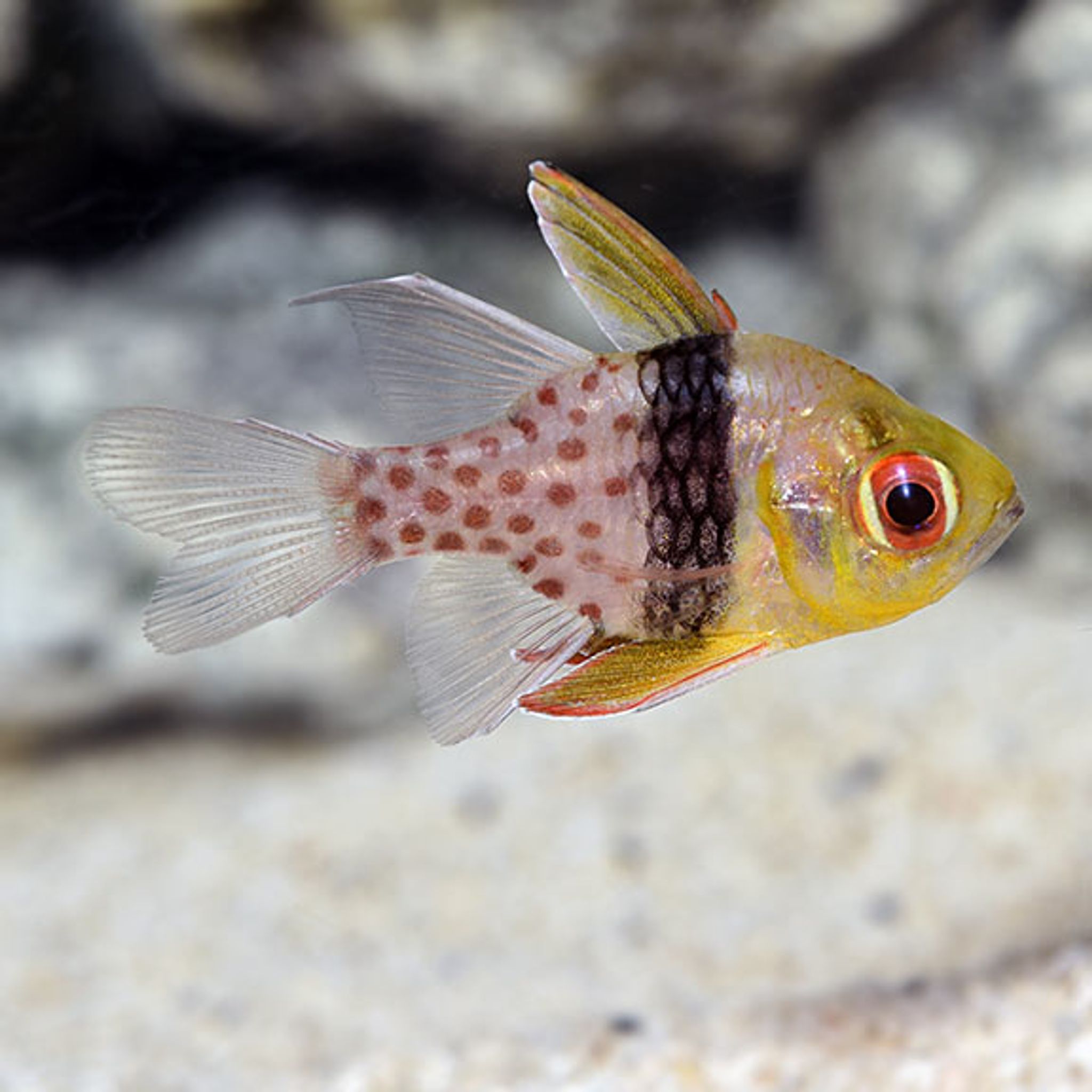
The pajama cardinal gets its name from a genuinely distinctive look: a round, laterally compressed body with a translucent orange-red rear half covered in white polka dots, a yellow-green face, large eyes, and a pale midsection band separating the front from the back. Two separate dorsal fins sit close together, the front one spiny, adding to the patchwork "sleepwear" appearance.
Adults reach about 3 inches (7.5–8 cm), making this one of the more compact staple reef fish. In the wild it originates from Indo-Pacific reefs and lagoons, where it shelters in coral rubble and among branching corals and seagrass in loose aggregations rather than swimming in the open water column.
Tank Size and Setup
Sources disagree slightly on the minimum footprint, but the practical answer scales with group size:
- 20 gallons (75 L) is workable for a single specimen.
- 30 gallons (114 L) or more is the sensible minimum for a small shoal of three or more, since the fish coexist better with room to establish loose territories around rockwork.
- As a rule of thumb, budget roughly 5–6 gallons per additional fish beyond the first when sizing a shoal tank.
Regardless of footprint, the aquascape matters more than raw volume. Pajama cardinals want dense branching rock or coral structure with shaded caves and overhangs to retreat into during the day. An open swimming column is not a priority for this species — vertical hiding spots are.
Water Parameters
| Parameter | Recommended Range |
|---|---|
| Temperature | 76–78°F (24–26°C), broader tolerance 74–80°F (23–27°C) |
| pH | 8.1–8.4 |
| Specific gravity | 1.023–1.025 (broader range 1.020–1.025) |
| Alkalinity (dKH) | 8–12 |
| Ammonia / Nitrite | 0 ppm |
| Nitrate | Under 20 ppm, lower is better |
Splitting the difference on the ranges reported across care sheets keeps the water chemistry compatible with typical reef corals and invertebrates housed alongside the fish, rather than optimizing narrowly for the cardinal alone.
Behavior and Social Structure
Pajama cardinals are crepuscular to nocturnal: most active at dusk, into the night, and during feeding, while spending daylight hours tucked into caves or hovering motionless near branching coral. Their swimming style is slow and hovering rather than darting, which makes them easy for faster tankmates to out-compete.
They are naturally shoaling fish. Keeping a group of 3–6, ideally with mixed sexes, produces more natural behavior and generally reduces stress compared with a single specimen — though a lone pajama cardinal will still do fine in a suitable setup. A single fish kept alone is more prone to hiding constantly, which is often mistaken for illness when it's really just a social response.
Diet and Feeding Schedule
Pajama cardinals are carnivorous micro-predators that do best on a rotation of meaty foods:
- Frozen mysis shrimp
- Frozen brine shrimp
- Finely chopped seafood
- Quality marine pellets or flakes
Feed small portions 2–3 times daily rather than one large meal — their stomachs are small and their feeding style is unhurried, so frequent light feedings suit them better than bulk feeding. Time at least one of those feedings near dusk or just before lights-out, ideally under dim blue or actinic lighting.
This timing isn't arbitrary. In the wild, crepuscular reef predators evolved alongside zooplankton that rises up from the reef structure as light fades, so cardinalfish are biologically wired to key their feeding response to low light rather than bright daytime conditions. A tank fed only under full daylight lighting can leave a nocturnal feeder like this one missing meals entirely, even if food is technically available.
Tankmates and Reef Safety
Pajama cardinals pair well with peaceful to semi-aggressive reef fish that won't outcompete them at feeding time:
- Gobies and blennies
- Dartfish
- Other cardinalfish species
- Clownfish
- Dwarf angelfish
Avoid large or aggressive predatory fish, and steer clear of fast, boisterous swimmers that will beat a slow-hovering cardinal to every meal. Shoppers building out a peaceful reef community can browse compatible gobies alongside cardinals for a calm, cave-loving stocking mix.
On reef safety, the pajama cardinal is a genuine staple: it is fully reef safe and does not pick at corals, clams, or the vast majority of invertebrates. Snails, hermit crabs, and feather duster worms are unambiguously safe around it. The one caveat involves very small ornamental shrimp — adult cardinals are unlikely to target established marine shrimp, but very tiny shrimp fry could occasionally be eaten opportunistically since the fish is, after all, a micro-predator by nature.
Breeding the Pajama Cardinalfish
This species breeds readily in home aquaria, which makes it a favorite entry point into marine fish breeding. Keeping a mixed-sex group of 3–6 lets natural pairs form on their own. Males are mouthbrooders, carrying fertilized eggs (and sometimes newly hatched fry) in their mouths for roughly 1–3 weeks until release.
No dedicated breeding tank is strictly required, but separating a holding male or the resulting fry into a breeding/grow-out tank or a net breeder noticeably improves survival odds, since fry in the main display are vulnerable to being eaten. Larval and juvenile fry need small live foods — copepods, rotifers, and newly hatched baby brine shrimp — to survive the first weeks.
Expect a well-cared-for pajama cardinal to live roughly 3–5 years.
Pajama Cardinal vs. Banggai Cardinalfish
The single most common shopping mix-up in this category is confusing the pajama cardinal with the Banggai cardinalfish (Pterapogon kauderni). They share a common name pattern but are quite different fish:
| Feature | Pajama Cardinalfish | Banggai Cardinalfish |
|---|---|---|
| Body shape | Round, compact | Elongated, more angular |
| Adult size | ~3 in (7.5–8 cm) | Larger, with long fin filaments |
| Pattern | Orange-red rear, white polka dots | Bold black, white, and silver stripes |
| Conservation status | Not a wild-collection concern | Wild populations endangered; choose tank-bred stock |
Double-check the species label before buying — the two carry very different price points, adult sizes, and conservation considerations.
Related Cardinalfish Worth Comparing
The family Apogonidae is large, and several relatives are worth knowing about if you're weighing options in the cardinalfish category:
- Seale's cardinalfish: A similarly sized 3–4 inch species with blue eyes; juveniles show dark horizontal stripes that shift to pinkish-red bars with age. Unlike the pajama cardinal, it's diurnal and more actively schooling. Reef safe, but best kept away from very small ornamental shrimp.
- Red stoplight cardinalfish: Needs a 30-gallon-plus tank with heavy rockwork and caves. Strictly nocturnal, with deep red coloring that visibly pales or pinks under stress — a handy at-a-glance health indicator. Carnivorous diet fed best at dusk; avoid boisterous tankmates like wrasses or hawkfish.
- Flame and orange/red-lined cardinals: Additional hobby staples that, like the pajama cardinal, tend toward nocturnal habits, mouthbrooding reproduction, and reef compatibility, though adult size and schooling tendency vary by species.
Common Mistakes to Avoid
- Buying a single fish and expecting bold behavior. Pajama cardinals kept alone are noticeably shyer; a small group encourages more natural, visible activity.
- Pairing with fast, aggressive feeders — larger damsels or tangs in a small tank will outcompete a cardinal at every meal, leading to slow, hard-to-notice starvation.
- Feeding only during the day. Since the fish is most active at dusk, a daytime-only feeding schedule can mean it never gets a fair shot at food.
- Skimping on hiding spots. Inadequate caves and overhangs cause chronic stress, color loss, or fish that refuse to eat — solve it with more rockwork.
- Skipping quarantine. New arrivals should spend 2–4 weeks in a separate quarantine tank before joining the display, which catches issues like marine ich or Uronema before they reach established livestock.
- Adding fish to an uncycled tank. Confirm ammonia and nitrite both read zero before stocking anything.
Keeping Nocturnal Fish Successfully
A few general habits make nocturnal and crepuscular species like the pajama cardinal easier to keep happy long-term:
- Run a dim actinic or "moonlight" lighting period so nocturnal fish stay visible and active without full daytime brightness.
- Provide ample caves and overhangs for daytime shelter.
- Feed at least once after the main lights dim, matching the natural feeding window.
- Watch for daytime tankmates monopolizing food if feeding only happens under bright light — that's a common way nocturnal species end up underfed despite an apparently well-fed tank.
Where the Pajama Cardinal Fits in a New Reef Tank
For anyone still building out a reef, pajama cardinals make a solid "second wave" addition: add them once the tank has fully cycled (zero ammonia and nitrite) but before more territorial or aggressive species have staked their claim. Stocking hardy, peaceful fish first — and researching adult size and reef compatibility before every purchase — lets the biofilter and social hierarchy settle in gradually rather than all at once.
Frequently Asked Questions
Is the pajama cardinalfish reef safe?
Yes. It doesn't eat or damage corals, clams, or the great majority of invertebrates, making it one of the more dependable staple fish for a reef tank.
How many pajama cardinalfish should I keep together?
A small shoal of 3–6 is ideal for natural behavior and reduced shyness. A single specimen will still adjust fine, just with more hiding.
What is the minimum tank size for pajama cardinalfish?
20 gallons (75 L) works for one fish; plan for 30 gallons (114 L) or more for a small group, along with generous rockwork regardless of footprint.
What do pajama cardinalfish eat?
Meaty foods — frozen mysis shrimp, frozen brine shrimp, chopped seafood, and quality marine pellets — fed in small portions 2–3 times a day, with one feeding timed near dusk.
Can pajama cardinalfish breed in a home aquarium?
Yes. They're easy mouthbrooders that pair off naturally within a mixed-sex group; males carry fertilized eggs in their mouths for roughly 1–3 weeks before release.
What's the difference between pajama cardinalfish and Banggai cardinalfish?
Pajama cardinals are smaller, rounder, and polka-dotted; Banggai cardinals are larger and more elongated, with long fin filaments, bold black-and-white striping, and wild conservation concerns that make tank-bred stock the better choice.
Why is my pajama cardinalfish hiding all the time?
It's often just normal nocturnal, shy behavior, but check for inadequate cover or bullying from faster tankmates — adding more caves and reviewing tankmate compatibility usually resolves it.
What temperature and salinity do pajama cardinalfish need?
Aim for 76–78°F (24–26°C), specific gravity 1.023–1.025, and pH 8.1–8.4 — standard reef water quality that also suits typical coral and invertebrate tankmates.
Ready to add pajama cardinals or one of their relatives to a reef community? Browse available marine cardinalfish to compare species and stock.

