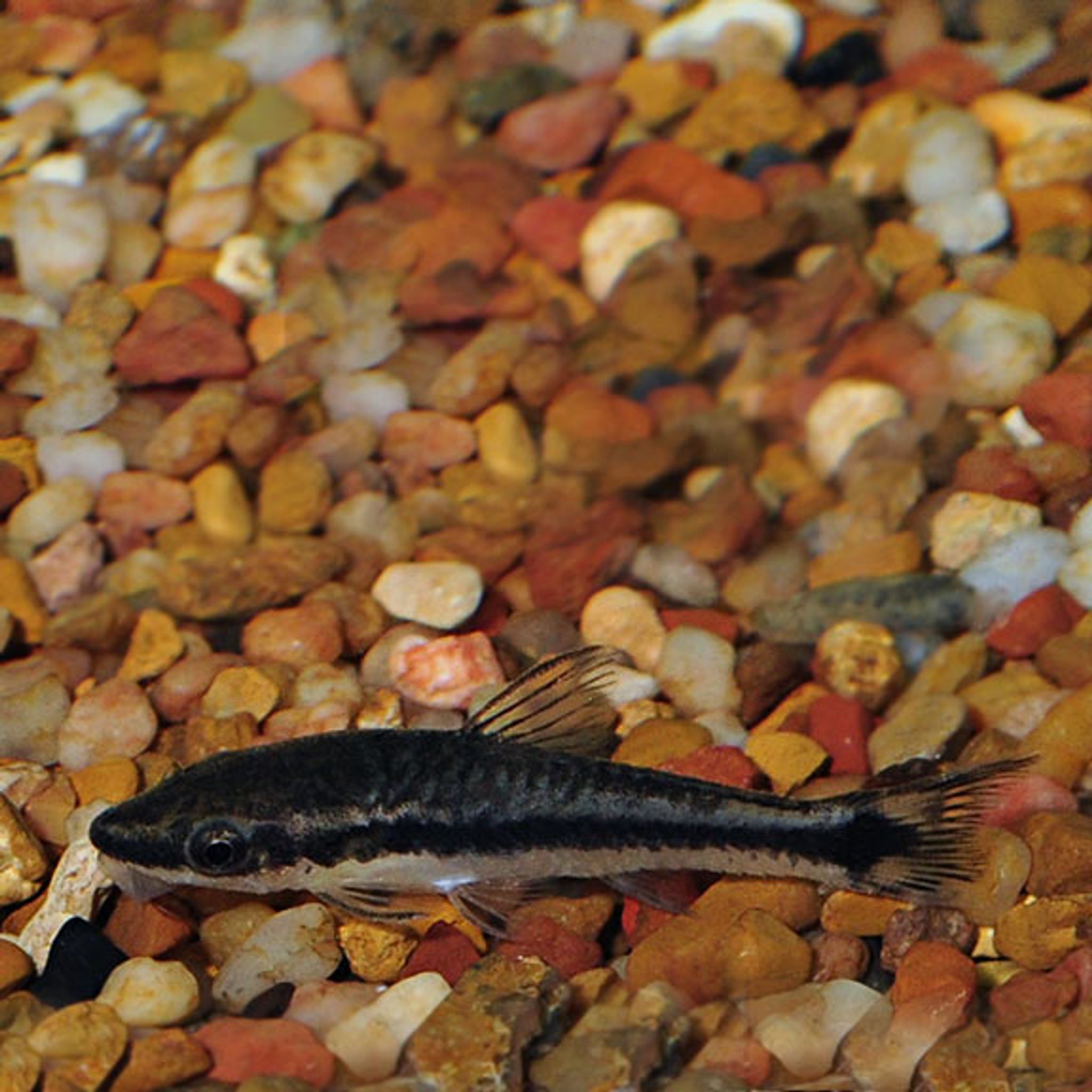

Otocinclus Catfish Care Guide: Tank Size, Diet, Water Parameters and Temperament
Otocinclus catfish are small, peaceful algae grazers that punish rushed setups more than almost any other community fish sold today. This guide covers exactly what they need — tank maturity, group size, water parameters, and diet — so you can tell before you buy whether your tank is ready, and troubleshoot fast if your otos are already struggling.
Species Basics
Otocinclus (often shortened to "otos") are small suckermouth armored catfish native to slow-moving streams in South America. Several species are sold under the generic "oto" trade name and look nearly identical on a store shelf. For practical care purposes, species identification barely matters — tank requirements, diet, and behavior are essentially the same across the group, so this guide applies regardless of which one you bring home.
- Size: adults typically reach 1–2 inches (2.5–5 cm); dwarf types stay closer to 1–1.5 inches (2.5–4 cm).
- Lifespan: most keepers see 3–5 years. Figures of 8–15 years do appear in hobbyist reports, but these represent best-case outcomes with ideal conditions from day one. The wide range exists mainly because so many otos arrive already stressed or underfed — a fish that survives its first month in good shape has a real shot at the long end of that range.
- Temperament: peaceful, shy, and non-aggressive. When startled, they dart quickly and then freeze rather than bolt continuously. They're entirely safe around shrimp, snails, and other small peaceful fish.
Is Your Tank Ready? A Quick Checklist
Tank readiness is the single factor that explains most oto deaths, so check it before you buy rather than after.
| Readiness factor | What to look for |
|---|---|
| Tank age | At least 2–3 months old, fully cycled |
| Biofilm/algae | Visible light film or algae on glass, decor, and plant leaves |
| Group ready to buy | 5–6 minimum, ideally 8–10+ |
| Tank size | 10 gallons (38 L) minimum for a small group; 20+ gallons (76+ L) for a full school |
| Quarantine plan | A separate tank or container for 1–2+ weeks before adding to display |
The biofilm test: turn off the lights for a day, then check the glass and decor under normal lighting. A faint, slightly slimy film you can feel with a fingertip means there's grazing material present. A tank that looks spotless — recently scaped, freshly wiped glass, brand-new hardscape — has nothing for otos to eat and is the top cause of early deaths, regardless of how long the filter has been running.
Tank Size and Setup
Sources disagree on the minimum, with some recommending as much as 30 gallons (114 L). In practice, 10 gallons (38 L) can support a small group of 4–6 otos in a well-established, planted tank, but 20 gallons (76 L) or more — favoring a long, wide footprint over a tall one — is the better choice for a proper school of 8–10. More floor and glass surface area means more grazing real estate, which matters more to otos than raw water volume.
Filtration and flow: aim for gentle-to-moderate flow with good oxygenation, mimicking a slow stream. Avoid strong, turbulent current from an oversized filter outlet, which can exhaust a fish this small.
Substrate and decor:
- Fine sand or smooth, rounded gravel protects their delicate bellies and barbels from abrasion.
- Driftwood, broad-leaved plants, and rock surfaces all function as grazing real estate and hiding spots.
- Sharp or rough substrate is a common cause of belly and barbel injuries that lead to secondary infections.
Water Parameters
Stability matters more than hitting an exact number. Sudden swings during water changes are a common source of stress and disease, so match temperature and pH when refilling and change water gradually.
| Parameter | Target range |
|---|---|
| Temperature | 72–79°F (22–26°C) |
| pH | 6.0–7.5 (slightly acidic to neutral preferred) |
| Hardness | Soft to moderately hard, generally under 10–15 dGH/KH |
Because otocinclus are tropical fish, a heater is necessary in nearly every US home aquarium setup to hold a stable temperature within that range.
Group Size and Temperament
Otos are schooling fish that need company to feel secure. Sources range from a bare minimum of 3–6 up to 8–10+; the sensible middle ground is 6 as a true minimum, with 8 or more strongly preferred, especially in larger tanks. A larger group grazes more constantly, hides less, and shows less fin-nipping among individuals than a pair or trio, which often stresses out and declines.
Tank mates: otos do well with small, peaceful community fish — tetras, rasboras, danios, guppies, mollies, dwarf gouramis, corydoras, small loaches, and cherry or amano shrimp. Avoid large or aggressive fish and anything with a mouth big enough to swallow them. FishyHub's Small Community Fishes category is a good place to browse compatible tank mates.
Diet: What Otocinclus Actually Eat
Otocinclus are herbivorous grazers. Their primary food is soft algae and biofilm (aufwuchs) and diatoms growing on hard surfaces — not every type of algae in the tank.
- What they eat well: soft green algae films, diatoms, and biofilm on glass, decor, and leaves.
- What they generally ignore or barely touch: black beard algae, hair/staghorn algae, and cyanobacteria (technically a bacteria, not a true algae).
- Supplemental foods: algae wafers, blanched or fresh vegetables (zucchini, cucumber, spinach, lettuce), and vegetable-based gel or frozen foods. Weigh vegetables down with a clip or a fork tine so they sink and stay put, and remove uneaten food within 24 hours to protect water quality.
Feeding timing is genuinely mixed across sources. Some recommend feeding at night or right after lights-out, since otos are often most active then, especially when newly added. Many otos become noticeably more active during the day once they've settled in over a couple of weeks, so don't assume nocturnal behavior is permanent — treat the first week or two as a settling-in period rather than a red flag.
A common long-term mistake: assuming algae alone will feed them indefinitely. Once a tank matures, gets more heavily planted, or is scrubbed regularly, natural algae supply often drops — a tank can become "too clean" to support a group of otos on grazing alone. If you notice less algae over time, increase supplemental feeding proportionally rather than waiting for a problem to show up.
Algae Identification and Control Basics
Understanding what's actually growing in your tank explains what your otos will and won't help with:
- Diatoms: brownish, dusty coating, common in newly set up tanks; otos eat these readily.
- Green dust or green spot algae: thin green film or hard green dots on glass; otos handle the dust form better than hardened spots.
- Hair or staghorn algae: thin green strands; otos largely ignore this.
- Black beard algae: dark, bristly tufts, usually on plant edges and hardscape; otos won't touch it.
- Cyanobacteria: a slimy blue-green or reddish coating, technically bacteria; no algae eater reliably controls it, and it usually signals a nutrient or flow issue.
Improving Water Quality to Reduce Nuisance Algae
Otos are a supplement to good husbandry, not a fix for excess light or nutrients. The real long-term solutions are reducing photoperiod, avoiding overfeeding and overstocking, and keeping up with regular water changes. Adding grazers to a tank with an ongoing algae problem caused by too much light or too many nutrients just adds another mouth to feed without solving the underlying cause.
UV Sterilizers for Green Water
A UV sterilizer is worth considering for green-water outbreaks — free-floating algae that clouds the water — since no fish, including otos, can address algae suspended in the water column. This is a distinct problem from the surface algae otos graze on glass and leaves.
Building an Algae-Eating Cleanup Crew
Otos are best suited to soft green algae and diatoms on glass and leaves, and they're a good fit for nano and planted tanks. Different algae types call for different cleanup crew members, so consider pairing otos with nerite snails, amano shrimp, or Siamese algae eaters rather than expecting one species to handle everything. Browse FishyHub's algae eater category to compare options, and see the full range of shrimp available as tank mates.
Common Algae-Eater Mistakes
- Overcrowding a tank with more grazers than the algae supply can support.
- Picking a species unsuited to the tank's size or water parameters.
- Expecting one species to eat every type of algae present.
- Adding a cleanup crew before the tank has an actual algae problem to solve, or before it's established enough to feed them.
Manual Glass Cleaning
A simple algae scraper or pad is a useful complement to biological grazers, especially in the early weeks before an oto group is established enough to keep up with what's growing.
Otocinclus in High-Tech Planted and CO2 Tanks
Otos are frequently added specifically to combat diatom blooms in new high-light, CO2-injected planted tanks — a distinct use case from simply controlling existing algae in an established community tank. In these setups, diatom blooms are common in the first several weeks as the tank finds its balance; a group of otos can help manage that bloom, but the tank still needs at least some biofilm established before they go in, and supplemental feeding becomes more important as high-tech tanks are often scrubbed and dosed to stay very clean.
Selecting Healthy Stock and Acclimation
Because most otos sold are wild-caught, they typically arrive stressed and underfed. At the store, look for:
- Fuller-bodied fish — avoid anything with a concave or pinched belly, a sign of starvation that's often difficult to reverse even with excellent care afterward.
- Clear eyes and intact fins and barbels.
- Active clinging behavior on glass or decor rather than fish sitting listlessly at the bottom.
Once home, use slow drip acclimation and quarantine new otos for 1–2 or more weeks before adding them to the display tank. This species is notoriously sensitive to shipping stress, and skipping quarantine is one of the most common causes of losses in the first few weeks.
Breeding
Breeding is possible but genuinely difficult in a home aquarium and not a realistic goal for most keepers. Egg-scattering behavior is somewhat similar to corydoras, and spawning is typically triggered by pristine water, a slight temperature increase, and abundant food. Fry require established algae and very stable, clean water to survive, conditions that are hard to maintain consistently alongside adult otos.
Common Mistakes and Troubleshooting
- Adding otos to a tank under 2–3 months old or one with no visible algae or biofilm — the leading cause of rapid deaths.
- Buying too few — pairs or trios of 2–3 often stress out and decline; buy in proper schools of 6 or more.
- Assuming tank algae alone will feed them long-term, then failing to supplement once algae becomes scarce.
- Choosing visibly thin or starved individuals at the store.
- Skipping drip acclimation or quarantine on a shipping-sensitive species.
- Using rough or sharp substrate that abrades bellies and barbels.
- Overreacting to initial hiding or nocturnal behavior — give a new group 1–2 weeks to settle before assuming a problem.
- Making sudden parameter swings during water changes instead of matching temperature and pH.
- Housing otos with fin-nippers or large, aggressive tank mates.
Frequently Asked Questions
How many otocinclus should I get for a 10-gallon or 20-gallon tank?
For a 10-gallon (38 L) tank, aim for a small group of 4–6, and only in a well-established, planted setup. A 20-gallon (76 L) or larger tank gives you room for a fuller school of 8–10, which shows more natural grazing behavior and less stress than a smaller group.
Will otocinclus catfish eat algae fast enough to keep my tank clean?
Not on their own. They supplement good water-quality and light management rather than replace it, and the algae growth rate needs to roughly match their grazing capacity. If algae keeps outpacing them, address photoperiod, nutrient input, and feeding before adding more fish.
Why do my new otos keep dying?
The most common causes are a tank that's too new or lacks biofilm, poor or skipped acclimation, or fish that were already starved before purchase. Check tank age and algae presence first, since that single factor explains most early losses.
Can otocinclus live with shrimp?
Yes, they're fully compatible. Otos and shrimp such as cherry or amano shrimp thrive under similar water conditions and pose no threat to each other.
Do otocinclus need a heater? What temperature do they need?
Yes. Otocinclus are tropical fish and need stable water in the 72–79°F (22–26°C) range. A heater is essential in most home setups, and keeping temperature steady matters more than hitting an exact number.
How can I tell if my otocinclus is starving?
Watch for a sunken or concave belly, visible ribs, lethargy, and constant hiding instead of grazing. These signs mean the fish needs more supplemental food immediately, and a badly starved individual may not fully recover even with improved care.
Do otocinclus breed in home aquariums?
Rarely, and only with real effort. Breeding needs a mature, pristine, stable setup with abundant food and established algae for the fry, which makes it impractical as a beginner project.
What's the difference between otocinclus and other small algae-eating catfish like dwarf plecos or hillstream loaches?
Otocinclus target soft algae and diatoms on glass and leaves in still-to-moderate flow, making them well suited to nano and standard planted tanks. Dwarf plecos have broader diets and grow slightly larger, while hillstream loaches need strong current and cooler water, making them a better fit for high-flow streambed setups rather than a typical community tank.
If your tank checks the readiness boxes above, browse FishyHub's Plecos, Corys & Bottom Dwellers category to find otocinclus and compatible bottom-dwelling tank mates for your setup.


