
Odessa Barb Care Guide: Tank Size, Diet, Water Parameters and Temperament
The Odessa barb is a hardy, cool-tolerant schooling fish that shows off a bold red stripe when kept in a proper group and clean water. This guide covers exactly how big a tank it needs, what water conditions and food keep it colorful, which tankmates actually work, and the mistakes that cause most new-owner problems.
Species Snapshot
The Odessa barb's scientific name is Pethia padamya. For years it was sold and even classified as a color form of the closely related ticto barb (Pethia ticto), and the two are still mixed up at times — a point worth knowing if you're trying to confirm exactly what you bought. Most sources place its native range in Myanmar, though a few list India or Bangladesh; this discrepancy is most likely bleed-over from the ticto barb's range rather than a real split in the species, so treat "Myanmar" as the best-supported answer without expecting perfect consensus in the hobby literature.
The common name has nothing to do with its origin — it references Odessa, Ukraine, where the fish became popular in the aquarium trade despite never occurring there naturally.
Key facts:
- Adult size: 2–2.5 in (5–6.5 cm), occasionally to 3 in (7.5 cm)
- Lifespan: 3–5 years typical, up to 6 years with excellent care
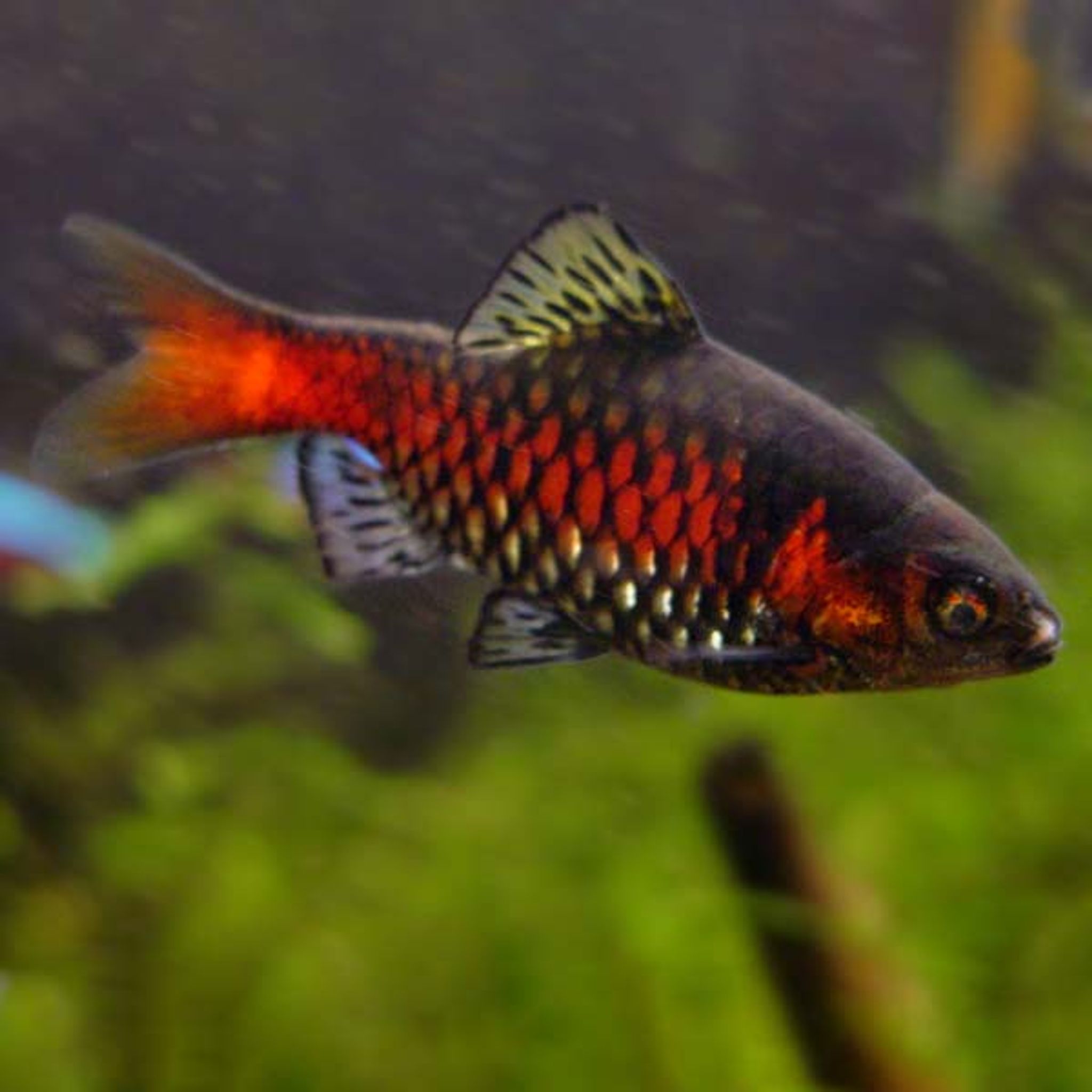
- Appearance: metallic silver body with a faded reddish-orange horizontal stripe from eye to tail base, plus one or two dark vertical bars near the gill and tail
- Sexual dimorphism: males develop a bold crimson-red stripe that deepens with age, diet, and water quality; females stay duller gold-brown and are rounder-bodied
Tank Size and Setup
Odessa barbs are active, mid-water swimmers that need real horizontal space, not just water volume.
- 20 gallons (76 L) is the practical floor for a school of 6.
- 30 gallons (114 L) is the better recommendation, especially once you go beyond 6 fish or want a group of 8–10.
Sources genuinely split on the minimum, and the difference comes down to activity level: a 20-gallon long tank works, but a 30-gallon gives noticeably calmer, more natural schooling behavior.
Décor and Filtration
Recreate a vegetated stream with open water in front:
- Plants: heavily plant the back and sides, leaving open swimming room in the middle/front; floating plants help diffuse light, matching the shaded, vegetated waters this species comes from
- Hardscape: driftwood, rocks, and caves for visual breaks and retreat spots
- Flow: moderate to fairly active current from a properly sized HOB or canister filter mimics their native stream habitat better than a dead-still tank
Basic Equipment Checklist
| Item | Notes for Odessa barbs |
|---|---|
| Filter | HOB or canister rated for the tank's volume; moderate flow preferred |
| Heater | Optional — useful mainly for stability if room temperature swings |
| Substrate | Fine gravel or sand; dark substrate makes the red stripe pop |
| Plants (live or artificial) | Dense cover plus open swimming lanes |
| Décor | Driftwood, rock, caves |
| Water test kit | For ammonia, nitrite, nitrate, pH |
| Net | Fine-mesh, sized for a small, fast fish |
Water Parameters
| Parameter | Range | Notes |
|---|---|---|
| Temperature | 64–79°F (18–26°C) | 70–76°F (21–24°C) is the sweet spot |
| pH | 6.0–8.0 | Aim for 6.5–7.5 |
| Hardness | 4–20 dGH | Middle of the range (roughly 5–15 dGH) is safest |
| Ammonia | 0 ppm | Always |
| Nitrite | 0 ppm | Always |
| Nitrate | Under 20 ppm | Manage with weekly water changes |
The Odessa barb is one of the few barbs that thrives without a heater in a normal room-temperature US home, since many homes naturally sit in the low-to-mid 70s°F. Sustained temperatures above about 78–79°F stress the fish over time, so resist the urge to run it in a warm tropical community setup by default.
On pH and hardness, the wide published ranges (pH 6–8.5, hardness 4–20 dGH) likely reflect genuine adaptability rather than conflicting data. Pick a moderate target — pH 6.5–7.5, dGH 5–15 — and hold it steady; this fish tolerates broader swings once acclimated, but only if changes happen gradually. For long-term stability rather than chasing a single number, blending RO water with tap water lets you dial in a consistent hardness instead of fighting your tap water's natural chemistry every water change.
Diet
Odessa barbs are easy, omnivorous eaters:
- Staple: high-quality flake or micro-pellet
- Protein boost: live or frozen bloodworms, daphnia, brine shrimp, or tubifex
- Plant matter: blanched zucchini, cucumber, spinach, or peas
Feed twice daily (some keepers go to three smaller feedings), giving only what the group clears in one to two minutes. Diet variety is not cosmetic — it directly drives how intense the male's red stripe becomes, so a flake-only diet is the most common reason a male looks washed out.
Temperament and Compatibility
Odessa barbs are active and curious, using all levels of the tank, and they are noticeably more peaceful than tiger barbs when kept correctly. The catch is that "correctly" means a real school: fish kept in groups smaller than six redirect their energy into nipping tankmates and each other, while a proper school of 6 or more channels that same energy into male-to-male displaying and chasing, which is normal social behavior, not a compatibility failure. More is better — 8–10 fish in a 30-gallon-plus tank produces the calmest, most colorful group dynamic.
Good Tankmates
- White cloud mountain minnows, zebra danios
- Other peaceful barbs (cherry, rosy)
- Rasboras, neon and ember tetras
- Corydoras catfish, bristlenose plecos, hillstream loaches
- Rainbowfish
- Amano shrimp, nerite snails
Tankmates to Avoid
- Bettas, fancy guppies, fancy goldfish, or other long-finned slow swimmers
- Aggressive cichlids
- Strictly warm-water tropical species
- Freshwater snails in general are a gray area — some get eaten or harassed, so treat them as a trial-and-error addition rather than a safe default
The Temperature-Compatibility Trap
Most standard "tropical community" fish are bred and kept at 76–82°F, which sits at or above the Odessa barb's upper comfort line. Before combining an Odessa barb with a typical tropical tankmate list, check whether that species can also handle running cooler — the danios, minnows, and rosy/cherry barbs above genuinely can, which is why they show up repeatedly as safe picks. You can browse compatible options in FishyHub's freshwater livestock listings to compare temperature needs before adding anything new.
Managing Males and Females in a Display Tank
Even outside a dedicated breeding setup, male Odessa barbs will chase females and each other during normal social interaction. Keeping a female-leaning ratio (roughly two to three females per male) and maintaining a full school of six or more spreads that chasing out across multiple targets instead of fixating on one fish, which noticeably reduces stress on any single individual.
Breeding
Odessa barbs are egg-scatterers and considered easy to moderate to breed:
- Set up a separate, bare-bottomed breeding tank densely packed with java moss or spawning mops.
- Raise the temperature slightly, to 72–79°F, to help trigger spawning.
- A well-conditioned female can scatter roughly 200–300 eggs.
- Remove the adults immediately after spawning — they will eat their own eggs.
- Eggs hatch in about 24–48 hours (some report as fast as 36 hours).
- Fry become free-swimming in about 5–7 days.
- Start fry on infusoria or a liquid fry food, then move to baby brine shrimp as they grow.
Because sexes are easy to tell apart on sight, conditioning a small group of extra females alongside your display tank makes it simple to pull a ready pair or trio into the breeding setup when you want to try it.
Spotting Illness Early
Run a quick weekly check against this list:
- Listlessness or hiding more than usual
- Clamped or folded fins
- Protruding scales (can signal an internal or kidney issue)
- Excess slimy coating on the body
- Cotton-like white tufts (fungal infection)
- Loss of appetite
Ich (White Spot Disease)
Ich is caused by a parasite that produces classic pepper-like white spots across the body and fins. Standard treatment combines:
- Raising temperature to roughly 82–86°F — do this cautiously and gradually with a cool-water species like the Odessa barb, since it's more heat-sensitive than typical tropicals
- Aquarium salt and/or a commercial ich medication
- Continuing treatment for 1–2 weeks after the last visible spot disappears, since the parasite has stages that aren't visible on the fish
Quarantine every new fish for 2–4 weeks before adding it to your display tank; this single habit prevents most ich outbreaks in an established tank.
Slime Disease
Slime disease is caused by protozoan parasites (such as Chilodonella or Trichodina) that irritate the skin and trigger excess mucus production, which shows up clearly against the Odessa barb's darker markings. It's difficult to confirm without a microscope, so the practical approach is to treat presumptively with an appropriate anti-parasitic medication while improving water quality — these parasites need a host quickly and die off once conditions improve.
Fish Tuberculosis
This is a rare but real bacterial disease caused by Mycobacterium marinum. It's notable for two reasons: fish often show no visible symptoms before dying, making it hard to diagnose, and it's zoonotic — it can infect humans through open cuts, though the human form is generally mild. Always wash your hands (or wear gloves if you have a cut) after tank maintenance, and avoid buying visibly wasting or listless stock in the first place.
Rapid Mouth Movement — Is It a Problem?
Fish rapidly opening and closing their mouths ("gilling") is usually normal, especially right after a water change, a temperature shift, or being introduced to a new tank — it's just extra oxygen intake during a stressful moment. It only becomes a concern when it's persistent and paired with other stress signs like lethargy or gasping at the surface, which usually points to low dissolved oxygen, overstocking, or declining water quality. Test your water and increase surface agitation before assuming disease.
Quarantine Dips
A brief medicated dip (5–10 minutes) can knock down external parasites or pests on new fish or plants before they ever reach your display tank. This is strictly a quarantine-tank tool, not something to dose into an established display — common active ingredients (such as malachite green–based products) are used the same way for early fungal and parasitic issues.
When to Add an Air Pump
A filter alone often provides enough surface movement, but a dedicated air pump and airstone earn their place in:
- Deeper tanks, where surface agitation from the filter alone doesn't reach the bottom
- Densely stocked or heavily planted tanks with a higher bioload
- Warmer water, which holds less dissolved oxygen
- As a battery-powered backup during power outages
Match the pump's output to your tank's depth and size, and factor in noise tolerance for your space — check FishyHub's filters category if you're weighing filtration and aeration together.
Common Mistakes to Avoid
- Buying too few fish. Two to four Odessa barbs is the single biggest cause of nippy, stressed behavior — it does the opposite of what new owners expect.
- Running the tank too warm long-term. Mid-70s°F and above, sustained, stresses this cool-water species and can shorten its lifespan.
- Overfeeding. Leads to poor water quality and swim bladder issues; feed only what's cleared in 1–2 minutes.
- Skipping quarantine. The fastest way to introduce ich or slime disease to an established tank.
- Poor tankmate choices. Long fancy fins, aggressive cichlids, and warm-water-only species are all mismatches.
- Neglecting water changes. Roughly 25–30% weekly keeps nitrate from creeping up unnoticed.
- Assuming rapid mouth movement always means illness. Check other symptoms and test your water before jumping to disease.
Weekly Maintenance Checklist
- Change 25–30% of the water
- Test ammonia, nitrite, nitrate, and pH
- Wipe down glass and check filter flow
- Visually scan the school for the illness warning signs above
- Confirm temperature is holding in the 70–76°F target range
Frequently Asked Questions
Do Odessa barbs need a heater?
Not strictly — they tolerate room temperature down into the mid-60s°F, which is unusual for a barb. A heater still helps by holding a stable target around 70–76°F if your room's temperature fluctuates a lot.
Are Odessa barbs fin nippers like tiger barbs?
Less so. Kept in a proper school of 6 or more, they're one of the more peaceful barbs available, though occasional squabbling among males is normal and not a sign of trouble.
How many Odessa barbs should I keep together?
At least 6, and ideally 8–10 in a 30-gallon-plus tank. Larger groups spread out social chasing and produce calmer, more colorful fish.
Can Odessa barbs live with bettas or fancy guppies?
It's not recommended. Their activity level and any nipping tendency put long, flowing fins at real risk.
How can I tell males from females?
Males show a bright red lateral stripe that intensifies with age and diet; females stay duller gold or brown and are rounder-bodied, especially when carrying eggs.
Why is my Odessa barb losing color?
Usually it's diet — needing live or frozen food variety rather than flake alone — combined with stress, poor water quality, or a lack of other males to display against.
How do I treat ich without overheating my Odessa barbs?
Raise the temperature moderately toward the lower-to-middle part of the standard ich-treatment range and combine it with aquarium salt and/or medication, rather than pushing to the very top of that range, since this species is more heat-sensitive than typical tropicals.
Is it normal for my fish to gulp at the surface?
Occasionally, yes, especially right after a water change or a stressful event. If it's constant, check oxygenation and water quality first before assuming illness.
Ready to start or expand your school? Browse available Odessa barbs and other compatible species in FishyHub's barb category.


