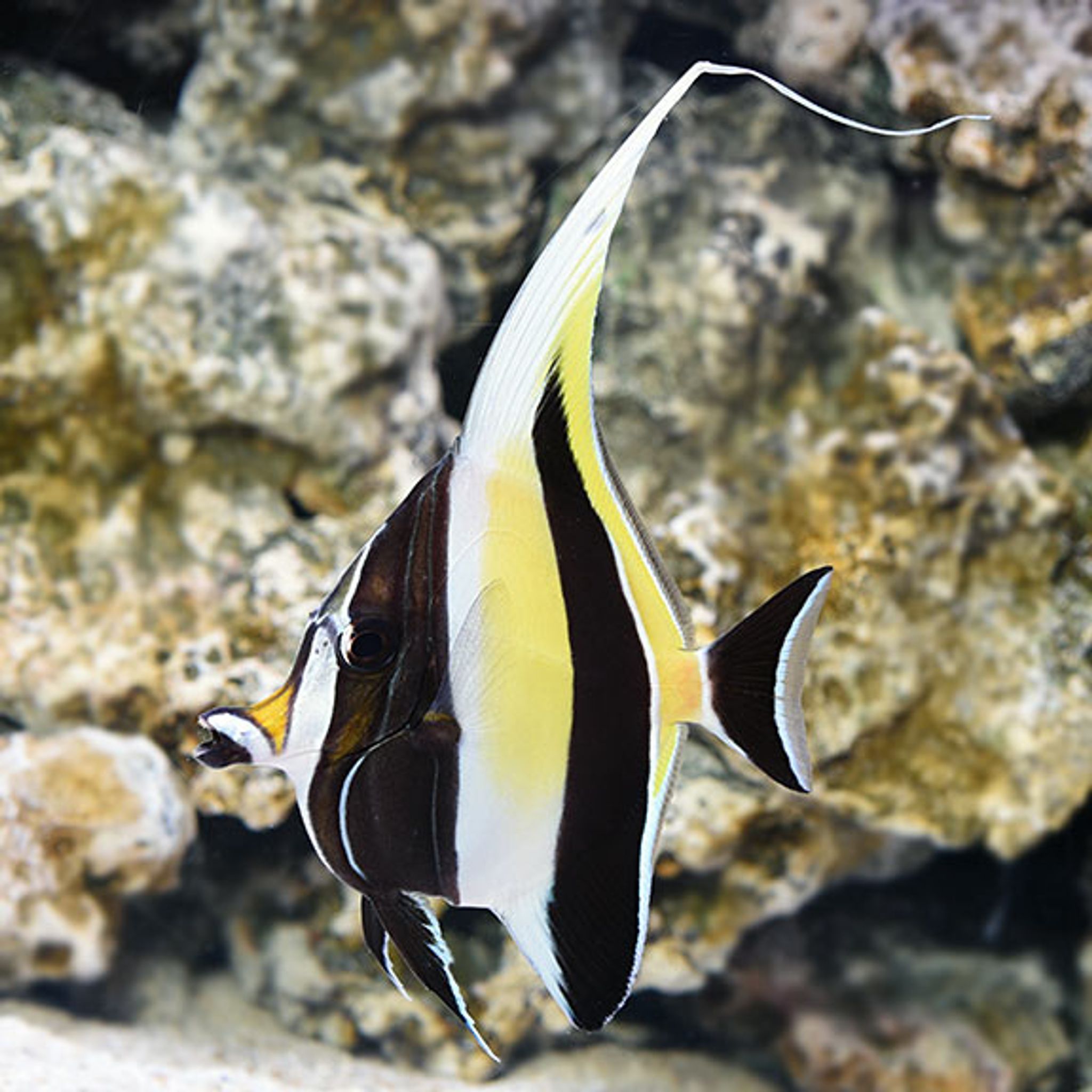

Moorish Idol Care Guide: Tank Size, Diet, Compatibility and Reef Safety
The Moorish Idol (Zanclus cornutus) is one of the most recognizable fish in the ocean, and one of the hardest to keep alive in a home aquarium. This guide lays out the real tank size, diet, and compatibility requirements so you can decide honestly whether you're ready for this species — not just admire it in a store tank.
Species Snapshot
The Moorish Idol is the sole member of its genus and family, Zanclidae — it has no close aquarium relatives, despite its resemblance to other banded reef fish. It's frequently confused with juvenile Heniochus species (bannerfish), which belong to an entirely different family (Chaetodontidae) and are far hardier and easier to feed. Mixing the two up at the point of sale is one of the most common — and costly — mistakes new buyers make.
| Trait | Moorish Idol |
|---|---|
| Scientific name | Zanclus cornutus |
| Family | Zanclidae (monotypic — only species in the family) |
| Adult size | 7–9 in (18–23 cm) in the wild; often smaller in captivity |
| Lifespan potential | 15+ years in the wild; captive survival varies widely |
| Origin | Wild-caught only; no reliable commercial captive breeding |
| Temperament | Peaceful, slow swimmer |
| Reef compatibility | Reef safe with caution |
Why This Is an Expert-Only Fish
Moorish Idols carry a well-earned reputation as "heartbreaker" fish: a specimen can look perfectly healthy at purchase and slowly starve over several weeks in a tank that isn't ready for it. That reputation is rooted in three specific facts:
- No captive breeding. Every Moorish Idol sold is wild-caught, so there's no line of fish bred or conditioned for aquarium foods.
- A highly specialized wild diet. In nature, they graze almost constantly on sponges, tunicates, and other encrusting invertebrates, plus algae and detritus on live rock — foods that simply aren't present in most aquariums.
- High captive mortality. Even experienced keepers lose specimens. Success stories of fish living 5–10+ years in captivity exist, but they're the exception, not the norm.
Sources disagree on how to frame this. Some older material calls Moorish Idols manageable for "advanced" hobbyists; more welfare-focused voices argue they're essentially unsuited to home aquariums and question whether the species should be collected for the trade at all, given how many don't survive the transition. This guide presents the husbandry honestly and lets you weigh that ethical question yourself — it isn't a decision to make lightly.
Who Should NOT Buy a Moorish Idol
- Anyone without a fully mature, 125+ gallon reef or FOWLR system already running.
- Beginner or intermediate saltwater keepers, regardless of tank size.
- Anyone unwilling to commit to a dedicated, multi-week feeding project and a proper quarantine period.
- Anyone who can't observe the fish eating before buying it.
If any of these apply, a Heniochus (bannerfish) — covered below — delivers a very similar look with dramatically better odds of survival, and you can browse options among FishyHub's butterflyfish.
Tank Size and System Maturity
Minimum tank size: 125 gallons, with 180+ gallons strongly preferred for long-term success. Sources vary here — some cite 100 gallons as an absolute floor, while retail- and breeder-oriented guidance insists on 125 gallons minimum. The realistic recommendation is 125 gallons as the floor, treating anything larger as materially better because this species needs long swimming distance, not just water volume, plus a large surface area of mature live rock to graze on.
The tank itself must be well established — at least 6–12 months old, fully cycled, with visible sponge and algae growth and an active pod (copepod/amphipod) population on the rock. A Moorish Idol should never go into a new system. If you're still building toward that maturity, see the setup basics later in this guide, and browse glass tanks sized for the long-term footprint this fish needs.
Aquascaping Considerations
For a sensitive, slow-swimming grazer like this, aquascape design matters as much as tank volume:
- Build a large but not overly cluttered rock structure — the goal is open swimming lanes alongside grazing surface, not a maze.
- Start with dim, low-stress lighting rather than a bright display setup on day one.
- Minimize handling and netting during acclimation; use a container-to-container transfer where possible instead of chasing the fish with a net.
Water Parameters
Stability matters more than hitting an exact number. Target standard reef-safe ranges and avoid swings:
| Parameter | Target Range |
|---|---|
| Temperature | 75–80°F (24–27°C) |
| Salinity | 1.023–1.025 SG (~35 ppt) |
| pH | 8.1–8.4 |
| Alkalinity | 8–12 dKH |
| Ammonia / Nitrite | 0 ppm |
| Nitrate | Under 10–20 ppm |
Run strong but not turbulent flow, and invest in real filtration capacity — a protein skimmer, generous live rock, and a refugium all help. Plan on 10–15% water changes every one to two weeks to keep parameters steady.
Diet: The Real Challenge
This is the section that determines survival. In the wild, Moorish Idols graze almost continuously on sponges, tunicates, and encrusting invertebrates. In captivity, most specimens are notoriously reluctant to accept anything resembling a prepared food, and this single issue explains the majority of captive deaths.
Feeding Strategy
- Provide live rock with existing sponge and algae growth from day one — this is often the only thing a newly imported idol will touch.
- Offer sponge-based frozen preparations, enriched mysis shrimp, enriched brine shrimp, sheets of nori or marine algae, and frozen formulas containing sponge material or spirulina.
- Feed small amounts, 3–5 times per day, to mimic constant natural grazing rather than one or two big meals.
- Be patient. It can take weeks to months before a wild-caught fish accepts anything other than live grazing surfaces.
A Basic Feeding Escalation Plan
If a newly acquired idol isn't eating, work through options methodically rather than giving up after a day or two:
- Days 1–7: Rely on grazing from mature live rock; offer nori clipped near the rockwork.
- Week 2: Introduce small amounts of enriched frozen mysis and sponge-based preparations at multiple feedings.
- Weeks 3–6: Rotate food types daily, feed at the same times, and reduce competition from tankmates during feeding so the idol has a real chance to eat.
- Beyond 6 weeks: If the fish still won't take anything but live grazing, continue supplementing the rock's natural growth and keep watching body condition closely — this is the point where many keepers seek more experienced guidance.
Why Tank Maturity Feeds the Diet Solution
This connects directly back to system age. An established tank's biofilm and pod populations are what make natural grazing possible at all — a new tank simply doesn't have the sponge growth, algae film, or invertebrate life a Moorish Idol relies on to survive its first weeks. The more mature and "dirty" (in a good, biologically rich sense) the rock is, the better the odds of a successful transition to prepared foods.
Sourcing and Quarantine
Because success is so tied to whether a specimen is already eating, sourcing decisions matter more here than for almost any other marine fish.
What to look for in a healthy specimen:
- Full-bodied, with no sunken belly or pinched stomach profile — this is a major red flag for starvation, not a normal body type.
- Clear eyes and no white patches (a common secondary infection or parasite issue in stressed idols).
- Alert, active swimming rather than hiding or listing.
Questions worth asking before buying:
- How long has this fish been in-house?
- Is it eating, and on what specifically?
- Can you see it eat before purchase?
Only buy a specimen that's been observed eating already. Once home, quarantine for 2–4 weeks in a separate system, watching closely for feeding behavior and any signs of disease before moving it to the display tank. Skipping quarantine risks introducing disease to a fish that has very little physiological reserve to fight it off.
Compatibility and Behavior
Moorish Idols are peaceful, slow-moving fish that do best kept singly in most home systems. In the wild, juveniles are sometimes seen in small loose groups on reef slopes, while adults tend toward solitary or paired behavior — but replicating a school in captivity isn't practical for hobbyists and isn't a stocking goal.
Sources differ slightly on solo versus paired keeping. The safer approach: keep one per tank unless the system is very large (200+ gallons) and the pair arrived and was introduced together from the start — introducing two unrelated adults later tends to end in aggression or one fish being outcompeted.
Good tankmates are peaceful to semi-aggressive reef fish that won't out-hustle a slow grazer at feeding time:
- Docile wrasse species
- Tangs and surgeonfish
- Peaceful gobies
- Calm angelfish
Avoid boisterous, fast-eating species and known fin-nippers — both will stress the idol and reduce the amount of food it actually gets.
Reef Safety
Moorish Idols are generally considered reef safe with caution. They may nip at certain soft corals, zoanthids, clam mantles, or encrusting sponges and tunicates already established in the tank. If you keep prized coral specimens, introduce the idol carefully and monitor its behavior around them rather than assuming it will leave everything alone.
Disease Susceptibility
This species is prone to marine ich, velvet, and secondary bacterial infections when stressed — and malnutrition makes all of these worse by weakening the immune system. In practice, keeping a Moorish Idol healthy long-term comes down almost entirely to getting it eating consistently; a well-fed idol is a far more disease-resistant idol.
Cost and Availability
Expect a moderate-to-high price point. Because there's no commercial captive breeding, every specimen is wild-caught and availability is seasonal, tied to collection regions and shipping schedules rather than steady stock levels.
A Hardier Alternative: Bannerfish (Heniochus)
If the black-white-yellow banded look is what draws you in, Heniochus species (bannerfish) are worth serious consideration instead. They share a similar color pattern and general body shape but belong to the butterflyfish family, are captive-hardy, and adapt to prepared foods far more readily than a true Moorish Idol. For less experienced reefers — or anyone without a 125+ gallon mature system ready today — a bannerfish delivers most of the visual appeal with a much higher survival rate.
Readiness Checklist Before You Buy
Work through this before purchasing, not after:
- Tank is at least 125 gallons, ideally 180+, with a long footprint
- System is fully cycled and at least 6–12 months old
- Live rock shows visible sponge/algae growth and an active pod population
- A separate quarantine tank is set up and ready
- You've confirmed the specimen is already eating at the point of sale
- You have a feeding escalation plan and the patience for weeks of trial and error
- Tankmates are peaceful and won't outcompete it for food
New Saltwater Tank Setup Basics
If your system isn't mature enough yet, a Moorish Idol should be one of your last additions, not your first. The standard build sequence:
- Choose a tank and stand, and plan equipment placement (filtration, skimmer, return pump).
- Add live rock and sand.
- Mix and add saltwater.
- Run a fishless cycle using an ammonia source, waiting until ammonia and nitrite both process down to zero.
- Test parameters to confirm stability.
- Stock slowly, starting with hardy species, and let the tank age for months before considering a sensitive species like this one.
Mixing Salt Correctly
- Use RO/DI water no warmer than about 68°F (20°C) while mixing.
- Always add salt to water, never water to salt.
- Mix with a powerhead or pump for up to a couple of hours — avoid excess aeration, which can cause precipitation.
- Check and adjust salinity before adding the water to your system.
- Use freshly mixed batches within about a week if stored covered.
Flow and Return Pump Basics
When sizing a return pump for a large idol tank, remember that a pump's rated flow drops as vertical lift (head height) and plumbing friction increase — always size based on your system's actual head, not the pump's maximum-rated GPH on the box. Oversized flow can also stress a shy grazer that prefers steady, non-turbulent current, so tune output after installation rather than assuming more flow is automatically better. A reliable filter sized correctly for your tank volume supports the water quality this species needs to stay stable.
Frequently Asked Questions
Can beginners keep a Moorish Idol?
No. This species calls for years of reef-keeping experience, a large and fully mature system, and readiness to run a dedicated, potentially months-long feeding project before you even consider it.
Why do Moorish Idols keep dying in home aquariums?
Overwhelmingly, it comes down to starvation from refusing prepared foods, which then compounds into stress and secondary disease. A fish that isn't eating enough has little resilience against ich, velvet, or bacterial infections.
What is the best tank size for a Moorish Idol?
A 125-gallon tank is the realistic minimum, with 180+ gallons better for long-term success. A long footprint that supports continuous swimming matters as much as total volume.
Are Moorish Idols reef safe?
Generally yes, with caution. They may pick at some soft corals, zoanthids, clam mantles, or encrusting sponges, so observe behavior closely if you keep valuable coral specimens.
What do Moorish Idols eat in captivity?
Live rock with sponge and algae growth is the best starting point, followed by sponge-based frozen preparations, enriched mysis and brine shrimp, nori, and frozen formulas containing sponge material or spirulina. Feed small amounts several times a day.
Can Moorish Idols be bred in captivity?
No. There's no reliable commercial captive breeding program for this species — every specimen sold is wild-caught.
What's the difference between a Moorish Idol and a Bannerfish?
They're different genus and family entirely — Zanclidae versus Chaetodontidae — despite a similar black-white-yellow banded look. Bannerfish (Heniochus) are considerably hardier and easier to feed, making them a practical substitute for less experienced keepers.
How long do Moorish Idols live?
Up to 15+ years in the wild. Captive lifespan varies widely and is often much shorter without ideal care, though committed keepers with mature systems do report multi-year successes.
Ready to evaluate your own system before considering a Moorish Idol or a hardier look-alike? Browse FishyHub's full range of marine fish to compare species and plan your stocking list around what your tank can realistically support.


