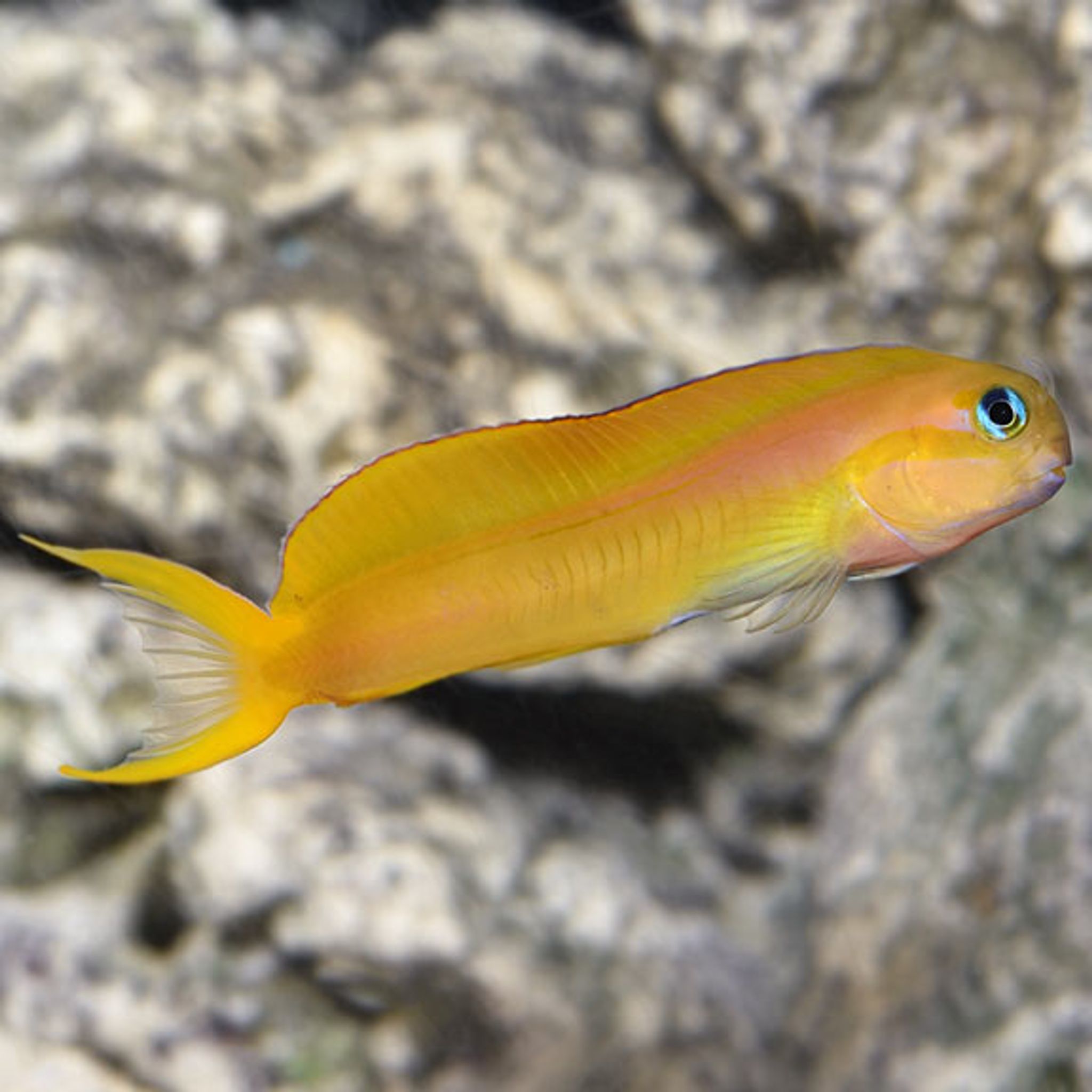

Midas Blenny Care Guide: Tank Size, Diet, Compatibility and Reef Safety
The Midas blenny (Ecsenius midas) is a gold, active, mid-water swimmer that's genuinely reef safe and easy to feed, which is why it shows up on so many stocking lists. This guide covers the tank size, water parameters, diet, and compatibility rules that keep one happy long-term, and clears up the confusion between the Midas and its similarly colored, sometimes venomous relatives.
Species Snapshot
The Midas blenny is also sold as the Golden Blenny or Lyretail Blenny. It belongs to the genus Ecsenius, unrelated to the Meiacanthus "fang" blennies despite occasionally being lumped in with them by common nickname.
| Trait | Detail |
|---|---|
| Adult size | 4–5 in (10–13 cm), occasionally reported to 6 in (15 cm) |
| Minimum tank size | 30 gal (114 L) for one; 90+ gal (340+ L) for a pair or harem |
| Temperature | 74–80°F (23–27°C) safe range; tolerates up to ~84°F (29°C) |
| pH | 8.1–8.4 |
| Specific gravity | 1.020–1.025 (mid-range ~1.025 typical) |
| Carbonate hardness | 8–12 dKH |
| Lifespan | 2–5 years, up to 5+ with excellent care |
| Diet | Omnivore, meaty/planktonic-leaning |
| Reef safety | Reef safe |
| Venomous | No |
Sources vary slightly on temperature (readings from 72–84°F appear across different care sheets), so 74–80°F is the safest overlap for a reef system that also has to suit corals, with the understanding that the fish itself can handle brief excursions toward 84°F.
Tank Size and Aquascaping
A single Midas blenny needs at least 30 gallons (114 liters). That's the consensus minimum across care guides and gives it enough swimming room plus space to establish a territory.
Unusually for the blenny family, the Midas is a continuous mid-water swimmer rather than a bottom-hopper. Most true blennies lack a swim bladder and perch or hop between rocks; the Midas has active, fish-like swimming behavior instead, which changes what the aquascape needs to provide:
- Live rock with caves, crevices, and overhangs for retreat and sleeping, which is the primary structural need.
- Open water column space for swimming, since this species won't just sit on a rock all day.
- Soft sand as a nice-to-have rather than essential — burrowing is a trait more associated with sand-sifting blennies in general, and isn't well documented as a defining Midas behavior specifically.
- A tight-fitting lid, non-negotiable. The Midas is an excellent jumper, especially when startled, and an uncovered tank or a gap around cords and plumbing is the single most common cause of losing one.
If you're weighing a pair or small harem, most care sheets only address solitary keeping at the 30-gallon level; one source specifically calls for 90+ gallons with abundant rockwork to divide territory between multiple fish. Treat solitary keeping as the safe default and reserve a harem attempt for larger, well-aquascaped systems run by experienced keepers.
Diet and Feeding
The Midas blenny is an omnivore weighted toward meaty and planktonic foods, not a pure algae grazer — a common misconception since so many other blennies are herbivores. In the wild it feeds on zooplankton in the water column and picks at copepods, amphipods, and film algae on live rock.
A practical feeding routine:
- Feed 2–3 times daily, offering only what's consumed within a couple of minutes.
- Rotate mysis shrimp, brine shrimp, chopped clam or mussel, and cyclops as the meaty base.
- Add marine pellets and spirulina or nori algae sheets to round out the diet.
- In a tank with limited natural microfauna, lean on frequent small meals rather than one or two large feedings — this species grazes almost continuously in nature, and sporadic feeding in a pod-poor tank can lead to gradual weight loss.
Reef Safety
The Midas blenny is reef safe. It doesn't host on or nip anemones, and it leaves LPS and SPS coral polyps alone under normal circumstances. It's also considered safe around clams and most sessile invertebrates, making it one of the more dependable fish for a mixed reef display.
Compatibility and the "Peaceful" Question
Care sheets often call the Midas blenny "peaceful," and that's true toward dissimilar fish — but it's incomplete. The more accurate framing is: peaceful toward unrelated fish, intolerant of its own kind and similar competitors.
Good tankmates generally include:
- Clownfish
- Cardinalfish
- Basslets and dottybacks
- Flame angelfish
- Wrasses and tangs
Fish to avoid pairing it with:
- Other Midas blennies (same-species aggression is common in tanks under 90 gallons)
- Other blenny species entirely — they compete for the same territory and planktonic food
- Small gobies and firefish, for the same resource-competition reasons
If you notice your blenny single out one particular tankmate for harassment while ignoring everyone else — a behavior blennies are known for, even otherwise mild-mannered individuals — the fix is usually rearranging rockwork to break the sightline or territory claim, or rehoming the targeted fish rather than the blenny itself.
Shoppers browsing the full blenny selection should plan on one Midas per display tank in most home setups.
Health, Sensitivity, and Common Mistakes
Blennies, including the Midas, have no scales — only skin. That makes them more vulnerable to parasites and ammonia spikes than scaled fish, and it's the reason behind several recurring mistakes:
- Skipping the lid. Worth repeating: jumping is the leading cause of death for this species, particularly during acclimation or after a startle.
- Adding into an uncycled or unstable tank. A scaleless fish has less protection against parameter swings. Make sure the tank is fully cycled, and acclimate slowly — a drip acclimation is a better fit than a quick float-and-dump for a species this sensitive to rapid changes.
- Underfeeding. As covered above, sporadic meals in a low-microfauna tank can leave this active swimmer underweight.
- Assuming it's algae-only. It needs meaty and planktonic foods, not just rock to graze.
- Buying on color alone and confusing it with a venomous lookalike (more on that below), which can lead to mishandling risk or the wrong assumptions about aggression.
One useful diagnostic built into the fish itself: Midas blennies change color when stressed. A shift in coloration is worth treating as an early warning to check water parameters, look for aggression from tankmates, or reassess how recently the fish was introduced.
Midas Blenny Lookalikes: Side-by-Side Comparison
The Midas is frequently confused with several yellow or gold blennies that look similar at a glance but differ in swimming style, temperament, and — in some cases — venom. Since these fish are commonly displayed side by side, it's worth knowing the differences before choosing one based on color alone.
| Species | Swimming style | Venomous | Diet | Notes |
|---|---|---|---|---|
| Midas blenny (Ecsenius) | Active mid-water swimmer | No | Meaty/planktonic-leaning omnivore | No confirmed captive breeding; wild-caught only |
| Canary blenny (Meiacanthus) | Active mid-water swimmer | Yes (mild, defensive fang bite) | Omnivore/zooplankton | Most visually confused with the Midas due to similar yellow color and swimming style |
| Forktail blenny (Meiacanthus) | Active swimmer (has a functional swim bladder) | Yes (mild) | Omnivore, easy on flakes/pellets | Shares the Midas's active-swimming trait, another source of mix-ups |
| Striped/lyretail fang blenny (Meiacanthus) | Active swimmer | Yes (defensive fang teeth) | Omnivore | Sociable in harem groups, unusual for the family; hardy, especially captive-bred stock |
| Bicolor blenny (Ecsenius) | Bottom-percher | No | Herbivore-leaning | May nip coral polyps or clam mantles while grazing — a reef caveat the Midas mostly avoids |
| Barnacle blenny | Bottom-percher (tiny crevices) | No | Mostly carnivorous (unusual for the family) | Needs small caves/holes rather than open swimming space |
Why some blennies swim and others hop
Most combtooth blennies (the group that includes the Midas, bicolor, and barnacle blenny) lack a swim bladder, which is why they perch on rock and hop rather than cruise open water — a habit sometimes called "rockskipping." The Midas and the Meiacanthus fang blennies (canary, forktail, striped/lyretail) are exceptions that swim actively, which is exactly why shoppers mix them up. If you see a gold blenny hovering mid-tank rather than resting on rock, that's a strong clue it's either a Midas or a Meiacanthus species — check for the fang-blenny venom warning before assuming it's a Midas.
The venom mechanism, briefly
Meiacanthus fang blennies carry glandular tissue at the base of their canine-like fang teeth that delivers a mild toxin, used purely in self-defense if the fish is swallowed by a predator or mishandled by a keeper — often described as feeling roughly like a bee sting to a person. The Midas blenny is not documented as venomous, but because it's so often displayed and priced alongside its venomous relatives, confirming the exact species before handling any gold blenny is good practice.
The Blenny Family, Briefly
Beyond the Midas and its lookalikes, the blenny family spans several genera worth knowing if you're comparing options: Ecsenius (the Midas and bicolor's genus, generally small and territorial-but-peaceful), Meiacanthus (the venomous fang blennies), Salarias, Atrosalarias, and Blenniella (mostly algae-grazing rockskippers). Across the family, a few traits hold broadly true: most lack a swim bladder and perch rather than swim, most are strong jumpers that need a secure lid, and nearly all tolerate a community of dissimilar fish while refusing to tolerate their own species without generous territory.
Breeding
The Midas blenny has not been reliably bred in captivity or commercially; every specimen available for sale is wild-caught. In the wild, they're harem spawners, with a male guarding the nest site. Because of this, and because wild-caught scaleless fish are more prone to skin parasites, a quarantine period is worth the extra step — standard parasite medications such as copper need to be dosed cautiously on a fish that lacks the scale layer that offers other species some protection.
Frequently Asked Questions
Is a Midas blenny reef safe?
Yes. It's safe with corals, clams, and most reef invertebrates, and it doesn't harass anemones or ornamental shrimp under normal conditions.
What size tank does a Midas blenny need?
A minimum of 30 gallons (114 liters) for a single specimen. If you want to attempt a pair or small harem, plan for 75–90+ gallons (280–340+ liters) with substantial rockwork to divide territory.
Can you keep two Midas blennies together?
Only in large tanks with abundant rock to split territory. In smaller setups, two Midas blennies are prone to fighting since they're the same species competing for the same niche and food source.
What do Midas blennies eat?
An omnivorous diet weighted toward meaty and planktonic foods — mysis shrimp, brine shrimp, and chopped seafood — supplemented with some algae or spirulina. Feed several small meals a day rather than one large one.
Is the Midas blenny venomous?
No. Unlike its lookalike relatives — the canary blenny and the various fang blennies — the Midas is not documented as venomous, though it's easy to confuse the two at a glance.
Why does my blenny keep changing color?
Color change is usually a stress or mood response tied to poor water quality, aggression from a tankmate, or adjustment to a new environment. Treat a color shift as an early warning sign and check your parameters.
Can Midas blennies be bred at home?
Not reliably. There's no confirmed history of successful captive breeding, so all specimens on the market are wild-caught.
What fish should I avoid keeping with a Midas blenny?
Other blennies, small gobies, and firefish. All three compete with the Midas for the same mid-water planktonic food and territory, which tends to trigger chasing and aggression.
Ready to add one to your reef? Browse the current blennies for sale on FishyHub to compare available specimens.


