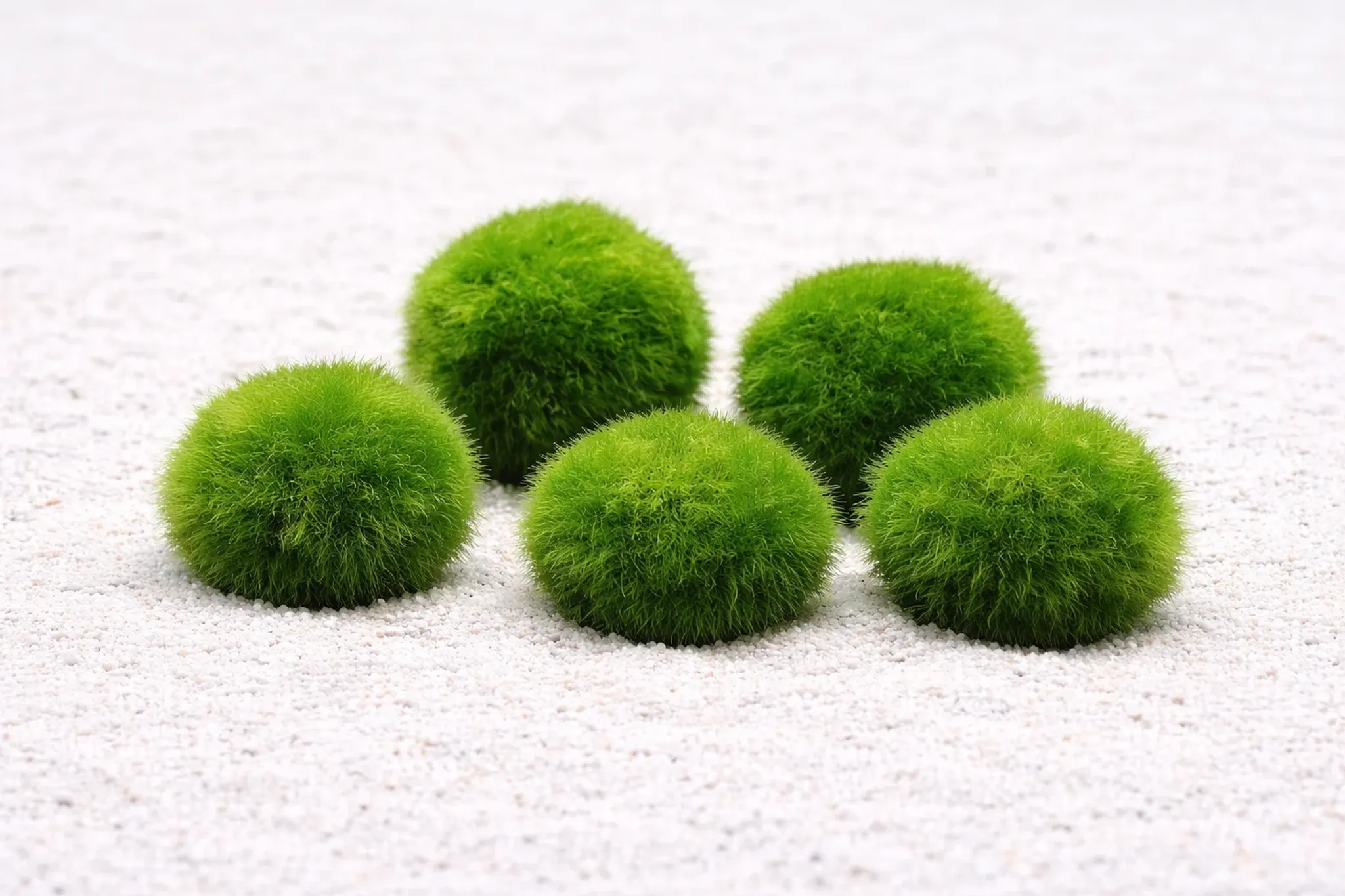

Marimo Moss Ball Care Guide: Light, CO2, Substrate and Growth Tips
A marimo moss ball is one of the easiest living additions you can put in a tank or bowl, but the plant-care instincts most keepers already have can actually work against it. This guide covers exactly how much light it needs, why CO2 and fertilizer are a waste of money on this species, whether substrate matters, and how to keep a ball round, green, and healthy for years.
What a Marimo Ball Actually Is
Despite the name, a marimo "moss" ball isn't a moss or a true plant at all — it's a rare, unattached spherical growth form of a filamentous green algae called Aegagropila linnaei. It occurs naturally in only a handful of cold lakes across Japan, Iceland, Estonia, and parts of Northern and Central Europe, where gentle wave action slowly rolls loose algae strands into dense green orbs.
That algae identity matters for care: because a marimo ball has no roots and doesn't feed through a substrate, most of the routines built around stem plants and carpeting plants simply don't apply.
Wild balls can take decades to reach 8–12 inches across, but the balls sold for aquariums are almost always young, farmed, or hand-rolled specimens in the 1–3 inch range — not wild-harvested ones, since natural marimo colonies (Japan's Lake Akan population in particular) are protected. If you're comparing sellers, it's worth knowing that "wild" claims on a small commercial ball are essentially never accurate.
The Quick Do/Don't Checklist
Before getting into specifics, here's the contrast that trips up most new keepers coming from planted-tank care:
| Typical plant care | Marimo ball reality |
|---|---|
| Needs a dedicated grow light | Ambient or indirect room light is enough |
| Benefits from injected CO2 | No measurable benefit — skip it |
| Roots into substrate | Free-floating; no substrate required |
| Regular liquid fertilizer | Not needed; grows too slowly to use it |
| Root tabs for feeding | Not applicable — it absorbs nutrients from the water column |
If you keep marimo alongside true aquatic plants that do use CO2 or ferts, that's fine — it just means the marimo is a bystander benefiting from cleaner water, not a plant you need to dose for.
Lighting Requirements
Marimo balls evolved on dim lake bottoms, so low to medium indirect light is ideal — a shaded spot near a window or the ambient light in a normally lit room is generally enough. Reported tolerance spans a wide range, from very dim conditions around 50 lux up to bright indirect light above 700 lux, but more isn't better here.
Avoid two things specifically:
- Direct sunlight, which can overheat the water and bleach or brown the outer filaments
- Intense high-output aquarium LEDs run for long photoperiods, which have the same bleaching effect
If your tank already runs strong lighting for other plants or corals, position the marimo in a shaded corner or behind taller plants rather than under the direct beam. Browse aquarium lighting options if you're setting up a tank where light intensity needs to be adjustable for a mixed setup.
CO2 and Fertilizer: Skip Both
This is the section most sources bury, but it deserves top billing: marimo balls do not need injected CO2 or liquid fertilizer. Growth is so slow (more on that below) that neither input produces any visible difference. Unless your tank already runs CO2 and ferts for other plants, adding either just for the marimo is added cost and complexity with no payoff.
The one caveat: if you're already dosing for stem plants or carpeting species in the same tank, there's no need to remove or isolate the marimo — it simply won't respond to the extra nutrients one way or the other.
Substrate: None Required
Marimo isn't rooted, so it doesn't need any substrate at all. It can:
- Sit loose on bare glass
- Rest on gravel or sand
- Float freely in open water
If you do run substrate in the same tank for other plants or fish, plain gravel is easier to manage than fine sand or soil, which can work its way into the algae filaments and make cleaning more of a chore. A quick browse of substrate options can help if you're setting up a mixed planted tank where the marimo is just one resident among true rooted species.
Temperature and Water Chemistry
Marimo prefers cool-to-moderate water. The commonly cited safe range runs roughly 43–82°F (6–28°C), but the balls stay firmest and greenest when kept at or below about 75–76°F (24°C). Sources disagree slightly on the upper limit — some treat up to 80°F as fine in warmer community or betta tanks, while others draw the line closer to 75–77°F. The practical takeaway: brief excursions into the high 70s won't cause disaster, but sustained heat above roughly 80°F is what actually speeds browning and internal decay. If a heat wave pushes your tank warm, some keepers chill the ball in the refrigerator for a few hours as a temporary fix.
On water chemistry, marimo is notably tolerant and adaptable:
- pH: roughly 7.0–8.0 (neutral to slightly alkaline)
- Hardness: a wide range, from very soft to very hard (about 2–20 dGH)
- Source water: dechlorinated tap water is fine; filtered or RO water keeps the surface cleaner for longer
- Mild brackish conditions are tolerated in a pinch, though not ideal long-term
Whatever parameters you land on, change them gradually rather than in a sudden swing.
Growth Rate and Sizing
Marimo grows extremely slowly — on the order of 0.2 inches (about 5 mm) of diameter per year. That means a 2-inch ball you buy may already be a decade or more old, and a ball won't visibly change size over a season or even a year of normal care. This slow growth is exactly why CO2, ferts, and "faster growth" tricks borrowed from stem-plant care are irrelevant here; there's no growth rate to accelerate in any meaningful way.
If you keep more than one ball in the same tank or bowl, give each enough clearance that they don't constantly rest against each other or block light from one side — a couple of inches of separation is plenty in most setups.
Maintenance Routine
The entire maintenance routine happens at water-change time, roughly every 1–2 weeks depending on bioload (heavier bioload or a dirtier tank calls for more frequent squeezing; some keepers simply squeeze whenever the water comes out visibly cloudy rather than on a fixed schedule):
- Remove the ball from the tank.
- Squeeze it gently in a separate container of clean, dechlorinated water to flush out trapped debris and any waste it has absorbed.
- Reshape it by rolling it between your palms into a round form.
- Rotate it before returning it, so a different side faces the light source than before.
That rotation step alone prevents most of the flattened, discolored patches keepers run into — a marimo left sitting in one position for weeks develops a flat, brown underside from lack of light and debris buildup.
Propagation
Marimo naturally divides as it grows, and it can also be manually cut or torn into smaller pieces. To propagate:
- Cut or tear off a section of the parent ball.
- Roll the piece firmly between your palms into a small sphere.
- Optionally tie it loosely with thread to help it hold shape.
- Give it several weeks to months to firm up into a self-supporting ball.
This is a low-stakes way to turn one ball into several over time, useful if you're stocking multiple small tanks or bowls.
Tankmate Compatibility
Marimo pairs well with most community fish and inverts, many of which actually benefit from having it around:
| Tankmate | Interaction with marimo |
|---|---|
| Bettas | Enrichment and play object; safe to nose around and rest near |
| Shrimp (Neocaridina/Caridina) | Grazes biofilm off the surface; useful shelter during molting |
| Fry | Hiding spot and grazing surface |
| Tetras, guppies, corydoras, kuhli loaches | Generally ignore it or graze biofilm harmlessly |
| Snails, small crabs/crayfish | Compatible; some graze surface algae |
| Goldfish | Avoid — will pick it apart or eat it |
| Most plecos | Avoid — will rasp and shred the filaments |
| Larger crayfish | Avoid — will tear it apart |
If you're stocking a marimo-friendly community setup, shrimp and bettas are two of the most natural pairings, since both benefit from the grazing surface and shelter it provides.
Benefits Beyond Decor
A marimo ball isn't just an inert green sphere — it does real work in a tank:
- Absorbs nitrates and other dissolved nutrients from the water column
- Competes with nuisance algae for those same nutrients, which can help suppress it
- Produces oxygen through photosynthesis
- Gives shrimp and fry a grazing surface and a shelter spot
Think of it as light biological filtration layered on top of a low-maintenance decoration, rather than either one alone.
Marimo Outside the Aquarium
Marimo balls are widely kept outside filtered tanks entirely — in sealed jars, vases, and desktop bowls as low-maintenance "pets" or decor. In Japan, especially large or old marimo are sometimes treated as lucky heirlooms passed down over generations. Care in a no-filter container is slightly different:
- Change the water more frequently than you would in a filtered tank, since there's no biological filtration doing ongoing cleanup
- Keep the container out of direct sun
- Always dechlorinate tap water before adding it
Marimo in Fish Bowls
Marimo is one of the best "plants" for a bowl precisely because it needs no substrate, no filter, and no CO2 — the same traits that make it low-maintenance in a full tank make it close to ideal in a bowl. Aim for a bowl temperature in the roughly 68–82°F range and keep it in indirect light. The main adjustment versus a filtered tank is frequency: bowls need more frequent manual water changes to compensate for the lack of a filter, regardless of whether the marimo is present.
Choosing a Container by Setup
| Container type | Water-change frequency | Light placement |
|---|---|---|
| Sealed jar/vase (no fish) | Every 2–4 weeks or when water looks cloudy | Indirect light, away from windows |
| Fish bowl (e.g., single betta) | Weekly or more, no filter to buffer waste | Bright shade, never direct sun |
| Filtered tank | Every 1–2 weeks alongside routine changes | Shaded area or behind taller plants |
Common Mistakes and Troubleshooting
- Direct sun or intense planted-tank lighting: causes bleaching, whitening, or brown patches. Move to indirect light and rotate periodically.
- Letting the ball sit still for weeks: creates a flattened, discolored underside. Roll it at every water change.
- Adding CO2, fertilizer, or substrate "just in case": unnecessary expense that won't speed growth meaningfully.
- Ignoring rising tank temperature: prolonged heat above the mid-70s°F is the top cause of a marimo going soft, dark, or falling apart internally.
- Skipping the squeeze: marimo pulls mulm and waste from the water column; left unaddressed, it can start to smell or rot from the inside.
- Housing it with goldfish, plecos, or large crayfish: these will shred or eat it over time.
- Panicking at a floating ball: usually just trapped gas from photosynthesis or decomposition. Squeeze it gently underwater to release the bubbles and it should sink again.
- Assuming a black, mushy ball is salvageable as-is: that's internal decay. Cut away the dead tissue and reshape what's left, or discard it if the whole ball is affected.
On the subject of brown spots specifically: some keepers suggest a small dose of aquarium salt to help resolve them, but this isn't a universal fix and salt isn't safe for every tankmate — several plants, scaleless fish, and most invertebrates are salt-sensitive. Check lighting, temperature, and cleaning frequency first, and treat salt as an optional, situational tool rather than a default step.
Frequently Asked Questions
Do marimo moss balls need a filter or air pump?
No. They get by on ambient dissolved oxygen in the water. In a bowl with no filter, frequent hand water changes take the place of filtration.
Can marimo balls live in a bowl with just one fish, like a betta?
Yes, this is one of the most common bowl setups. Just keep water changes frequent since there's no filter handling waste buildup on its own.
Why is my marimo ball turning brown, white, or black?
Brown usually means trapped debris and a need for cleaning. White or pale coloring points to too much light. Black and soft indicates internal decay — see the troubleshooting section above for fixes specific to each.
How often should I clean and reshape my marimo ball?
Roughly every 1–2 weeks, ideally timed with a routine water change. Squeeze out debris in a separate container of clean water, then re-roll it into shape before returning it to the tank.
Do marimo balls need special substrate or soil?
No. They're free-floating and unrooted, so plain gravel or a bare bottom is simplest if any substrate is present at all. Fine sand or soil tends to work into the filaments and complicate cleaning.
Can marimo balls multiply on their own?
Yes. They naturally split into smaller balls over time, and you can also manually divide and re-roll pieces to propagate more intentionally.
What fish or invertebrates should I avoid keeping with marimo balls?
Goldfish, most plecos, and larger crayfish, since all three tend to pick apart or eat the algae over time. Smaller community fish, shrimp, and snails are generally safe companions.
Marimo moss balls are about as close to "set it and forget it" as living tank decor gets — no CO2, no substrate, no fertilizer, just periodic squeezing and a shaded spot. If you're building out a low-maintenance community setup around one, take a look at FishyHub's shrimp selection for tankmates that will actually put the marimo's grazing surface to good use.


