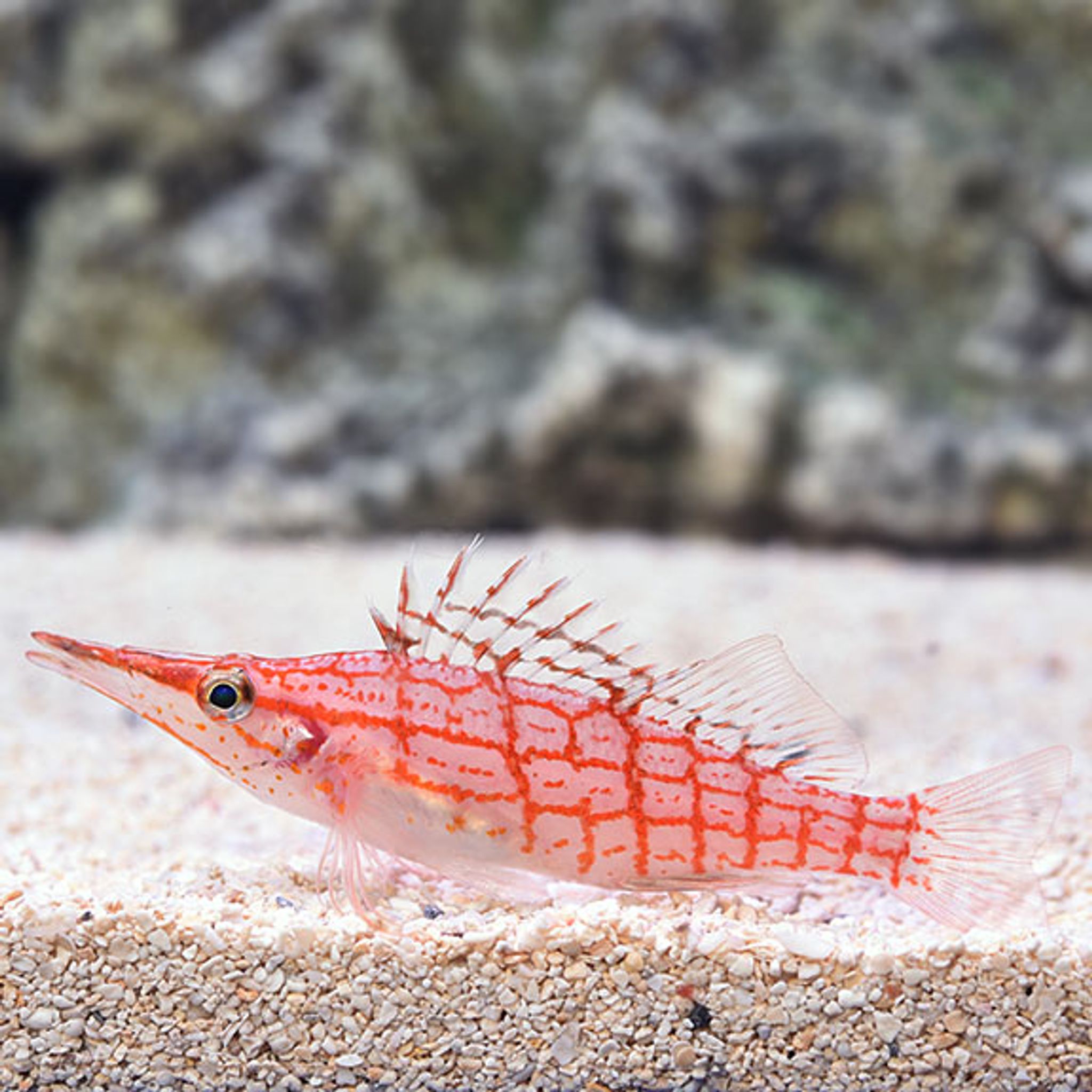
Longnose Hawkfish Care Guide: Tank Size, Diet, Compatibility and Reef Safety
The longnose hawkfish (Oxycirrhites typus) is a favorite for reef keepers who want a hardy, characterful fish without risking their coral. This guide covers the real minimum tank size, water parameters, feeding routine, and a straight answer on reef safety — including exactly which invertebrates are still at risk.
Species Snapshot
Native to the Indo-Pacific, Red Sea, and eastern Pacific, longnose hawkfish are found in the wild perched on gorgonians, sea fans, and black coral in deeper reef zones. In the aquarium they reach about 4–5 inches as adults, with males typically growing larger than females. With good care, expect a lifespan of 5–7 years, and up to around 10 years in an excellently maintained system.
| Trait | Detail |
|---|---|
| Adult size | 4–5 in (10–13 cm) |
| Lifespan | 5–7 years typical, up to ~10 years |
| Diet | Carnivore, meaty foods |
| Temperament | Peaceful to similarly sized fish, predatory to small invertebrates |
| Reef safety | Coral safe; not safe for small shrimp/crabs |
| Minimum tank | 40–50 gallons recommended |
Tank Size: How Much Room Does It Actually Need?
Recommendations across the hobby range widely, from a bare 30-gallon minimum up to 60 gallons. The gap comes down to how the fish is kept. A 30-gallon tank can work for a single longnose hawkfish in a fish-only setup, but it leaves little room for the multiple perch sites and defined territory this species wants.
A more realistic baseline:
- 40–50 gallons — safe practical minimum for one longnose hawkfish long-term.
- 75 gallons or more — better if the tank is reef-heavy or will carry several tankmates, since more rockwork and swimming space reduces territorial friction.
- 100+ gallons — needed if you want to attempt keeping more than one hawkfish, and only as a bonded pair.
Keep it to one hawkfish per tank unless you have a mated pair that was raised together. Unrelated individuals — even of different hawkfish species — will fight, sometimes fatally.
Water Parameters
Longnose hawkfish do best held to reef-tank standards, even in a fish-only system, since it makes future coral additions easier:
| Parameter | Target range |
|---|---|
| Temperature | 75–82°F (24–28°C) |
| pH | 8.0–8.4 |
| Specific gravity | 1.024–1.026 (reef tanks); 1.020–1.023 acceptable fish-only |
| Salinity | ~35 ppt |
| Alkalinity (dKH) | 8–12 dKH |
| Ammonia / Nitrite | 0 ppm |
| Nitrate | Under 10–20 ppm |
| Phosphate | Under 0.1–0.2 ppm |
Some sources list specific gravity as low as 1.020, but if corals are anywhere in the tank's future, aim for the tighter 1.024–1.026 range and use a calibrated refractometer rather than a swing-arm hydrometer. Water movement should be strong but not extreme, and lighting is flexible for the hawkfish itself — it will adapt to whatever intensity your corals require.
Setting Up the Tank
Because a longnose hawkfish lacks a swim bladder, it doesn't cruise the water column the way most fish do — it perches, then hops between rocks and coral heads like a bird of prey scanning for prey. That single anatomical fact drives most of its setup requirements:
- Abundant live rock or gorgonian-style decor with ledges, overhangs, and branching structure at multiple heights, so it always has a perch within reach.
- Avoid pointing strong current directly at favorite resting spots — the fish needs a stable perch, not a fish constantly buffeted while stationary.
- Sand or fine gravel substrate works fine, since it doesn't sift the bottom.
- A tight-fitting lid is non-negotiable. Longnose hawkfish are notorious, powerful jumpers, especially when startled or lunging after food, and an unsecured or gapped lid is the single most common way keepers lose this fish.
Diet and Feeding
In the wild and in the tank, this is an ambush predator. Offer meaty marine foods:
- Frozen, enriched mysis and brine shrimp
- Chopped shrimp, scallop, or squid
- Krill
- Marine fish flesh, cut small
Feed once or twice daily, always sized to fit its small mouth — cut larger pieces down, since underfeeding or oversized food is a common cause of weight loss in this species. Most individuals eventually accept a quality pellet or gel food, but that shouldn't be the sole diet. Live feeding can help a shy, newly acquired fish start eating, but avoid it as a routine once the fish is established — it reinforces hunting behavior toward anything small and mobile in the tank, including the invertebrates you want to keep.
Compatibility and Tankmates
Longnose hawkfish are peaceful toward fish their own size or larger. Good tankmates include:
- Tangs and larger wrasses
- Dwarf angels
- Clownfish
- Dottybacks
- Blennies and larger gobies
- Anthias and damsels
The problem is smaller, mobile invertebrates. This fish will hunt and eat ornamental shrimp, hermit crabs, feather dusters, small crabs, and similar tankmates — no exceptions worth relying on. If you're building a tank centered on ornamental marine shrimp or small crabs, a longnose hawkfish is a poor match.
Stocking order matters too: add the hawkfish mid-to-late in your stocking sequence, once the tank is established, rather than first. Added too early, it tends to claim the entire tank as its territory and bully smaller fish introduced afterward. If you plan to keep prized small crustaceans, add the hawkfish before them, or skip that combination entirely.
Is a Longnose Hawkfish Reef Safe?
The honest answer is "reef safe with caution." It will not pick at or sting-damage stony or soft corals, which makes it one of the more coral-compatible hawkfish species available. Where the reputation breaks down is with small, mobile invertebrates — ornamental shrimp, bristleworms, juvenile crabs, and similar creatures are all fair game. When two sources disagree about whether this fish is "reef safe," they're usually just talking about different animals: safe for the coral, not safe for a shrimp-and-crab-focused invert tank.
Hawkfish Family Overview
The longnose is the most popular member of a small family that shares several genus-wide traits:
- No swim bladder — all hawkfish perch rather than swim freely.
- Jumping risk — a secure lid is essential across the family, not just for longnose.
- Generally hardy once acclimated.
- Mostly solitary — territorial toward their own kind.
Other common species in the trade include the flame hawkfish, the dwarf (falco) hawkfish, and the spotted hawkfish. They differ mainly in size, coloration, and how aggressively they may bother invertebrates — the longnose is comparatively gentle by hawkfish standards, but still not invert-safe. Browse the current hawkfish selection to compare species side by side.
Behavior and Breeding
Longnose hawkfish are intelligent and curious, often watching or recognizing their keeper over time. They're protogynous hermaphrodites — every individual starts life female, with the capacity to change to male. Unlike many hawkfish that form harems, longnose pairs are monogamous, formed and maintained between two individuals. Spawning happens at dusk with a distinct courtship display, and captive breeding remains rare and difficult; nearly all specimens in the trade are wild-caught. Activity tends to peak near dawn and dusk, which is also when they hunt most actively.
Acclimation and Quarantine
Wild-caught longnose hawkfish can arrive stressed, so take acclimation seriously even though the species is naturally hardy once settled:
- Drip-acclimate slowly over 45–60 minutes rather than a quick dump-and-float.
- Quarantine for 2–4 weeks in a separate system before adding to the display.
- Watch for parasites and bacterial issues — marine ich is the most common risk with wild imports.
- Check feeding response during quarantine before committing the fish to your main tank.
When choosing a specimen at the point of purchase, look for clear eyes, full and undamaged fins, an alert perching posture, and a visible feeding response — all signs of a fish that's already stabilized.
Getting the Tank Ready First
A longnose hawkfish is almost always added to an already-established reef, not a brand-new tank, so the groundwork matters as much as the fish itself.
The Nitrogen Cycle
Before adding any fish, cycle the tank for 4–6 weeks using an ammonia source or live rock and bacteria starter, testing with a liquid reagent kit until ammonia and nitrite both read zero and nitrate is present. Never add a fish to an uncycled tank — it's the single most common cause of early livestock losses.
Choosing a Reef Salt Mix
If you're keeping corals alongside the hawkfish, choose a marine salt formulated for reef tanks — these carry higher calcium, alkalinity, magnesium, and trace elements than basic fish-only mixes. Check batch consistency and mixing time; reef-grade mixes cost more but reduce ongoing dosing work.
Salinity Stability
Swings in salinity stress fish and corals more than a slightly-off absolute number. Mix and pre-adjust top-off and replacement water to match your display's salinity, use a calibrated refractometer, and top off daily for evaporation with fresh RO/DI water only — never saltwater — to avoid slowly concentrating salinity over time.
Basic Reef Setup Essentials
- Appropriate substrate depth and type for your aquascape
- Quality live rock, or dry rock seeded with bacteria, for biological filtration
- Adequate flow pumps for both fish and coral health
- A protein skimmer to manage bioload
Tank Automation
For keepers who travel or want to reduce manual error, consider an auto top-off (ATO) system to stabilize salinity, a controllable return or dosing pump, and a monitoring/alert system for pH, temperature, and salinity. None of this is required, but it meaningfully reduces the parameter swings that stress both the hawkfish and any corals sharing the tank.
Common Mistakes to Avoid
- Leaving any gap in the lid — this is the most common way longnose hawkfish are lost.
- Assuming "reef safe" covers all invertebrates — losing shrimp or crabs is the most frequent surprise complaint.
- Adding the hawkfish too early in the stocking order, letting it claim the whole tank.
- Housing two unpaired hawkfish together, risking serious or fatal fighting.
- Feeding oversized pieces or skipping meals, leading to weight loss.
- Skipping quarantine on a wild-caught specimen.
- Topping off with saltwater instead of freshwater, slowly pushing salinity out of range.
Frequently Asked Questions
Is a longnose hawkfish reef safe?
Yes for corals and other sessile life — it won't pick at or sting-damage them. It is not safe for small, mobile invertebrates like ornamental shrimp, crabs, and bristleworms, which it will actively hunt.
What is the minimum tank size for one longnose hawkfish?
Around 40–50 gallons is a safer practical minimum for long-term health. A 30-gallon tank can work in a fish-only setup, while 75+ gallons is better for a reef-heavy or multi-fish community.
Can I keep two hawkfish together?
Only if they're a bonded, mated pair raised together. Unrelated individuals, even of different hawkfish species, will typically fight, sometimes fatally.
What do longnose hawkfish eat?
Meaty marine foods — enriched mysis and brine shrimp, chopped shrimp, scallop, squid, krill, and marine fish flesh — fed once or twice daily in mouth-sized pieces.
Will a longnose hawkfish eat my cleaner shrimp or crabs?
Likely yes over time. It's a known predator of small crustaceans, even ones marketed as reef cleanup crew, so avoid combining the two if you value the invertebrates.
Why did my hawkfish jump out of the tank?
Longnose hawkfish are strong, sudden jumpers, especially when startled or lunging at food. Any gap in the lid — even a small one around cords or plumbing — is enough for an escape, so use a tight-fitting mesh lid or egg-crate cover at all times.
How long do longnose hawkfish live?
Typically 5–7 years with good care, and up to about 10 years in an excellently maintained system.
Do longnose hawkfish need a mate or partner to thrive?
No. They do perfectly well kept solo, and pairs only form naturally under the right conditions with two compatible individuals raised together — a partner isn't required for the fish's health or well-being.
If you're ready to plan stocking around a longnose hawkfish, browse current marine fish options on FishyHub to find compatible tankmates for your setup.

