
Kuhli Loach Care Guide: Tank Size, Diet, Water Parameters and Temperament
Kuhli loaches are eel-bodied, sand-burrowing nocturnal fish that thrive in a 20-gallon-long or bigger tank with a group of six or more, soft acidic-to-neutral water, and sinking food fed after lights-out. Most "my kuhlis disappeared" complaints trace back to too few fish, sharp substrate, or feeding methods that never reach a shy, nighttime forager. This guide gives the specific numbers and setup habits that turn a handful of hidden loaches into a visible, thriving group.
What Exactly Is a Kuhli Loach?
The species most commonly sold as "kuhli loach" is Pangio kuhlii (older literature lists it as Acanthophthalmus or Cobitis). In practice, the trade name covers a group of closely related dwarf loaches — P. semicincta, P. kuhlii, the darker P. oblonga, the pale P. anguillaris, and P. myersi — often mixed in the same shipment. Care needs are essentially identical across all of them, so "kuhli loach" is best treated as a care category rather than one species.
In the wild, they live in shaded, slow-moving, leaf-littered forest streams across the Malay Peninsula, Sumatra, Borneo, and Java — dim light, soft substrate, cover, and stable warm water, which is the blueprint for a home setup.
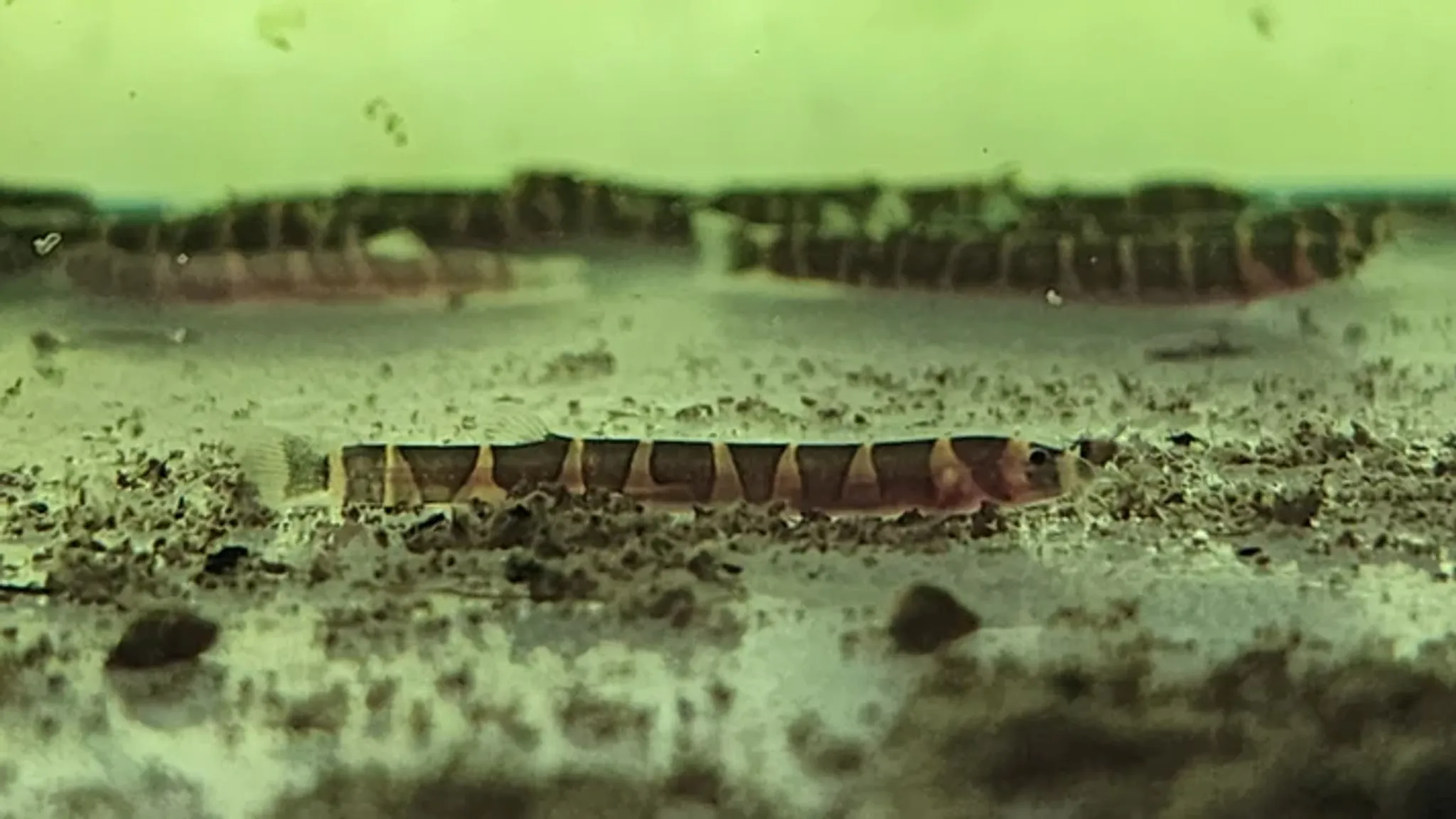
Identifying features: a long, eel-like body with tiny scales; an orange-to-pink base color with 12–17 dark saddle-shaped bands; four pairs of barbels around the mouth; and a small, sharp spine beneath each eye that can snag soft aquarium nets.
Size and lifespan: 3–4 inches (7.5–10 cm) in captivity, occasionally up to about 4.7 inches (12 cm). With stable care they commonly live 10 years or more, and well-kept individuals reach 14 — a longer commitment than most community fish.
Tank Size and Setup
Minimum Tank Size
A 20-gallon long (30 x 12 x 12 in / 76 x 30 x 30 cm) is the realistic minimum for a starter group. Footprint matters more than height, since kuhlis forage along the bottom rather than swimming through open water. A full group of 8 or more does better in a 29- to 30-gallon tank, with more sand to work and more separate hiding zones. A 10-gallon tank suits one or two loaches only as a temporary stopgap.
Group Size
Kuhli loaches are deeply social and should never be kept alone or in pairs. Keep at least 6, and aim for 8–10 or more if space allows — larger groups pile together, feel secure, and forage in the open far more readily. Because kuhlis are slim, low-bioload fish, adding more of them costs relatively little in stocking terms compared with adding another mid-sized community fish.
Substrate
Fine, soft sand is strongly preferred, since kuhlis burrow and sift through it constantly. If sand isn't an option, smooth, rounded fine gravel is an acceptable fallback — sharp or angular gravel scrapes barbels and bellies, leading to irritation and infection. Keep the sand bed 1–2 inches (2.5–5 cm) deep and stir it occasionally to release trapped gas pockets.
Decor, Lighting and Flow
Provide generous cover — caves, driftwood, rock piles, leaf litter, and dense planting such as crypts, Java fern, Anubias, and floating plants. More hiding spots, somewhat counterintuitively, make the group bolder and more visible over time. Keep lighting dim to moderate, since kuhlis are most active at dusk and after dark. Use gentle flow, cover every filter intake with a pre-filter sponge (kuhlis get pulled against intakes or wedge inside housings), and use a tight-fitting lid with no gaps — a loach found dried out on the floor is one of the most common "mystery death" stories in the hobby.
Water Parameters
| Parameter | Acceptable range | Recommended target |
|---|---|---|
| Temperature | 73–86°F (23–30°C) | 75–80°F (24–27°C) |
| pH | 5.5–7.0 | 6.0–7.0, kept stable |
| General hardness (GH) | 0–10 dGH (roughly under 150 ppm) | Soft to moderate |
| Ammonia | 0 ppm | 0 ppm |
| Nitrite | 0 ppm | 0 ppm |
| Nitrate | Under 20 ppm | As low as practical |
Stability matters more than chasing an exact number on any single parameter. Tank-bred kuhli loaches, now the majority sold, adapt well to neutral-ish US tap water as long as swings are avoided. The tank must be fully cycled before kuhlis go in — they're sensitive to ammonia and nitrite spikes, and adding them too early is one of the most common ways new keepers lose the whole group within days. A heater is necessary in most US homes, since room temperature alone rarely holds steady in this range.
Diet and Feeding
Kuhli loaches sit closer to the carnivore end of the omnivore spectrum — scavenging predators of small invertebrates in the wild, not algae grazers or a cleanup crew for leftover flake. Treating them as tank janitors is a common mistake that leads to slow starvation and pinched, sunken bellies.
Staples: quality sinking pellets or wafers sized for small bottom feeders, and gel food formulated for bottom dwellers.
Occasional treats: frozen or live bloodworms, blackworms, brine shrimp, daphnia, and mosquito larvae.
Feeding Method
Because kuhlis feed mainly at night, drop sinking food right after the lights go out, once or twice a day, in an amount the group clears within a few minutes. In a busy community tank, target-feed near known kuhli hiding spots so they get their share rather than losing every meal to faster tankmates. Sinking foods and gel diets built for bottom feeders can be browsed in FishyHub's Food & Supplements category.
Temperament and Tank Mates
Kuhli loaches are peaceful, shy, and completely harmless to other fish. They're nocturnal by nature, often piling together in a writhing clump during the day, and it's normal for the whole group to burrow into the sand or vanish behind decor for days — this is not a sign of illness on its own.
Good tank mates include small, peaceful community fish: tetras, rasboras, danios, corydoras, otocinclus, honey or dwarf gouramis, and peaceful livebearers. A calm betta usually coexists fine, though results vary by individual, so watch for harassment. Avoid cichlids, large or aggressive species, persistent fin-nippers, and goldfish, which need cooler water and can outcompete or bully kuhlis.
Adult shrimp and snails are generally safe alongside kuhlis. Shrimplets and very small snails, however, are opportunistically eaten, so a breeding colony of either may shrink over time.
Sexing and Breeding
Sexing is difficult. Mature, well-fed females look fuller-bodied, with greenish eggs sometimes visible through the belly skin when gravid; males have larger, paddle-shaped pectoral fins.
Breeding at home is rare and usually accidental. It tends to happen in a well-fed group kept in soft, slightly acidic, warmer water with dense fine-leaved or floating plants — not the cool temperatures or brackish setups sometimes suggested elsewhere. Eggs get scattered among plant thickets, parents eat any they find, and surviving fry take infusoria before graduating to baby brine shrimp. Fry often show up unannounced in mature, heavily planted tanks rather than from a deliberate project.
Related Loaches and Bottom Dwellers
Giant kuhli loach (Pangio myersi): reaches 4–5 inches, thicker-bodied than standard kuhlis, and needs a 30-gallon minimum. Care is otherwise the same, but its bolder nature makes it less likely to vanish, and its size means it may eat shrimp fry a standard kuhli would ignore.
Other kuhli color forms: black kuhli (P. oblonga, also sold as "Java loach"), silver kuhli (P. anguillaris), and "panda" or zebra-patterned Pangio types all share the same care requirements described above.
Golden spined loach: a different but related sand-sifting spined loach, small and pale, needing the same fine sand, group setting, and soft, peaceful setup. The netting caution below applies to it too.
Horseface loach: a longer-snouted relative growing to roughly 8 inches that dives deep into sand. It needs a considerably larger tank and deeper sand bed — a step up in space requirements, not a beginner substitute.
Kuhlis among community loaches: kuhlis are one of the best small loaches for a community tank, alongside dwarf chain, hillstream, and yoyo-type loaches — a useful contrast to clown loaches, which start small but eventually outgrow all but very large aquariums. Compare bottom-dweller options in FishyHub's Plecos, Corys & Bottom Dwellers category.
Other sand burrowers: horseface loaches, some corydoras, weather loaches, and spiny eels all dig into substrate to varying degrees. Any tank with these fish benefits from the same 1–2 inch sand depth and occasional stirring to prevent gas buildup.
Water Changes Without Stressing the Group
Kuhlis may dart or hide during water changes. Match the new water's temperature and dechlorinate before adding it, siphon gently and keep the tube slightly off the substrate to avoid pulling buried loaches in, and change 20–30% weekly rather than large, infrequent swaps that shock a sensitive, thin-scaled fish.
Health, Medication and Quarantine
Kuhli loaches have very fine scales, which makes them unusually sensitive to medication. Start at half the labeled dose rather than full strength, avoid copper-based medications entirely, use malachite green or formalin with caution, and use aquarium salt sparingly if at all.
Common issues include ich, bacterial infections, and slow wasting caused by underfeeding rather than disease. Quarantine new arrivals for 2–4 weeks, both to catch illness early and because trade-sourced kuhlis are a mixed group of unknown origin — tank-bred stock tends to be noticeably hardier than wild-caught imports.
Warning signs worth testing water over immediately: rapid breathing at the surface, frantic glass-surfing, clamped or pale coloring, visible white spots, red streaks, an emaciated or pinched belly, or a loach lying exposed in daylight instead of hidden.
Netting Kuhli Loaches
The spine beneath each eye tangles easily in soft aquarium net mesh, sometimes injuring the fish or the person handling it. Use a small cup or container to scoop kuhlis instead of a standard net whenever possible.
Common Mistakes
- Keeping only 1–3 fish: near-permanent hiding — add more to reach at least 6.
- Sharp gravel substrate: torn barbels and belly infections — switch to sand or smooth fine gravel.
- Assuming they'll eat leftovers: slow starvation and pinched bellies — feed them deliberately.
- Unguarded filter intakes and gapped lids: fish lost inside filters or found dried out on the floor.
- Full-dose or copper-based medication: can be fatal — halve the dose or use a hospital tank.
- Adding fish to an uncycled tank: a leading cause of early group losses.
"My Kuhlis Disappeared" — Before You Assume the Worst
Check under decor, inside and behind the filter, and in the sand itself using a red or blue flashlight after the room lights are off — these wavelengths disturb nocturnal fish far less than white light. A dim aquarium night light on a timer lets you watch feeding behavior after dark without robbing the fish of the true darkness they still need each night.
Frequently Asked Questions
How many kuhli loaches should I keep?
At least 6, with 8 or more being ideal for visible, confident behavior. Smaller groups tend to stay hidden almost permanently.
Can a kuhli loach live in a 10-gallon tank?
Only as a short-term or temporary setup. A 20-gallon long is the realistic minimum for a proper group long-term.
Why can't I see my kuhli loaches?
They're nocturnal and naturally shy. Boost the group size, add more cover, dim the lighting, and check after lights-out with a red or blue flashlight before assuming anything is wrong.
Do kuhli loaches eat snails or shrimp?
Adult snails and shrimp are generally left alone. Shrimplets and very small snails are at more risk of being eaten opportunistically.
Can kuhli loaches live with a betta or a goldfish?
A calm betta usually works, though it's worth monitoring for harassment. Goldfish are not a good match — they need cooler water than kuhlis and can outcompete or bully them.
Will kuhli loaches clean up my tank?
No. They are not algae eaters or a cleanup crew, and relying on leftovers leads to starvation. Feed them sinking foods directly.
Do kuhli loaches need a heater?
Yes, in most US homes. Aim for a stable 76–78°F (24–26°C), within their overall 75–80°F preferred range.
How long do kuhli loaches live?
Typically 10 to 14 years with stable water and consistent feeding — a longer-term commitment than most community fish species.
Ready to start or expand a kuhli loach group? Browse available stock in FishyHub's loach category for kuhlis and compatible bottom-dwelling species.


