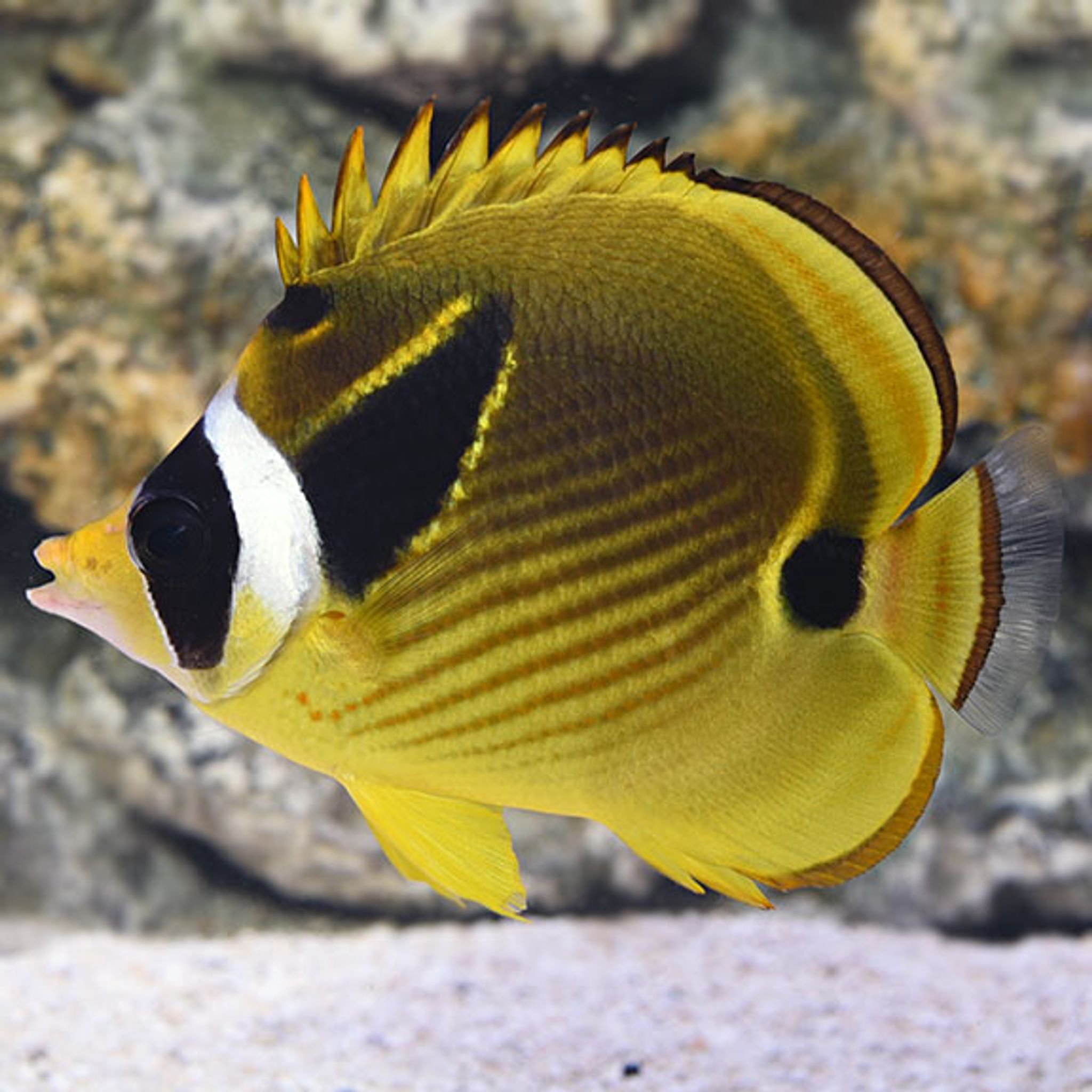

Is Raccoon Butterflyfish Reef Safe? Coral and Invertebrate Compatibility Explained
The short answer is: not fully, but not a flat no either. The raccoon butterflyfish is best described as reef safe with caution — it will often leave motile invertebrates and small-polyp corals alone, but it has a real, documented tendency to nip large-polyp stony corals, zoanthids, mushrooms, and clam mantles. Whether it works in your tank depends on what you keep, how large your system is, and how consistently you feed.
Species Snapshot
The raccoon butterflyfish (Chaetodon lunula) is also sold as the crescent-masked or half-moon butterflyfish, named for the broad black band running across its eyes like a mask, paired with a yellow-orange body and a dark saddle patch near the tail. It's native to the Indo-Pacific and Red Sea, where it patrols reef flats and lagoons in loose groups or pairs.
Key facts to know before buying:
- Adult size: roughly 7–8 inches (18–20 cm)
- Minimum tank size: 100–125 gallons for an adult (some sources cite 75 gallons, but the larger size reduces stress-driven nipping and gives this active swimmer room to establish territory)
- Temperament: semi-aggressive, particularly toward conspecifics and similarly shaped or colored fish
- Diet: omnivorous and opportunistic in the wild — coral polyps, coral mucus, small invertebrates, algae, and zooplankton
In captivity, most specimens adapt to a varied diet of frozen mysis or brine shrimp, marine algae sheets, and quality pellets. New arrivals, especially wild-caught individuals, can be picky eaters at first, so ask to see a fish feeding before you commit to a purchase.
Reef Safety Verdict: Conditional, Not Guaranteed
Care guides disagree on how to label this fish. Some flatly call it "not reef safe," while others use softer terms like "reef safe with major caveats." The most accurate framing is risk-based: the raccoon butterflyfish can coexist with reef life, but it will likely sample or damage certain coral types eventually, especially in smaller or understocked systems.
There's also meaningful individual variation. Some specimens never touch a coral for years in a mixed reef; others become persistent, targeted coral pickers within weeks. No care sheet can promise which behavior you'll get, so plan for the worst case and be pleasantly surprised if it doesn't happen.
Coral Risk by Type
Not all corals face the same odds. The distinction between large-polyp stony (LPS) corals and small-polyp stony (SPS) corals matters more than most general fish-compatibility charts admit.
| Coral group | Risk level | Notes |
|---|---|---|
| LPS (hammer, torch, frogspawn/Euphyllia) | High | Exposed fleshy tissue is a frequent, repeated target |
| Zoanthids and palythoa | High | Fleshy polyps are easy to pick at |
| Mushroom corals (Discosoma, Rhodactis) | High | Soft, exposed tissue is attractive to nip |
| Leather corals | Moderate | Occasionally nipped, less consistently than LPS |
| Clams (Tridacna) | Moderate | Some keepers report mantle nipping |
| SPS (Acropora, Montipora) | Lower | Small polyps are less accessible, though not risk-free |
If your reef leans heavily toward SPS corals, a raccoon butterflyfish is a more reasonable gamble than in a tank centered on LPS hard corals or soft-coral colonies you'd hate to lose.
Invertebrate Risk
The picture is more forgiving for motile invertebrates. Raccoon butterflyfish are generally not predatory toward shrimp, crabs, snails, and hermits of normal adult size — they simply aren't built to chase fast-moving crustaceans as prey. Very small ornamental shrimp could occasionally get an experimental nip, but established populations are usually left alone.
Sessile or slow-moving invertebrates fare worse:
- Feather dusters — commonly picked at
- Flatworms and bristleworms — actively hunted, which some reefers use to their advantage
- Small polyps — vulnerable in the same way as zoanthids
One genuine upside: raccoon butterflyfish are known to eat aiptasia (glass anemones) and bristleworms, and some keepers add one specifically hoping for pest control. Treat this as a possible bonus rather than a dependable solution — sources disagree on how consistently it happens, and a fish that ignores your aiptasia outbreak while nipping your favorite torch coral is a real possibility. Don't buy one purely as a pest-control tool.
For ornamental anemones, the pattern mirrors coral risk: small aiptasia-type pest anemones are more likely targets, while larger host anemones are generally left alone, though never guaranteed safe.
A Practical Decision Framework
Rather than a blanket yes-or-no, use your existing (or planned) livestock to gauge risk:
- Low risk: SPS-dominant reef, no LPS/zoanthid centerpieces, willing to feed 2–3 times daily, tank 100+ gallons
- Moderate risk: mixed reef with some LPS or soft corals you could tolerate losing, consistent feeding schedule
- High risk: reef built around prized LPS, zoanthid, or mushroom colonies as centerpieces — skip this fish and consider a different butterflyfish or a non-chaetodon species instead
This framework matters more than any single compatibility list, because the same fish can be a non-issue in one tank and a costly mistake in another.
Feeding Strategy to Reduce Coral Nipping
The mechanism behind coral nipping is straightforward: a hungry, opportunistic omnivore samples whatever is available, and in a reef tank that includes coral tissue. Satiation reduces browsing behavior — a well-fed fish has less incentive to investigate a coral polyp as a food source.
Practical steps:
- Feed 2–3 times per day, not once
- Rotate frozen mysis or brine shrimp, marine algae/nori sheets, and enriched pellets
- Offer algae sheets clipped in the tank so grazing needs are met without turning to coral
- Watch feeding response closely in the first few weeks after introduction
A raccoon butterflyfish that's genuinely full is simply less motivated to pick at a hammer coral out of hunger — this is the single most effective lever a keeper has.
Introducing the Fish: Order Matters
Most care sheets skip a useful strategic question: should you add the fish to an established reef, or build the reef around the fish?
- Adding to an established reef: higher risk, since the fish encounters a full buffet of coral immediately. Introduce it, then hold off on new coral purchases for several weeks while you observe.
- Building around the fish: lower risk. Add corals gradually after the fish is established and well-fed, starting with SPS, and watch reactions to each new addition before buying more.
Either way, don't add multiple new corals at once right after introducing the fish — you won't be able to tell which one it's targeting if something gets nipped.
Quarantine and Disease: An Indirect Threat to Your Reef
Raccoon butterflyfish can be sensitive to shipping stress and are prone to marine ich if introduced without preparation. Quarantine for 2–4 weeks before adding one to a display or reef tank.
This isn't just about protecting the fish — a sick fish stresses the whole system. Treating disease in a display tank means medication exposure for corals and inverts, and a stressed, recovering fish is not a well-fed one, which circles back to increased coral-picking risk. Quarantine is reef stability insurance, not just fish health insurance.
Bridging Section: Coming From Freshwater to Reef
If you're moving from a freshwater setup toward your first marine or reef tank, several things change beyond just salt:
- Salinity management: you'll maintain specific gravity (1.020–1.025) using a refractometer or hydrometer, not just temperature and pH
- Live rock and biological cycling: reef tanks cycle around live rock and bacteria colonies that also host beneficial pods and microfauna, not just a filter cartridge
- Calcium, alkalinity, and magnesium dosing: photosynthetic corals need these dosed and monitored — a parameter category with no freshwater equivalent
- Lighting intensity and spectrum: corals need specific PAR levels depending on species, well beyond typical freshwater plant lighting
- Slower stocking pace: reef tanks reward patience — livestock and coral get added gradually, with quarantine at each step
- Higher equipment cost: budget for a protein skimmer, RO/DI water production, and a proper reef test kit covering calcium, alkalinity, magnesium, nitrate, and phosphate
The key takeaway: a semi-aggressive, coral-nipping fish like the raccoon butterflyfish adds risk on top of an already complex system. If you're brand new to reefkeeping, it's worth mastering stable water parameters and coral husbandry with a more predictable fish first before introducing this species.
Water Parameters at a Glance
Standard reef parameters apply — nothing exotic, but consistency matters more than any single number.
| Parameter | Target range |
|---|---|
| Temperature | 72–78°F (22–26°C) |
| Specific gravity | 1.020–1.025 |
| pH | 8.1–8.4 |
| Alkalinity | 8–12 dKH |
| Nitrate/phosphate | Low and stable |
Common Mistakes to Avoid
- Skipping the observation period — watch closely for the first several weeks and be ready to remove the fish if it targets specific colonies
- Underfeeding — a hungry butterflyfish samples coral far more readily
- Assuming "reef safe with caution" means guaranteed safety — losses can and do happen
- Housing two raccoon butterflyfish (or similar species) in too small a space — this causes ongoing aggression rather than peaceful cohabitation
- Skipping quarantine — leads to ich outbreaks that stress the fish and indirectly increase coral-picking behavior
- Buying a poorly-fed, wild-caught specimen without confirming it's eating well first
Frequently Asked Questions
Is the raccoon butterflyfish reef safe?
Conditionally. It can live in a reef tank, but there's a real risk of nipping LPS corals, zoanthids, mushrooms, and clam mantles. SPS corals and motile invertebrates are generally safer choices to keep alongside it.
What does a raccoon butterflyfish eat?
An omnivorous diet of frozen mysis or brine shrimp, marine algae or nori sheets, quality pellets, and enriched foods. Feed several small meals daily rather than one large feeding to reduce coral-picking behavior.
Will a raccoon butterflyfish eat my shrimp or crabs?
Generally no — they aren't predatory toward established, normal-sized motile crustaceans. Very small ornamental shrimp could occasionally get picked at, but adult shrimp, crabs, snails, and hermits are typically left alone.
Do raccoon butterflyfish eat aiptasia?
They can and often will, but it isn't a guaranteed or complete solution. Treat aiptasia control as a possible side benefit rather than a reason to buy one — it shouldn't be your primary pest-control strategy.
What size tank does a raccoon butterflyfish need?
At least 100 gallons for an adult, given its 7–8 inch size and active swimming behavior. Smaller tanks can stunt growth and increase stress-driven aggression and coral nipping.
How do I reduce the chance my raccoon butterflyfish eats my coral?
Feed it well and often (2–3 times daily with a varied diet), lean toward SPS over LPS or soft corals where possible, and monitor any new coral addition closely in the weeks after introducing the fish.
Browse available specimens in the butterflyfish category on FishyHub, or check compatible marine invertebrates if you're planning stocking order around this fish's known coral risks.


