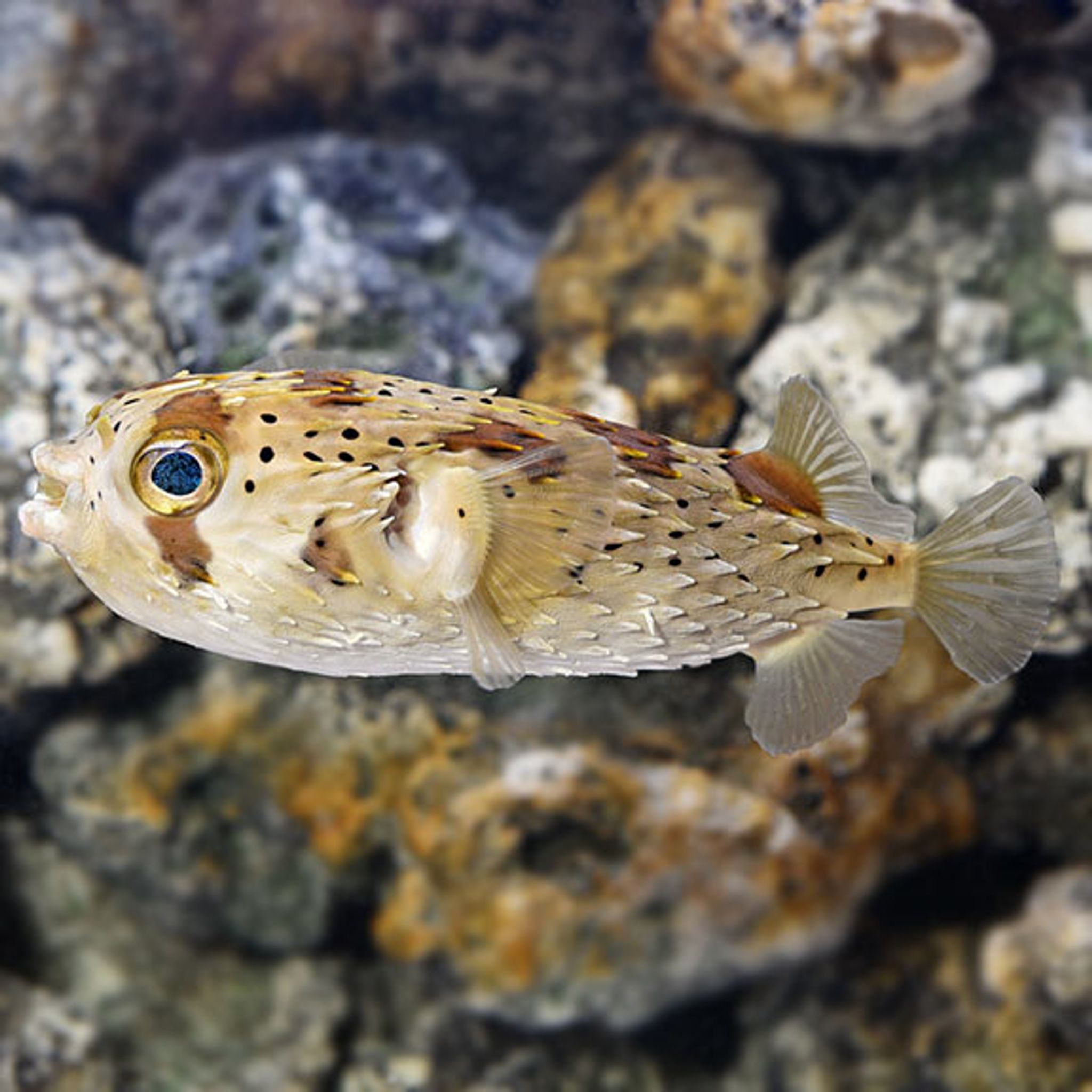

Is Porcupine Puffer Reef Safe? Coral and Invertebrate Compatibility Explained
A porcupine puffer will generally leave your coral alone, but it will not leave your cleanup crew alone. Those are two different questions with two different answers, and mixing them up is the most common reason new owners end up disappointed. This guide separates "coral-safe" from "invertebrate-safe" so you can stock accordingly.
The short answer: coral-safe, not invertebrate-safe
Porcupine puffers (Diodon holocanthus) are reef safe with caution when "reef" means coral. They don't pick at coral polyps the way some butterflyfish or angelfish do, so soft corals, LPS, and SPS are typically left physically undisturbed by feeding behavior.
They are not reef safe when "reef" includes a live invertebrate cleanup crew. Snails, hermit crabs, crabs, shrimp, urchins, and similar hard-shelled or soft-bodied invertebrates are the puffer's natural prey, not incidental casualties. This distinction matters because a lot of marketing and casual advice uses "reef safe" as one blanket label, when it should really be two separate labels: coral-safe and invertebrate-safe.
Why the predatory instinct never turns off
In the wild, porcupine puffers are specialized crustacean and mollusk hunters. Their fused, beak-like teeth exist specifically to crush shells — snails, hermit crabs, crabs, sea urchins, clams, and other mollusks make up the bulk of their natural diet. That hunting drive is hard-wired, not a learned behavior tied to hunger or availability, so it doesn't switch off just because the puffer is living in a tank instead of open water.
This is also why size doesn't offer a grace period. A juvenile porcupine puffer still has the full instinct to hunt shelled prey; it's simply working with a smaller mouth and smaller prey capacity. Assuming "it's too small to bother anything yet" is a common and costly miscalculation.
Invertebrates and tankmates to avoid
The table below sorts common reef inhabitants by realistic risk level when housed with a porcupine puffer.
| Category | Risk with a porcupine puffer | Notes |
|---|---|---|
| Snails (all types) | Very high — expect loss | Primary natural prey; shells are exactly what the beak is built for |
| Hermit crabs & true crabs | Very high — expect loss | Includes emerald and porcelain crabs in many cases |
| Shrimp (cleaner, peppermint, ornamental) | Very high — expect loss | Slow-moving and easy to corner |
| Sea urchins | High — losses common over time | Spines don't reliably deter a determined puffer |
| Starfish | High — losses common over time | Slow movement makes them easy targets |
| Feather dusters | Moderate to high | Occasional nipping reported even without full predation |
| Clams (Tridacna/giant clams) | High — treat as unsafe | Many keepers report puffers eventually crack the shell |
| Large anemones | Low to moderate | Occasional nipping reported; not a guaranteed loss |
| Stony coral (LPS/SPS) | Low | Tissue predation is rare; physical bumping is the real risk |
| Soft coral | Low | Same pattern — physical disturbance more likely than predation |
| Large, robust fish (tangs, angelfish, groupers) | Low | Temperament toward fish is generally peaceful |
The general principle extends beyond this one species: any hard-shelled, slow-moving invertebrate is at risk from shell-crushing predators. Boxfish and some triggerfish share the same basic incompatibility pattern, so the same caution applies when stocking around those fish too.
Coral risk: mostly physical, not predatory
The main coral hazard isn't feeding — it's clumsiness. Porcupine puffers are large, curious, and not especially graceful swimmers, and adults can knock frags loose or disturb rockwork simply by moving through it. Aquascape with that in mind: secure frags well and leave swimming room rather than a dense, tightly packed layout.
Clams are the clearest exception to "corals are fine." Even though a clam isn't technically a coral, it's commonly kept in reef systems, and it behaves more like an invertebrate target than a coral in this context — treat Tridacna and other giant clams as unsafe with a porcupine puffer. Large, fleshy anemones and feather dusters sit in a similar gray zone: not guaranteed losses, but higher risk than a typical stony or soft coral.
Sources disagree on exactly how much caution is warranted here. Some call porcupine puffers fully coral-safe; others flag occasional nipping at fleshy LPS or clams. The sensible middle ground: treat hardy SPS, LPS, and soft corals as generally safe, but don't assume every coral and coral-adjacent invertebrate carries zero risk. If you're building out a coral collection around a puffer, browsing marine corals with an eye toward hardy stony and soft species is a reasonable starting point.
Tank size and housing requirements
Porcupine puffers reach roughly 18–20 inches (46–51 cm) in the wild and commonly 12–15 inches (30–38 cm) in home aquariums — a large-bodied fish that needs a correspondingly large, well-filtered system.
- Absolute minimum for a juvenile: around 125 gallons (473 L), with a clear plan to upgrade
- Minimum for a full-grown adult, long term: roughly 180 gallons (681 L) or more
- Filtration: strong mechanical and biological filtration plus solid protein skimming, since porcupine puffers are messy, heavy waste producers relative to their size
Sources cite anywhere from 125 to 200+ gallons as a minimum, largely depending on whether they're describing a juvenile's starting tank or an adult's forever home. Buying a small juvenile for a 125-gallon tank without a real upgrade path is a common planning mistake — predation risk and bioload both escalate as the fish grows, so a tank that looks safe for a young puffer isn't a long-term guarantee of the same stocking plan staying safe.
Water parameters
Because coral isn't the compatibility issue, standard reef parameters work fine — there's no special accommodation needed for the puffer itself beyond adequate filtration for its bioload.
| Parameter | Target range |
|---|---|
| Temperature | 74–80°F (23–27°C) |
| Specific gravity | 1.020–1.025 |
| pH | 8.1–8.4 |
| Nitrate/phosphate | Kept low, as in any reef system |
Diet, feeding schedule, and beak management
A porcupine puffer's beak — its fused, continuously growing teeth — is a genuine husbandry requirement, not just an enrichment detail. Without regular hard-shelled food to grind it down, the beak can overgrow and eventually interfere with eating.
A varied captive diet should include:
- Silversides
- Shrimp, ideally raw and shell-on for teeth wear
- Squid
- Clams on the half-shell
- Crab legs
- Hard-shelled snails
Feed adults 2–4 times per week, and avoid overfeeding — captive puffers fed only soft foods (shrimp meat, mysis) without shell-on items are prone to overgrown beaks, obesity, and fatty liver issues over time. Rotating in shell-on items isn't optional maintenance; it's the mechanism that keeps the beak worn down and functional.
Temperament and fish tankmates
The predation problem is specific to invertebrates, not fish. Porcupine puffers are generally peaceful and non-aggressive toward tankmates, often described as curious and interactive, sometimes compared to a "dog-like" personality in how they respond to their keeper.
They can typically be housed with other large, robust fish that can hold their own — tangs, larger angelfish, groupers, and triggerfish with some caution. Avoid chronic fin-nippers or overly aggressive tankmates; even a hardy puffer can suffer suppressed appetite and stress-related health issues if it's being harassed constantly. If you're building a compatible stocking list, marine tangs and surgeonfish are a commonly cited pairing that also double as useful algae grazers.
Realistic stocking: FOWLR or coral-only, not a full reef
Given the invertebrate predation issue, a dedicated fish-only-with-live-rock (FOWLR) system or a fish-and-coral-only setup — no cleanup crew, no ornamental invertebrates — is the realistic path for a porcupine puffer, not a full mixed reef with snails and shrimp doing cleanup duty.
Without a live cleanup crew, algae and detritus control has to come from elsewhere:
- Manual cleaning on a set schedule (glass, substrate, rockwork)
- Larger algae-grazing fish that aren't shelled prey (certain tangs and blennies)
- Strong protein skimming and media reactors to offset the missing scavenger crew
- Regular water changes to manage the nutrient load a cleanup crew would normally help control
Common mistakes to avoid
- Adding a puffer to an established reef with a full cleanup crew and assuming disappearing snails or crabs point to a water quality problem — assume predation first.
- Overfeeding soft foods without shell-on items, leading to an overgrown beak, feeding difficulty, and obesity or fatty liver.
- Underestimating adult size and moving a juvenile into what will become a permanently undersized tank, causing stunting and stress.
- Housing with fin-nippers or aggressive tankmates, which can suppress appetite and immune response even in an otherwise hardy fish.
- Assuming small size means safe size — juveniles retain full predatory instinct, just against smaller prey.
- Failing to minimize stress and handling — inflation (puffing) is a physiologically taxing stress response and shouldn't be treated as a party trick.
A note on toxin safety
Porcupine puffers contain tetrodotoxin, a potent neurotoxin. This isn't a tankmate compatibility issue — it doesn't affect how the fish interacts with other livestock — but it's worth a brief safety note for handling, netting, and disposal, particularly in households with curious pets or small children who might have access to the tank or a deceased specimen.
Frequently Asked Questions
Can porcupine puffers live in a reef tank with coral?
Yes, for most hard and soft coral — direct tissue predation is uncommon. But "reef tank" needs clarification: a coral-only reef is generally fine, while a reef tank with a full invertebrate cleanup crew is not a safe combination long term.
Will a porcupine puffer eat cleaner shrimp?
Very likely, given enough time. Cleaner shrimp and other ornamental shrimp should be treated as incompatible rather than a calculated risk.
Will it eat snails and hermit crabs?
Yes — these are among its primary natural food sources. Plan for losses rather than hoping for an exception.
Do porcupine puffers eat coral?
Generally no direct coral tissue predation occurs, but they can physically damage coral by bumping into frags and rockwork while swimming, since they're large and not particularly agile.
What size tank does a porcupine puffer need?
A minimum of about 125 gallons (473 L) for a juvenile, with an upgrade plan to roughly 180 gallons (681 L) or more for a full-grown adult, due to eventual size and a heavy bioload.
What do porcupine puffers eat in captivity?
A varied diet of shell-on shrimp, squid, clams, crab, hard-shelled snails, and silversides — the shell and hard material are essential for wearing down the continuously growing beak.
Can porcupine puffers be kept with other fish?
Generally yes, with large, robust, non-nippy tankmates. Temperament toward fish is largely peaceful and curious; the incompatibility issue is specific to invertebrates, not other fish.
Are porcupine puffers dangerous to keep because of their toxin?
They contain tetrodotoxin, which isn't a risk to tankmates but is relevant for careful handling and disposal, especially around pets or children.
If you're planning a porcupine puffer build, browsing available marine puffers is a good next step for sizing up options against the tank and stocking plan you've settled on.


