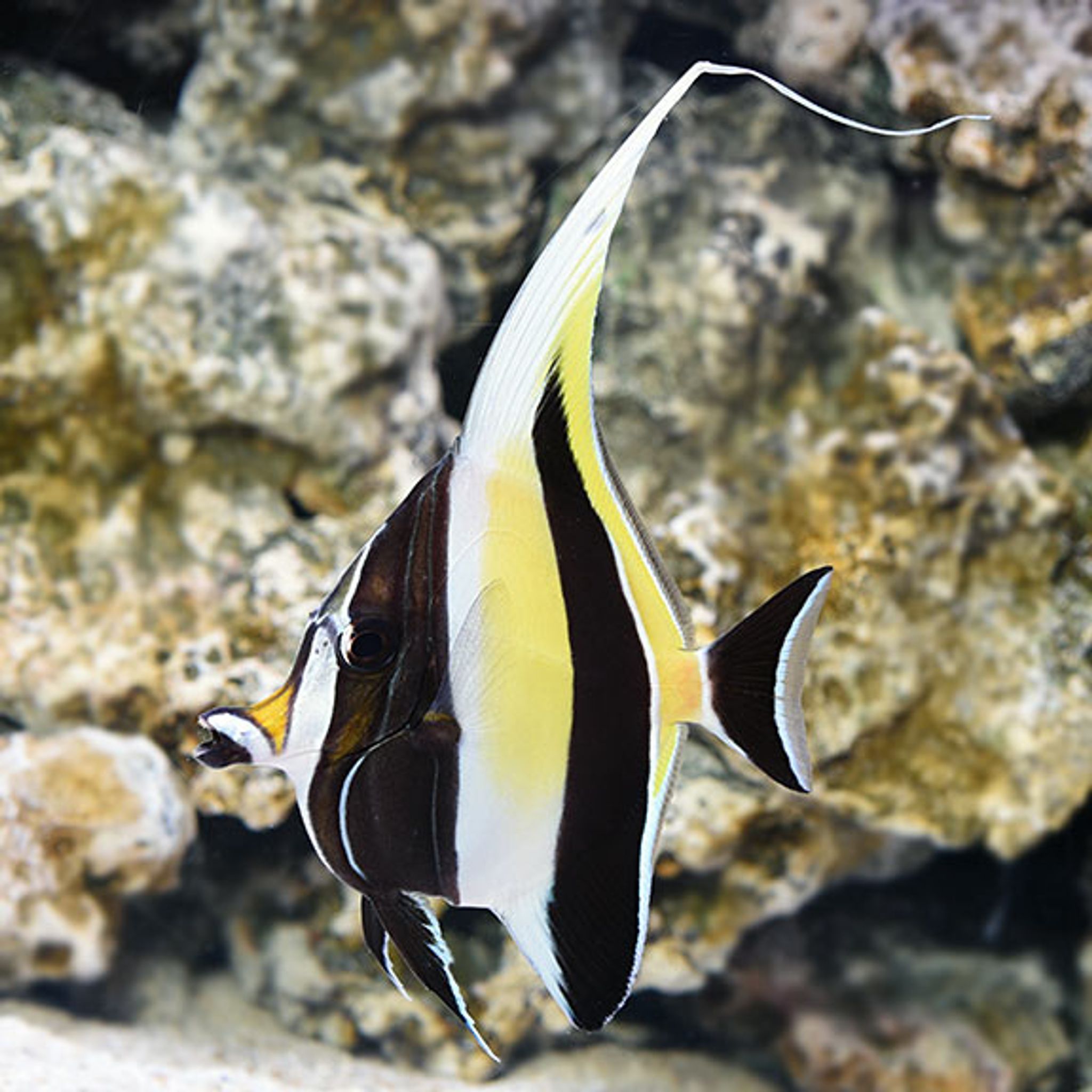

Is Moorish Idol Reef Safe? Coral and Invertebrate Compatibility Explained
A Moorish Idol (Zanclus cornutus) is generally reef safe when it comes to stony and soft corals, so it will not strip your reef the way a butterflyfish or angelfish sometimes will. The bigger question isn't whether it will wreck your coral — it's whether it will survive in your tank at all, since this species has one of the poorest captive survival records of any commonly sold marine fish.
What Is a Moorish Idol?
The Moorish Idol is the only species in the family Zanclidae, easily recognized by its disc-shaped body, bold black-white-yellow banding, and a dramatically long, trailing dorsal filament. In the wild it reaches roughly 8–9 inches, though captive specimens often stay somewhat smaller. Its striking, almost pennant-like silhouette is part of why it shows up so often in the aquarium trade despite being a genuinely difficult animal to keep.
In nature, it is a specialized micro-predator and grazer, not a generalist feeder. Its diet leans heavily on:
- Sponges
- Tunicates
- Small invertebrates picked from reef crevices
- Some algae grazing
That narrow natural diet is the key to everything else in this guide — both why it's mostly coral-safe and why it's so hard to keep alive.
Is a Moorish Idol Reef Safe for Corals?
Yes, with a caveat. Moorish Idols do not typically pick at stony coral polyps, and both large-polyp stony (LPS) and small-polyp stony (SPS) corals are usually left alone. Clams and other bivalves are also generally unaffected, since this fish isn't built to prey on shelled mollusks.
Where the "reef safe" label gets murkier is around soft, encrusting, or sponge-based life:
- Feather dusters — at modest risk; the fish may pick at the crown
- Ornamental sponges — a natural food source in the wild, so display sponges are a target
- Some soft corals with heavy, fleshy tissue — occasional picking has been reported
- Sponge-encrusted live rock — expect grazing here; this is actually useful (see the diet section below)
So the honest verdict is: reef safe for corals, reef safe with caution for select invertebrates. A reader who only has stony corals and clams has little to worry about. A reader with a prized feather duster colony or a sponge garden should watch behavior closely after introduction rather than assume total safety.
Reef Compatibility at a Glance
| Tankmate type | Typical risk from a Moorish Idol |
|---|---|
| LPS corals | Low — generally left alone |
| SPS corals | Low — generally left alone |
| Soft corals (fleshy types) | Low to moderate — occasional picking |
| Feather duster worms | Moderate — may pick at the crown |
| Ornamental/display sponges | Moderate to high — natural food source |
| Clams and bivalves | Low — not targeted |
| Shrimp, crabs, hermits | Low — not a predator of crustaceans |
| Snails | Low — not targeted |
Sources Disagree on "Reef Safe" — Here's the Sensible Read
Some care sheets flatly call the Moorish Idol reef safe, focusing only on its indifference to coral polyps. Other, more detailed sources qualify that label because of its sponge- and soft-invert-picking tendencies. The reasonable middle ground: treat it as reef safe for coral-dominated systems, but flag it as a caution case if your display leans on feather dusters, ornamental sponges, or delicate soft corals.
Difficulty ratings show a similar split. Some retail-style profiles list the Moorish Idol as "intermediate," implying that a big enough tank and clean water are all that's needed. More candid, experience-based sources are blunter: this is an expert-only fish, and the barrier isn't aggression or water chemistry — it's convincing the fish to eat.
Minimum tank size estimates also range from about 125 to 180+ gallons (473–681+ L). Given the fish's adult size and its need for continuous open swimming room as an active, semi-pelagic swimmer, 180 gallons (681 L) is the more defensible minimum to recommend.
The Real Risk: Starvation, Not Aggression
This is the point every prospective buyer needs to internalize: most Moorish Idols that die in captivity die from starvation and wasting, typically within the first one to three months, not from disease caused by poor water quality and not from fighting with tankmates. Even experienced reef keepers lose specimens this way.
Why Feeding Is So Difficult
- Wild diet is narrow and specialized (sponges, tunicates), so many individuals never recognize prepared foods as edible
- Capture and shipping stress suppresses appetite right from the start
- Some specimens simply refuse everything offered and decline over weeks
What to Offer
A realistic feeding plan combines several elements rather than relying on one product:
- Mature, established live rock with natural sponge and algae growth already present, ideally rubble transferred from an existing system
- Sponge-based frozen foods
- Mysis
- Spirulina and nori
- A high-quality marine pellet food
Offering food multiple times a day, in variety, gives a hesitant fish more chances to start eating. A tank with a mature refugium or chaeto growth that supports natural sponge and pod populations meaningfully improves the odds, because the fish can graze the way it would on a reef.
Tank Setup and Water Parameters
Beyond feeding, the Moorish Idol needs a large, mature, reef-standard system:
- Tank size: 180 gallons (681 L) minimum, larger is better
- Live rock: 100+ lbs (45+ kg) of mature rock carrying natural sponge and algae growth
- Swimming space: ample open water — this is not a fish for a rockscape-dominated tank
- Temperature: 72–78°F (22–26°C)
- Specific gravity: 1.020–1.025
- pH: 8.1–8.4
- Alkalinity: 8–12 dKH
- Ammonia/nitrite: near zero
- Nitrate: ideally under 20 ppm, with some sources recommending under 10 ppm for long-term health
Temperament is genuinely one of this fish's strengths — it is peaceful toward other fish and does best kept singly, or as a mated pair in a very large system. It can be shy and skittish, so it benefits from plenty of structure to retreat into balanced against the open swimming room it needs.
Disease Risk and Why Quarantine Matters
Moorish Idols are prone to marine ich and velvet, largely because capture and shipping stress weaken their immune response before they ever reach a tank. A fish that isn't eating is also a fish with fewer reserves to fight off disease, which compounds the risk.
A long, careful quarantine — at least four weeks — with close observation that the fish is actively eating before it goes into the display, is essential. Skipping this step and adding a stressed, freshly wild-caught specimen directly to a reef tank is one of the most common ways hobbyists lose this fish.
Sourcing Matters More Than Almost Anything Else
Where a specimen comes from has an outsized effect on survival:
- Captive-bred or tank-raised individuals do best when available
- Long-term-holder fish — already eating and conditioned onto prepared foods — have dramatically better odds than fish pulled straight from a shipment
- A source that pre-conditions fish onto frozen and pellet foods before sale removes much of the risk a buyer would otherwise inherit
Buying the cheapest, freshest-off-the-boat specimen is usually the worst decision a prospective owner can make, even if the fish looks identical to a well-conditioned one in the tank.
An Ethical Note Worth Stating Plainly
Wild-collection mortality for this species — both before and after sale — is unusually high compared to most reef fish in the trade. That's a legitimate reason to reconsider the purchase entirely, not a minor footnote buried under care specs. A species this hard to keep, sold this widely, deserves a buyer who has thought through the ethics, not just the tank size.
Common Mistakes to Avoid
- Buying on impulse without a mature, sponge-rich display or refugium already established
- Skipping quarantine and adding a stressed wild-caught fish straight to the display
- Assuming "reef safe" means safe with every invertebrate, and not watching behavior toward feather dusters, sponges, or soft corals after introduction
- Housing in too small a tank, which restricts swimming space and adds stress that suppresses appetite
- Offering only one type of food instead of a varied, sponge-inclusive menu
- Giving up in a day or two — some individuals take days to weeks to start eating, and patience with varied offerings sometimes turns things around. That said, a fish showing zero interest after one to two weeks and visibly wasting is unlikely to recover.
Signs of a Healthy Specimen at Point of Sale
Most care sheets skip this, but it matters as much as any water parameter:
- A rounded belly, not a pinched or sunken abdomen
- Actively picking at rock or food while still in the store's system
- No clamped fins or listless resting on the substrate
- Alert, responsive behavior to movement outside the tank
A fish that already shows these signs has a meaningfully better shot than one pulled straight from a recent shipment.
A Decision Checklist Before You Buy
Ask honestly before purchasing:
- Is my live rock mature and old enough to carry natural sponge and pod growth?
- Do I have a refugium or chaeto system supporting a natural food web?
- Do I have a quarantine tank ready and free for at least four weeks?
- Am I prepared to offer food multiple times a day and be patient for weeks if needed?
- Am I buying from a source that conditions fish onto prepared foods, rather than the cheapest option available?
Answering "no" to more than one of these is a strong signal to wait, upgrade your system first, or choose a different species.
Species Not Recommended for Beginners
The Moorish Idol belongs on a broader list of saltwater fish that are commonly sold but genuinely difficult, usually for the same underlying reasons — specialized diets, high stress sensitivity, or dependence on established biological food sources rather than tank size or aggression:
- Moorish Idol — sponge/tunicate specialist, poor feeding transition
- Mandarin dragonets — need a constant supply of live copepods
- Certain butterflyfish — coral-polyp or sponge specialists
- Cleaner wrasses — depend on live parasites they clean from other fish
- Some pipefish and seahorses — require live or specialized foods without dedicated setups
Availability Isn't the Same as Suitability
The aquarium trade regularly stocks animals with poor captive survival records simply because they sell. Alongside the Moorish Idol, this list includes:
- Pinnatus and Platax batfish, which frequently suffer starvation issues
- Wild-caught anemones and sponges that sometimes arrive already dying
- Cleaner wrasses, which starve without a constant supply of live fish parasites
- Certain hard-to-feed butterflyfish
The takeaway is simple: the fact that a store carries a species is not evidence it's suitable for a typical reef tank. Research survival track record before purchase — never let price or availability be the deciding factor. FishyHub lists a wide range of options in marine fish, and it's worth browsing hardier alternatives before committing to a specialist feeder.
An Easier Alternative: Heniochus Bannerfish
For readers drawn to the Moorish Idol's look but not its risk profile, Heniochus species — sometimes nicknamed the "poor man's Moorish Idol" — offer a visually similar banded, high-finned appearance with far more forgiving husbandry.
| Trait | Moorish Idol | Heniochus (Bannerfish) |
|---|---|---|
| Reef safety (coral) | Generally safe | Generally safe |
| Reef safety (sponges/soft inverts) | Caution advised | Generally safe |
| Feeding difficulty | Very high — frequent refusal of prepared foods | Moderate — usually accepts prepared foods readily |
| Overall difficulty | Expert only | Intermediate |
| Minimum tank size | 180 gal (681 L)+ | Typically smaller, though still a sizable system |
| Appearance | Long trailing filament, bold banding | Similar banding and elongated dorsal fin |
For most hobbyists who don't already have a mature, sponge-rich system and a dedicated quarantine setup, a Heniochus species delivers a comparable look with a dramatically better survival outlook.
Frequently Asked Questions
Is a Moorish Idol reef safe?
Yes, for corals in general — it typically leaves LPS and SPS corals alone. Use caution around sponges, feather dusters, and some soft corals, since these overlap with its natural wild diet.
Will a Moorish Idol eat my clams, snails, shrimp, or crabs?
No. It is not a predator of crustaceans or mollusks, so clams, snails, shrimp, crabs, and hermits are generally safe tankmates.
Why do Moorish Idols have a reputation for dying quickly in aquariums?
Mainly a feeding and diet-transition problem tied to capture stress, not aggression or poor water quality. Many individuals never successfully switch onto prepared foods and starve within their first few months in captivity.
What tank size does a Moorish Idol need?
A large, mature system — commonly cited around 180 gallons (681 L) minimum — with established live rock carrying natural sponge and algae growth, plus plenty of open swimming space.
Can beginners keep a Moorish Idol?
It's not recommended. Despite being sold to hobbyists of all experience levels, it's considered an expert-only fish because of its specialized diet and high sensitivity to stress.
What should I feed a Moorish Idol?
Offer sponge-based frozen foods, mysis, nori and spirulina, and quality pellets, alongside natural grazing opportunities on mature live rock with existing sponge and algae growth.
Is there an easier alternative that looks similar?
Yes — Heniochus species, nicknamed the "poor man's Moorish Idol," offer a visually similar banded look with much better hardiness and an easier feeding response.
How long should a new Moorish Idol be quarantined?
At least four weeks, with close monitoring to confirm the fish is actively eating before it's moved into the display tank.
Bottom Line
A Moorish Idol is reasonably reef safe around corals, with a few sensible caveats for sponges and select soft-bodied invertebrates. The real gatekeeper is diet and survival, not compatibility — this is a fish for an experienced keeper with a mature, sponge-rich system and a real quarantine plan, not an impulse buy for a new reef tank. Browse marine invertebrates and corals on FishyHub to plan a compatible reef community before adding any specialist fish to the mix.


