Is Flame Hawkfish Reef Safe? Coral and Invertebrate Compatibility Explained
The short answer is: yes for corals, no for most small motile invertebrates. A flame hawkfish (Neocirrhites armatus) won't eat coral tissue, but it is a genuine predator toward shrimp, small crabs, snails, and pods, and it can physically irritate coral colonies just by perching on them. The rest of this guide breaks down exactly what's at risk and what isn't, so you can stock around it instead of finding out the hard way.
What Is a Flame Hawkfish?
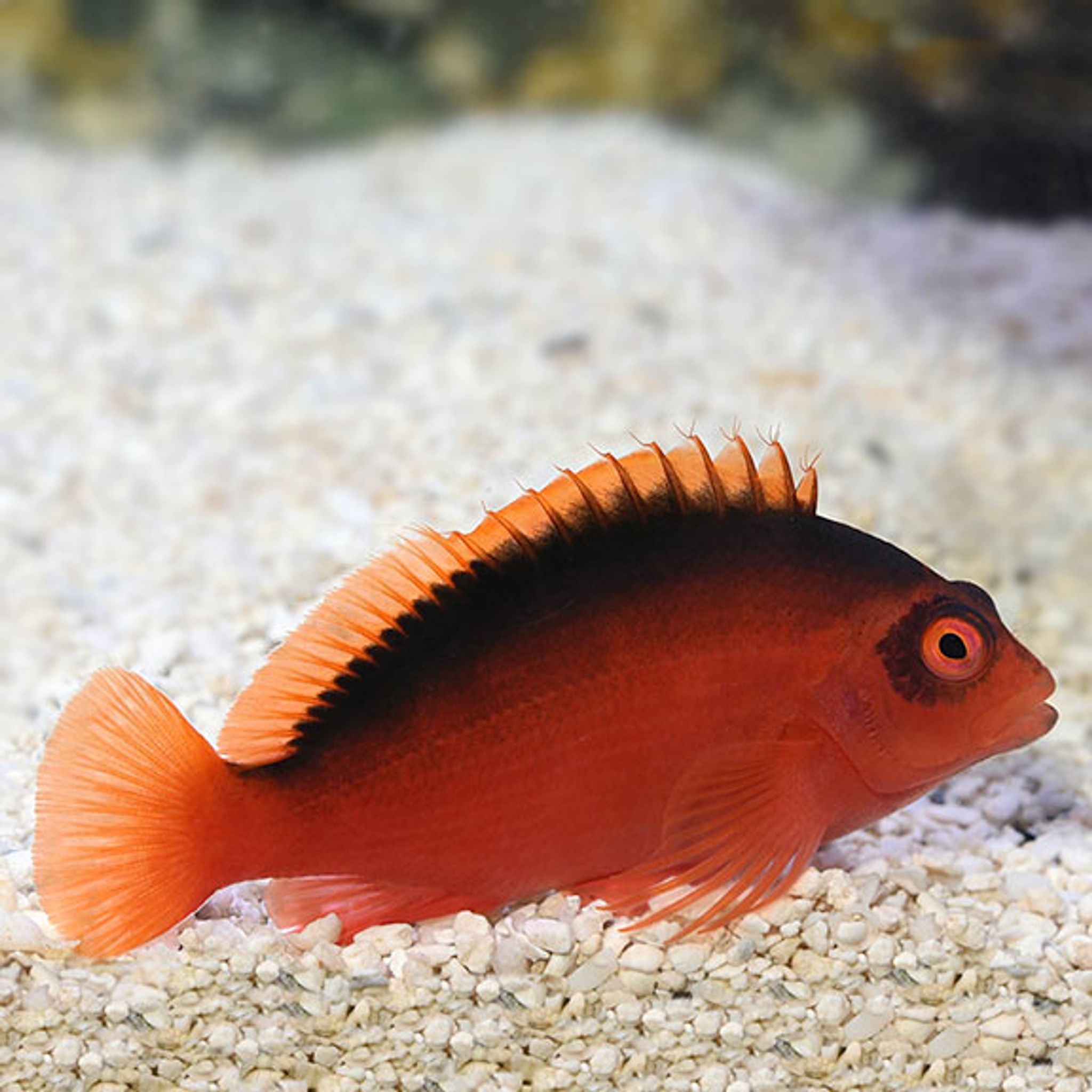
The flame hawkfish, also called the flame tail hawkfish, belongs to the family Cirrhitidae. It's one of the most recognizable small marine fish sold for reef tanks thanks to its:
- Bright red-to-orange body
- Black-tipped dorsal spines
- Black ring encircling each eye
Native to the Pacific, most specimens in the trade come from areas around Fiji and the Line Islands. In the wild and in aquariums, they're found perched on rocky or coral outcrops rather than swimming freely in open water — a habit that matters a lot for reef compatibility, which we'll get to below.
Quick Profile
| Trait | Detail |
|---|---|
| Scientific name | Neocirrhites armatus |
| Origin | Pacific (commonly Fiji, Line Islands) |
| Max size | About 3.5 in / 9 cm |
| Lifespan | 5+ years with good care |
| Diet | Carnivore |
| Difficulty | Easy / beginner-friendly |
| Minimum tank size | 20-30 gal (24-30 gal realistic for one fish) |
| Temperament | Semi-aggressive, territorial with similar bottom-dwellers |
| Breeding | Egg scatterer; rarely bred in home aquaria |
Flame hawkfish also lack a swim bladder, so they don't cruise continuously through the water column like a wrasse or tang. Instead, they "perch and hop" between rocks — this is completely normal behavior, not a sign of illness.
Is a Flame Hawkfish Reef Safe? The Real Answer
"Reef safe" gets used as a single blanket label, but it really covers two separate questions: is the fish safe with corals, and is it safe with invertebrates? For a flame hawkfish, the answers are different.
- Corals: reef safe. They don't bite, rasp, or consume coral tissue or polyps.
- Invertebrates: reef safe with caution. They actively hunt small crustaceans and worms.
Treating both categories as one score is exactly why some owners are surprised — either by a healthy coral collection next to a completely empty shrimp population, or by a coral that mysteriously stops opening in one specific spot.
Coral Compatibility: Consumption Risk vs. Stress Risk
It helps to separate two different mechanisms that both get lumped under "reef safety":
- Consumption risk — will the fish actually eat the coral? For flame hawkfish, no.
- Stress/irritation risk — will the fish's behavior harm the coral indirectly? Yes, potentially.
Why Perching Is the Real Coral Issue
Flame hawkfish use elevated points as hunting lookouts, and they tend to favor the highest, most stable perches in the tank — which is often the top of a branching coral colony. Repeated perching on the same coral can cause:
- Polyp retraction and reduced feeding/expansion
- Tissue irritation or abrasion at the contact point
- Reduced light and flow reaching that spot
- Chronic stress that shows up as slow decline rather than sudden damage
Branching SPS corals like acropora, and LPS corals like hammer or torch, are the most commonly affected because their upper branches make convenient perches. A flame hawkfish sitting on the same acropora tip day after day is a common, avoidable mistake — not because the fish is "eating" the coral, but because that one polyp cluster never gets a break.
Rockscaping to Redirect Perching Behavior
Rather than just avoiding branching corals altogether, you can manage this proactively:
- Build a few tall rock towers or ledges away from your prized coral colonies specifically as decoy perches.
- Place your most valuable SPS/LPS pieces lower in the rockwork or tucked to the side, not at the highest point.
- Watch any newly placed coral for the first 1-2 weeks — if the hawkfish adopts it as a favorite perch, relocate the coral rather than waiting for visible stress.
If you're building out a coral collection with this fish in mind, browsing LPS hard corals with an eye toward placement — not just species — will save you some rearranging later.
Invertebrate Compatibility: The Part Most Guides Underplay
This is where flame hawkfish reputation gets murkiest. They are opportunistic predators of small motile invertebrates, and this is the actual reef-safety issue for most reef keepers — not the corals.
Generally Not Safe
- Small or juvenile ornamental shrimp (cleaner shrimp, cardinal/fire shrimp, especially when small)
- Small hermit crabs
- Small snails
- Feather duster worms (tentacle crowns may get nipped)
- Bristle worms
- Copepods and amphipods
- Tiny gobies or blennies close to the hawkfish's own size
Generally Safer (Not Guaranteed)
- Adult cleaner shrimp, once the hawkfish is accustomed to their presence
- Established peppermint shrimp populations
- Larger hermit crabs
- Sea stars
- Anemones (won't be eaten, but may be perched on or irritated)
- Larger clams (won't be eaten, but should still be monitored)
Shrimp Safety, Species by Species
| Shrimp type | Risk level | Notes |
|---|---|---|
| Cleaner shrimp (juvenile) | High | Prime target, especially early on |
| Cleaner shrimp (large, established) | Moderate | Better odds once the hawkfish is used to it, still not guaranteed |
| Fire/blood shrimp | High | Small size and slow movement make them vulnerable |
| Peppermint shrimp (population) | Lower | A larger group tolerates occasional losses better than a single specimen |
Two factors matter more than species alone: size and timing. A juvenile shrimp of any species is far more vulnerable than a full-grown one, and a newly introduced hawkfish is more predatory and exploratory than one that's settled into a routine.
Copepods and Refugium Populations
If you run a refugium to culture pods for coral and fish nutrition, know that a flame hawkfish in the display tank will actively hunt any pods that migrate out. Over time this can offset or even outpace what your refugium produces, which is worth flagging if you're relying on that supply to feed picky eaters or supplement coral nutrition.
Introduction Order: The Fix Most Guides Skip
The single most effective way to reduce invertebrate losses is sequencing, not species selection:
- Stock your inverts and let pod populations establish first, in a tank without the hawkfish present.
- Give shrimp, crabs, and snails time to grow past the most vulnerable juvenile stage.
- Add the flame hawkfish last, once inverts are established and have places to hide.
Adding shrimp or hermit crabs into a tank where the hawkfish is already settled and territorial is a common mistake — it turns a curious new tankmate into prey introduced directly into a hungry predator's territory.
If You Already Have Shrimp and Want to Add a Hawkfish Anyway
- Feed the hawkfish heavily in the days before and after introduction so it's less driven to hunt immediately.
- Add or increase hiding spots — PVC sections, dense rockwork, overhangs — that shrimp can retreat into.
- Monitor closely for the first month, since this window carries the highest predation risk.
General Care and Husbandry
Tank Setup
- Minimum tank size: 24-30 gallons (91-114 L) for a single specimen in a mature reef system with adequate rockwork. Some sources cite 20 gallons (76 L) as workable, but more rock structure and swimming room reduces stress and aggression.
- Larger tanks (75-100+ gal / 284-379+ L) are needed for multiple specimens or boisterous tankmates.
- A secure lid or tight-fitting screen top is essential. Flame hawkfish are known jumpers, particularly when startled or chasing food.
Water Parameters
Flame hawkfish don't need anything beyond standard, stable reef parameters:
| Parameter | Range |
|---|---|
| Temperature | 72-80°F (22-27°C), 78°F (26°C) ideal |
| pH | 8.1-8.4 |
| Specific gravity | 1.020-1.026 |
| dKH | 8-12 |
Feeding
As carnivores, flame hawkfish do well on:
- Mysis shrimp
- Frozen krill or brine shrimp
- Chopped seafood
- Quality marine carnivore pellets or flakes
Feed once or twice daily. They'll also supplement this diet by hunting live pods in the tank, which is part of why pod populations can decline over time with one in residence.
Temperament and Tankmates
Flame hawkfish are best described as semi-aggressive and territorial toward fish that share their niche — other hawkfish, dottybacks, and similarly shaped small bottom-dwelling blennies or gobies competing for the same rockwork. Toward fish that occupy the mid or upper water column, like clownfish, tangs, dartfish, and angelfish, they're generally peaceful.
This nuance gets lost when guides label them simply "aggressive" or simply "peaceful" — both are true, depending on which part of the tank the other fish lives in. A clownfish from FishyHub's clownfish selection, for example, typically coexists without issue, while a bottom-hugging blenny competing for the same perch may not.
Keeping two flame hawkfish together works only in a large tank, and even then, success isn't guaranteed unless they're a bonded pair. In smaller setups, two unrelated flame hawkfish will usually fight.
Acclimation and Hardiness
Flame hawkfish are considered hardy and adapt well to captivity once settled. Drip acclimation is recommended, as with most marine fish, but they don't require unusual handling beyond that.
Common Mistakes to Avoid
- Assuming "reef safe" covers all invertebrates just because corals aren't eaten
- Adding shrimp or hermit crabs after the hawkfish is already established and territorial
- Placing branching SPS at the very top of the rockwork, where the hawkfish naturally wants to perch
- Keeping the fish in too small a tank with insufficient rock structure, which raises stress, aggression, and jumping risk
- Skipping the lid, leading to a startled or feeding-frenzy jump out of the tank
- Assuming peacefulness toward all fish just because the hawkfish is small
- Not watching new coral placements closely during the first 1-2 weeks for early signs of perching stress
Frequently Asked Questions
Will a flame hawkfish eat my cleaner shrimp?
It's a real possibility, especially for small, juvenile, or newly added shrimp. Larger, established cleaner shrimp have better odds of coexisting, but there's no guarantee — treat any shrimp addition as a monitored risk rather than a sure thing.
Is flame hawkfish safe with pods and copepod cultures?
No. Flame hawkfish actively hunt copepods and amphipods, and a display tank fish can suppress or even crash a pod population that a refugium is trying to sustain.
Will it eat my corals?
No, flame hawkfish don't consume coral tissue or polyps. The risk to corals comes from perching behavior, which can stress or irritate small-polyp branching species like acropora over time — not from feeding.
Can I keep two flame hawkfish together?
Only in a large tank, and even then success depends heavily on whether the pair is bonded. In smaller setups, two unrelated flame hawkfish will typically fight, so single-fish stocking is the safer default.
What fish should I avoid pairing with a flame hawkfish?
Avoid other hawkfish, dottybacks, and similarly shaped small bottom-dwelling fish that compete for the same rockwork territory. Mid- and upper-water fish like clownfish or tangs are generally fine.
Does it need a special diet?
No. A standard marine carnivore diet — mysis shrimp, frozen meaty foods, and quality pellets — fed once or twice daily covers its nutritional needs.
Is a flame hawkfish reef safe overall — yes or no?
It's a nuanced yes: safe for corals, but risky for small or motile invertebrates. Whether it's a good fit depends entirely on what else you're planning to stock.
Do flame hawkfish need a lid?
Yes. They're known jumpers, and a secure lid or screen top is strongly recommended to prevent them from jumping out during a startle or while chasing food.
Final Thoughts
A flame hawkfish can be a striking, low-maintenance addition to a coral-focused reef tank, as long as you stock with its predatory instincts in mind. Keep corals as the centerpiece, add invertebrates before the fish rather than after, and give it plenty of rock structure to claim as its own. If you're planning your stocking order, browse marine invertebrates to build out your cleanup crew first, then look at hawkfish once your reef is established.

