Is Flame Angelfish Reef Safe? Coral and Invertebrate Compatibility Explained
The short answer: a Flame Angelfish (Centropyge loriculus) is reef safe with caution, not guaranteed reef safe. Most specimens leave coral alone, but individual behavior varies, some fish nip soft corals or zoanthids, and once nipping starts it rarely stops on its own. This guide breaks down exactly which corals and invertebrates are at risk, why the behavior happens, and how to stack the odds in your favor before you buy one.
What Is a Flame Angelfish?
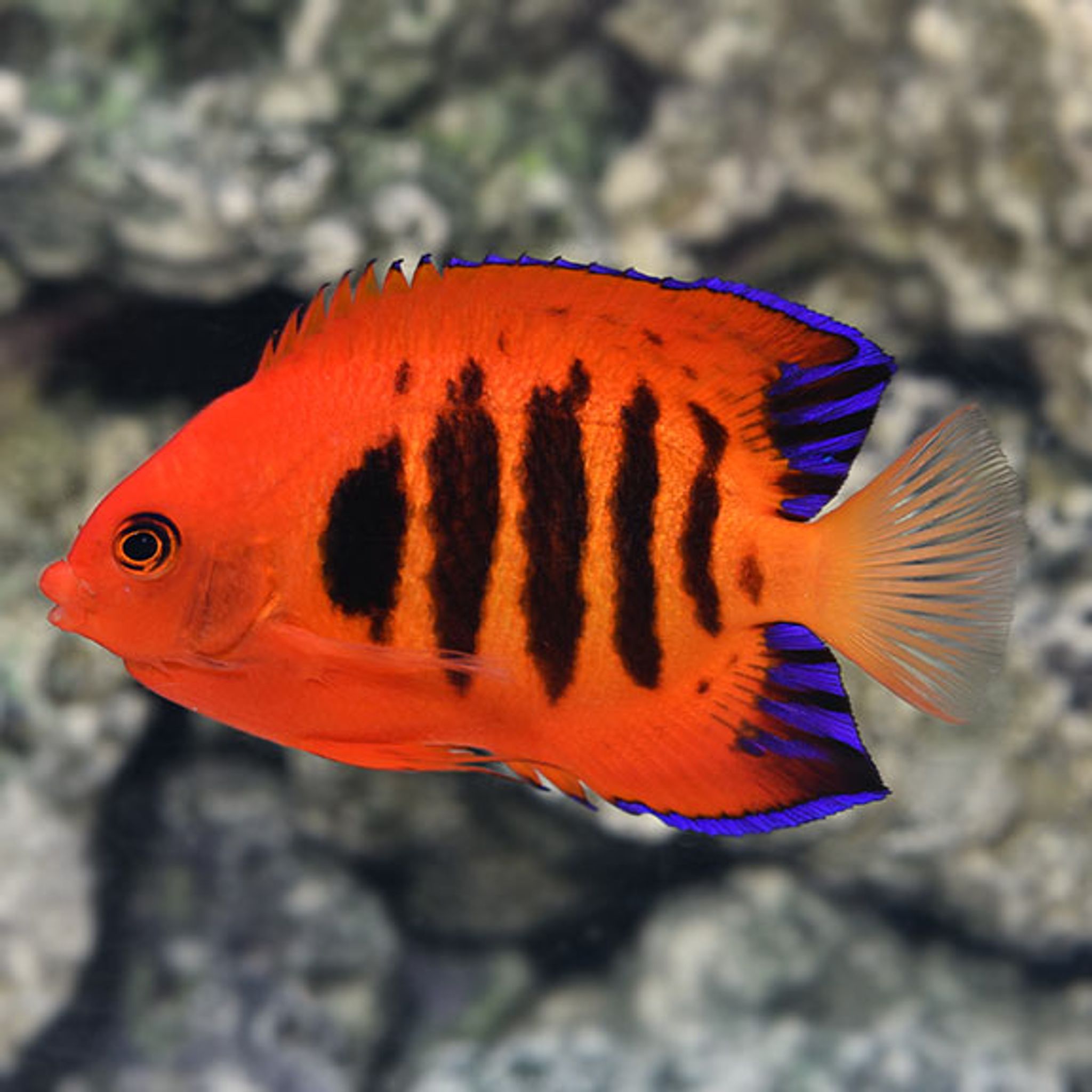
The Flame Angelfish is a dwarf (pygmy) angelfish in the genus Centropyge, native to the Indo-Pacific and commonly sourced from the Marshall Islands and Cook Islands. It's easy to see why it's one of the most requested fish in the hobby: a fiery red-orange body crossed with bold black vertical bars, topped with blue-edged fins. It consistently ranks among the most visually striking saltwater fish sold, which is exactly why so many reef keepers want one despite the compatibility caveats discussed below.
Basic profile:
| Trait | Detail |
|---|---|
| Adult size | About 4 in (10 cm) |
| Minimum tank size | 70–80 gal (265–300 L) for one specimen; 120+ gal (450+ L) for multiple angels or a heavily stocked reef |
| Temperature | 76–82°F (24–28°C) |
| pH | 8.1–8.4 |
| Specific gravity | 1.023–1.025 (35 ppt) |
| Temperament | Semi-aggressive, territorial toward other angels |
| Diet | Omnivorous grazer |
Water chemistry needs nothing exotic — stable calcium, alkalinity, and magnesium at standard reef levels are sufficient. The real compatibility question isn't chemistry; it's behavior.
So, Is It Actually Reef Safe?
Here's where sources disagree, and it's worth being upfront about it. Some general care guides label the Flame Angelfish flatly "reef safe." More reef-focused sources push back, insisting on "reef safe with caution," citing frequent reports of individual fish nipping coral tissue. The honest, defensible position sits with the second group: treat reef safety here as individual- and luck-dependent, not a guarantee either direction.
That means:
- Many Flame Angels live for years in mixed reef tanks without touching a single polyp.
- A meaningful minority develop a taste for coral tissue, sometimes right away, sometimes after months of good behavior.
- There's no reliable way to predict which category your fish falls into before you own it.
Don't take a single glowing forum thread as proof a Flame Angel is "safe" — individual temperament varies widely even within the species, and one person's success story doesn't transfer to your tank.
Coral Risk Tiers: What's Actually at Stake
Rather than a vague warning, it helps to rank coral types by how often they get targeted.
| Risk tier | Coral types | Notes |
|---|---|---|
| High risk | Zoanthids, mushroom corals, other soft corals with fleshy polyps | Most frequently reported targets; fleshy, exposed tissue is easy to pick at |
| Moderate risk | LPS (large-polyp stony) corals | Broader warning in some sources; fleshy polyp extension makes these vulnerable too |
| Lower risk | SPS (small-polyp stony) corals like Acropora and Montipora | Generally left alone more often, but not risk-free — especially if the fish is underfed |
If you're building a coral collection around this fish, lean toward SPS-dominant scaping and treat prized zoanthid colonies, mushrooms, and soft coral pieces as the ones to watch most closely, or to add only after your angel's habits are well established. You can browse a range of options in LPS hard corals and soft corals if you're planning a mixed reef around one.
A critical caveat: once a Flame Angel starts nipping a specific coral, that behavior is very hard to stop or retrain. It tends to persist and can even escalate to other similar corals nearby. The realistic fix at that point is removing the fish, rehoming it, or physically protecting the coral in question — not waiting it out.
Diet: The Biggest Lever You Control
Diet is the single most important mitigating factor in whether a Flame Angel turns to coral. In the wild and in mature tanks, these fish are constant grazers, picking algae film and microfauna off live rock throughout the day. When that food source is missing or insufficient, coral tissue becomes an easy substitute.
Feeding checklist to reduce nipping risk:
- Offer dried seaweed or nori clips several times a week.
- Supplement with marine algae-based pellets or flakes as a daily staple.
- Add meaty foods like mysis or brine shrimp multiple times a day for protein.
- Never add a Flame Angel to a brand-new tank that lacks an established algae film and pod population — this is one of the most common setup mistakes and a leading driver of later coral nipping.
There's also a tank-maturity angle worth connecting explicitly: tanks with more established live rock and a larger standing population of pods and algae biomass tend to see fewer nipping incidents, because the fish has constant natural grazing available instead of relying entirely on scheduled feedings. A young, sparse tank is a higher-risk environment even with a good feeding routine.
Invertebrate and Clam Compatibility
Beyond coral, most reef cleanup crews are unaffected by a Flame Angel:
- Snails and hermit crabs — generally safe; not a typical target.
- Ornamental shrimp (peppermint, cleaner shrimp) — occasional risk, particularly to small or soft-bodied individuals. Watch any newly added shrimp closely for the first week or two.
- Clams (Tridacna) — some risk of mantle nipping, a pattern seen across several Centropyge species. Approach with extra caution in a high-value clam display.
If you're stocking shrimp alongside a Flame Angel, browse marine shrimp and introduce new additions during a period when you can monitor interactions directly rather than adding them and walking away.
A Practical Trial-Period Method
Rather than gambling a full coral purchase on an unknown fish, or gambling an established fish's reputation on a new expensive frag, use a short trial period:
- Add the angel to the display before buying prized coral, and observe its general grazing behavior for a few weeks.
- When adding a new coral frag, isolate it in an acrylic guard or a quarantine tank for about a week and observe the angel's interest from a distance if visible, or introduce the frag briefly under supervision before committing it to open scaping.
- If a coral gets repeated attention (the fish returning to investigate or nip the same spot), don't wait for it to stop — relocate the coral to a frag rack out of the angel's territory or reconsider keeping that species long-term.
If you already have a coral-nipping specimen and don't want to remove it outright, some hobbyists reduce pressure on prized corals by target-feeding the angel right before lights-out (when grazing activity often peaks) and spot-feeding near the problem coral to redirect its attention elsewhere. These are mitigation tactics, not guaranteed cures — persistent nipping usually still ends with rehoming the fish or permanently protecting the coral.
Temperament and Tankmates
Flame Angels are semi-aggressive and territorial, especially toward other angelfish and similarly shaped or colored fish. Practical guidelines:
- Add a Flame Angel as the last or near-last fish to an established reef, after other territories are set.
- Avoid pairing two Flame Angels, or a Flame Angel with a similarly shaped dwarf angel, in a standard home reef tank — this typically leads to sustained aggression rather than coexistence, and needs a very large, carefully aquascaped tank to have any chance of working.
- Give the fish a large tank if you're building a multi-angel display; 70 gallons is a solid single-specimen minimum, but that number climbs quickly once you add competitors.
Genus Context: Not All Angelfish Carry the Same Risk
It helps to zoom out. Reef safety in angelfish is a genus- and individual-level trait, not a fixed property of "angelfish" as a category — a useful mental model to carry into evaluating any other angelfish species you're considering.
- Centropyge (dwarf angels), the genus that includes the Flame Angel, are opportunistic omnivores that graze algae and biofilm and, in a subset of individuals, coral tissue. As a group, they're best described as reef safe with caution.
- Genicanthus (swallowtail/lyretail angels) sit in a different category entirely. They're planktivores that feed in the water column rather than grazing rockwork or coral, are sexually dimorphic, and live in deeper water in the wild. Because they simply don't graze on coral tissue, they're considered the more reliably reef-safe angelfish group. The tradeoff: they're pricier, less commonly available, need more open swimming room, and require consistent plankton-style feeding rather than algae grazing.
If guaranteed coral safety matters more to you than having this specific species, a Genicanthus angel is worth researching as an alternative. If you're drawn specifically to the Flame Angel's color and are willing to accept some risk, it remains one of the most popular dwarf angels for good reason — just go in with realistic expectations. You can compare options across dwarf angelfish currently available.
Sourcing and Health Considerations
Captive-bred or aquacultured Flame Angels are increasingly available and tend to acclimate faster, adapting to prepared foods a bit more predictably than wild-caught fish. That said, captive breeding doesn't eliminate the underlying unpredictability of reef-safety behavior — a captive-bred individual can still develop coral-nipping habits.
Dwarf angels as a group, Flame Angels included, can be more prone to marine ich, velvet, and Uronema infections when quarantine is skipped or handled poorly. Combined with the behavioral uncertainty, this makes a proper quarantine period doubly important:
- Quarantine new stock for 2–4 weeks before introducing to the display.
- After acclimation, observe behavior closely in the display for the first several weeks before trusting the fish fully around prized corals.
- Don't skip quarantine to save time — introducing disease to an established reef is a much bigger setback than a delayed introduction.
Common Mistakes to Avoid
- Adding a Flame Angel to a brand-new tank with no established algae film or live rock biofilm.
- Underfeeding overall, or feeding only meaty foods without algae or vegetable matter.
- Trusting a single forum success story as a guarantee of your own fish's behavior.
- Adding prized zoanthid or mushroom colonies to a tank with an established angel without any trial or observation period.
- Housing two Flame Angels, or a Flame Angel with a similar dwarf angel, in too small a tank.
- Skipping quarantine on new stock.
- Ignoring early warning signs — repeated investigating or nipping of one coral — and hoping it resolves on its own.
Frequently Asked Questions
Is the Flame Angelfish 100% reef safe?
No. Most experienced sources classify it as reef safe with caution, meaning behavior varies by individual and can include coral nipping, especially of soft corals and zoanthids.
Which corals are safest to keep with a Flame Angelfish?
SPS corals like Acropora and Montipora are generally lower risk. Soft corals, zoanthids, and LPS carry higher risk, with zoanthids and soft corals topping the list of frequently reported targets.
Will a Flame Angelfish eat cleanup crew members like snails, hermit crabs, or shrimp?
Snails and hermit crabs are typically safe. Small or soft-bodied ornamental shrimp can occasionally be targeted, so monitor any newly added shrimp closely during their first week or two.
What tank size does a Flame Angelfish need?
A well-established reef tank of at least 70 gallons (265 L) is the common minimum for a single specimen. Multiple angels, or a heavily stocked reef community, call for 120+ gallons.
Why did my Flame Angelfish suddenly start eating corals after months of good behavior?
Coral-nipping behavior can develop later in a fish's life, often linked to insufficient grazing food and algae availability, or simply individual preference emerging over time. Once it starts, it's difficult to reverse.
Can I keep two Flame Angelfish together?
Generally not recommended in a typical home reef tank due to territorial aggression between similar dwarf angels. It requires a very large tank and a careful, simultaneous introduction to have any real chance of working.
How does a Flame Angelfish compare to a "true" reef-safe angel like a Genicanthus swallowtail angel?
Genicanthus angels are planktivores that feed in open water and don't graze on coral tissue, making them more reliably reef safe. The tradeoff is that they're less commonly available, pricier, and need more open swimming space plus consistent plankton-style feeding.
What should I feed a Flame Angelfish to reduce coral-nipping risk?
Give it constant access to algae growing on mature live rock, plus regular dried seaweed or nori clips, algae-based pellets, and meaty foods like mysis or brine shrimp multiple times a day.
If you've weighed the risks and decided a Flame Angelfish fits your reef plan, you can browse current stock and compatible tankmates under marine fish on FishyHub.


