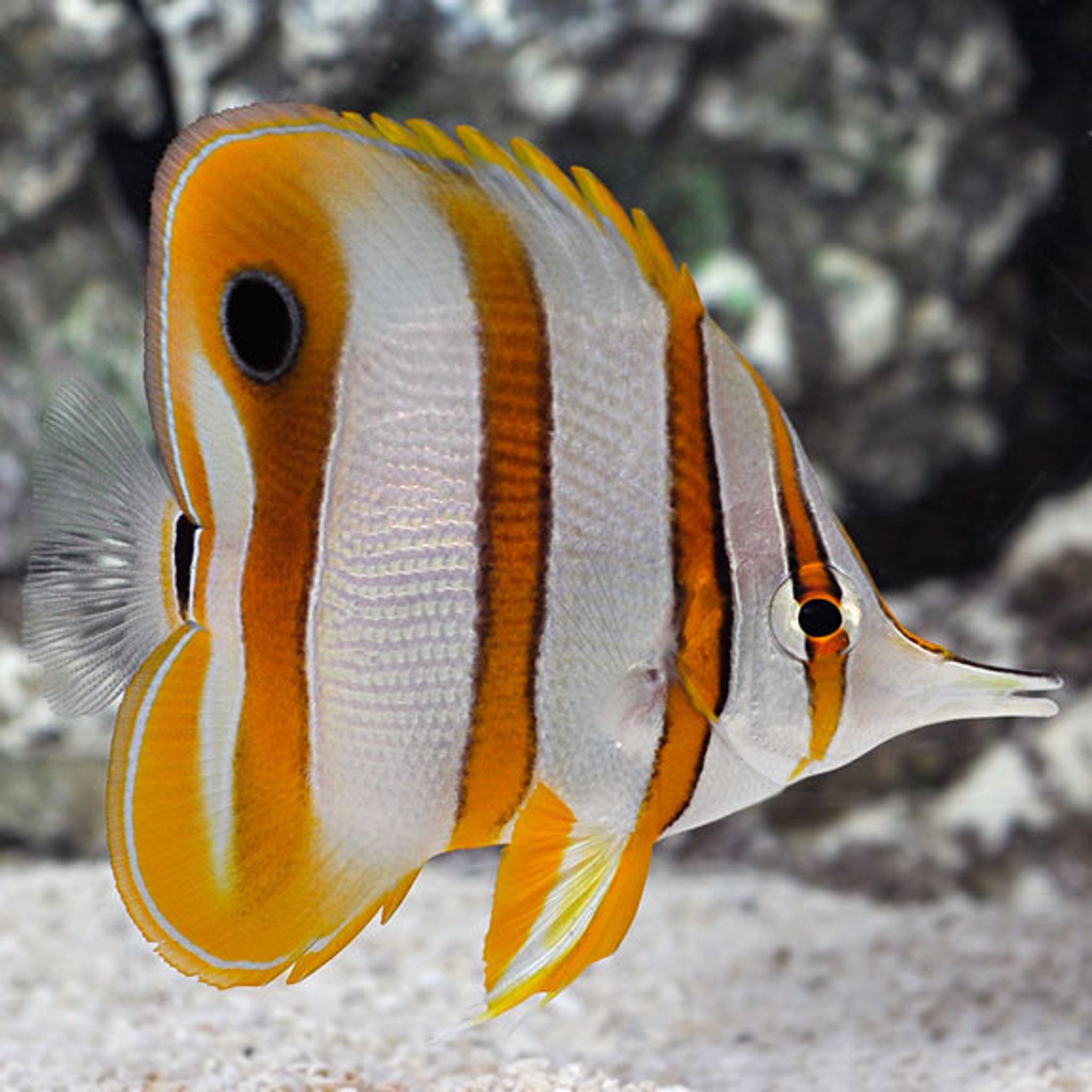

Is Copperband Butterflyfish Reef Safe? Coral and Invertebrate Compatibility Explained
The honest answer is "conditionally." The Copperband Butterflyfish (Chelmon rostratus) is not a guaranteed reef destroyer, but it isn't a guaranteed-safe planktivore either — its behavior around coral and invertebrates depends heavily on the individual fish, how well it's fed, and what it's housed with. This guide explains the mechanism behind that unpredictability and how to stack the odds in your favor.
Why "Reef Safe" Isn't a Simple Yes or No for This Fish
In the wild, Copperband Butterflyfish eat worms, small crustaceans, amphipods, zooplankton, and anemones — including Aiptasia. That diet makes them opportunistic omnivores, not obligate coral eaters and not strict planktivores either. Because their natural feeding strategy is "eat whatever edible thing is available," captive behavior varies from fish to fish depending on personality, hunger level, and what's on offer in the tank.
This is also why the species divides opinion. Some keepers report years of trouble-free coexistence with stony and soft corals; others report a fish that eventually starts picking at coral polyps or invertebrate flesh. Both experiences are real. The sensible take is to treat Copperband Butterflyfish as situationally reef safe: safer in large, mature, consistently fed reef systems without valuable clams or prized LPS, and riskier in small, underfed, or newly established tanks.
The Real Draw: Aiptasia Control (With a Catch)
Most reef keepers who buy a Copperband are hoping for natural Aiptasia anemone control. The fish's long, slender snout is well suited to reaching into rockwork crevices where Aiptasia hide, and many individuals do pick these pest anemones apart readily.
The catch: this is not a guaranteed outcome. Some Copperbands ignore Aiptasia completely, even when it's abundant. Treat Aiptasia control as a possible bonus, not a reason on its own to buy the fish — you should be prepared to keep it as a general reef inhabitant for years, whether or not it ever touches a single Aiptasia.
There's also a second-order risk: once the Aiptasia supply runs out, a fish that has learned to pick at things in the rockwork may shift that same searching, picking behavior toward coral polyps or invertebrates out of habit or hunger. This is one of the more commonly overlooked reasons a previously "reef safe" Copperband starts causing problems months after Aiptasia disappear.
Coral Risk: What Actually Gets Nipped
Most Copperband Butterflyfish leave stony coral colonies alone entirely. When problems occur, they tend to follow a pattern:
- Large-polyped stony (LPS) corals — brains, Acan-type corals, and open-brain (Trachyphyllia-type) corals are the most frequently reported targets, likely because their fleshy, exposed polyps resemble the anemone tissue this fish is adapted to eat.
- Soft coral polyps — occasional nipping is reported, usually secondary to LPS picking.
- Zoanthids — flagged as a higher-risk group alongside open-brain LPS.
- Small-polyped stony (SPS) corals, like Acropora, are nipped far less often, though isolated reports exist.
Because severity is individual-dependent, don't assume either extreme. Watch new coral additions closely for the first few weeks rather than assuming a "reef safe" reputation means guaranteed safety.
Coral Risk at a Glance
| Coral type | Typical risk level | Notes |
|---|---|---|
| SPS (e.g., Acropora) | Low | Nipping reported but uncommon |
| Soft corals | Low–moderate | Occasional polyp picking |
| LPS (brains, Acans) | Moderate | Among the most commonly nipped |
| Open-brain / Trachyphyllia-type LPS | Moderate–high | Fleshy tissue resembles natural prey |
| Zoanthids | Moderate–high | Flagged as a higher-risk group |
If you keep LPS hard corals, introduce them gradually and monitor each new piece rather than adding several at once.
Invertebrates: The Bigger Blind Spot
Reef keepers often focus on coral risk and overlook that invertebrates are the more frequent casualties with this species. Commonly reported targets include:
- Clam mantles — Copperbands are known to pick at exposed clam mantle tissue, making them a genuine risk in clam-focused reefs.
- Feather duster and tube worms — their exposed feeding crowns are an easy, anemone-like target.
- Small ornamental shrimp — particularly smaller, slower species.
- Non-Aiptasia anemones — any anemone with exposed tissue can be at risk, not just pest species.
If you're building a display around prized clams, feather dusters, or display anemones, factor this risk in before adding a Copperband — or accept that you'll need to watch those animals closely and be ready to remove the fish if problems start.
Tank Size and Water Parameters
Copperband Butterflyfish need room to forage and swim, plus mature live rock to graze on between meals.
- Minimum tank size: 75 gallons (284 L) for a single fish, treated as an absolute floor.
- Preferred tank size: 100+ gallons (379+ L) gives noticeably better long-term outcomes.
- Bonded pairs: 125+ gallons (473+ L).
- Tank maturity: avoid systems younger than about 6 months — a young, still-stabilizing tank stresses this species and can suppress its already-hesitant appetite.
Target reef-standard water parameters:
| Parameter | Target range |
|---|---|
| Temperature | 75–82°F (24–28°C) |
| pH | 8.1–8.4 |
| Specific gravity | 1.020–1.025 |
| dKH | 8–12 |
Stability matters more than any single number — swings in these parameters are a common trigger for stress-related feeding refusal in this species.
Feeding: The Single Biggest Factor in Reef Compatibility
Copperband Butterflyfish are notoriously shy, deliberate eaters that often refuse prepared foods at first. Feeding is also the most direct lever you have over coral- and invert-picking behavior: a consistently well-fed fish has far less incentive to forage on tankmates.
A workable feeding approach:
- During acclimation (first 2–4 weeks): offer live or frozen mysis shrimp, brine shrimp, and blackworms 2–3 times daily in small amounts, ideally at consistent times.
- Once established: taper toward 2 feedings a day of a varied diet — frozen mysis, high-protein pellets or flake, and occasional blackworms — while letting the fish continue grazing copepods and amphipods from live rock between meals.
- Throughout: keep offering variety rather than a single food type; a bored or monotonous diet can push a fish back toward picking at rock and coral surfaces.
Mature live rock stocked with copepods and amphipods gives the fish something to forage on constantly, which measurably reduces idle picking at coral polyps and invertebrates. This is also the biological reason behavior varies so much fish to fish: a facultative feeder with strong hunger drive and nothing else to eat will opportunistically sample whatever is available, while a well-fed, distracted fish rarely bothers.
Quarantine and Acclimation Best Practices
Because feeding difficulty is the leading cause of early death in this species — not coral or invertebrate aggression toward the fish — a deliberate quarantine and acclimation protocol matters more here than for most reef fish.
- Quarantine for roughly 4 weeks before adding to the display.
- Culture or seed the quarantine tank with copepods/amphipods to give the fish something to graze on while it adjusts.
- Confirm the fish is reliably eating prepared or frozen foods before placing it with expensive frozen-food-only or prepared-food-only reef stock.
- Acclimate slowly and minimize handling stress, since stressed Copperbands frequently stop eating altogether.
Choosing Butterflyfish for a Reef Tank
Reef safety across the butterflyfish family is a spectrum, not a single answer. It helps to think in three tiers when matching a species to your reef:
- Reef-safe planktivores — genus Hemitaurichthys (Pyramid Butterflyfish) and Bannerfish (Heniochus diphreutes) feed almost entirely in the water column and largely ignore coral. These are the safest choices for coral-dense, SPS-dominant tanks.
- Facultative/risky species — Copperband, Klein's, and Auriga Butterflyfish fall here: mostly reef-compatible but capable of nipping LPS, soft coral polyps, or invertebrates depending on the individual and feeding regimen.
- Unsafe or obligate corallivores — Ornate and Exquisite Butterflyfish eat almost nothing but coral polyps in the wild and typically starve in captivity; Raccoon Butterflyfish regularly eat coral and invertebrates and should be avoided in reef tanks altogether.
Match your choice to how strict your coral collection is. An SPS-dominant reef should lean toward tier 1 and avoid facultative species like the Copperband. A softie- or LPS-light reef, or a fish-with-live-rock (FOWLR) leaning system, has more tolerance for a facultative feeder.
Tankmates
Copperband Butterflyfish do best with peaceful community fish that won't compete aggressively for food or stress them into refusing to eat:
- Good tankmates: clownfish, gobies, dartfish, dottybacks, chromis, and dwarf angelfish.
- Avoid: other butterflyfish, including conspecifics — this species is territorial toward its own kind and close relatives.
- Avoid: overly aggressive or boisterous tankmates, since Copperbands are easily stressed and stop eating under pressure, which compounds the feeding difficulty already discussed above.
If you're stocking a peaceful reef community around a Copperband, clownfish are a commonly compatible starting point.
A Lower-Risk Alternative or Complement for Aiptasia
If your primary goal is Aiptasia control rather than owning a Copperband specifically, consider a dedicated Aiptasia-eating shrimp as a lower-risk option or a complement to the fish. Unlike a Copperband, a peppermint shrimp poses no risk to coral or clam mantles and doesn't require the same tank size, feeding difficulty, or long-term commitment. You can browse options among marine shrimp as a comparison point before committing to a Copperband purely for pest control.
Common Mistakes to Avoid
- Buying a Copperband solely to fix an Aiptasia outbreak without a backup plan for after the pest is gone (or if the fish never touches it).
- Undersized housing — adding one to a tank under 75–100 gallons or without mature live rock to forage on.
- Introducing it too early — placing it in a young or unstable reef where parameter swings quickly stress and starve the fish.
- Skipping quarantine — not confirming the fish eats before placing it with expensive prepared-food-only livestock.
- Assuming "reef safe" means "will never touch anything" — failing to watch new clams, feather dusters, and LPS closely after introduction.
- Underfeeding — infrequent feeding is one of the strongest predictors of coral and invertebrate picking.
- Housing with another butterflyfish or an overly boisterous tankmate, triggering stress-driven appetite loss.
Frequently Asked Questions
Will a Copperband Butterflyfish eat my coral?
Usually not entire colonies. Individual fish may nip at LPS corals or soft coral polyps, especially open-brain types and zoanthids, particularly if the fish is underfed. SPS corals are nipped far less often.
Is Copperband Butterflyfish good for Aiptasia control?
Often effective, but not guaranteed — some individuals ignore Aiptasia entirely. Treat it as a possible bonus rather than a certainty, and don't buy the fish for pest control alone without a plan to keep it long term regardless of outcome.
What's the minimum tank size for a Copperband Butterflyfish?
75 gallons (284 L) is the absolute minimum for a single fish, with 100+ gallons (379+ L) strongly recommended. A bonded pair needs 125+ gallons (473+ L).
Are Copperband Butterflyfish reef safe with clams?
This is riskier territory than hard coral. They're known to pick at exposed clam mantle tissue, so caution — or avoidance if you keep valuable clams — is wise.
Why won't my Copperband Butterflyfish eat?
They're shy, deliberate feeders that can be slow to accept prepared foods. Live rock fauna, varied live or frozen foods, low tank stress, and patience during a proper quarantine period all help. Confirming feeding before introduction to the display avoids compounding the problem.
Can Copperband Butterflyfish live with other butterflyfish?
Generally not recommended. They can be territorial toward conspecifics and similar butterflyfish species, and the resulting stress can suppress feeding.
What are truly reef-safe butterflyfish alternatives?
Pyramid Butterflyfish and Bannerfish species (genus Hemitaurichthys and Heniochus) are considered the safest choices — they're water-column planktivores that largely ignore coral.
How long can a Copperband Butterflyfish live in a reef tank?
With stable, mature water parameters and consistent feeding, they can live for years in a reef setting. Poor feeding and acclimation, not coral aggression toward the fish, is the main cause of early death in this species.
Ready to plan your stock list? Browse butterflyfish on FishyHub to compare species and find one suited to your reef's coral mix.


