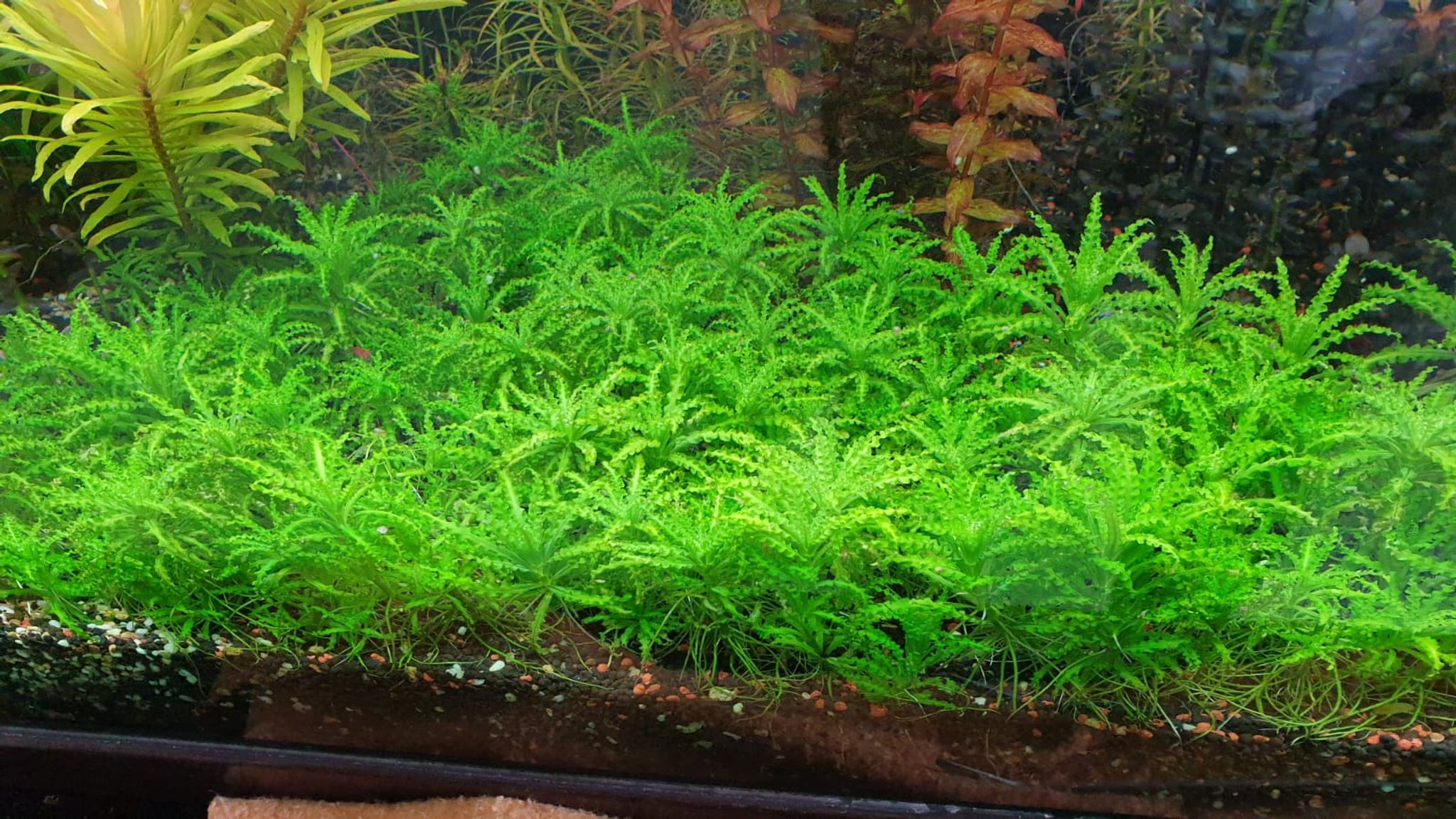

How to Plant and Propagate Subwassertang in a Freshwater Aquarium
Subwassertang has no roots, so "planting" it really means tying or gluing a clump to hardscape until it fuses in place. This guide covers realistic water parameters, the exact tying method, and a foolproof division process for turning one clump into a full mat or a moss wall.
What Is Subwassertang, Really?
Despite how it looks and how it's usually sold, subwassertang (also called süsswassertang, German for "freshwater seaweed") is not a moss and not a liverwort. It is the gametophyte — the juvenile, non-flowering — stage of a climbing fern related to the genus Lomariopsis. That's why it has no roots, no true stems, and no true leaves: just flat, translucent-green thalli that fork and branch like a ribbon.
A few practical consequences follow from this identity:
- It never produces spores or seeds in aquarium conditions. The only way to multiply it is physical division.
- Every specimen in the hobby traces back to a single clone, first collected in Taiwan in the early 2000s. That means no varietal differences to shop for, but also that any disease or pest susceptibility is identical across every piece of it worldwide — there's no "hardier strain" to switch to if something goes wrong.
- Because it's a fern gametophyte and not a moss, care techniques borrowed from true mosses (like tying to netting) still work, but expectations around growth and attachment are a little different, as covered below.
Water Parameters That Actually Work
Sources online quote a wide spread of numbers for this plant. Here's a consolidated set of ranges that reflects the consensus rather than any single extreme:
| Parameter | Tolerable range | Best growth |
|---|---|---|
| Temperature | 60–80°F (15–27°C) | 68–75°F (20–24°C) |
| pH | 6.0–7.5 (up to 8.0 tolerated) | 6.5–7.2 |
| General hardness (GH) | 0–8 dGH ideal, adapts higher | 2–6 dGH |
| Lighting | Low to medium | Medium, non-intense |
| Flow | Low to gentle | Low, indirect |
| Tank size | 2.5 gallons (9.5 L) and up | No upper limit |
A few notes worth expanding on:
- Temperature matters more than most people expect. Growth stalls noticeably above roughly 78–80°F, which makes subwassertang a genuinely good option for unheated or coldwater/goldfish-adjacent setups, not just tropical tanks.
- Lighting is where people most often go wrong. Subwassertang survives fine under low light — it's a solid choice for a low-tech beginner tank — but grows faster and denser under medium light. Push into high-intensity, high-PAR territory and the fronds can bleach or melt, and because the plant has no real defense against epiphytic growth, algae tends to colonize the surface of a struggling clump quickly. A basic light with a dimmable setting from the lighting category gives you more control than a fixed-output unit.
- Flow should be gentle. Strong current physically shreds the thin fronds into loose fragments — not always a disaster since fragments can become new plants, but it looks messy and makes trimming harder to control.
- CO2 and fertilizer are optional. Subwassertang does fine in a low-tech tank running on nothing but fish or shrimp waste. If you already dose liquid or pressurized CO2 for other plants, it's a bonus, not a requirement. One caution: glutaraldehyde-based liquid-carbon products can burn or kill the fronds, so dose carefully and avoid concentrating it directly over a dense mat.
Two Ways to Keep It: Floating vs. Anchored
Because it has no roots or holdfasts, subwassertang can be kept two fundamentally different ways.
Floating
Letting a clump drift as a loose mat at the surface is the lowest-effort option and a favorite in fry and shrimp tanks, where it functions as a hiding cushion and biofilm-grazing surface for babies.
- Pros: zero tying required, easy to net out and split, dense cover right where fry and shrimp need it.
- Cons: shades whatever is growing underneath, can block light from reaching a planted foreground, and drifts into filter intakes if not corralled.
Anchored
Tying or gluing a clump to hardscape gives you a controlled, aquascape-style look — a moss wall, a "tree" of climbing fronds on driftwood, or a low carpet across a flat stone.
- Pros: predictable placement, doesn't shade other plants, looks intentional in a designed layout.
- Cons: requires tying, has a slower-looking start while it's still attaching, and needs periodic trimming to keep its shape.
Many tanks use both: a floating mat in a corner for shrimp cover, plus an anchored patch on the main hardscape for the display.
How to Plant (Attach) Subwassertang Step by Step
Subwassertang can't be pushed into substrate like a rooted plant — it has no rhizoids, so burying it will smother the fronds and kill the tissue that isn't getting light or flow. Instead:
- Start with a clump roughly the size of a golf ball to a tennis ball. Smaller wisps work but take longer to establish visibly.
- Wedge it into a crevice in driftwood or lava rock, or spread it thin across a flat piece of slate or rock.
- Secure it loosely with cotton thread, fine fishing line, or a dab of plant-safe cyanoacrylate glue gel at just a few contact points. Don't wrap it tightly — the fronds need open water flow across both sides to photosynthesize.
- Consider alternative mounts for specific goals: tuck it into fine mesh or canvas to build a moss wall, wedge it into rockwork crevices, or attach it to a suction-cup mesh pad or ledge if you want a piece you can reposition later.
- Treat the tie or glue as permanent support, not training wheels. Unlike anubias or java fern, subwassertang never develops true root-like holdfasts. Over several months it will mat itself onto rough surfaces and become harder to dislodge, but the original thread or glue point is still doing real work indefinitely.
What to Expect After Planting
Give it time before judging the attempt. A freshly tied clump typically looks static — sometimes even slightly worse — for the first two to four weeks as it adjusts to its new spot. This is normal acclimation, not failure. Signs of a successful attachment: fronds staying bright green, new growth visible at the cut or tied edges, and the mass gradually thickening rather than thinning. Signs it's failing: browning from the inside out, fronds detaching in sheets rather than growing outward, or a slimy texture developing at the tie points.
How to Propagate Subwassertang
Division is the only propagation method used in the hobby, and it's about as close to foolproof as aquarium plants get — any fragment with living tissue can start a new colony.
- Wait for a healthy, established mother clump. Don't divide a piece that's still in its own acclimation window.
- Cut or gently pull the mass apart with clean scissors or by hand. Pieces roughly 1–2 inches (2.5–5 cm) across survive and bulk up fastest; smaller fragments still work but take noticeably longer to look like anything.
- Re-tie or press each new piece onto its own hardscape, or simply let some pieces float, using the same attachment method described above.
- New fronds emerge from the cut edges. If divided pieces are left touching on the same surface, they'll fuse back into one continuous mat over time.
- No node, growth tip, or hormone treatment is needed. This is what makes subwassertang genuinely beginner-friendly to multiply — there's no "wrong" place to cut it.
Growth speed after division follows the same pattern as after initial planting: a slow first few weeks, then a moderate-to-fast expansion once the piece settles in, sped up by cooler water and medium light.
Trimming and Ongoing Maintenance
- Trim overgrown mats with sharp, ideally curved, scissors. Turning the filter off briefly during a trim keeps loose clippings from getting pulled into the intake.
- Gently rinse or siphon detritus that collects between dense fronds during water changes — a thick, untouched mat traps mulm in its interior, which leads to brown, dying patches that are hard to spot from the outside.
- Collect floating trimmings promptly. Any stray fragment that settles somewhere in the tank will start growing there, which is great if you want more plants and less great if you didn't plan a colony behind the filter.
- Skip root fertilizer entirely. Subwassertang has no roots, so tabs pushed into substrate do nothing for it — all its nutrition comes from the water column.
Ideal Tanks and Tank Mates
Subwassertang fits a wide range of setups, but it particularly shines in:
- Shrimp tanks — its dense structure and large surface area make it one of the best biofilm-grazing and hiding surfaces for cherry, bee, and crystal shrimp, especially for molting adults and newly hatched young.
- Breeder and fry tanks — livebearer and egg-scattering fry use it as nursery cover.
- Nano tanks — its small footprint and tolerance for a range of conditions suit compact setups.
- Moss walls — meshed or tied flat across a background panel for a dense green backdrop.
- Coldwater and unheated tanks — its tolerance for cooler water makes it a rare plant option for goldfish-adjacent or unheated setups (though see the caveat below).
Good tank mates: dwarf shrimp of all kinds, peaceful nano fish like tetras, rasboras, and small catfish or otocinclus, and fry from livebearers or egg scatterers. Shoppers can browse compatible species in the shrimp category or small community fish category.
Poor fit: large cichlids, crayfish, and other substrate diggers that uproot hardscape, plus goldfish and other large omnivores that will graze the soft fronds down to nothing.
Buying and Sourcing Tips
A healthy portion should be bright, even green with no slimy texture or brown patches. Avoid clumps with a sour smell or fronds that separate at the slightest touch — that usually indicates tissue that's already dying.
Because the tissue is so thin and fragile, skip harsh quarantine methods. Bleach dips and heavy chemical treatments used on hardier plants will kill subwassertang outright. A short freshwater rinse combined with a careful manual inspection for pests is a safer way to quarantine a new portion before adding it to an established tank.
Common Mistakes to Avoid
| Mistake | Why it's a problem | Fix |
|---|---|---|
| Tying too tightly or burying in substrate | Smothers thin fronds that need flow on both sides | Tie loosely at a few points only |
| High flow or placement under a powerhead outflow | Shreds fronds into scattered fragments | Position in low-flow zones |
| Very intense/high-PAR lighting | Causes melting, bleaching, and algae on fronds | Use low-to-medium, non-intense light |
| Letting detritus build up inside a thick mat | Causes brown, rotting interior patches | Gently rinse or siphon during water changes |
| Bleach or heavy chemical quarantine dips | Kills the thin tissue outright | Use freshwater rinse and manual inspection instead |
| Assuming it needs root fertilizer | It has no roots — tabs do nothing | Rely on water-column nutrients only |
| Housing with goldfish or large grazers | Fish eat the soft fronds down to nothing | Keep with shrimp and small peaceful fish instead |
Frequently Asked Questions
Is subwassertang a moss?
No. It's the gametophyte stage of a climbing fern, not a true moss or liverwort. It's cared for similarly to aquarium mosses and looks the part, but its biology and lack of roots are different.
Does subwassertang need CO2 or fertilizer?
No. It grows fine in a low-tech tank off fish or shrimp waste alone. Light CO2 and mild fertilization will speed up growth if you're already running them for other plants, but neither is required.
How do you attach subwassertang without roots?
Tie it loosely to driftwood or rock with cotton thread or fine fishing line, dab it on with aquarium-safe cyanoacrylate glue gel, or skip attachment entirely and let it float as a loose mat.
How fast does subwassertang grow?
Expect a slow, sometimes stalled first two to four weeks after planting or dividing while it adjusts. Growth then picks up to moderate or fast, especially under medium light and cooler, moderate temperatures.
Can subwassertang live in a coldwater or unheated tank?
Yes. It tolerates cooler temperatures well and is one of the few plant options suited to unheated or goldfish-adjacent setups — just note that goldfish will eat the soft fronds if kept together.
How do you propagate subwassertang?
Cut or gently pull an established mass into pieces roughly 1–2 inches (2.5–5 cm) across, then re-tie or attach each piece to new hardscape or let it float. No special cutting technique or growth node is required.
Why is my subwassertang turning brown or melting?
The usual causes are too much light or heat, poor flow that lets detritus build up inside the mat, or a sudden swing in water parameters. Trim away the affected sections and address the underlying condition rather than waiting for it to recover on its own.
Is subwassertang good for a shrimp tank?
Yes — it's considered one of the best plants for shrimp tanks thanks to its large surface area for biofilm grazing and its dense structure for hiding molting adults and newly hatched young.
Once you've got a clump established, browse the full range of nano-tank-friendly plants and hardscape for shrimp and fry setups in the shrimp category on FishyHub.


