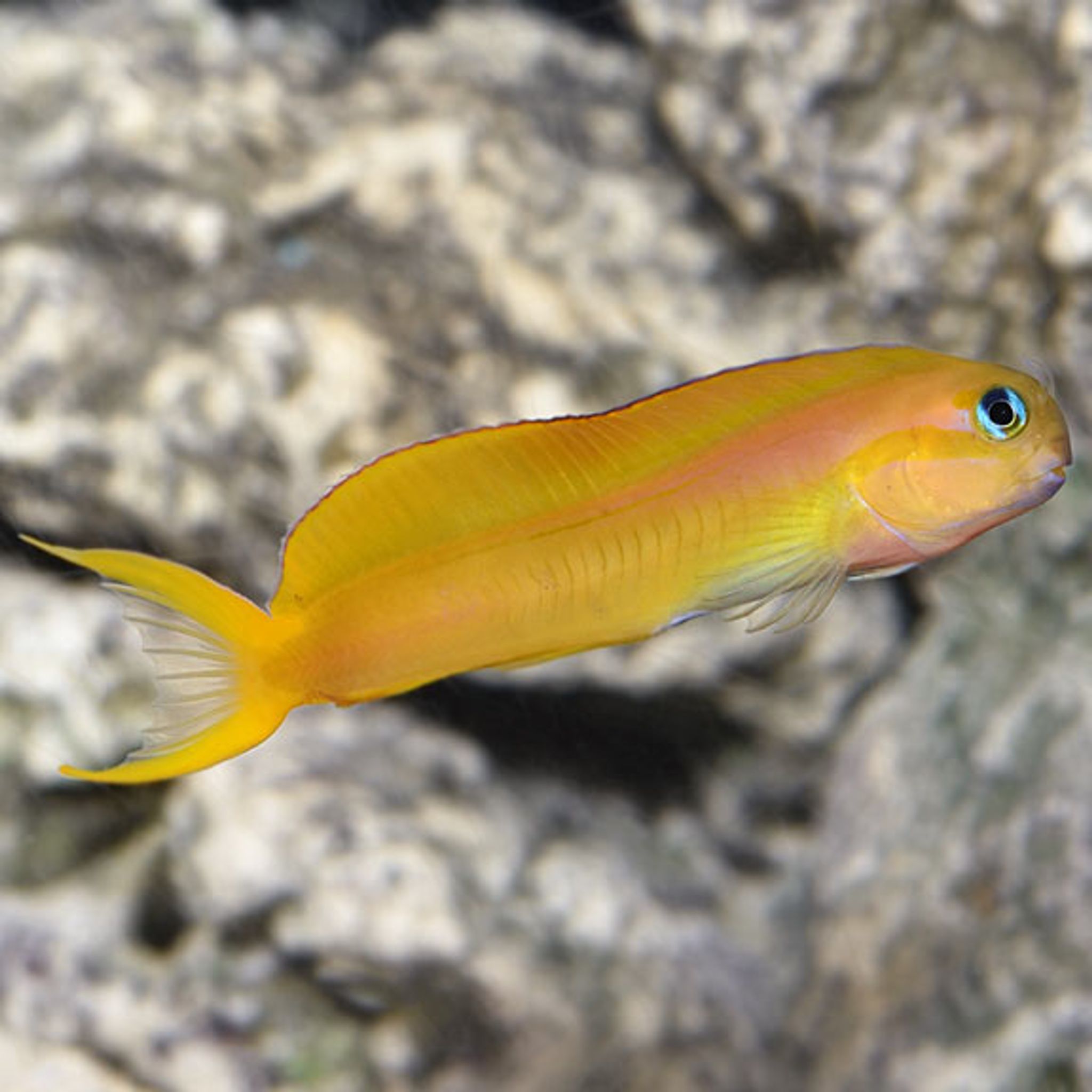

How to Feed Midas Blenny: Foods, Frequency and Common Feeding Problems
A Midas blenny needs more than herbivore flakes to stay healthy and hold its bright golden color. This guide covers the exact foods to rotate, how many times a day to feed, portion sizes, and how to solve the feeding problems that come up most — refusal, weight loss, and food-guarding.
Why Midas Blenny Feeding Is Different From Other Blennies
Most blennies in the hobby are rock-grazers that pick algae film off live rock most of the day. The Midas blenny (Ecsenius midas) breaks that pattern. In the wild it schools mid-water alongside anthias, darting out to snatch drifting zooplankton rather than parking on rock and grazing.
That means it behaves like a planktivore with omnivore leanings, not a dependable algae eater. Some care sheets describe it as primarily a plant eater with meaty food as a bonus; others call it a fish that needs a meaty diet with algae as an afterthought. The realistic middle ground: treat it as an omnivore skewed toward carnivorous, and build the week around meaty frozen foods with algae-based foods in a supporting role.
Best Foods for a Midas Blenny
Meaty foods (the backbone of the diet)
These should make up most of the weekly menu:
- Mysis shrimp — a staple frozen food sized well for this fish's mouth
- Vitamin- or HUFA-enriched brine shrimp — enrichment boosts nutritional value beyond plain brine shrimp
- Finely chopped clam, mussel, or a marine seafood mix — good protein variety
- Krill (chopped small enough to swallow easily)
- Copepod or cyclops-type foods — closer to the wild diet's zooplankton profile
Plant-based foods (supplement, not sole diet)
- Spirulina flakes or pellets
- Dried seaweed sheets clipped in the tank
- Marine algae blends and other herbivore preparations
These fill a real nutritional gap but should not replace the meaty rotation — a Midas blenny fed only algae-based food over time tends to lose condition.
Prepared foods as a convenient base
A high-quality marine flake or small pellet with strong marine-protein content (fish, krill, or squid meal listed near the top of the ingredients) works well as a base food between frozen feedings. It's not a substitute for frozen foods, but it fills gaps on busy days and adds variety.
If you're stocking up, both frozen and dry marine foods, along with the fish itself, can be browsed in FishyHub's Blennies and Food & Supplements categories.
How Often and How Much to Feed
Feed 2–3 small meals a day rather than one large one. This fish is a high-energy, constantly active swimmer, and its metabolism runs closer to a reef fish that grazes continuously than a sedentary bottom-dweller.
Portion rule: offer only what disappears within about 2 minutes. Anything left after that is overfeeding and will foul the water. As a rough sizing guide relative to the fish's own body:
| Feeding | Approximate portion | Notes |
|---|---|---|
| Morning | A pinch equal to roughly the fish's eye size in volume | Meaty food (mysis or enriched brine shrimp) |
| Midday | Similar small pinch | Alternate meaty and algae-based food |
| Evening | Similar small pinch | Include a flake/pellet base food if frozen wasn't offered earlier |
Scale portions up slightly for a larger, established adult and down for a recently added juvenile still settling in.
Feed the water column, not just the rocks
Because this fish expects food to drift past mid-tank the way it would in a wild plankton cloud, dropping food only near the rockwork or substrate often means it misses the meal entirely. Broadcast frozen food gently across the middle of the water column, in more than one spot if the tank is large, so it drifts down naturally instead of sinking straight to one pile.
Enrichment for Color and Health
Soaking frozen foods in a vitamin or HUFA (highly unsaturated fatty acid) supplement before feeding improves overall condition and supports the vivid yellow coloration this fish is prized for. Consistent, varied, enrichment-soaked feeding is really the main lever a hobbyist has over color retention — a fish fed the same plain food every day, with no enrichment or variety, tends to look duller over time even without any obvious illness.
A Sample 7-Day Feeding Rotation
Because most care guides don't spell out a concrete schedule, here's a practical week that keeps the diet balanced without much daily thinking:
| Day | Morning | Midday | Evening |
|---|---|---|---|
| Mon | Enriched brine shrimp | Marine flake/pellet | Mysis shrimp |
| Tue | Mysis shrimp | Dried seaweed sheet | Marine flake/pellet |
| Wed | Chopped clam/mussel mix | Marine flake/pellet | Enriched brine shrimp |
| Thu | Krill (chopped) | Spirulina pellet | Mysis shrimp |
| Fri | Copepod/cyclops blend | Marine flake/pellet | Enriched brine shrimp |
| Sat | Mysis shrimp | Dried seaweed sheet | Chopped seafood mix |
| Sun | Enriched brine shrimp | Marine flake/pellet | Krill (chopped) |
This gives roughly 5 days a week anchored on meaty foods with algae-based foods rotated in 2–3 days a week, matching the omnivore-skewed-carnivorous approach.
Feeding in a Reef Tank vs. a Fish-Only Tank
A Midas blenny in an established reef tank has an advantage most fish-only setups don't: incidental grazing on live rock pods, amphipods, and film algae throughout the day. That natural snacking reduces (but doesn't eliminate) the need for extra feedings — reef-tank keepers can often stick to the lower end of the 2–3 feedings/day range, while fish-only tank owners should stay consistent with all scheduled feedings since there's no pod population to fall back on.
Reef caution: a Midas blenny that is genuinely underfed may start picking at coral polyps or clam mantles out of hunger. This isn't typical behavior for a well-fed fish, but it's a real risk if feedings are skipped or portions are too small — another reason not to treat this species as a "set and forget" grazer in a reef system.
Common Feeding Mistakes
- Flake/pellet only, no frozen food — leads to poor color and a thinner body over time.
- One large feeding instead of several small ones — spikes waste and lets faster fish steal most of the food.
- Dropping food only on rock or substrate — misses this fish's mid-water feeding instinct.
- Not watching mixed-species tanks at feeding time — a Midas blenny is a fast, assertive eater that can out-compete slower tankmates like small gobies or firefish, leaving them underfed.
- Assuming a newly arrived fish is sick because it's hiding and not eating — normal post-shipping stress can last several days; only worry if it persists beyond a week.
- Ignoring a pinched-belly look despite apparent eating — can point to internal parasites, especially alongside stringy white feces or ongoing weight loss.
- Leaving the tank uncovered — feeding-time excitement is a classic trigger for jumping in this species.
- Underfeeding copepods/rotifers when raising fry — larval starvation is a common reason breeding attempts fail for advanced hobbyists.
Tank Setup That Supports Good Feeding
Feeding success is tied to the environment, not just the food:
- Tank size: a minimum of about 30 gallons (114 L) for a single fish, with 40–50+ gallons (151–189+ L) recommended to reduce food-competition aggression toward tankmates. A pair needs roughly 90 gallons (341 L) or more and is rarely attempted since Midas blennies are usually kept solitary.
- Water parameters: temperature 72–78°F (22–26°C), pH 8.1–8.4, specific gravity 1.020–1.025. Stable parameters support a healthy appetite; swings often suppress feeding response before any other symptom shows.
- A tight-fitting lid is essential given this species' well-known jumping tendency.
- New reef keepers should have a fully cycled tank with stable parameters and established live rock, and ideally some experience with hardier soft corals, before adding a Midas blenny. Regular testing of ammonia, nitrite, nitrate, and pH protects both the fish's appetite and coral health, since uneaten food is one of the most common nutrient-spike sources in a newer tank.
- New arrivals often look darker or duller and stay low or hidden for the first several days after shipping stress. Color and appetite typically normalize within days with a slow drip acclimation and a quiet, cave-rich space to settle into.
Frequently Asked Questions
What do Midas blennies eat in the wild vs. in captivity?
In the wild, their diet is mostly zooplankton picked out of the water column, with some opportunistic algae grazing. In captivity, mirror that with mysis or brine shrimp as the backbone and algae-based foods worked in, rather than feeding a purely herbivore diet.
How often should I feed a Midas blenny?
Feed 2–3 small meals a day, offering only as much as the fish clears in about 2 minutes each time. More frequent, smaller meals suit its active metabolism better than one large feeding.
Will a Midas blenny eat algae off my rocks?
It will pick at film algae opportunistically, but it isn't a reliable algae-control fish. Don't add one expecting it to manage a nuisance algae problem on its own.
Why is my Midas blenny not eating?
The most common causes are recent transport stress, unstable water parameters (ammonia, salinity, or temperature swings), or bullying from tankmates. Check your parameters, provide a quiet space with cover, and give the fish a few days before assuming a health issue.
Can Midas blennies be kept in pairs?
They're generally best kept singly because of aggression toward their own species. A pair can sometimes work in a large tank of 90 gallons (341 L) or more if both fish are introduced together as juveniles.
Why does my Midas blenny attack other fish at feeding time?
This is usually territorial or food-guarding behavior, and it's more common in tanks under about 40 gallons (151 L). Adding more rockwork and caves, and spreading food across multiple spots in the tank, usually reduces the aggression.
Is frozen food or flake/pellet better for a Midas blenny?
Neither alone covers everything this fish needs. Use frozen foods like mysis and enriched brine shrimp as the backbone of the diet, and rotate in a quality marine flake or pellet plus algae sheets for convenience and variety.
Do Midas blennies jump out of tanks?
Yes — it's a well-documented jumping risk, especially when excited during feeding. A tight-fitting lid isn't optional for this species.
Ready to add one to your setup or restock its feeding supplies? Browse live Midas blennies and other marine fish in FishyHub's Marine Fish category, along with frozen and freeze-dried options in Freeze Dried Food.


