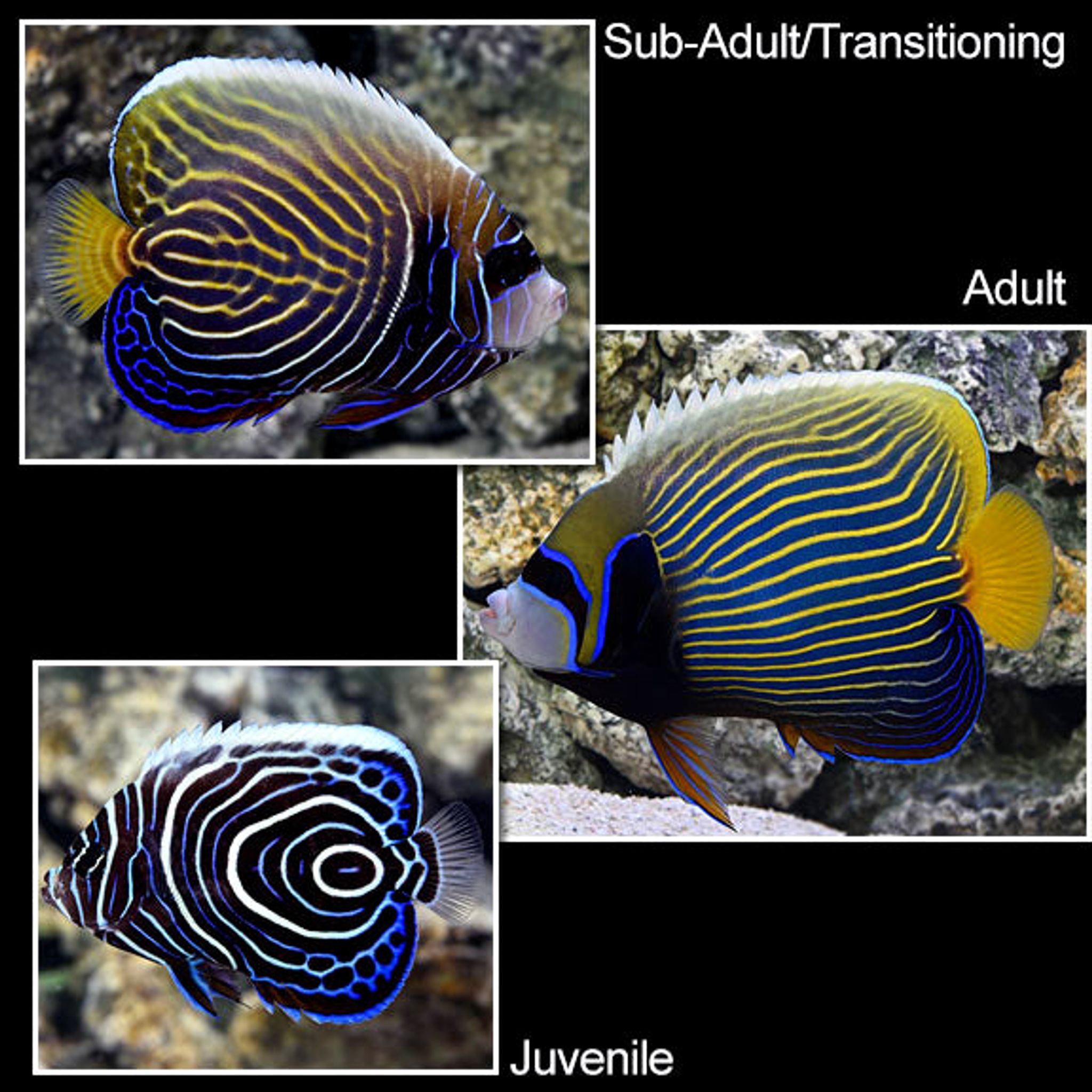

How to Feed Emperor Angelfish: Foods, Frequency and Common Feeding Problems
Emperor Angelfish (Pomacanthus imperator) are more diet-sensitive than most marine omnivores because their wild feeding revolves around sponges, not flake or pellet. This guide covers exactly what to feed, how often, how much as the fish grows, and how to troubleshoot the most common feeding problems — from picky new arrivals to unexplained wasting.
Why This Species Is Different From a Typical Reef Omnivore
In the wild, Emperor Angelfish spend most of their grazing time picking at sponges and tunicates, with algae and a few other invertebrates rounding out the diet. That's a narrower, more specialized menu than a generic reef omnivore like a damselfish or a dottyback, which will happily eat almost anything offered. A captive diet that ignores this — relying only on flake and pellet — tends to work in the short term but produces problems months down the line: dull coloration, weight loss, and higher susceptibility to disease.
The practical takeaway is that Emperor Angelfish need a diet built around three pillars, not one:
- Meaty protein for growth and energy
- Algae and plant matter for digestion and natural grazing behavior
- Sponge material specifically for long-term coloration and immune health
What to Feed: Building a Complete Diet
Protein Sources
Offer a rotating mix rather than the same cube every day:
- Mysis shrimp
- Chopped clam, mussel, and scallop
- Squid and prawn
- Krill
- Other marine fish flesh
Avoid freshwater feeder fish and fatty mammal or bird meat — neither matches the fatty-acid profile a marine angelfish needs, and feeder fish carry disease risk.
Algae and Plant Sources
- Nori or dried seaweed sheets clipped to a feeding clip
- Marine algae sheets
- Spirulina-enriched foods
- Blanched zucchini or broccoli as an occasional supplement
Sponge-Based Foods
A prepared frozen or gel food that contains real sponge material is the single biggest differentiator between a diet that merely keeps an Emperor Angelfish alive and one that keeps it vibrant long-term. It's the closest captive analog to their dominant wild food source, and its absence is the most common hidden cause of gradual color fading and wasting in otherwise well-fed specimens.
That said, a sponge-formula food isn't an absolute requirement from day one. If a new fish is barely eating anything, the priority is getting it to accept any varied food first — mysis, clam, nori — and then work sponge-inclusive foods into the rotation as the fish stabilizes. Think of sponge content as strongly recommended for the long haul rather than a mandatory first bite.
Flake and Pellet
A high-quality marine flake or pellet formulated for angelfish and butterflyfish is a fine supplement to fill in nutritional gaps between feedings, but it should never be the sole diet. You can browse dedicated marine feeding options, including freeze-dried food, to round out a rotation.
Sponge-Based vs. General Omnivore Diets
It helps to think of Emperor Angelfish feeding on a spectrum rather than a single "correct" answer:
| Diet style | Pros | Cons | Best used |
|---|---|---|---|
| Sponge-forward (sponge gel/frozen food as a regular staple, plus algae and meaty variety) | Mimics wild feeding, supports long-term color and immune health | Sponge-specific products can be harder to source and pricier | Once the fish is established and eating reliably |
| General omnivore (clam, mussel, shrimp, nori, algae, no dedicated sponge product) | Easy to source, keeps most fish eating and growing short-term | Risks slow nutritional gaps — dulling color, thinner condition over months | New arrivals, quarantine, or as a bridge while transitioning |
The sensible approach is to blend both, shifting the weighting toward sponge and algae content as the fish matures and settles in, rather than treating it as an either/or choice.
Feeding Frequency and Portion Size
How Often to Feed
Emperor Angelfish do best on 2–3 small-to-moderate feedings per day rather than one large meal. Their high metabolism and natural grazing behavior — constant small bites of sponge and algae throughout the day in the wild — make frequent small meals more natural than one or two large sittings. This holds true for both juveniles and adults; general reef-fish advice that suggests once or twice daily is adequate for established reef fish is aimed at less specialized grazers and doesn't fully apply here. Only scale back frequency if body condition and water quality suggest you're overfeeding.
Feed at consistent times each day. A predictable schedule reduces stress and works especially well for a food-motivated, territorial species that quickly learns when and where to expect a meal.
How Much to Feed
Offer only what the fish (and any tankmates) can finish within about 2 to 5 minutes. Anything left over should be siphoned or netted out promptly — Emperor Angelfish are a large-bodied species, and adults kept in the 220+ gallon (830+ liter) systems they eventually need produce a heavy bioload. Leftover food breaks down fast and pushes ammonia and nitrate up quickly in a tank that size.
Portion Scaling by Size
Frequency stays roughly the same from juvenile to adult, but the volume per feeding needs to grow with the fish. As a rough guide:
| Size | Approx. length | Feeding guidance |
|---|---|---|
| Juvenile | 2–4 in (5–10 cm) | Small pinches of finely chopped food, 2–3x daily |
| Sub-adult | 5–9 in (13–23 cm) | Moderate portions, still consumed in 2–5 minutes |
| Adult | Up to ~15 in (38 cm) | Larger absolute volume per feeding; same 2–3x daily schedule |
Boosting Appetite and Immunity: The Vitamin Soak
Soaking frozen or gel foods in a vitamin or garlic-based supplement before feeding is a widely used technique to support immune function and stimulate appetite, particularly in new or stressed fish. A practical routine: soak the thawed food for 5–10 minutes, 2–3 times per week, rather than every feeding. This gives a meaningful boost without becoming an unnecessary daily chore.
Weaning a Picky New Arrival: Step by Step
New and wild-caught Emperor Angelfish are frequently reluctant eaters, which is why buying a tank-raised or already-established, quarantined specimen that's already eating a varied diet significantly lowers acclimation risk. If you're working with a fish that isn't eating well yet, a gradual approach works better than throwing the full target diet at it immediately:
- Start with live or frozen mysis shrimp. It's highly attractive and usually the easiest first food to trigger a feeding response.
- Move to other frozen/gel foods (chopped clam, mussel, squid) once the fish is reliably taking mysis.
- Introduce algae sheets and sponge-based foods gradually, offered alongside foods the fish already accepts rather than as a sudden swap.
- Settle into a full rotation across proteins, algae, and sponge content once the fish is feeding confidently every day.
Feed at lights-out or in low light during this early period — many new arrivals feel less exposed and are more willing to come out and eat when the tank is dimmer.
Quarantine-Period Feeding Checklist
Quarantine is a high-risk window where hobbyists commonly lose Emperor Angelfish to slow starvation because the fish is stressed and the feeding routine isn't dialed in yet. During quarantine:
- Offer food 2–3 times daily even if early attempts are refused — don't reduce frequency to "avoid waste" during this period.
- Try live mysis or brine shrimp first if the fish is completely refusing frozen food.
- Keep lighting dim and minimize disturbance around feeding times.
- Watch for actual consumption, not just food disappearing (tankmates or filtration can remove uneaten food and mask a feeding problem).
- Move to vitamin-soaked foods once the fish accepts anything reliably, to support immune recovery.
Common Feeding Problems and Fixes
| Problem | Likely cause | Fix |
|---|---|---|
| New fish won't eat at all | Stress, unfamiliar food, feels exposed | Try live/frozen mysis, feed in low light, soak food in a garlic/vitamin supplement |
| Fish hides and doesn't come out | Insufficient rockwork, aggressive tankmates, new-tank stress | Improve hiding spots and reduce competition before assuming it's a food issue |
| Established fish suddenly stops eating | Water quality problem or illness (e.g., marine ich or velvet) | Test water parameters and check for disease signs first, before changing diet |
| Fish eats well but looks thin or "wasting" | Diet lacks sufficient sponge/algae content despite accepting meaty foods | Add sponge-based and algae foods to the rotation, not just more volume |
| Aggression toward tankmates at feeding time | Territorial, food-motivated behavior, especially toward other angelfish | Spread food across multiple points in the tank to reduce competition |
| Overfeeding, cloudy water, algae blooms | Portions too large or uneaten food left in tank | Feed only what's consumed in 2–5 minutes; siphon leftovers promptly |
| Dull adult coloration despite regular feeding | Poor nutrition during growth phase, missing sponge/algae component | Rebalance diet toward sponge and algae sources; color recovery is gradual |
Feeding, Coral Nipping and Reef Tanks
Emperor Angelfish have a reputation for nipping large-polyp stony corals, clam mantles, and soft coral tissue, which partly traces back to their natural diet of sessile invertebrates. A varied, sponge- and algae-rich diet can reduce this tendency — a well-fed fish is less likely to go looking for alternative food sources in the rockwork — but it won't eliminate the risk entirely. If you're considering an Emperor Angelfish for a reef system alongside coral, weigh that natural feeding instinct into your stocking plan rather than relying on diet alone to prevent nipping.
Frequently Asked Questions
What do Emperor Angelfish eat in the wild?
Primarily sponges and tunicates, with algae making up a smaller portion of the diet. They're best described as a spongivore-leaning omnivore rather than a generalist grazer.
How often should I feed my Emperor Angelfish?
Feed 2–3 times daily in small portions that are fully consumed within a few minutes. Keep the schedule consistent from day to day to reduce stress and support natural grazing behavior.
Do Emperor Angelfish need sponge-specific food?
It's strongly recommended for long-term health and coloration, since sponge material makes up most of their wild diet. It doesn't have to be the first food a new fish accepts, but it should become part of the regular rotation.
Why isn't my Emperor Angelfish eating?
The most common causes are new-arrival stress, competition or bullying from tankmates, unfamiliar food type or size, and lighting that leaves the fish feeling exposed. Rule out illness and water quality issues as well, especially if a previously eating fish suddenly stops.
Can Emperor Angelfish be fed only pellets or flakes?
Not as a long-term diet. They need meaty foods like mysis, clam, and squid, plant/algae sources like nori and spirulina, and ideally sponge content — pellets and flakes work best as a supplement, not the foundation.
How much should I feed an adult Emperor Angelfish?
Offer enough that it's consumed within about 2–5 minutes, 2–3 times a day. As the fish grows toward its adult size of roughly 15 inches (38 cm), increase the portion size per feeding rather than the number of feedings.
Are Emperor Angelfish reef safe regarding feeding on corals?
They have a known tendency to nip large-polyp stony corals, clam mantles, and soft coral tissue, linked to their natural diet of sessile invertebrates. A varied, sponge/algae-rich diet can reduce this behavior but won't guarantee reef safety.
How long can an Emperor Angelfish go without eating?
A healthy adult can typically tolerate a few days without food without lasting harm. If refusal continues beyond about a week, investigate stress, illness, or water quality rather than waiting it out.
Ready to add an Emperor Angelfish to your system, or upgrade tankmates that can handle its eventual size? Browse Large Marine Angelfish on FishyHub, along with marine feeding supplies to build out a complete diet from day one.


