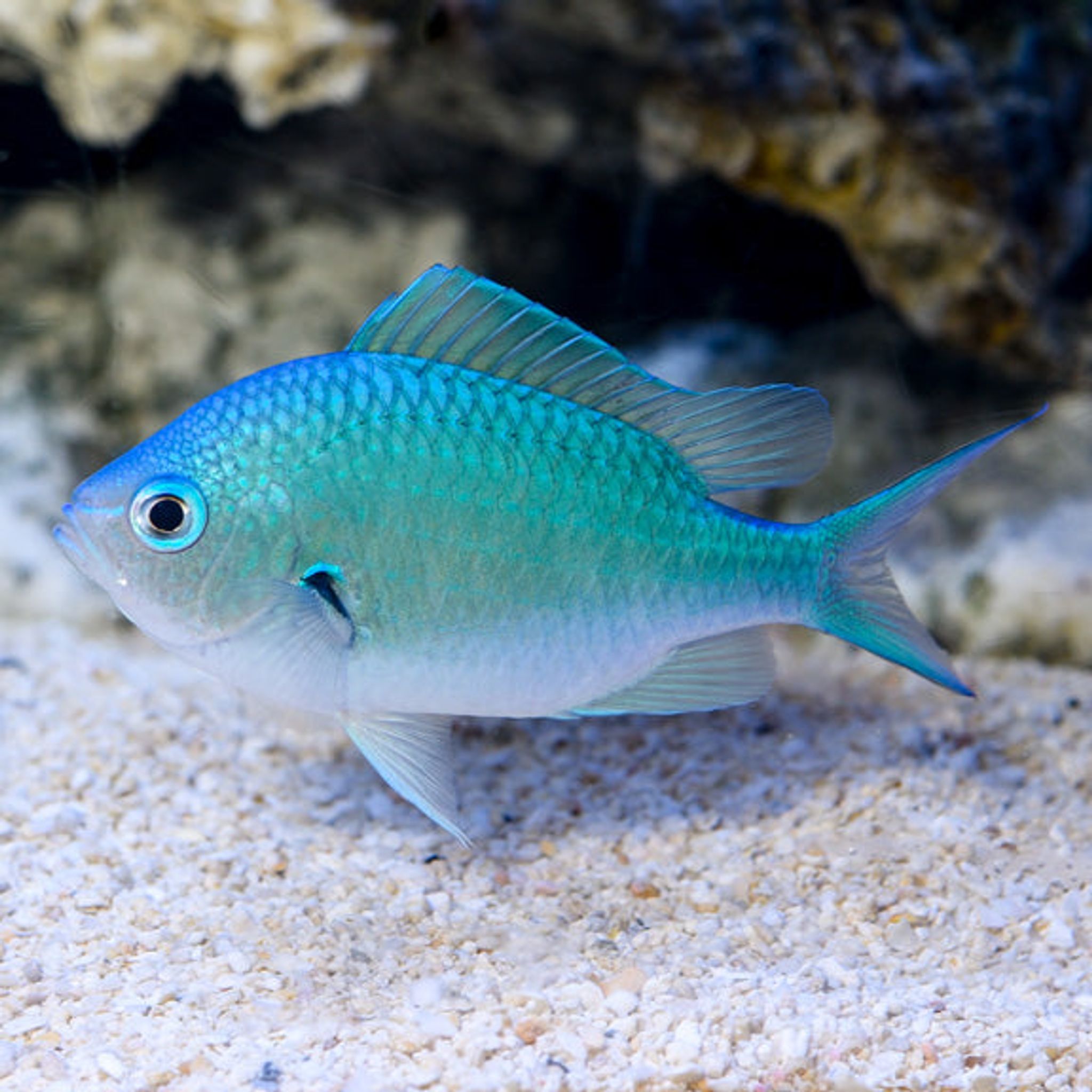
How to Feed Blue-Green Chromis: Foods, Frequency and Common Feeding Problems
Blue-green chromis (Chromis viridis) are among the easiest marine fish to feed — a school will rush to the surface the moment food touches the water. This guide covers exactly what to offer, how often, how much, and how to solve the feeding problems that actually come up: skinny fish, food monopolized by faster tankmates, and new arrivals that won't eat.
What Blue-Green Chromis Eat in the Wild
In the wild, blue-green chromis are planktivores and opportunistic omnivores. They hover above reef structure picking copepods, amphipods, and zooplankton out of the water column, and they'll also graze phytoplankton, tiny fish larvae, and filamentous algae directly off the rock when plankton is scarce. This mixed feeding strategy is why they adapt so readily to prepared aquarium foods — they're built to sample whatever is drifting by rather than hunting a single prey type.
Core Aquarium Diet
A varied diet built around frozen meaty foods, with flake or pellet as a supplement, matches their natural feeding pattern best.
- Frozen mysis shrimp — the staple. Good size match for their mouths and solid nutritional profile.
- Frozen brine shrimp — best when vitamin or HUFA-enriched, since plain brine shrimp is nutritionally thin on its own.
- Frozen or live copepods and zooplankton — the closest match to their wild diet, and especially valuable for juveniles.
- Marine flake or pellet food formulated for omnivores — include a spirulina or algae-based option to cover the plant-matter side of their diet.
- Finely minced meaty seafood (shrimp, clam) — an occasional variety item rather than a daily staple.
Rotating protein sources and including an algae-based food supports long-term color vibrancy and immune health — a flake-only routine works in the short term but tends to dull coloration over months.
You can browse frozen and freeze-dried options, along with flake and pellet foods, in FishyHub's Food & Supplements section, which also carries freeze-dried foods as a convenient rotation item.
Feeding Frequency and Portion Size
The consensus recommendation is 2–3 small feedings per day, mimicking the near-constant grazing chromis do in the wild rather than one large daily meal. Some general damsel-care advice is vaguer — "feed like other marine fish, once or twice a day" — but for a schooling planktivore, splitting food across more, smaller feedings reduces waste and competition. Once-daily feeding can still work in an established tank with a heavy natural pod population, since the fish are supplementing between meals anyway.
For portion size, the simplest reliable rule is:
Feed only what the school clears in 2–3 minutes. Anything left after that sinks, decays, and starts fouling water and rock.
| Feeding aspect | Recommendation |
|---|---|
| Frequency | 2–3 small feedings/day (1/day workable in established, pod-rich tanks) |
| Portion size | Only what's consumed in 2–3 minutes |
| Staple food | Frozen mysis shrimp |
| Supplemental foods | Enriched brine shrimp, marine flake/pellet, copepods |
| Dry food prep | Soak briefly in tank water before adding |
| Group feeding | Broadcast across multiple spots for groups of 6+ |
Soaking Dry Foods
Flakes and pellets float at first, which means fish either ignore them or gulp air snapping at the surface. Soak dry food briefly in tank water before feeding so it softens and sinks to the mid-water depth where chromis naturally school and feed.
Let Live Rock Do Some of the Work
An established reef with mature live rock produces a steady trickle of copepods and amphipods that chromis graze on between scheduled feedings. This doesn't replace prepared feeding, but it does reduce how dependent the fish are on any single feeding being perfectly timed, and it's part of why chromis do reasonably well even on a once-daily schedule in a mature system.
Feeding a School: Group Size Matters
Chromis are schooling fish, and feeding behavior is one of the clearest reasons to keep them in proper numbers. A group of 4–6 fish in a 40–50+ gallon tank is the safer, most commonly recommended setup — it gives the school room to spread out at feeding time instead of balling up around one food source. Some smaller nano setups can support a trio, but expect more competition and a higher chance of one fish getting pushed to the back of the group. Solitary chromis or pairs tend to become skittish and can undereat, since part of their feeding confidence comes from schooling behavior itself.
You can view available stock in FishyHub's Chromis selection if you're building out or topping up a school.
Are Chromis Aggressive at Feeding Time?
Damselfish as a family have a reputation for being territorial, but that reputation doesn't apply evenly. Blue-green chromis (and the similar Chromis parasema) are among the least aggressive damsels, especially compared to three-stripe or sergeant major damsels, which become distinctly territorial as they mature. That matters directly for feeding: in a mixed tank, chromis are far less likely to bully tankmates off food than those more aggressive relatives, and they're also less likely to be the aggressor if you're worried about competition at the food dish.
For comparison, raising sergeant major damsels involves similar flake and frozen foods, but their growing territoriality means they need more space and lower stocking density as they mature — a good illustration of why chromis remain the easier, reef-friendlier choice for a community or reef tank. If you're comparing damsel species generally, FishyHub's Damselfish category is worth browsing to see the range of temperaments on offer.
Water Quality and Appetite
Feeding problems and water quality problems are often the same problem wearing different clothes. Keep parameters stable:
- Specific gravity: 1.020–1.025 (salinity roughly 32–35 ppt)
- Temperature: 72–78°F (22–26°C)
- pH: 8.1–8.4
A sudden salinity, temperature, or ammonia swing commonly shows up first as a reduced feeding response, before other visible symptoms appear. If a previously reliable eater suddenly goes off food, check water parameters before assuming illness or a diet problem.
Buying Tip: Origin and Feeding Readiness
Blue-green chromis range across the Indo-Pacific, including the Philippines, and most of the aquarium trade supply is still wild-collected, though captive-bred stock is increasingly available. Fish that pass through well-run collection and holding facilities are typically already feeding confidently on prepared foods by the time they reach a hobbyist's tank — which is a genuinely useful thing to ask about (or watch for) before buying. A chromis already eating frozen mysis in the dealer's tank is a much safer bet than one that's never seen prepared food.
This hardiness and easy feeding is also a big part of why blue-green chromis consistently show up on lists of the best beginner saltwater fish — they tolerate a normal feeding routine, school predictably, and don't demand specialized foods to thrive.
Common Feeding Problems and Fixes
| Problem | Likely cause | Fix |
|---|---|---|
| Cloudy water, algae blooms | Overfeeding | Feed smaller amounts more often; remove uneaten food |
| Some fish look thin despite feeding | Food monopolized by faster/dominant fish | Broadcast food at multiple spots; feed at dusk when competition drops |
| New chromis won't eat | Shipping/acclimation stress | Try live baby brine shrimp or strong-scented frozen mysis; dim lights; wait 24–48 hours |
| Fish ignore or gulp at surface food | Floating, unsoaked pellets/flakes | Pre-soak dry food so it sinks to schooling depth |
| Good eater suddenly stops eating | Water quality swing | Test salinity, temperature, and ammonia before anything else |
| Dull color over time | Flake-only diet | Rotate in frozen mysis, brine shrimp, and occasional live food |
| Timid fish miss meals to aggressive tankmates | Bullying from true damsels or dottybacks | Target-feed the chromis directly with a turkey baster or feeding tube |
Recognizing Hunger vs. Illness
A gradually pinched or concave belly, fading color, and clamped fins point toward malnutrition or feeding competition rather than disease — especially if the fish is still active and swimming normally. True illness usually comes with additional signs: labored breathing, spots or lesions, erratic swimming, or hiding constantly. If a thin fish is otherwise behaving normally, correcting feeding technique (more feeding spots, target feeding, checking water quality) is worth trying before assuming disease.
Target Feeding in Multi-Species Tanks
In a tank with faster or more assertive tankmates, broadcast feeding alone won't guarantee every chromis gets fed. A turkey baster, feeding tube, or target stick lets you deliver a small cloud of food directly to the chromis school or an individual fish that's being pushed out, without having to dump extra food into the tank overall.
Feeding While You're Away
For owners who can't manage 2–3 manual feedings a day, an automatic feeder on a timer loaded with dry pellets or flake can cover the midday feeding, with manual frozen feedings handled morning and evening. This keeps the school on a consistent schedule even when no one's home, though it still needs periodic food refills and a quick check that the dispenser isn't jamming or clumping.
Bringing a Stress-Fasting New Arrival Back on Food
A freshly imported or unconditioned chromis may refuse food for a day or two after acclimation. Live baby brine shrimp or live copepods are the most reliable way to break that fast, since scent and movement trigger a feeding response even when the fish is otherwise stressed. Once it's actively chasing live food, transition it onto frozen mysis and enriched brine shrimp over the following week, keeping lighting dim and disturbance low in the meantime.
Frequently Asked Questions
How often should I feed blue-green chromis?
Feed 2–3 small meals per day, offering only as much as the school can clear in a couple of minutes. This spreads out food availability and reduces waste compared to one large daily feeding.
What is the best staple food for chromis?
Frozen mysis shrimp is the most widely recommended staple, supplemented with vitamin or HUFA-enriched brine shrimp and a quality marine flake or pellet formulated for omnivores.
Do chromis need live food?
Not for established fish eating normally. Live baby brine shrimp or copepods are mainly useful for coaxing new arrivals or juveniles into feeding, and as occasional enrichment for an already-eating school.
Can chromis survive on flakes alone?
They can survive on flakes, but they do noticeably better long-term on a varied diet that includes frozen meaty foods. Flake-only feeding over many months risks duller coloration and weaker immune resilience.
Why is my chromis not eating?
The usual causes are acclimation stress in a new fish, a water quality swing in salinity, ammonia, or temperature, or competition from tankmates monopolizing the food. Check parameters and feeding technique before assuming illness.
How many chromis should I keep together, and does group size affect feeding?
Groups of 4–6 in a 40–50+ gallon tank school and feed more naturally, spreading out competition at mealtime. Solitary fish or pairs tend to be more skittish and can undereat as a result.
Are blue-green chromis reef safe with corals when it comes to feeding?
Yes, they don't pick at coral flesh and are considered reef safe. The one thing to watch is that an excited feeding-time school can occasionally bump the aquascape or stir up sand.
How is chromis feeding different from other damselfish?
Blue-green chromis are far less aggressive at the food dish than territorial damsels like three-stripe or sergeant major damsels, which makes shared feedings calmer and less stressful for tankmates. This is part of why chromis are often recommended over other damsels for reef and community setups.
Ready to start or expand a school? Check current availability in FishyHub's Marine Fish category.

