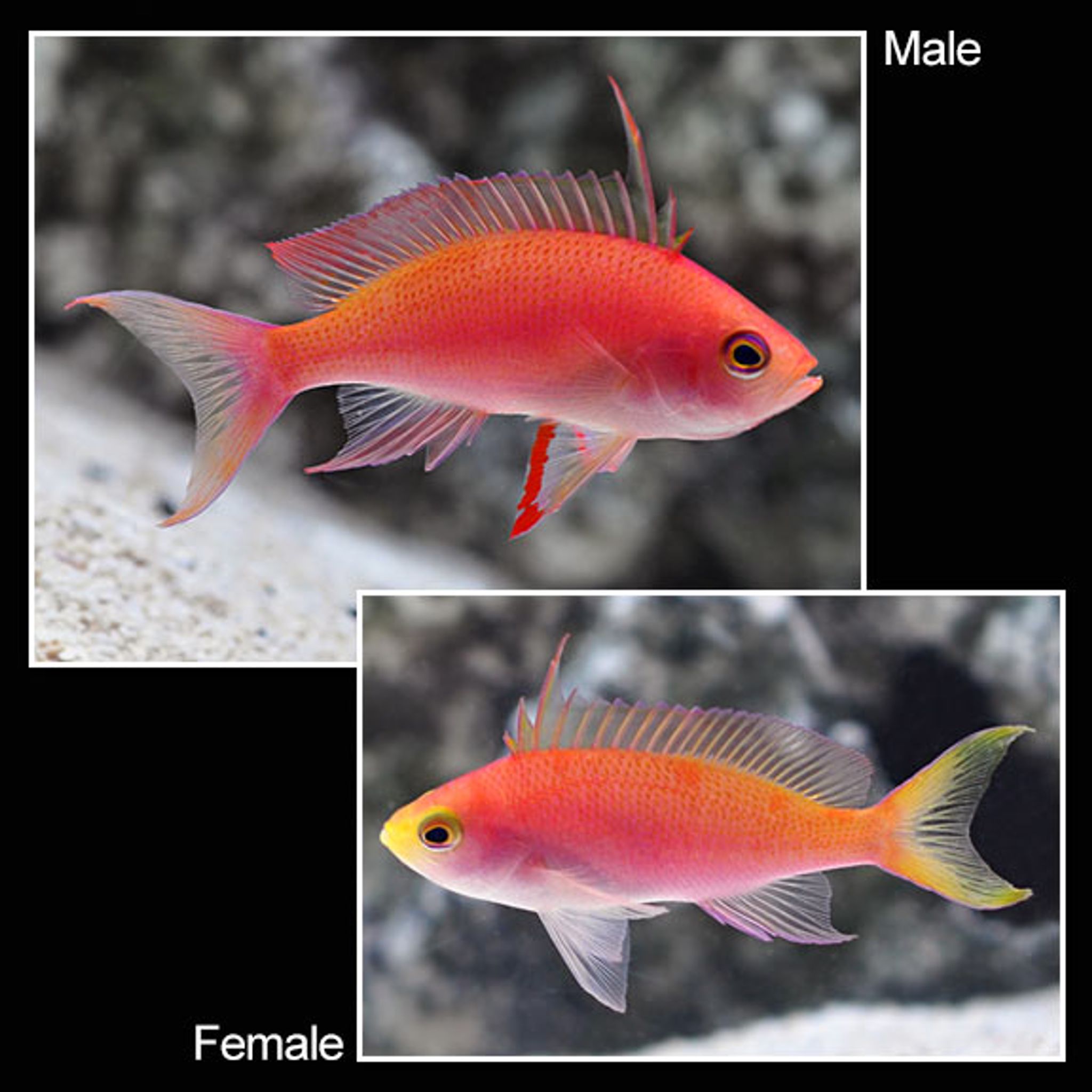
How to Feed Anthias: Foods, Frequency and Common Feeding Problems
Anthias are some of the most rewarding reef fish to watch and some of the easiest to underfeed to death. This guide covers exactly what to feed them, how many times a day, and how to spot and fix the feeding problems that cause slow decline in an otherwise healthy shoal.
Why Anthias Feeding Is Different From Most Reef Fish
In the wild, anthias (genus Pseudanthias, family Serranidae) are obligate planktivores. They hover in open water above the reef almost all day, picking copepods, amphipods, fish eggs, and other tiny zooplankton out of the current one bite at a time. They never gorge on a big meal because there isn't one to be had — the food stream is constant but tiny.
That biology carries straight into the aquarium. Anthias have small stomachs and a fast metabolism built for near-continuous grazing, not for one or two large feedings a day. This single fact is the most important thing to understand about keeping them long-term: feeding frequency matters more than feeding volume.
How Often to Feed Anthias
There's no single magic number, but the pattern that works is small amounts, offered often:
- Minimum: 2–3 feedings a day for an established, confidently eating shoal.
- Ideal: 3–5 feedings a day for most home aquariums.
- New, shy, or recently shipped fish: up to 8–10 tiny feedings a day can help build confidence and get a nervous fish swallowing food again.
Treat this as "as often as practical, small amounts each time" rather than a fixed rule. A fish that gets five small meals a day will almost always do better long-term than one that gets two large ones, even if the total food volume is similar.
If you can't be home for multiple feedings, an automatic feeder loaded with a pellet or freeze-dried food, or a drip-style feeding ring for frozen food, can fill the gaps between the feedings you do by hand.
Portion Sizing
Feed only what the shoal can finish in about two minutes, and repeat that small portion several times a day rather than dumping in a large amount once. If food is still drifting uneaten after a couple of minutes, you fed too much for that session — cut the portion, not the frequency.
What to Feed Anthias
Core Frozen Diet
Frozen foods should form the backbone of an anthias diet once the fish is established:
- Mysis shrimp
- Enriched or gut-loaded brine shrimp
- Cyclops
- Chopped krill
- Frozen copepods
- Fish roe or eggs
- Reef or plankton blends
- Finely minced clam or mussel
Rotate between three or four of these across the week instead of feeding the same cube every time. Variety supports color, growth, and long-term health, and it reduces the risk of a fish going off one food if it develops a preference or aversion.
Live Foods for Acclimation and Picky Eaters
Live food isn't strictly required, but it is often the fastest way to get a new or stressed anthias eating:
- Live copepods
- Newly hatched (baby) brine shrimp
- Live blackworms
- Live rotifers
Movement is the trigger here — a drifting live copepod triggers a feeding response that a motionless frozen chunk doesn't always get from a nervous fish. Culturing your own copepods or hatching brine shrimp at home is also a practical, low-cost way to keep a steady live supply going.
Pellets and Flake
Some anthias — Lyretail Anthias in particular, along with other hardier species — can eventually be trained onto a high-quality small pellet or flake. This works best as a supplement once the fish is established and eating confidently, not as a first food for a new or shy specimen. Frozen and live foods remain the more reliable core diet, especially in the first weeks after arrival.
Feeding Technique That Actually Works
- Target-feed shy fish. Use a turkey baster or a similar pipette to aim thawed frozen food directly at subordinate or shy individuals so faster, more aggressive tankmates don't grab everything first.
- Broadcast in small pinches. Several small pinches spread over a few minutes beats one big dump, both for anthias and for water quality.
- Feed anthias before other aggressive eaters in a mixed tank, so they get first access while they're still hungry and attentive.
- Watch for actual swallowing, not just interest. Anthias frequently mouth a piece of food and spit it back out. A fish that repeatedly "goes for" food without swallowing is not actually eating, even though it looks engaged.
Tank Setup That Supports Good Feeding
- Water flow: moderate but steady flow helps carry food through the water column so it reaches fish hovering mid-tank, rather than settling straight to the substrate.
- Caves and rockwork ledges: these give subordinate fish somewhere to retreat and still catch drifting food, instead of being chased off entirely during meals.
- Multiple feeding points: broadcasting food in more than one spot reduces the chance that one dominant fish or tankmate monopolizes it.
Anthias also make an attractive centerpiece shoal for a mixed reef community; you can browse live anthias fish stock to plan out group size and species mix before setting up a feeding routine.
New Arrival Protocol
A freshly shipped anthias is stressed, and stress suppresses appetite. A few days of refusal is normal and not an emergency:
- Dim or turn off display lighting for the first 1–2 days to reduce stress and encourage the fish to relax enough to eat.
- Expect 2–10 days without eating to be tolerable for an otherwise healthy fish. Don't panic-feed heavily right away — offer small amounts often instead.
- Offer live food first if the fish is ignoring frozen offerings; the movement often triggers a response frozen food doesn't.
- Avoid overcrowding the introduction. Adding a single male to an established female group, or too many males at once, can cause feeding-time aggression that suppresses appetite in the whole shoal. Introduce fish in a sensible order and watch behavior at mealtimes.
Deepwater Species Need Extra Patience
Several popular anthias — including Bartlett's (red-belted type) and Borbonius (Blotched) Anthias — are collected from deep reef zones, sometimes 100 feet (30 m) down and in some cases 300–1,000 feet (90–300 m). These deep-collected species tend to be pricier and more delicate on arrival than shallow-reef anthias, and they often need extra time adjusting to normal tank lighting and a typical feeding routine. The dim-light acclimation approach above matters even more for these species — give them a longer, gentler transition before expecting confident daytime feeding.
Common Feeding Mistakes and How to Fix Them
| Mistake | Why It's a Problem | Fix |
|---|---|---|
| Feeding only 1–2 times a day | Slow wasting and death over weeks is the most common outcome for anthias fed this way | Move to at least 3 feedings a day, more for new fish |
| Assuming interest means eating | Anthias often mouth and spit out food without swallowing | Watch for actual swallowing before assuming the fish is fed |
| Introducing males without an order | Triggers feeding-time aggression that suppresses appetite | Establish females first, add males carefully, watch mealtime behavior |
| Too few females per male or an aggressive setup | Bullying keeps subordinates away from food | Provide caves/ledges as feeding refuges, adjust stocking ratio |
| Skipping the dim-light acclimation period | Fresh arrivals stay too stressed to eat confidently | Dim lights for 1–2 days after introduction |
| Treating refusal as only a food problem | A previously eating fish that suddenly stops may have internal parasites, such as flukes | If refusal persists past several days, consider a health-focused check and deworming, not just a diet change |
| Overfeeding to compensate for thinness | Fouls water quality, which further stresses fish and worsens appetite | Increase frequency of small feedings instead of portion size |
| Feeding one food type long-term | Reduces acceptance and nutritional completeness | Rotate 3–4 food types across the week |
A Note on Water Quality
Frequent small feedings raise bioload compared to the feeding schedule of a typical, less active reef fish. Keep an eye on nutrient export — protein skimming and routine water changes matter more when you're feeding four or five times a day rather than once. If nitrate or phosphate starts creeping up after switching to a more frequent schedule, that's a sign to tighten up husbandry rather than to cut back on feeding frequency, since underfeeding is the bigger risk for this group.
Sample Daily Feeding Schedule
A realistic schedule for a working aquarist might look like this:
| Time | Food | Notes |
|---|---|---|
| Morning (before work) | Mysis shrimp or enriched brine shrimp | Small pinch, target-feed shy fish |
| Midday (auto-feeder) | Pellet or freeze-dried food | Only once fish are established eaters |
| Early evening | Frozen cyclops or copepods | Broadcast in two spots |
| Evening | Chopped krill or a reef blend | Rotate food type from the day before |
| Late evening (optional) | Live baby brine shrimp | Especially useful for new or shy individuals |
An automatic feeder or timer-driven feeding ring can cover the midday slot reliably, which is often the hardest one to hit in a normal workday.
Diet, Longevity, and a Notoriously Short Captive Lifespan
Anthias have a reputation for declining in captivity faster than many other reef fish, and feeding quality is one of the biggest levers you actually control. A shoal fed once or twice a day on a single frozen food may survive for a while but tends to lose color, condition, and eventually weight over weeks and months. Consistent, varied, frequent small feedings are the single best thing you can do to push against that trend and support a longer, healthier run for the group.
Feeding a Mixed-Species Shoal
If you're keeping more than one Pseudanthias species together, pay attention to food size preferences — a larger-mouthed species may out-compete a smaller one for chopped krill, while the smaller fish does better on cyclops or copepods. Offering a range of particle sizes across your rotation, and target-feeding smaller species directly, helps make sure a mixed shoal doesn't develop winners and losers at mealtime.
Frequently Asked Questions
How many times a day should I feed anthias?
At least 3 small feedings a day is the baseline for an established shoal. More — 4 to 5 or even higher — is better, especially for new, shy, or recently acquired fish still building confidence.
Will anthias eat flake or pellet food?
Some will, particularly hardier species like Lyretail Anthias, once they're trained onto it over time. Treat frozen and live foods as the reliable core diet, especially early on, and add pellets or flake as a supplement later.
Why is my anthias not eating?
Usually it's stress from a new environment, bullying from tankmates, or internal parasites such as flukes. Try dimming the lights, offering live or target-fed food, and check for signs of parasites if refusal continues past several days.
Can anthias survive if I can only feed twice a day?
They can survive short term, but tend to decline over weeks or months without more frequent meals. An automatic feeder or a feeding ring can help fill in extra feedings when you can't be there in person.
Do anthias need live food?
Not strictly, but live copepods or freshly hatched brine shrimp greatly help get new or picky individuals started eating, since the movement triggers a stronger response than still frozen food.
How do I stop other fish from eating all the food before my anthias get some?
Target-feed the anthias directly with a baster or pipette, broadcast food across multiple spots in the tank, and feed the anthias first, before more aggressive tankmates are given access.
Is it normal for anthias to look thin?
A slightly slim profile between meals is normal for such an active, fast-metabolism fish. A visibly pinched or concave belly, though, signals chronic underfeeding and needs to be corrected with more frequent meals right away.
What tank setup helps with feeding success?
Moderate, steady water flow to carry food through the water column, plus caves and rockwork so subordinate fish have somewhere to retreat without being chased away from every meal.
Getting the frequency and variety right is most of what separates a thriving anthias shoal from one that slowly fades. If you're stocking up on frozen staples or trying pellets as a supplement, you can browse frozen and freeze-dried food options, or the wider Food & Supplements category, to build out a rotation before your next shoal arrives.


