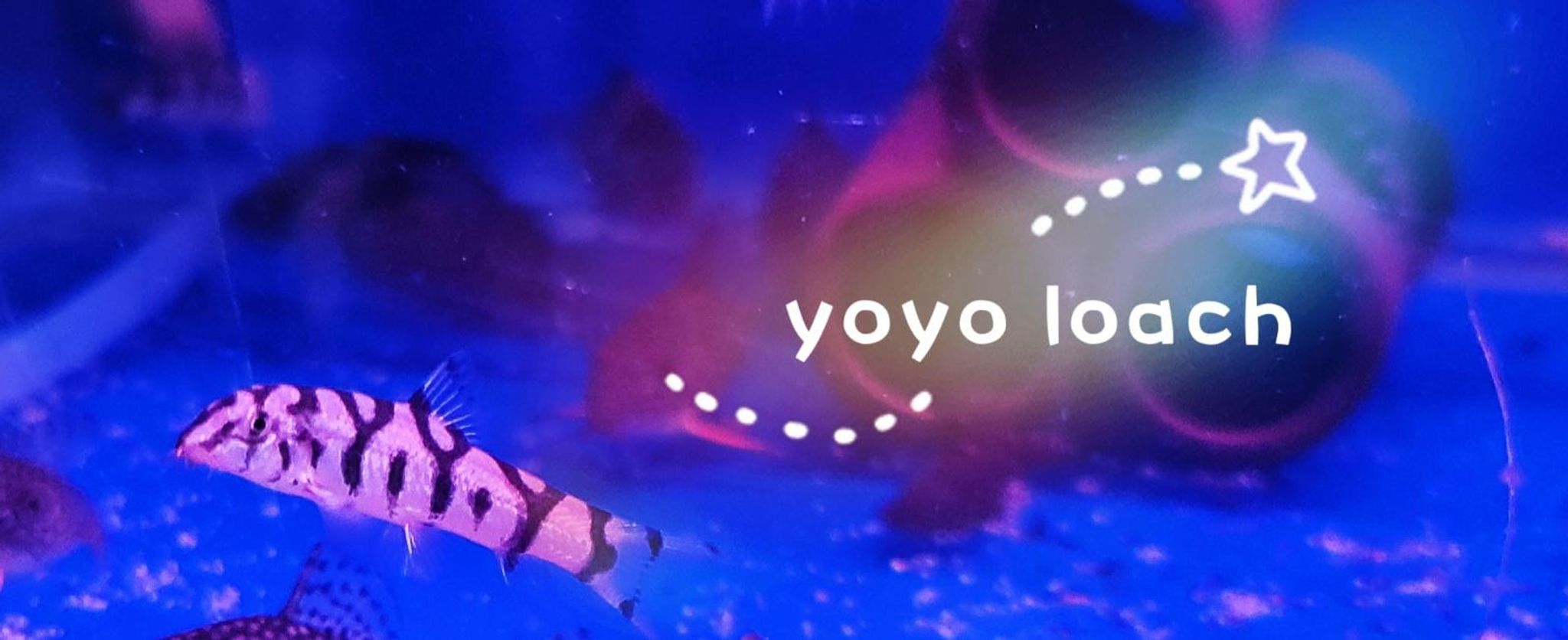

How Big Do Yoyo Loach Get? Growth Rate, Adult Size and Tank Planning
A Yoyo Loach bought at the store as a 1 to 1.5 inch juvenile will typically settle at 3 to 5 inches as an adult, occasionally reaching 6 inches under exceptional long-term care. That difference between store size and adult size is exactly why so many owners end up scrambling for a bigger tank a year in. Here's the real growth timeline and the tank math to plan around it from day one.
Yoyo Loach Species Basics
The Yoyo Loach (Botia almorhae, sometimes sold under the closely related Botia histrionica) is a bottom-dwelling schooling loach also marketed as the Pakistani Loach or Reticulated Loach. The name comes from the "Y" and "O" shaped markings that appear along its flanks as it matures — a pattern that shifts and gets less regular with age, which is part of why size and markings are sometimes reported inconsistently between sources.
Some of the size variation reported online also traces back to which strain is being sold. Botia histrionica and Botia almorhae are frequently sold interchangeably as "Yoyo Loach," and import strains can differ slightly in typical adult length and pattern density. That's not a reason to worry about which one you have — just a reason not to treat any single size figure as an exact promise.
How Big Does a Yoyo Loach Actually Get?
The honest range is 3 to 5 inches (8-13 cm) in a well-run home aquarium, with "about 4 to 5 inches" being the most commonly cited adult figure. A maximum of around 6 inches is possible but rare, and only shows up in fish that have had large tanks, excellent water quality, and years of consistent feeding.
You'll see some sources claim a conservative 2.5 to 3 inches, and others claim 5 to 6 inches as typical. Both are outliers rather than errors — they mostly reflect different tank sizes, diets, and care quality behind the numbers, not two different "true" sizes for the species. Genetics and strain differences play a smaller role than husbandry does.
Why Captive Size Often Falls Short of Wild Size
Wild Yoyo Loaches range through rivers with far more swimming room, current to exercise against, and a constantly varying wild diet than most aquariums replicate. In captivity, three factors most often cap growth below the wild ceiling:
- Tank volume — a cramped tank limits exercise and can physically stunt growth.
- Water flow and space — loaches that never have to swim against current develop less muscle mass and reach length more slowly.
- Diet variety and quality — a narrow diet of only dry pellets grows a smaller, less robust fish than a varied diet including protein-rich frozen and live foods.
- Genetics from farmed stock — generations of farm breeding can gradually narrow the size ceiling compared with wild populations.
None of this means you need a river to keep them well — it just explains why "up to 6 inches" is a ceiling, not an expectation.
Growth Rate: What to Expect Month by Month
Growth is fastest in the first year and then tapers noticeably. As a rough benchmark for a fish kept in good conditions from a 1 to 1.5 inch juvenile:
| Age | Approximate length | Notes |
|---|---|---|
| At purchase | 1-1.5 in (2.5-4 cm) | Typical juvenile size sold in stores |
| 3 months | 1.5-2 in (4-5 cm) | Fast early growth with regular feeding |
| 6 months | 2.5-3 in (6-8 cm) | Body starts thickening, pattern sharpens |
| 12 months | 3.5-4.5 in (9-11 cm) | Near full length in good conditions |
| 18 months | 4-5 in (10-13 cm) | Most individuals close to adult size |
| 24-36 months | 4-5 in, rarely to 6 in (10-15 cm) | Slow filling-out phase toward maximum potential |
Most Yoyo Loaches reach close to their full length by 12 to 18 months with good feeding and stable water quality, then spend the next one to two years slowly filling out toward their individual maximum. A fish that stays small in a 10 to 20 gallon tank isn't "compact" — undersized housing and thin diet stunt growth, and that stunting typically comes with a shortened lifespan, not a harmless smaller adult.
Measuring Growth Without Stressing the Fish
You don't need to net a loach to track its size. Instead:
- Compare it against a known landmark inside the tank — a piece of driftwood, a rock, or a background grid line of known size.
- Take a photo from directly above or the side against a ruler taped to the outside of the glass, then compare over months.
- Watch body depth and thickness, not just length — a filling-out midsection is often the clearer sign of maturity than a few extra millimeters of length.
Tank Size by Group Size
Because floor space matters more than height for a bottom-dwelling fish, plan around footprint rather than gallons alone.
| Group size | Minimum tank | Typical footprint | Notes |
|---|---|---|---|
| 2-3 (juveniles only, temporary) | 20-30 gallons | ~30 x 12 in | Acceptable short-term for young fish, not a long-term home |
| 4-5 (minimum adult group) | 40 gallons long | ~48 x 13 in | Real minimum for a full-grown group |
| 6+ | 75-110+ gallons | 48-60+ x 18 in | Add roughly 10-15 gallons per loach beyond the first few |
A "long" footprint always beats a tall tank of the same volume for this species — Yoyo Loaches spend almost all their time working the substrate and lower water column, so extra height above them is largely wasted space.
If you're setting up a dedicated bottom-dweller tank, browsing a long-format glass tank built for floor-space-first stocking is a reasonable starting point before you commit to a group size.
Social Needs: Groups, Not Pairs
Yoyo Loaches need to be kept in groups of 4 to 6 or more — not pairs, and never singly. A lone or paired loach tends to hide constantly, lose color, and become either skittish or unexpectedly nippy toward tankmates as it compensates for the missing group dynamic. The group itself absorbs social pressure that would otherwise fall on other fish in the tank.
Substrate: Sand Over Gravel
Yoyo Loaches use sensitive barbels to feel along the substrate constantly, so sand or very fine, smooth gravel is the safer consensus choice. Standard sharp-edged aquarium gravel can fray or damage barbels over time, raising infection risk even though a few sources list "large gravel or small rocks" as acceptable. When in doubt, go softer than you think you need to. A fine-grain gravel and sand substrate is the straightforward way to cover this.
Water Parameters
- Temperature: 75-86°F (24-30°C)
- pH: 6.5-7.5 as the sweet spot, with 6.0-8.0 as the outer tolerance range
- Hardness: roughly 3-12 dKH/dGH
- Flow: moderate to low, well-oxygenated
- Tank maturity: fully cycled and established before adding a group
Diet
Yoyo Loaches are omnivorous scavenger-predators. Offer sinking pellets and wafers as a base, supplemented with frozen or live brine shrimp, bloodworms, daphnia, and earthworms. They also actively hunt and eat pest snails — and notably, ramshorn and other small ornamental snails as well, thanks to pharyngeal "throat teeth" adapted for crushing shells. Feed small portions multiple times a day rather than one large meal, since they're prone to overeating.
Lifespan
Typical lifespan is 5 to 8 years, with well-documented reports of 10 to 15+ years under excellent long-term care — stable water quality, adequate space, and a varied diet all extend that ceiling meaningfully.
Sexing and Breeding
Sexing is only reliable at maturity: females are plumper and rounder-bodied, especially when gravid, while males tend to show longer or redder barbels and a slimmer build. Breeding, however, is essentially not achievable in a home aquarium. Wild spawning is tied to seasonal upstream migration and monsoon triggers that a home tank can't replicate, and commercial supply comes from hormone-assisted breeding by professional facilities — not something to plan for as a hobby project.
Yoyo Loach vs. Zebra Loach: Choosing by Size
If 40+ gallons is more than you can offer, the Zebra Loach is a smaller relative worth comparing. It tops out around 3-4 inches (about 10 cm) and needs only about 30 gallons minimum — noticeably less demanding than a full Yoyo Loach group. On the broader loach size spectrum, Yoyo Loach sits comfortably in the middle: larger than the dwarf Zebra Loach, but well short of the Clown Loach, which can approach 12 inches given enough time and space.
Tankmates
Good tankmates are peaceful community fish of similar size: tetras, corydoras, rasboras, mollies, platies, bristlenose plecos, angelfish, and even other loaches such as the Clown Loach where size and temperament line up. Avoid aggressive cichlids, oscars, and tiger barbs. Also skip small ornamental shrimp and snails you intend to keep alive — a Yoyo Loach won't distinguish them from pest snails. A corydoras group is a classic, low-conflict floor-sharing companion since both species forage without competing aggressively for space.
Medication Sensitivity
Yoyo Loaches are scaleless fish, which makes them more sensitive to medications than scaled tankmates. Dose copper-based or salt-based treatments at half strength, or follow loach-safe dosing instructions specifically — a full-strength treatment aimed at scaled fish can cause serious distress or death.
Common Mistakes to Avoid
- Buying based on the 1-1.5 inch juvenile size on display, then being caught off guard by a 4-5 inch adult that outgrows the tank.
- Keeping only one or two loaches, which causes stress, hiding, faded color, and sometimes bullying of smaller tankmates.
- Using standard sharp gravel, leading to frayed barbels and higher infection risk over time.
- Overdosing medication by ignoring scaleless-fish sensitivity.
- Assuming a loach that stays small in a 10-20 gallon tank is simply "compact" rather than stunted and likely shorter-lived.
- Adding them purely for snail control, then being surprised they also eat small ornamental shrimp and snails.
- Expecting to breed them at home without the migration-triggering conditions professional breeders use.
Frequently Asked Questions
How big does a Yoyo Loach get in a home aquarium?
Typically 3 to 5 inches (8-13 cm), with 6 inches possible but rare and only reached with excellent long-term care in a large tank.
How fast do Yoyo Loaches grow?
Growth is fastest in the first year, with most individuals reaching close to full length by 12-18 months. Filling out toward maximum potential size can continue for another one to two years.
What size tank does a Yoyo Loach need?
A 40 gallon long tank is the real minimum for an adult group of 4-6. Smaller tanks of 20-30 gallons are acceptable only temporarily while loaches are still juveniles.
How many Yoyo Loaches should be kept together?
A minimum of four, with five or six or more being ideal for natural schooling behavior and reduced stress.
Do Yoyo Loaches eat snails?
Yes — they actively hunt pest snails and will also eat ramshorn and other small ornamental snails, plus small shrimp, so they're not selective about which mollusks they target.
Can Yoyo Loaches be bred in a home aquarium?
Essentially no. Their spawning is tied to seasonal migration triggers that home aquaria can't reproduce, so captive breeding is not something hobbyists reliably achieve.
What do Yoyo Loaches eat?
An omnivorous mix of sinking pellets and wafers, plus frozen or live brine shrimp, bloodworms, daphnia, and earthworms, fed in small portions multiple times a day.
How long do Yoyo Loaches live?
Typically 5 to 8 years, with reports of 10 to 15+ years under excellent long-term care.
Ready to plan a group around the right tank size? Browse available Yoyo and other loaches on FishyHub to see current stock before you commit to a footprint.


