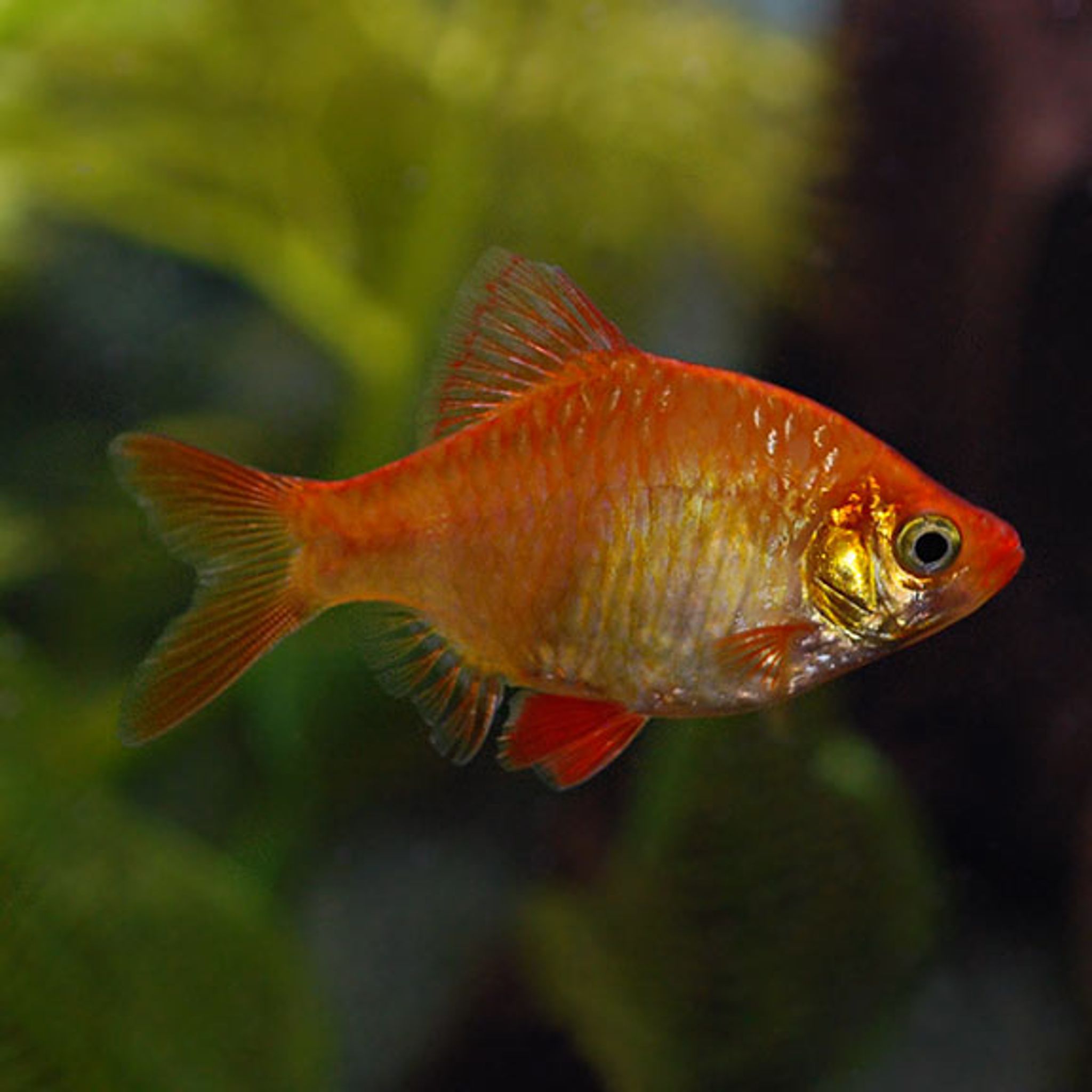

How Big Do Tiger Barb Get? Growth Rate, Adult Size and Tank Planning
Most Tiger Barbs settle in at 2–3 inches (5–7.6 cm) as adults, with well-fed females in spacious tanks occasionally reaching closer to 3.5–4 inches (9–10 cm). For planning purposes, treat "about 3 inches" as your working number, then build the tank and school size around it rather than around the tiny juvenile in the bag.
Adult Size: What to Actually Expect
The commonly quoted range across hobbyist sources is 2–3 inches standard length, with occasional reports of 3.5–4 inches for exceptionally well-conditioned females in roomy, low-stress tanks. Genuine 4-inch specimens are uncommon in home aquariums — the oft-cited wild maximum reflects fish in large natural systems with unlimited swimming room and a lifetime of ideal food, not typical tank conditions. When you're sizing equipment, plan for the higher end of the range (closer to 3–3.5 in) so you're not caught off guard, but don't expect every fish to hit it.
Size alone doesn't tell the whole story. Tiger Barbs have a deep-bodied, laterally compressed diamond shape — tall relative to their length and quite thin from side to side. That body shape matters more for tank planning than the length number does: a school of diamond-shaped, fast-swimming fish needs open horizontal footprint (floor-level swimming space) more than it needs tank height.
Males vs. Females
Sexual dimorphism is noticeable once the fish mature:
- Females typically grow slightly larger and develop a rounder, fuller body — especially when gravid (carrying eggs).
- Males stay leaner and more streamlined, and often show deeper red coloring on the fins and nose when in breeding condition.
If you're trying to sex a group by eye, body shape and color intensity are more reliable cues than length alone.
Growth Rate: A Realistic Timeline
Tiger Barb fry hatch nearly microscopic and are invisible to the naked eye for their first days. Growth then accelerates quickly given good food and stable water. Here's a practical timeline to predict where your own fish are headed:
| Age | Approximate size | What's happening |
|---|---|---|
| Hatch – 1 week | Near-microscopic | Fry absorb yolk sac, begin free-swimming |
| 4–8 weeks | Rapid growth phase | Frequent feeding drives the fastest length gains |
| ~5–6 weeks | Roughly half of adult length | Under good conditions with consistent feeding |
| 6–8 weeks to a few months | 1–1.5 in (2.5–3.8 cm) | Sexual maturity reached; fish can begin breeding |
| 3–6 months | Most of adult length | Bulk of growth is complete |
| 6–12 months | Full adult size | Body continues to fill out and deepen |
The key takeaway: most of the length increase happens in the first two to three months, but the fish keep filling out — getting deeper-bodied and more robust — for up to a year. A Tiger Barb that looks "done growing" at four months may still visibly thicken over the following months.
What Speeds Up or Slows Down Growth
Several factors determine whether a given fish tracks toward the low end or high end of the size range:
- Swimming room — cramped bioload (the waste and oxygen demand a tank's population places on it relative to filtration) stunts development.
- Water quality and stability — consistent, clean parameters support steady growth; swings and ammonia spikes divert energy toward stress response instead of growth.
- Feeding frequency and diet variety — multiple small feedings of varied food outperform a single daily flake feeding.
- Temperature — warmer water within the safe range speeds metabolism and growth up to a point; overly warm water offers no further benefit and stresses the fish.
- Genetics and lineage — some breeding lines simply run larger or smaller.
- Stress level — chasing, crowding, and bullying (including from being kept in too small a group) can measurably stunt growth and dull color.
Tank Planning Around Adult Size
Minimum Tank Size
Quoted minimums for a school of six Tiger Barbs range from 15 to 30 gallons depending on the source. A sensible floor is a 20-gallon long (76 L) — the "long" footprint matters because Tiger Barbs are strong horizontal swimmers that use floor-level space far more than vertical space. For a more comfortable setup, or any time you're adding tankmates, step up to 29–30 gallons (110–114 L) or larger.
Worked example: a 20-gallon long stocked with 8 Tiger Barbs and a handful of similarly sized, fast-swimming dither fish (fish that signal "all clear" to a nervous or aggressive species, reducing tension in the school) makes a workable, fully-stocked community setup without overloading the bioload.
School Size and the Fin-Nipping Mechanism
Tiger Barbs are notorious for fin-nipping, but the mechanism behind it is straightforward: this is a species with a built-in social pecking order. In a group that's too small, that aggression concentrates on the few tankmates available — usually anything slow-moving with visible fins to peck at. Add more Tiger Barbs to the group, and the aggression spreads out across the school itself as normal pecking-order squabbling, which rarely causes real damage.
Keep them in groups of 6 or more, ideally 8–10. Smaller groups reliably intensify nippiness rather than reducing it — this is the single most common stocking mistake with this species.
Water Parameters
Tiger Barbs are hardy and forgiving of typical community-tank swings once the tank is fully cycled:
- Temperature: 74–79°F (23–26°C)
- pH: 6.0–8.0, with most sources centering on 6.5–7.5
- Hardness: moderate, tolerant of a range
Being hardy doesn't mean immune — sudden swings in temperature or pH still stress the fish and can slow growth or trigger disease, even though the species tolerates a wider steady-state range than many tropicals.
Diet for Healthy Growth
As omnivores, Tiger Barbs do best on a base diet of quality flake or pellet food supplemented several times a week with live or frozen protein — bloodworms, brine shrimp, or daphnia. A gel food or freeze-dried protein works well as a rotation option for owners who don't want to manage live or frozen cultures; you can browse freeze-dried food options to add variety to the rotation. A varied diet supports faster, healthier growth and noticeably better color than flake alone.
Choosing Tankmates by Size and Speed
Match Tiger Barbs with fish that are similarly sized, fast, and short-finned — other barbs, danios, larger tetras, or rainbowfish all work well. You can browse danios as one solid option for a Tiger Barb community. Avoid slow, long-finned species like bettas, angelfish, or fancy guppies — their trailing fins are exactly what triggers nipping.
Tiger Barb Size vs. Related Barbs
If you're comparing Tiger Barbs against other barb species while deciding what to stock, here's how they line up:
| Species | Typical adult size |
|---|---|
| Cherry Barb | ~2 in (5 cm) |
| Tiger Barb | 2–3 in (5–7.6 cm), rarely to ~4 in |
| Rosy Barb | ~3–4 in (7.6–10 cm) |
| Denison Barb | 6+ in (15+ cm) |
| Tinfoil Barb | 12+ in (30+ cm) |
Tiger Barbs land in the middle of the pack — noticeably larger than Cherry Barbs but far smaller than the giant barb species some hobbyists mistakenly lump them in with. You can browse the full barb selection to compare options directly.
Color and Fin Variants
Green Tiger Barbs, Albino Tiger Barbs, and Long-fin (sometimes called balloon) variants are all color or fin morphs of the same species and grow to essentially the same adult size range as the standard form. The long-fin variant's trailing fins can make it a target for nipping from standard-finned tankmates, so it's worth keeping long-fin individuals in their own school rather than mixing fin types.
Signs Your School Is Growing Well
Use this quick checklist to confirm your fish are on a healthy growth trajectory rather than stunted or stressed:
- Active schooling behavior with vibrant, saturated color
- Steady, eager appetite at every feeding
- Smooth, continuous fins — no clamping or ragged edges
- Normal upright swimming — not gasping at the surface or hiding constantly
If you're seeing the opposite of any of these, treat it as a troubleshooting signal (see below) before assuming it's just "how this fish looks."
Low-Maintenance? A Realistic Framing
Tiger Barbs are genuinely hardy — tolerant of parameter swings and not picky eaters, which makes them easy to keep alive. But their aggression and hard requirement for a real school (not just a couple of fish) push them into "medium" maintenance from a stocking level planning standpoint. The fish itself is forgiving; the social dynamics are not. Plan the school size and tankmates carefully and the rest of the care is straightforward.
Common Mistakes to Avoid
- Buying too few — fewer than 6 is the single biggest recurring mistake and the main driver of fin-nipping complaints.
- Undersized tank for adult footprint — buying a small starter tank sized to juveniles without planning for the adult school's floor-space needs. A quality glass tank sized for the full adult school from the start avoids a costly upgrade later.
- Mixing with long-finned or slow fish — bettas, fancy guppies, and angelfish are predictable nipping targets.
- Assuming juvenile size is permanent — a 1-inch fish at purchase will double or triple in length.
- Poor or inconsistent feeding, overcrowding, or poor water quality — all stunt growth and dull color; correct with regular water changes, a varied diet, and adequate space.
- Ignoring temperature or pH swings — hardiness isn't immunity; sudden swings still stress the fish and can slow growth.
Freshwater Safety Reminders
A few general habits protect both the fish and you while managing a Tiger Barb tank:
- Don't overstock beyond what your filtration's bioload can support for the tank size.
- Quarantine new fish before adding them to an established school.
- Use a secure, well-fitted lid — Tiger Barbs are active jumpers.
- Handle water conditioner and other chemicals separately; never mix treatment products directly together.
- Unplug heaters and other electrical equipment before doing tank maintenance.
Aquarium Terms at a Glance
- Bioload — the total waste and oxygen demand a tank's fish population places on its filtration and water quality.
- Footprint — the usable floor space of a tank, as distinct from total water volume; matters more than height for horizontal swimmers.
- Schooling vs. shoaling — schooling fish swim in a coordinated, tight group; shoaling fish stay loosely associated without matching movement. Tiger Barbs school more tightly when kept in adequate numbers.
- Dither fish — fast, confident fish added to a tank to signal "all clear," reducing tension in a nervous or aggressive species.
- Cycling — establishing the beneficial bacteria colony that processes fish waste before fish are added in numbers.
- Stocking level — how full a tank is relative to its bioload capacity, not just its gallon count.
- Fin-nipping — aggressive nipping at other fish's fins, often redirected onto tankmates when a school is too small.
Frequently Asked Questions
How big do Tiger Barbs get in a home aquarium?
Typically 2–3 inches (5–7.6 cm), occasionally up to about 4 inches (10 cm) for large, well-fed females. Home-aquarium fish generally run smaller than the maximum size sometimes reported from wild specimens.
How fast do Tiger Barbs grow?
Growth is fastest in the first couple of months, with most of the adult length reached by 3–6 months. The body continues to fill out and mature for up to a year.
What size tank do I need for Tiger Barbs?
A 20-gallon long is the sensible minimum for a school of six. Stepping up to 29–30 gallons or larger is better, especially once you add tankmates.
How many Tiger Barbs should I keep together?
At least 6, and ideally 8–10. Larger groups spread out the species' natural aggression and reduce fin-nipping on tankmates.
Do Tiger Barbs get bigger than other barbs like Cherry Barbs?
Yes. Tiger Barbs (2–3 in) run somewhat larger than Cherry Barbs (about 2 in), but they're smaller than bigger barb species like Rosy, Denison, or Tinfoil Barbs.
Why is my Tiger Barb not growing?
The usual causes are an undersized tank, poor or inconsistent diet, declining water quality, or overcrowding-related stress. Check tank size and school numbers first, then tighten up feeding variety and your water-change schedule.
Can males and females be told apart by size?
Yes, to a degree. Females typically run larger and rounder-bodied, especially when gravid, while males stay leaner and often show brighter red breeding color on the fins and nose.
Do Tiger Barbs stop growing at a certain age?
Growth slows sharply after the first year, though minor filling-out can continue. With good care, Tiger Barbs typically live 5–7 years, which is worth factoring into long-term tank planning.
A properly scaled school of Tiger Barbs — right tank footprint, right numbers, right tankmates — is one of the more rewarding sights in a freshwater tank: a tight, colorful group cruising the open water with none of the stress signs of a cramped setup. Once you've sized the tank and school correctly, browse freshwater livestock on FishyHub to round out the rest of your stocking plan.


