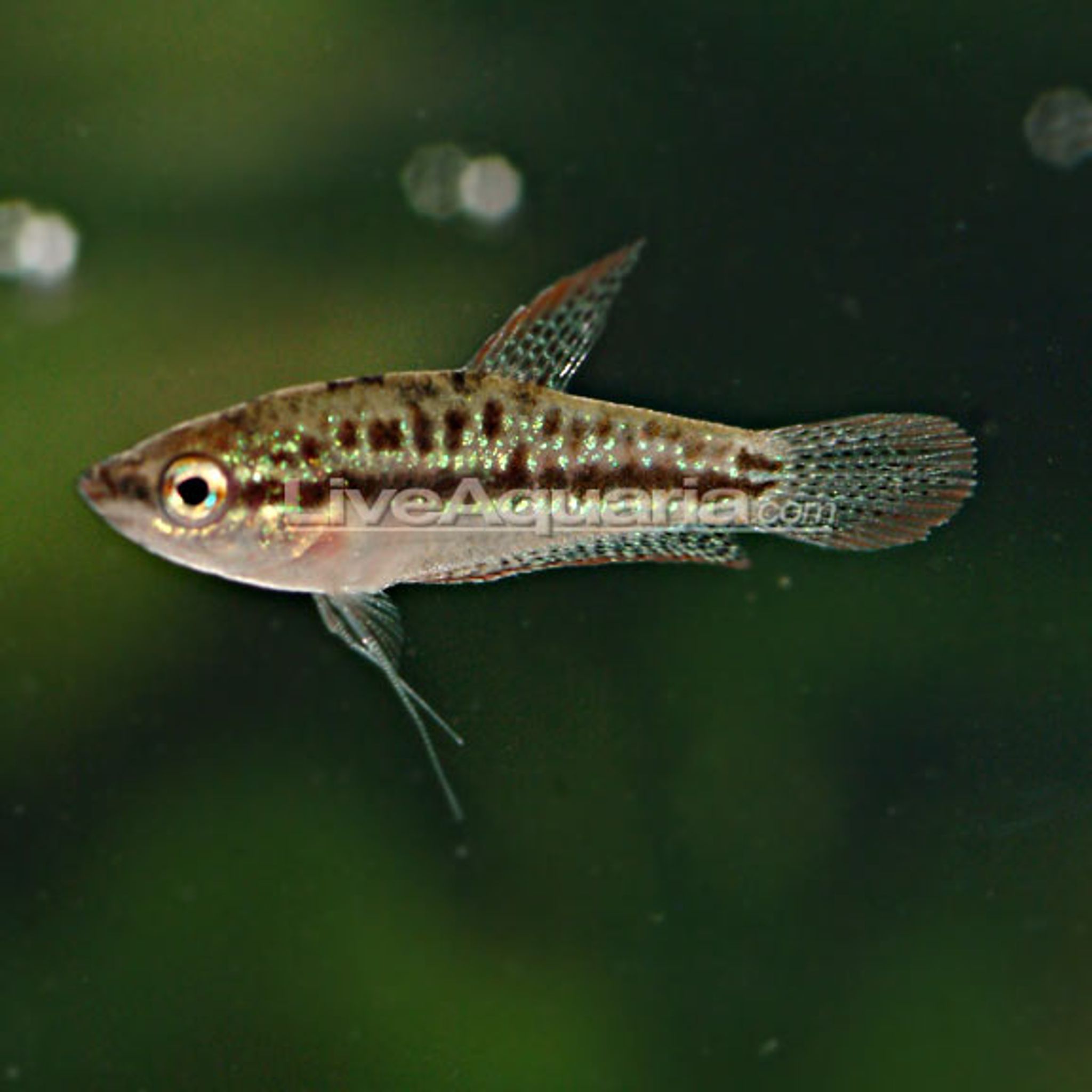

How Big Do Sparkling Gourami Get? Growth Rate, Adult Size and Tank Planning
Sparkling gourami (Trichopsis pumila) reach an adult length of roughly 1.4–1.6 inches (3.5–4 cm), making them one of the smallest gourami species kept in freshwater aquariums. That small size doesn't mean a small tank is fine, though — this article walks through the growth timeline from fry to adult, then translates the finished size into real gallons, group ratios, and tank-shape decisions for a US setup.
Adult Size: What "1.4–1.6 Inches" Actually Means
Trichopsis pumila belongs to its own genus, separate from the true dwarf/full-size gouramis in the genus Trichogaster and unrelated to bettas, despite all three being labyrinth fish that gulp air at the surface. It's genuinely one of the smallest labyrinth fish in the aquarium trade.
Most sources land somewhere in the 1.4–1.6 inch range for adults, and that spread isn't really a disagreement — it mostly comes down to measurement convention:
- Body length (standard length) measures snout to the base of the tail, excluding fin rays. This tends to produce the lower figures, closer to 1.4 in.
- Total length includes the fin extensions, especially the elongated dorsal and anal fin rays on mature males, which pushes the number toward 1.6 in.
For planning purposes, treat 1.5 inches (about 3.8 cm) as the practical average adult size. Females typically finish slightly smaller and rounder-bodied than males, though the difference is subtle enough that size alone isn't a reliable way to sex this species.
Sparkling Gourami vs. Dwarf/Honey Gourami
Buyers searching "small gourami" often land on either species, so it's worth a direct comparison:
| Trait | Sparkling Gourami | Dwarf/Honey Gourami |
|---|---|---|
| Adult size | ~1.4–1.6 in (3.5–4 cm) | ~2–3.5 in (5–9 cm) |
| Genus | Trichopsis | Trichogaster |
| Temperament | Mildly territorial between males | Generally peaceful, occasional mild territoriality |
| Notable trait | Audible croaking/clicking sound | Bubble-nest builder, quieter |
| Minimum group tank | 10 gal (38 L) | 10–15 gal (38–57 L) |
Sparkling gourami are the smaller, quieter-bodied, but sound-producing cousin — a genuinely different fish, not just a color morph.
Growth Rate: From Fry to Full Size
Sparkling gourami fry hatch nearly microscopic and can't take standard first foods — they need infusoria-type foods (or an equivalent-size live culture) for the first stretch of life before graduating to microworms and then baby brine shrimp.
Here's an approximate growth checkpoint table. Individual growth varies with temperature, feeding frequency, and water quality, so treat these as midpoints rather than guarantees:
| Age | Approximate Length | Notes |
|---|---|---|
| Hatch | Near-microscopic | Free-swimming after yolk sac absorption, needs infusoria-type food |
| 4 weeks | ~0.2 in (5 mm) | Body shape still larval; extremely fragile |
| 8 weeks | ~0.5–0.6 in (1.3–1.5 cm) | Body shape and early fin extension visible |
| 12 weeks | ~0.8–1.0 in (2–2.5 cm) | Coloration starting to develop |
| 16 weeks | ~1.1–1.3 in (2.8–3.3 cm) | Approaching adult proportions |
| 4–6 months | ~1.4–1.6 in (3.5–4 cm) | Near-adult length reached |
Most individuals reach close to full adult length by 4–6 months. Fin extension and color intensity — the male's longer dorsal/anal fin points and iridescent blue-red flecking — can keep filling in for a while after length has already capped, so a 5-month-old fish may still look a bit less vivid than a fully mature one.
Sexing and Size Differences
Because size alone isn't a dependable cue at this scale, look at fin shape and body proportion instead:
- Males: longer, more pointed dorsal and anal fins; more saturated blue and red iridescence, especially when displaying.
- Females: shorter, more rounded fins; a deeper body profile, particularly when gravid with eggs.
These differences become easier to spot once fish are past the 12-week mark and coloring up, which is also roughly when a breeding group can be reliably sexed for setting up ratios.
Tank Size: Turning 1.5 Inches Into Gallons
This is where "how big do they get" actually matters for planning. A 1.5-inch fish still needs real horizontal space, for two reasons: they're a shoaling species that does best in a group, and they're surface-air breathers.
Why Footprint Beats Volume for This Species
Sparkling gourami use a labyrinth organ to gulp air at the surface, so surface area matters more than raw volume. A tall, narrow tank might hold more gallons than a shallow long tank of the same footprint, but it gives the fish less usable surface to breathe from and less horizontal territory to spread out and avoid conflict. A long, shallow tank — a 20-gallon long over a 20-gallon high, for example — is the better shape even at equal volume.
Minimum Tank Size and Group Math
- 5 gallons (19 L): workable only as a single-fish nano build or a temporary species-only grow-out/quarantine tank — not a long-term group setup.
- 10 gallons (38 L): the realistic practical minimum for a small group (roughly 4–6 fish) in a planted setup. This is the number to plan around for a first sparkling gourami tank.
- 15–20 gallons (57–76 L): better if you want to add tankmates, keep more than one male, or simply want more margin for water-quality stability.
As a rough stocking guide, add about 1–2 gallons of headroom per additional adult beyond a base group of 4–6 in a 10-gallon. A 20-gallon long, for instance, comfortably supports a group of 8–10 with tankmates, where a 10-gallon is better kept to the species alone. You can browse freshwater community fish sized appropriately to round out a group like this.
Stocking Ratio and Aggression
Keep sparkling gourami in a group rather than a single pair. A common approach is 1 male to 2–4 females, or an all-female/juvenile group, which spreads male attention around instead of concentrating it on one female or one rival male.
Male-Male Behavior: What's Normal and What Isn't
Two mature males in under about 15–20 gallons of well-planted, sightline-broken space will often lock jaws and wrestle — a display that looks alarming but is rarely fatal in a spacious tank with places to retreat. This is genuinely analogous to how betta flaring gets misread as an emergency.
Step in when you see:
- Visible physical injury (torn fins beyond normal wear, open sores)
- One fish hiding constantly and refusing to surface or feed
- A clear, sustained loser being chased without any breaks
Dense planting, floating plants, and driftwood or leaf litter to break sightlines reduce this friction significantly. A single male with no refuges in the tank is a common setup mistake — it leads to constant chasing and stress-related color loss or appetite drop even without outright injury.
Water Parameters at a Glance
Ideal temperature range: 76–80°F (24–27°C). Wider figures of 70–83°F or 74–82°F circulating online represent the outer tolerance range this species can survive, not the husbandry target — treat 76–80°F as the sweet spot for daily care and breeding conditioning.
Full parameter reference:
| Parameter | Range |
|---|---|
| Temperature | 74–82°F (23–28°C); target 76–80°F (24–27°C) |
| pH | 6.0–7.5 tolerated; target a stable 6.5–7.0 |
| Hardness | Soft, roughly 1–10 dGH/dKH |
| Ammonia/Nitrite | 0 |
| Nitrate | Low |
pH figures quoted elsewhere range as wide as 5.0–8.0; rather than chasing either extreme, aim for a stable neutral-to-slightly-acidic 6.5–7.0, since stability matters more than hitting an exact number.
Filtration: Gentle, Not Strong
Sparkling gourami come from slow, still blackwater-type habitats, so gentle filtration is preferred over strong flow. A sponge filter or an air-driven filter is a better match than a powerhead or a hang-on-back unit running at full output. Strong current stresses fish that evolved for still water and can interfere with their ability to gulp air comfortably at the surface. Watch for fin-clamping or excessive hiding as a sign to dial the flow back. You can find suitable gentle options among aquarium filters sized for a 10–20 gallon footprint.
Diet
Sparkling gourami are omnivorous micro-predators. Live or frozen daphnia, baby brine shrimp, bloodworms, and microworms are strongly preferred, and many specimens genuinely need live or frozen food to thrive and color up properly — this matters especially when conditioning a breeding group. They'll accept quality flake, pellet, or freeze-dried foods, but fish surviving on dry food alone often stay duller and grow slightly slower than well-conditioned counterparts.
Housing and Décor
- Dense live planting and floating plants to break sightlines and reduce male-male conflict
- Driftwood and leaf litter for additional cover and a natural blackwater look
- A tight-fitting lid — sparkling gourami are strong jumpers, especially when startled or mid-display, and this happens often enough at night that a gap in the lid is a real risk
Tankmates and Shrimp Compatibility
Good tankmates include other small, peaceful nano fish — small rasboras and tetras, otocinclus, and pygmy corydoras — plus dwarf or pearl gourami in larger, more spacious setups. Poor matches include boisterous or fin-nipping species like tiger barbs, and male bettas, which brings territorial and labyrinth-fish conflict into a tank that's already tight on surface space.
Shrimp are a mixed bag. Many keepers report sparkling gourami picking off shrimp fry or very small shrimp, so treat shrimp compatibility as case-by-case rather than guaranteed-safe. If you're stocking a dwarf shrimp colony you want to breed out, watch closely for disappearing shrimplets before assuming the two are compatible in your specific tank.
Lifespan
With good care, sparkling gourami typically live 4–5 years, occasionally longer.
Common Diseases and Health
Most health issues in this species trace back to stress from cramped quarters or aggressive tankmates, which is exactly why the tank-planning angle matters as much as the species profile:
- Fin rot: ragged, receding fin edges, often following prolonged fin-nipping or poor water quality
- Ich (white spot disease): small white dots across body and fins, often triggered by temperature swings or stress
- Columnaris ("cottonwool" disease): fuzzy white/gray patches, a fungal-bacterial infection that takes hold faster in stressed, crowded fish
Stable parameters, gentle flow, adequate space, and low aggression levels go a long way toward preventing all three.
Breeding Overview
Sparkling gourami are bubble-nest builders, similar to bettas. The male builds a foam nest at the surface, often tucked under a leaf or floating plant, then eggs hatch in roughly 24–72 hours depending on temperature while the male guards and tends the nest.
Unlike some labyrinth fish, egg and fry predation by the parents is uncommon in this species — but it's not impossible, so many breeders still separate the male (or the whole pair) once fry are free-swimming. Fry rearing follows the same food progression as the growth section above: infusoria-type foods first, then microworms, then baby brine shrimp as they grow into it.
Fun Facts: The Croaking Sound and Jumping Ability
Sparkling gourami are named for the audible croaking or clicking sound they make during courtship and territorial display — produced via tendons on the pectoral fins, a sound-production method unique among gourami relatives. If you hear a faint clicking near the tank at dusk, that's normal breeding or territorial behavior, not a sign of distress.
They're also genuinely strong jumpers relative to their size, which is the other reason a tight lid isn't optional — a startled dash or an intense male display can send one clear out of an open top.
Common Mistakes to Avoid
- Underestimating space because the fish "looks tiny forever." Even at 1.5 inches, a proper group needs real horizontal footprint and dense planting, not a 1-gallon bowl.
- Using a tall, narrow tank instead of a long, shallow one — this reduces both surface area for breathing and usable floor territory.
- Skipping the lid. Jumping incidents cluster around startled moments and nighttime male displays.
- Overfiltering. Strong flow stresses a species built for still water; fin-clamping or constant hiding is your cue to dial it back.
- Housing a single male with no refuges, which produces chronic low-grade stress even without visible injury.
- Assuming shrimp are automatically safe. Watch for vanishing shrimp fry before trusting the combination.
- Underfeeding live and frozen foods. Dry-food-only diets tend to produce duller, slightly slower-growing fish.
Frequently Asked Questions
How big do sparkling gourami actually get?
Adults reach roughly 1.4–1.6 inches (3.5–4 cm) total length, making them among the smallest gourami species kept in the hobby. Use 1.5 inches as a practical planning average.
How long until they reach full size?
Most individuals reach close to full adult length in roughly 4–6 months from fry, though fin extension and full color intensity can keep developing a bit beyond that point.
What's the smallest tank I can keep them in?
A 5-gallon tank works only for a single fish, and even then only as a short-term or grow-out setup. For a proper long-term group, 10 gallons is the realistic minimum, with 15–20 gallons giving more margin if you add tankmates or a second male.
Can I keep just one sparkling gourami, or do they need a group?
They do best in small groups of around 5–6 fish with a skewed ratio, such as 1 male to 2–4 females, rather than as a solitary pet or a single pair. A lone male in particular tends to show more stress-related behavior than one kept in a proper group.
Do sparkling gourami need a heater and filter?
Yes to both. They need stable tropical temperatures in the mid-70s to low-80s °F and gentle filtration — a sponge or air-driven filter rather than a strong-flow unit — to match their still-water origin.
Are sparkling gourami aggressive?
They're mildly territorial between males, with visible flaring and jaw-wrestling displays, but generally peaceful toward other small, appropriately sized tankmates. Most real aggression problems trace back to crowding or a lack of refuges rather than the species' base temperament.
Will they eat my shrimp?
Possibly, especially shrimp fry and very small shrimp. Treat shrimp compatibility as a risk to monitor rather than a guaranteed-safe combination when stocking a dwarf shrimp colony alongside them.
Why do my sparkling gourami make clicking or croaking noises?
That sound is natural courtship and territorial communication, produced through tendons on the pectoral fins — a trait unique to this genus among gourami relatives. It's not a sign of illness or distress.
Ready to plan a group? Browse available gourami on FishyHub to find sparkling gourami and compare them against other small gourami species for your tank size.


