
How Big Do Rainbow Shark Get? Growth Rate, Adult Size and Tank Planning
A rainbow shark tops out around 4 to 6 inches as an adult, with a hard ceiling near 6 inches for most tank-raised fish and rare outliers pushing 7 to 8 inches under ideal conditions. Most of that growth happens fast, in the first year, which is exactly why a fish that looked harmless in a 1-2 inch store tank can outgrow a small aquarium before its first birthday. Below is the growth timeline, the tank-size math, and the husbandry details that keep this territorial floor fish healthy long-term.
Is a Rainbow Shark Actually a Shark?
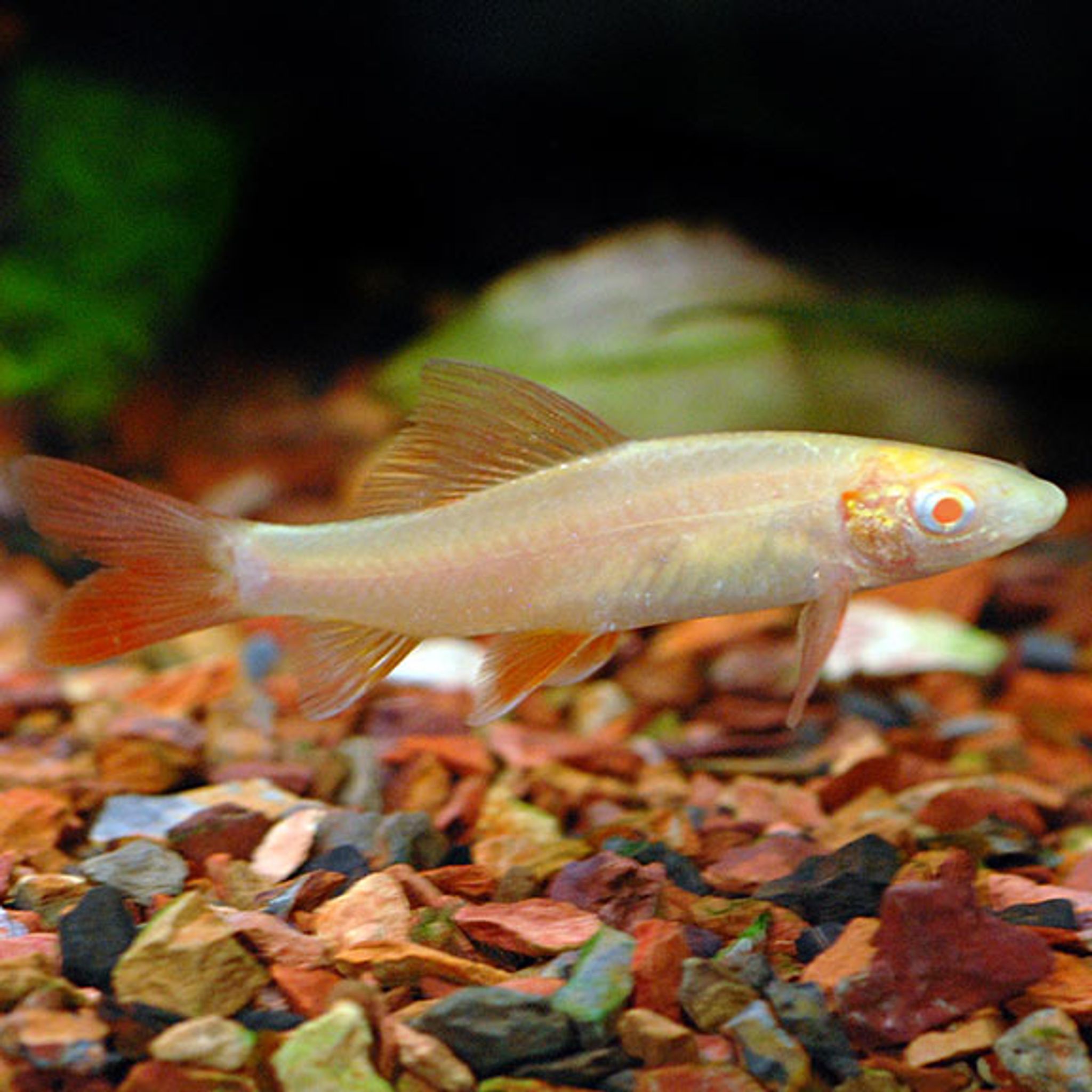
No. The rainbow shark (Epalzeorhynchos frenatum) is a freshwater cyprinid — a member of the minnow family, related to barbs and danios, not to any true shark. It earns the name from body shape alone: a torpedo-shaped body, a flat belly, and a tall, upright dorsal fin that mimics a shark's silhouette. There's no cartilage skeleton, no gill slits, nothing biologically shark-like about it. It's a bottom-dwelling scavenger with an attitude, and the resemblance stops at looks.
Adult Size: The Number to Plan Around
Plan for 6 inches (about 15 cm) as your working number. The realistic adult range is 4-6 inches, and while a small percentage of well-kept specimens in spacious, mature tanks reach 7-8 inches (18-20 cm), that's the exception, not something to expect from an average setup.
A few points worth knowing before you buy:
- No size difference between sexes. Unlike many aquarium fish where females run noticeably larger, male and female rainbow sharks reach essentially the same adult length. Sex doesn't help you predict size.
- Store-bred fish can plateau smaller. Individual variation across the 4-8 inch range is normal and usually reflects genetics and rearing conditions rather than anything you did wrong. A fish settling at 4.5 inches isn't a failure of care.
- Length matters more than bulk. These are lean, elongated fish — there's no "chunky" adult phase to watch for the way there is with, say, an oscar.
Growth Timeline: From Fry to Full Size
Sources scatter individual data points across "a few months" to "two full years," which makes it hard to tell if your own fish is on track. Here's that scattered information combined into one reference table.
| Age | Approximate Length | Notes |
|---|---|---|
| Newly hatched fry | Under 1/2 in (1.3 cm) | Nearly invisible; rarely seen in the retail pipeline |
| 2-4 weeks | 1/2-1 in (1.3-2.5 cm) | Fast early growth, still fragile |
| 6-12 months | 3-4 in (7.5-10 cm) | Fastest growth phase — 60%+ of adult length reached |
| Sexual maturity (~4 in) | ~4 in (10 cm) | Reached within the first year to 18 months |
| 18-24 months | 5-6 in (13-15 cm) | Approaching full adult size; growth slowing sharply |
| 24+ months | 6 in, occasionally 7-8 in | Essentially settled; only minor cosmetic filling-out continues |
The practical takeaway: expect the fastest, most visible growth in year one, with size largely locked in by 18-24 months. Treat that window as the realistic range rather than a fixed date — genetics, diet, and tank conditions all shift where an individual fish lands within it.
Growth Slowing Is Not Stunting
A common point of confusion: once a rainbow shark passes 18-24 months, growth decelerates dramatically, and owners sometimes read that as a health problem. In a fish that's been in an adequately sized tank the whole time, slowed growth after maturity is completely normal biology, not a warning sign. Stunting is a different thing entirely — it results from an undersized tank or poor water quality suppressing growth during the active growth window, and it usually comes bundled with other symptoms like poor color, clamped fins, or chronic stress behavior. If your fish grew normally through year one and then plateaus, that's expected, not stunted.
Tank Size: Why Footprint Beats Gallons
The minimum tank size for one adult rainbow shark is 50 gallons (190 L), though 55 gallons or more is the safer, more commonly recommended standard given how territorial this species gets in tight quarters.
Here's the point most care sheets skip: gallonage alone doesn't tell you if a tank works for this fish. A rainbow shark is a floor-territory species — it claims a patch of substrate and defends it, and what determines the size of a workable territory is floor length and width, not water volume. A tall, narrow 50-gallon column tank and a long, low 50-gallon tank hold the same amount of water, but only one gives the fish room to establish and patrol a territory without constantly bumping into glass or tankmates.
Practical footprint targets:
- Minimum tank length: 48 inches (4 feet)
- Minimum width/depth: around 18 inches
- Shape priority: long and low over tall and narrow
A tank that's undersized or oddly shaped — tall and narrow especially — tends to produce stress, glass-surfing, and heightened aggression even if the gallon number technically clears the minimum. You can browse appropriately sized, low-profile setups in FishyHub's glass tanks selection when planning floor footprint rather than just volume.
Stocking Multiple Sharks or Bottom Dwellers
Rainbow sharks are solitary-minded and will fight their own species, plus other bottom-dwelling or shark-shaped fish, in a tight footprint. If you want to keep more than one:
- Bump up to 75+ gallons minimum, with heavy visual breaks (rockwork, driftwood, dense planting) splitting the floor into separate territories.
- Think in terms of floor space per bottom-dweller, not gallons per fish — two sharks in a 75-gallon long, low tank with sightline breaks has a real chance; two sharks in a 75-gallon tall tank likely doesn't.
- Even at 75-100 gallons, cohabitation is genuinely hit-or-miss. Most keepers do better with one rainbow shark as the sole bottom-territory fish and reserve additional floor space for peaceful, differently-shaped species.
Water Parameters and Habitat
| Parameter | Range | Notes |
|---|---|---|
| Temperature | 72-79°F (22-26°C) | Some sources extend to 82°F (28°C); 77°F (25°C) is a good target |
| pH | 6.5-7.5 | Occasionally cited as wide as 6.0-8.0; stay in the tighter range if you can |
| Hardness | 5-11 dGH | — |
| Flow | Moderate to strong | Native to flowing streams — use a filter that produces visible current |
| Substrate | Soft sand or smooth gravel | Sharp substrate can scrape the fish's underside and barbels as it forages |
A filter sized for real flow does double duty here — it satisfies the current preference and keeps water quality stable for a fish that spends most of its time foraging along the substrate. Browse filters built for stronger circulation if your current setup runs sluggish.
Diet
Rainbow sharks are omnivores with a scavenging streak. A solid feeding routine:
- Base diet: quality sinking pellets or flakes, plus algae wafers
- Protein rotation: occasional bloodworms, brine shrimp, or daphnia (live or frozen)
- Vegetable matter: blanched zucchini, spinach, peas, or cucumber
Feed once or twice daily, offering only what's cleared in 2-5 minutes. An all-pellet diet with no vegetable matter is a common mistake — it's linked to duller coloration and weaker growth and overall condition over time.
Décor and Tankmates
This species needs caves, driftwood, and rock structures to claim as its own territory. Counterintuitively, giving it a defined space to call home tends to reduce aggression toward tankmates — a rainbow shark with a claimed cave has less reason to chase intruders across the entire tank floor.
Good tankmates occupy the mid-to-upper water column: danios, rasboras, barbs, gouramis, and other rainbowfish generally coexist fine since they don't compete for floor territory.
Avoid other bottom-dwelling or shark-shaped fish — red tail sharks, other rainbow sharks, and some loaches or cichlids get treated as territorial rivals and are attacked regardless of tank size.
Red Tail Shark: The Look-Alike to Know
The red tail shark is a close relative with an almost identical profile: same 4-6 inch adult size (with similar 7-8 inch outliers possible), the same growth curve — fastest in months 6-12, full size somewhere between 1-3 years — and the same 55-gallon-plus minimum tank recommendation. The two species are frequently confused and should never be housed together; near-guaranteed territorial fighting results from two look-alike floor-territory fish competing for the same space. The easiest way to tell them apart: a rainbow shark carries red-orange coloring across all its fins, while a red tail shark keeps that color confined to the tail alone, with a mostly black or dark gray body.
Siamese Algae Eater: A Reasonable Tankmate, Not a "Small Fish"
Often recommended as a peaceful bottom-dweller alongside sharks, the Siamese algae eater actually reaches a comparable 6 inches at full maturity, typically over about 2 years. It only requires a 20-gallon tank on its own, which is where the confusion starts — but its adult size and bottom-dwelling habits should factor into your overall stocking plan once you're already running a rainbow shark. You can compare options in FishyHub's algae eater listings if you're weighing this species as a tankmate.
Lifespan
With good care, a rainbow shark typically lives 5-8 years. Poor conditions — undersized tanks, inconsistent water quality, or repeated stress — can shorten that to as little as 4-6 years. Lifespan tracks care quality closely for this species, more so than for many hardier community fish.
Common Mistakes to Avoid
- Buying a 1-2 inch juvenile and assuming it stays small. This is the single most common surprise — a fish that looks tiny in a store tank can hit 6 inches of territorial attitude within a year, outgrowing a 20-30 gallon setup fast.
- Choosing a tall, narrow tank over a long, low one. Even at an adequate gallon count, insufficient floor length causes stress, glass-surfing, and elevated aggression.
- Housing it with other bottom-dwellers or shark-shaped fish. Aggression here is close to guaranteed, independent of tank size.
- Feeding an all-pellet diet. Skipping vegetable matter is linked to duller color and weaker growth.
- Skipping a full nitrogen cycle before adding the fish. As a bottom-foraging scavenger, it's particularly exposed to ammonia and nitrite spikes.
- Panicking over slowed growth after year one. This is normal deceleration in an adequately sized tank, not stunting.
Frequently Asked Questions
How big does a rainbow shark get in a 20-gallon tank?
Growth is often stunted or slowed, and stress-driven aggression tends to increase in a space this tight. A 20-gallon tank isn't a suitable permanent home for this species regardless of what final size the fish reaches.
How fast do rainbow sharks grow?
Growth is fastest in the first 6-12 months, when a fish can reach roughly half to most of its adult length. Size is essentially settled by 18-24 months, with only minor changes afterward.
Do rainbow sharks stop growing?
Growth slows dramatically after the fish reaches sexual maturity and near-adult length, typically around 1.5-2 years. Some very minor filling-out can continue beyond that, but it's not comparable to the growth seen in year one.
What is the minimum tank size for one rainbow shark?
50 gallons is the floor, with 55 gallons or more recommended as the comfortable standard. Prioritize a long, low footprint — at least 48 inches long and around 18 inches wide — over a tall, narrow tank of the same volume.
Can I keep two rainbow sharks together?
It's generally not recommended in tanks under roughly 75-100 gallons, and even then only with heavy sightline breaks from rockwork or driftwood. This species is territorial toward its own kind regardless of overall tank size.
Is a rainbow shark actually a shark?
No. It's a freshwater cyprinid — a relative of minnows and barbs — that only resembles a shark in body shape and fin profile.
Why is my rainbow shark's color fading or pale?
Faded color is usually driven by stress, poor water quality, an unvaried diet, or a lack of hiding and territory spots — not by the fish's size or age. Check water parameters and add more caves or driftwood before assuming anything more serious is wrong.
What's the difference between a rainbow shark and a red tail shark?
The two are nearly identical in size and care requirements, distinguished mainly by fin coloration: a rainbow shark shows red-orange on all its fins, while a red tail shark carries that color only on the tail. They should never be housed together, since near-identical territorial floor fish almost always fight.
Planning a rainbow shark's tank from the start makes the growth curve above a non-issue — size the aquarium for the 6-inch adult and long, low floor space it will eventually need, not the 1-2 inch juvenile in front of you. Browse rainbow sharks and compatible tankmates in FishyHub's freshwater shark selection to get started.


