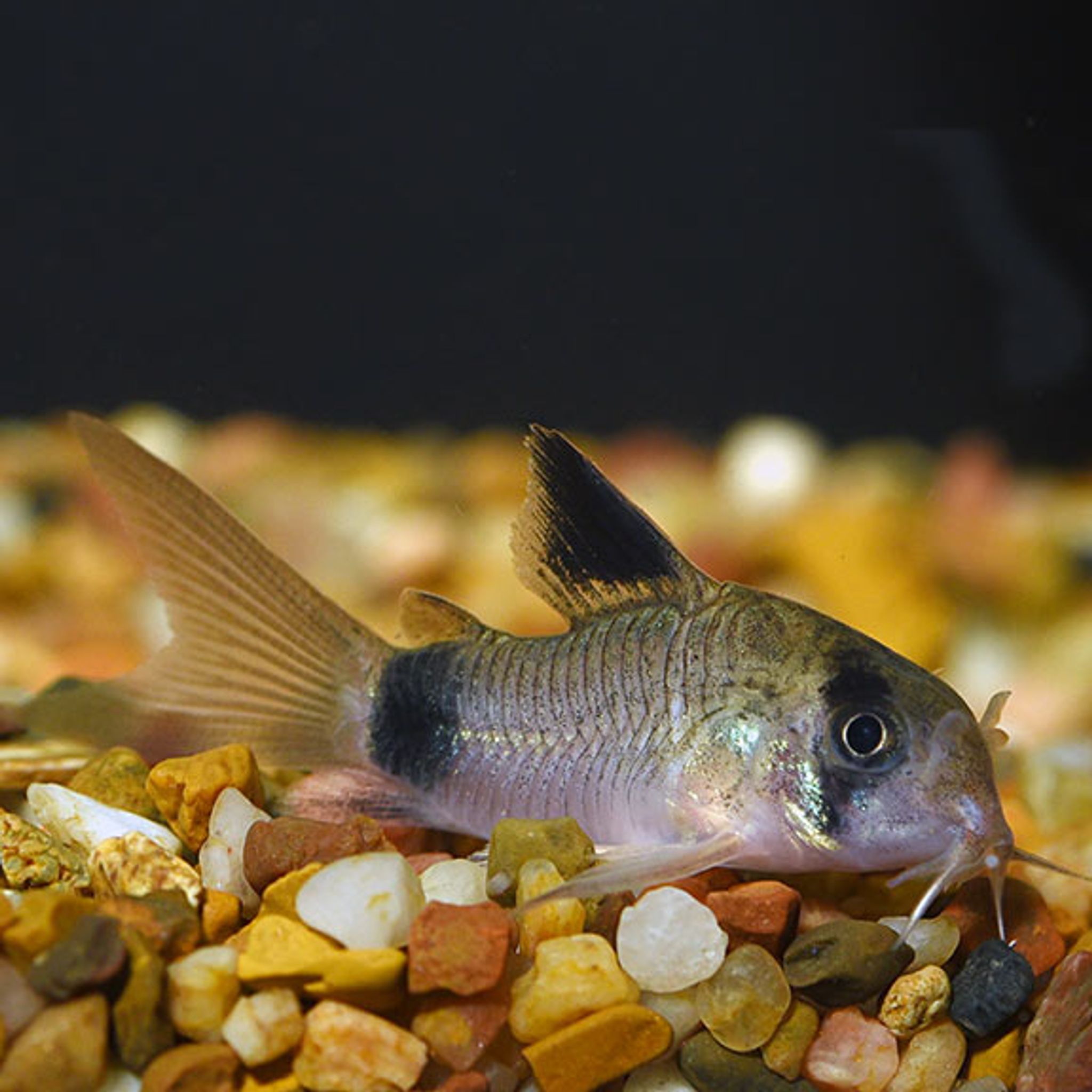

How Big Do Panda Cory Get? Growth Rate, Adult Size and Tank Planning
Panda corydoras (Corydoras panda) top out at roughly 1.6–2 inches (4–5 cm), with females finishing slightly larger and rounder than males. They get there gradually over about a year, and the tank size question isn't really about the size of one fish — it's about keeping a proper shoal of them long-term. Here's the real growth curve, the numbers behind it, and how to plan a tank around a group instead of a single tiny body.
Panda Cory Adult Size: The Real Range
Some general references round panda cory up to "about 2 inches" flat. That's not wrong exactly, but it blends males and females together and loses useful detail. The more precise picture:
- Males: typically stay closer to 1.6 in (4 cm), with a slimmer, more streamlined body.
- Females: reach the top of the range, up to 2 in (5 cm), and develop a noticeably deeper, rounder body — especially when gravid and carrying eggs.
- Captive-bred stock: sometimes matures slightly smaller than wild-collected fish, which is normal and not a sign of poor health.
If you're trying to sex your group as they mature, body depth viewed from above is the easiest tell — females look broader behind the head, males stay narrow front to back.
Growth Timeline: Fry to Full-Grown
Growth in panda cory is front-loaded. They add most of their length in the first six months, then growth slows sharply while the body fills out and deepens through month nine to twelve. Visible progress in month two or three can look painfully slow — that's expected, not a warning sign.
| Age | Approximate Length | Notes |
|---|---|---|
| Free-swimming fry | ⅛–¼ in (3–6 mm) | Nearly transparent, need frequent tiny feedings |
| ~2 months | ~1 in (2.5 cm) | Fastest growth phase, coloring develops |
| ~6 months | ~1.6 in (4 cm) | Most males near final length here |
| 9–12 months | Full adult length and body depth | Females finish filling out to ~2 in |
Panda cory mature and grow a bit faster than some of the smaller dwarf cory species, but they're still noticeably slower than fast-growing community fish like tetras — so patience is normal, not a red flag.
What Actually Affects Final Size and Growth Rate
Genetics set the ceiling, but several everyday factors determine whether a fish reaches it:
- Diet quality and frequency: protein-rich sinking foods fed consistently support steady growth; sparse or low-protein feeding slows it.
- Water quality and stability: ammonia/nitrite spikes and inconsistent parameters divert energy toward stress response instead of growth.
- Tank size and stocking density: cramped, overstocked tanks stunt growth even when the fish itself is small.
- Temperature: staying within 72–78°F (22–26°C) keeps metabolism and growth on track; running consistently above 78°F stresses the fish long-term.
- Genetics/line: some bloodlines simply mature a touch smaller, independent of care.
Feeding Schedule by Growth Stage
- Fry: several small feedings a day of finely crushed food or infusoria-type first foods.
- Juveniles (1–6 months): 2–3 feedings daily, varied between sinking pellets, crushed flake, and small live/frozen foods.
- Adults (6+ months): 1–2 feedings daily is enough — sinking pellets or wafers, plus frozen or live brine shrimp, bloodworms, and daphnia for variety. A gel food also works well as an occasional protein-dense option.
Water Parameters for Healthy Growth
| Parameter | Recommended Range | Ideal |
|---|---|---|
| Temperature | 72–78°F (22–26°C) | Mid-range, stable |
| pH | 6.0–7.5 | 6.5–7.0 |
| Hardness | 2–15 dGH | Mid-range, soft to moderate |
Stability matters as much as the exact numbers. Panda cory tolerate a fairly wide range but do poorly with swings, and warm water run long-term above 78°F is a common, avoidable stressor.
Tank Size: Why 20 Gallons Long Is the Safe Answer
A single panda cory barely needs any footprint at all — but that's the wrong way to plan for this species. Panda cory are obligate shoalers; a fish kept alone or in a pair becomes stressed, skittish, and hides instead of feeding and growing normally. The tank size question is really a group-size question.
- Recommended minimum: a 20-gallon long tank for a proper group of 6 or more. The long footprint matters more than depth, since these are floor-dwelling fish that need horizontal foraging space.
- Absolute floor: a 10-gallon tank can technically support a smaller group of 4–5 with excellent, consistent maintenance, but it leaves no real margin for error and isn't the recommended starting point.
- Group size: aim for 6 minimum, with 8–10+ being ideal for a more natural, confident-looking shoal.
Because adults stay under 2 inches, the bioload per fish is genuinely low — but multiply that by a group of 8, add a filter and stable cycle, and 20 gallons becomes the sensible baseline rather than overkill. You can browse live corydoras stock when you're ready to plan a group.
Simple Stocking Math for a Community Tank
If you're combining panda cory with mid- or top-column fish, treat the cory shoal as a fixed-size unit rather than counting them inch-by-inch against everything else:
- 20 gallons: one panda cory group of 6–8 as the bottom layer, plus a modest school of small mid-water fish.
- 29–40 gallons: a full group of 8–10 panda cory, with room for a larger community of tetras, rasboras, or similar small schooling fish above them.
The shoal's space and filtration needs, not the individual 2-inch body length, should drive the tank-size decision.
Substrate Matters More Than People Expect
Panda cory forage constantly with sensitive barbels around their mouths, sifting through substrate for food. Fine sand protects those barbels; coarse gravel can gradually wear or damage them. Barbel damage isn't cosmetic — it impairs foraging, which can indirectly stunt growth and open the door to secondary infections. If you're setting up a new tank, choose sand or another fine, rounded substrate over sharp gravel from the start.
Panda Cory vs. Similar-Looking Species
New keepers frequently mix up panda cory with other small or patterned corys. Size expectations shift a lot depending on which one you actually have.
| Species | Adult Size | Key Difference |
|---|---|---|
| Panda cory (C. panda) | 1.6–2 in (4–5 cm) | Black eye-mask and saddle marking |
| Habrosus (dwarf cory) | ~1.5 in (3.5–3.8 cm) | Largest of the true "dwarf" corys; wider pH tolerance (6–8), 70–78°F |
| True pygmy cory | ~1 in (2.5 cm) | Noticeably smaller than panda cory; often confused with it |
| C. adolfoi | 2.2–2.4 in (55–60 mm) | Similar coloring, grows visibly larger than panda cory |
| C. julii | 2–2.5 in (5–6.4 cm) | Spotted pattern instead of an eye-mask; also needs ~20 gal minimum |
The important takeaway: true pygmy corys and habrosus are genuinely tinier than panda cory, while adolfoi and julii are look-alikes that actually grow larger. Buying based on a photo alone is how keepers end up with the wrong tank-size expectations.
Can Panda Cory Live With Julii or Adolfoi?
Generally yes, in a large enough tank — but size differences mean it's better to keep each species in its own group of 6+ rather than splitting a tank between 2–3 of each. Mixed small groups of multiple cory species tend to shoal less cohesively than a single full-size group of one species.
Common Mistakes That Affect Size and Health
- Keeping fewer than 6: causes stress and hiding, which can suppress feeding and growth.
- Using coarse gravel instead of sand: damages barbels and impairs foraging over time.
- Panicking over slow growth at month 2–3: this is the normal early curve, not a problem — most length is added in the first six months, and the rest fills in more slowly.
- Overcrowding a small tank "because the fish is tiny": ammonia and nitrite spikes from an undersized filter or overstocked tank are a leading cause of stunted growth and illness, regardless of how small each individual fish is.
- Confusing panda cory with true pygmy or habrosus dwarf corys: leads buyers to expect an even smaller adult size and undersized tank than panda cory actually needs.
- Letting temperature run warm and unstable: consistently above 78°F stresses panda cory and can affect both growth and lifespan.
Is My Panda Cory Stunted, or Just Small?
Run through this quick checklist before assuming a problem:
- Check the timeline. Is the fish under 9–12 months old? Slow visible growth before then is normal.
- Check sex. Slimmer, smaller fish in a group are frequently just males — not stunted.
- Test water quality. Ammonia, nitrite, and stable pH/temperature all need to check out.
- Review diet. Confirm varied, protein-rich feeding at an appropriate frequency for its age.
- Watch for other symptoms. Fading color, appetite loss, or erratic swimming alongside small size points toward illness (columnaris and ich are the two flagged health risks for this species) rather than normal size variance.
Lifespan Context: Why Slow Growth Isn't a Red Flag
A well-cared-for panda cory commonly lives several years, with the broader corydoras genus typically cited in the 5–8 year range. Against that lifespan, a full year to reach adult size is proportionate, not slow. New keepers who expect tetra-speed growth often worry unnecessarily during the first few months — as long as water quality, diet, and group size are on track, the growth curve above is simply what healthy development looks like for this species.
Frequently Asked Questions
How big do panda corydoras get in inches?
Panda cory reach roughly 1.6–2 inches (4–5 cm) as adults, with females typically finishing at the larger end of that range and males staying closer to 1.6 inches.
How fast do panda cory grow?
Most of their growth happens in the first six months, reaching about 1.6 inches by then. Full adult length and body depth typically finish by 9–12 months, with growth tapering noticeably after the initial fast phase.
Do panda cory get bigger than pygmy cory?
Yes. Panda cory (1.6–2 in) are noticeably larger than true pygmy corys, which top out around 1 inch, and slightly larger than habrosus dwarf corys at about 1.5 inches.
What tank size do I need for panda cory?
A 20-gallon long tank is the recommended minimum for a healthy group of 6 or more. A 10-gallon tank can work as an absolute floor for a smaller group of 4–5 with excellent maintenance, but it's not the ideal starting point.
Why is my panda cory not growing?
Usually diet, water quality, or tank size and stress are the cause — all fixable with better feeding variety, more frequent water testing, or more space. If slow growth comes with color loss, appetite loss, or erratic swimming, rule out illness such as columnaris or ich rather than assuming it's just normal size variance.
Can panda cory live with other corydoras species like julii or adolfoi?
Generally yes in a large enough tank, but because of the size differences it's better to keep each species in its own group of 6+ rather than mixing smaller numbers of two or three species together.
How many panda cory can I keep in a 20-gallon tank?
Roughly 6–8 as your primary bottom-dwelling group, which still leaves room for mid- or top-column community tankmates above them.
Does gender affect adult size?
Yes. Females grow rounder-bodied and slightly longer than males, reaching up to 2 inches, especially once they're carrying eggs.
Ready to plan your shoal? Browse live freshwater livestock on FishyHub, including corydoras and other small community fishes that pair well with a panda cory group.


