
How Big Do Knifefish Get? Growth Rate, Adult Size and Tank Planning
That silvery blade-shaped fish in the store tank is only 3–4 inches long, but it will not stay that size. Most knifefish sold in the US hobby, especially the black ghost knifefish, grow into 14- to 20-inch adults that need a tank measured in feet, not inches. Here is what to actually expect, stage by stage, so you can buy the right tank once instead of upgrading three times.
How Big Do Black Ghost Knifefish Get?
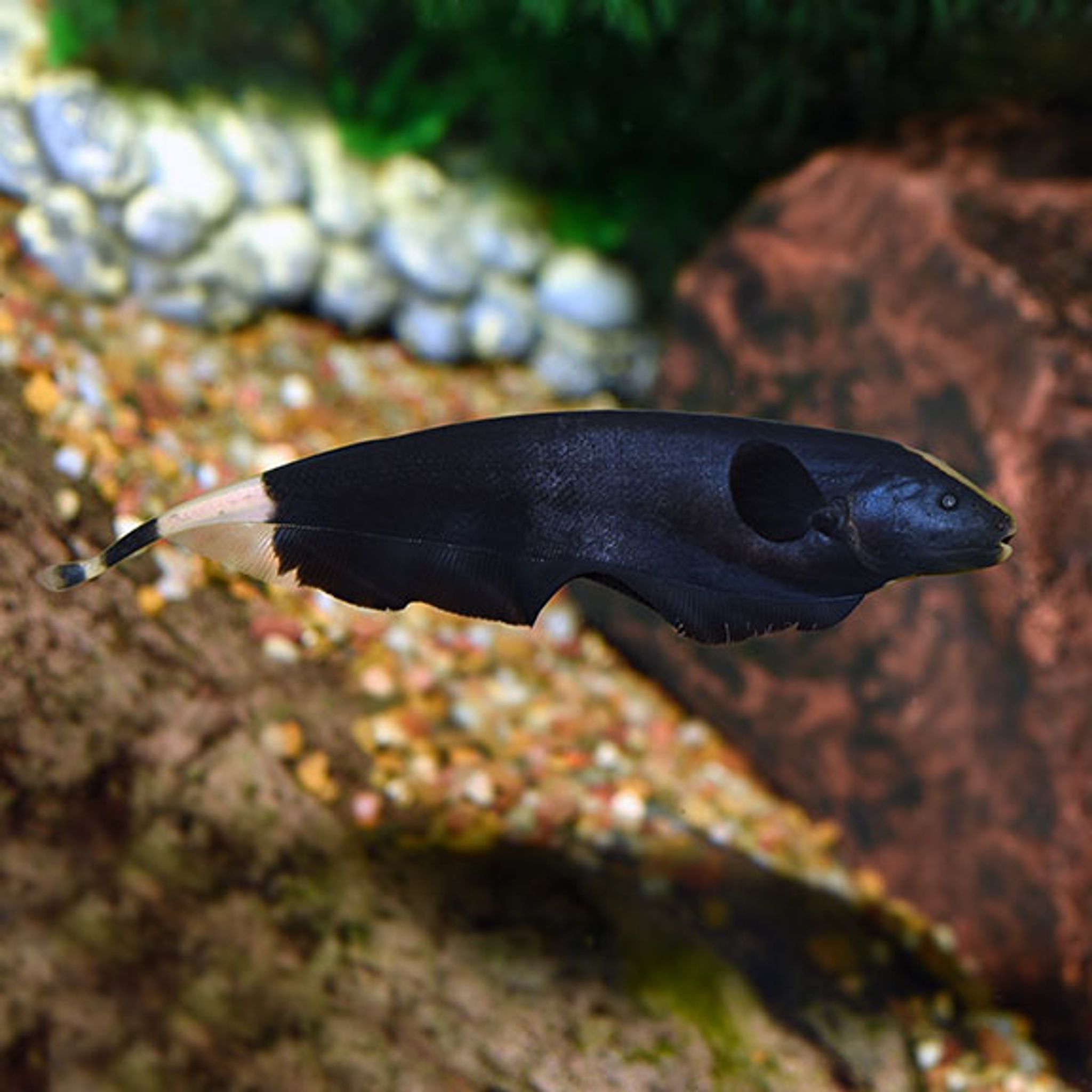
The black ghost knifefish (Apteronotus albifrons) is the species most commonly sold in US fish stores. Adults commonly reach 14–18 inches (35–46 cm), and a well-fed fish in excellent, stable conditions can occasionally push toward 20 inches (51 cm). That 20-inch figure gets cited often, but it represents the upper ceiling, not the average outcome.
For planning purposes, treat 14–18 inches as the realistic range and size your tank for the higher end anyway. A fish that "only" reaches 15 inches in a tank built for 20 inches is far better off than one that's cramped because you planned for the low number.
Growth Rate: How Fast Do Knifefish Grow?
Growth is front-loaded. A juvenile purchased at 3–4 inches grows quickly in its first year, then the pace slows considerably as it approaches adult size.
- First year: roughly 6–8 inches (15–20 cm) of growth — the fastest stretch of its life.
- Year two onward: growth slows to about 2–5 inches (5–13 cm) per year, continuing until the fish nears its maximum size.
- Full maturity: can take 3–5 years or longer, depending on genetics, diet, and tank conditions.
The wide range in year-two-and-beyond growth (some sources cite closer to 2 in/year, others 4–5 in/year) largely comes down to feeding frequency, food quality, and available swimming space. A knifefish kept in a cramped tank doesn't just grow slower — it can stunt outright, which is a welfare problem, not a convenient shortcut to a "manageable" size.
Growth-Rate Timeline
| Life Stage | Approximate Length | Typical Tank Stage |
|---|---|---|
| At purchase | 3–4 in (8–10 cm) | Starter/quarantine tank |
| 6 months | 8–12 in (20–30 cm) | Juvenile grow-out tank |
| 1 year | 10–14 in (25–36 cm) | Transitional tank |
| 2–3 years | 14–17 in (36–43 cm) | Sub-adult to adult tank |
| Full maturity (3–5+ years) | 14–20 in (36–51 cm) | Adult long-term tank |
Tank Size by Life Stage: The Upgrade Path
The mistake most new owners make is buying a tank for the fish they see, not the fish they'll have in a year. Plan the upgrade path before you bring the fish home.
- 20–29 gallons (76–110 L): acceptable only as a short-term starter for a juvenile under about 6 inches. Not a long-term home.
- 55 gallons (208 L): workable for roughly the first year, while the fish is still under 12–14 inches.
- 75 gallons (284 L): the next step up, and an absolute stopgap minimum once the fish approaches adult size — not where it should stay indefinitely.
- 100 gallons (378 L): a realistic long-term minimum for one adult black ghost knifefish.
- 120–180 gallons (454–681 L): the ideal, recommended target for a fully grown specimen, giving it real room to turn and cruise.
Footprint matters more than height. A knifefish needs a long, unobstructed swim lane along the bottom and mid-water, not a tall column of water. When comparing two tanks with similar gallon counts, choose the one with more floor length and width.
If you're keeping more than one, add another 75–100+ gallons per additional individual, not just a proportional gallon bump — black ghost knifefish can be territorial toward their own kind, and extra open space reduces clashes more reliably than extra volume alone.
Species Roundup: Not All Knifefish Stay the Same Size
Juveniles of several knifefish species look almost identical in a store tank — a generic silver blade with a long anal fin. Knowing which one you're looking at matters enormously for tank planning.
| Species | Adult Length | Temperament | Recommended Adult Tank |
|---|---|---|---|
| Black ghost knifefish | 14–18 in, up to ~20 in | Peaceful but easily bullied; solitary-leaning | 100 gal minimum, 120–180 gal ideal |
| Clown knifefish | Aquarium specimens commonly 24–36 in; wild reports of 3+ ft | Semi-aggressive/predatory as an adult | 200+ gal; generally unsuitable for typical home tanks |
| Glass (ghost) knifefish | Males up to 16–18 in; females often under 12 in | More peaceful, social — best in small groups | ~100 gal for adults |
Telling Them Apart at the Store
A few features help you avoid taking home a clown knife by mistake:
- Body shape: clown knifefish have a deeper, more compressed body even as juveniles, with dark oval spots along the upper body that darken with age.
- Coloration: black ghost knifefish are a uniform charcoal-black with one or two thin white or yellow tail-tip rings; glass knifefish are translucent to pale amber, often with visible internal organs.
- Fin profile: glass knifefish have a more slender, eel-like taper; clown knife juveniles already show a stockier, more torpedo-shaped body that hints at their eventual bulk.
- Ask before you buy: if a tag simply says "knifefish" with no species name, ask staff to confirm — the size difference between a black ghost and a clown knife is enormous, and misidentifying one commits you to a much larger setup than planned.
Water Parameters and Diet
Black ghost knifefish tolerate a moderate range, but they are sensitive to instability even within that range.
- Temperature: 73–82°F (23–28°C)
- pH: 6.5–7.8
- Hardness: soft to moderately hard water works; avoid extremes at either end. Stability matters more than hitting one exact number.
They are strict carnivores. Offer bloodworms, blackworms, brine shrimp, tubifex, small chunks of prawn or shrimp, and sinking carnivore pellets. Most individuals are reluctant to accept flakes at all, so flake-only feeding is a common cause of slow decline rather than a viable long-term diet. Since knifefish are nocturnal, feed after the lights go out for the best response.
Substrate, Decor, and Tank Mates
Knifefish have scaleless, sensitive skin, which shapes tank setup choices:
- Substrate: use smooth, fine sand. Sharp or coarse gravel scrapes their flanks and the wounds can become infected.
- Decor: provide caves, PVC pipe sections, driftwood, and dense planting for daytime hiding, plus dim lighting overall — this is a shade-loving, nocturnal fish, not a display piece under bright light.
For tank mates, choose calm species at least 6 inches long — big enough not to be eaten once the knifefish matures, but not aggressive fin-nippers that will damage its tail and skin. Reasonable choices include larger tetras, silver dollars, peaceful cichlids such as rams or acaras, corydoras, rope fish, bichirs, and other large peaceful catfish. Skip barbs and nippy tetra species; their bites target exactly the scaleless flanks that make this fish vulnerable. You can browse suitable community options in freshwater livestock or check plecos, corys and bottom dwellers for calm bottom-dwelling companions.
Electric Sense: Why They're Nocturnal
Black ghost and glass knifefish are weakly electric fish. They generate a continuous, low-voltage electric organ discharge that they use for electrolocation — sensing objects, food, and other fish in the dark without relying on sight. This is why they thrive under dim lighting and don't need bright illumination to navigate or feed. It also means they shouldn't be housed with other electrogenic species, since overlapping electric fields can interfere with each fish's ability to read its surroundings, and their discharge can occasionally interact oddly with certain electronic aquarium equipment.
Signs Your Knifefish Is Outgrowing Its Tank
Watch for these before they become a welfare issue:
- Curled or bent body posture, especially when resting or turning in a tight space.
- Injuries or scrapes from repeatedly brushing against decor or glass while turning.
- Lethargy or reduced activity at night, when the fish should normally be most active.
- Reluctance to swim the tank's length, hovering in one corner instead.
Any of these is a sign to upgrade tank size immediately, not to wait and see.
Common Mistakes to Avoid
- Buying a 3–4 inch juvenile for a 10–20 gallon tank with no upgrade plan, then facing an emergency rehoming situation months later.
- Using coarse or sharp gravel, which damages scaleless skin and invites infection.
- Feeding flakes only — most knifefish won't eat them reliably, and the fish slowly wastes away.
- Keeping the tank bright and bare, which stresses a nocturnal, shade-seeking fish; add cover and dim the lights.
- Misidentifying the species at purchase, ending up with a clown knife that needs 200+ gallons instead of a black ghost that needs 100–180.
- Housing with fin-nippers like barbs or aggressive tetra species, which damage the tail and skin over time.
- Assuming stalled growth means the fish is "fine" small — growth simply stunts in cramped conditions rather than settling at a healthy smaller size.
Lifespan: A Long-Term Commitment
Beyond size, a black ghost knifefish is a long-term commitment: expect roughly 10 years of lifespan under typical care, with 15+ years achievable under excellent, stable conditions. Sizing a tank correctly at the start avoids repeated upgrades over that entire span. A tank suited to an adult also gives you room to add the substrate and filtration this fish needs from day one — start with a fine, smooth sand or gravel substrate rather than retrofitting later.
Frequently Asked Questions
How big does a black ghost knifefish get in a home aquarium?
Typically 14–18 inches (35–46 cm), with up to roughly 20 inches (51 cm) possible in excellent, stable conditions with consistent feeding. Plan your tank around the higher figure rather than the average.
How fast do knifefish grow?
Fast in the first year, often adding 6–8 inches, then slowing to about 2–5 inches per year afterward until they approach their near-maximum size around year 3–5. Growth rate depends heavily on feeding and available space.
What size tank does an adult knifefish need?
A single adult black ghost knifefish needs 100 gallons as a realistic minimum, with 120–180 gallons as the ideal long-term target. Larger species like the clown knifefish need 200+ gallons, and multiples of any knifefish need substantially more.
Can knifefish be kept in a 55-gallon tank?
Only temporarily, during roughly the first year while the fish is still under 12–14 inches. A 55-gallon tank is not adequate as a permanent adult home.
Are knifefish aggressive toward other fish?
Generally peaceful, but they're easily bullied and have sensitive, scaleless skin. Choose calm, similarly-sized tankmates of 6 inches or more and avoid fin-nippers.
How long do knifefish live?
Around 10 years is typical, with 15 or more years achievable under excellent long-term care — a commitment closer to a decade and a half than a passing purchase.
Which knifefish species stays smaller?
The glass (ghost) knifefish tends to stay smaller than the black ghost knifefish, especially females, which often stay under 12 inches, compared to males reaching 16–18 inches.
If you're planning a knifefish setup, start by browsing appropriately sized species and tankmates in monster fishes and larger freshwater specimens on FishyHub before committing to a tank size.


