
How Big Do Harlequin Rasbora Get? Growth Rate, Adult Size and Tank Planning
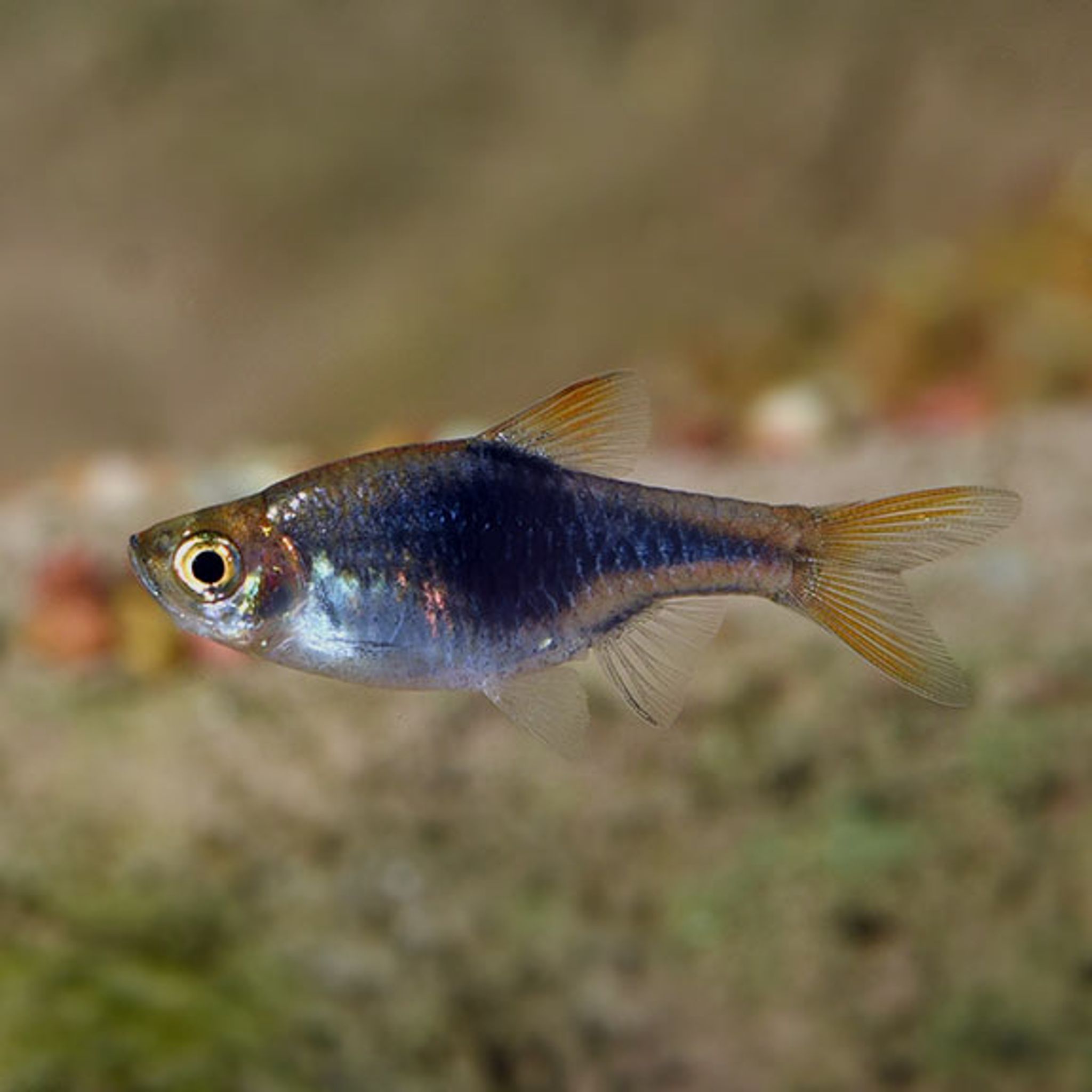
Harlequin rasboras top out at just 1.75–2 inches (4.5–5 cm) in standard length as adults, regardless of sex. That number alone doesn't tell you whether your tank will actually work for them, though — the real planning question is how many you need to keep together and how much floor space that shoal requires. This guide covers both: the growth timeline and the tank math.
Adult size: what the numbers actually mean
A mature harlequin rasbora measures 1.75 to 2 inches (4.5–5 cm) from snout to tail base. For context, that's roughly the same length as a cardinal tetra and noticeably smaller than a betta, which runs 2.5–3 inches. On paper, that's a tiny fish.
In the tank, harlequins read larger than their length suggests. Two body traits do the work:
- The harlequin patch — a bold, black triangular marking that covers the rear half of the body — creates strong visual contrast against the coppery-orange base color, making each fish easy to spot even in a busy shoal.
- A deep, laterally compressed body gives them a wider profile from the side than a slender fish of the same length, like a chili rasbora or a neon tetra.
So while the tape measure says "small," the visual impact of a well-fed shoal is bigger than the number implies.
Size compared to common tankmates
| Fish | Typical adult length |
|---|---|
| Chili rasbora | 0.6–0.8 in (1.5–2 cm) |
| Neon tetra | 1.2–1.5 in (3–4 cm) |
| Harlequin rasbora | 1.75–2 in (4.5–5 cm) |
| Cardinal tetra | 1.75–2 in (4.5–5 cm) |
| Cherry barb | 1.6–2 in (4–5 cm) |
| Betta | 2.5–3 in (6.5–7.5 cm) |
Harlequins sit comfortably in the middle of the nano-to-small-community range — bigger than chili rasboras and neon tetras, about on par with cardinal tetras, and smaller than a betta.
Growth rate: how fast do they get there
Growth isn't linear, and that trips up a lot of new keepers who panic when it slows down.
- First 2–3 months: fastest growth phase. Juveniles typically reach 50–60% of their eventual adult length in this window.
- Months 3 onward: growth slows sharply. This is normal biology, not a sign of a problem — don't assume something's wrong just because a five-month-old fish isn't visibly bigger than it was at three months.
- Full adult size: sources disagree on the exact timeline, ranging anywhere from 9 to 18 months. A practical rule of thumb is to expect full size by 9–12 months under good conditions, with up to 18 months possible in cooler water or on a lean diet. Treat "about a year" as your working answer rather than chasing a single precise figure.
What speeds up (or stunts) growth
| Factor | Effect |
|---|---|
| Varied diet (live/frozen daphnia, brine shrimp, bloodworm) | Faster growth, fuller adult size |
| Flake-only diet | Slower growth, often smaller, less vibrant adults |
| Stable warm water (mid-to-upper 70s°F) | Supports consistent growth |
| Fluctuating or poor water quality | Can slow growth or cause permanent stunting |
| Cramped tank / low headroom | Limits growth and shoal behavior |
| Disease during juvenile stage | Can permanently stunt final size |
A rotation of frozen and live foods alongside a quality flake or pellet base is the single biggest lever you control. FishyHub carries a range of live and frozen options worth working into a feeding rotation for small community fishes.
A note on lighting and feeding activity
Harlequin rasboras come from soft, tannin-stained blackwater habitats and tend to feed more actively under subdued lighting than under bright, high-intensity setups. It's a minor factor compared to diet and water quality, but if a shoal seems shy at feeding time, dimming the tank slightly can encourage more natural foraging behavior — which indirectly supports steadier growth.
Genetics and stock source
Not all harlequin rasboras start from the same baseline. Tank-raised stock that's been bred in captivity for generations can show slightly different maximum size and color intensity compared to wild-caught individuals, simply due to selective breeding pressure over time. This isn't well documented in most care guides, but it's worth knowing that two fish from different sources may not track identically even under the same care.
Sex differences: does size differ between males and females?
Length is essentially the same between sexes — don't expect a male vs. female size gap the way you might with livebearers. The differences show up in body shape and color instead:
- Females develop a rounder, plumper body, most visible from above, and especially pronounced when carrying eggs.
- Males stay leaner and more streamlined, and typically show more intense red/copper coloration, particularly when in breeding condition.
If you're trying to sex a shoal, look down at the fish from the top of the tank rather than relying on length alone.
Tank size: the question that actually matters
Because harlequin rasboras are small and produce relatively little waste per fish, the usual "how big a filter do I need" framing misses the point. The real constraint is swimming space and shoal cohesion, not bioload.
Why "one inch per gallon" doesn't work here
The old one-inch-of-fish-per-gallon rule was never a great general guideline, and it actively fails for shoaling nano fish. It ignores three things that matter more than raw length:
- Body shape and behavior — a shoaling fish needs open swimming room, not just a volume allowance.
- Bioload per fish — harlequins produce very little waste individually, so a tank stocked "by the rule" for waste capacity is often stocked far too sparsely for the shoal size they actually need.
- Filtration strength — bigger isn't automatically better. Harlequins are shy schoolers that do best with moderate flow; an oversized filter built for a heavier bioload can push more current than a rasbora shoal is comfortable swimming against.
Minimum tank size: 10 gallons as a floor
A 10-gallon tank is the commonly cited absolute minimum, and it can support a small starter shoal of 6–8 fish. It's a workable entry point, but it limits how large a shoal you can keep and gives you less buffer if water parameters drift.
The better answer: 15–20 gallons long
For a proper, natural-looking shoal, 15–20 gallons in a long-style footprint is the real "do it right" recommendation. A longer, shallower tank supports 8–12+ fish comfortably, gives the shoal more horizontal room to move as a group, and buffers water chemistry changes better than a smaller volume.
10 vs. 20 gallon: side-by-side
| 10 gallon | 20 gallon long | |
|---|---|---|
| Typical dimensions | 20 × 10 × 12 in | 30 × 12 × 12 in |
| Approximate full weight | ~111 lb | ~225 lb |
| Comfortable shoal size | 6–8 fish | 8–12+ fish |
| Stocking flexibility | Tight — little room for tankmates | Room to add calm tankmates |
| Parameter stability | Requires closer monitoring | More forgiving buffer |
If you're planning around the eventual shoal size rather than what fits on a shelf today, the 20-long is the tank to browse first in Glass Tanks.
Footprint beats gallons: 20g long vs. 20g high
Not all 20-gallon tanks are equal for a shoaling fish. A 20-gallon high (24 × 12 × 16 in) and a 20-gallon long (30 × 12 × 12 in) hold the same volume, but the long tank gives noticeably more horizontal swimming room — the dimension a rasbora shoal actually uses — while the high tank puts that same water into vertical space the fish rarely visit. For harlequins, always pick footprint over height.
10-gallon dimensions: watch for variants
A standard 10-gallon measures 20 × 10 × 12 in, but "long" and "tall" 10-gallon variants exist with different footprints at the same volume. Since floor space matters more than height for a shoaling fish, check the actual length and width before assuming any 10-gallon tank offers the same swimming room.
Aquarium sizes at a glance
| Size | Typical dimensions (L × W × H) |
|---|---|
| 5 gallon | 16 × 8 × 10 in |
| 10 gallon | 20 × 10 × 12 in |
| 20 gallon long | 30 × 12 × 12 in |
| 29 gallon | 30 × 12 × 18 in |
| 40 breeder | 36 × 18 × 16 in |
Bigger tanks aren't harder to keep stable — they're more forgiving. More water volume means slower swings in temperature and water chemistry, which benefits both the fish and your maintenance schedule.
A rough stocking formula by footprint
As a practical planning shortcut, use floor space rather than gallons alone:
- 20 × 10 in footprint (10g) → 6–8 harlequin rasboras
- 30 × 12 in footprint (20g long) → 8–12 harlequin rasboras
- 36 × 18 in footprint (40 breeder) → 15–20+ harlequin rasboras, with room for calm tankmates
This isn't a rigid rule, but it reflects how the fish actually use the tank — as a moving group across the floor plan, not stacked in the water column.
Shoaling requirements: why the group size is non-negotiable
Harlequin rasboras are obligate shoalers — they need company to feel secure, not just as a preference. Keep a minimum of 6, and ideally 8–10 or more.
A group smaller than 6 will visibly struggle:
- Faded, washed-out color instead of the full red-copper intensity
- Hiding behavior and reduced activity
- Visible stress responses like darting or clustering in a corner
If you can only manage a 10-gallon tank right now, stock the full 6–8 rather than splitting the budget between fewer rasboras and other species. The shoal's cohesion depends on numbers more than on tank decor or tankmates.
Common mistakes to avoid
- Buying too few fish. Under 6 causes stress and dull color — always buy a full shoal at once.
- Undersizing the tank for where you're headed. Plan around the target shoal (8–12) from day one instead of upgrading later.
- Panicking over slowed growth. Growth naturally drops off after the first couple of months — that's expected, not a sign of stunting.
- Feeding flake only. It tends to produce smaller, less colorful adults; rotate in live or frozen foods.
- Judging suitability by gallons alone. A tall, narrow tank holds the same water as a long, shallow one but gives a shoal far less usable swimming space.
- Picking the wrong tankmates. Harlequins have small mouths and a calm temperament — fast, competitive feeders will outcompete them and stress the shoal.
Measuring growth at home
A simple way to track your shoal's progress is to hold a clear plastic ruler against the outside of the glass and estimate a fish's length as it swims past a flat side. It won't be lab-precise, but checking every month or two gives you a real sense of whether growth is tracking normally — useful reassurance during that slower post-3-month phase.
Sustainable stocking practices
A few habits make harlequin rasbora keeping lower-impact without any real trade-off in fishkeeping quality:
- Choose captive-bred stock where available. Harlequin rasboras are widely bred in captivity, which reduces pressure on wild populations.
- Buy the shoal you're prepared for, not more. Avoid impulse-adding extra fish beyond your planned tank size.
- Feed responsibly. Portion control cuts waste and reduces how often you need to do larger water changes.
- Choose efficient equipment. A right-sized filter and heater for the tank volume reduce ongoing energy use without shortchanging the fish.
Tank-planning extras worth knowing
Fixing a leaking aquarium
If you're buying a used tank for your rasbora setup, know the difference between an upper-wall leak and a bottom/seam leak. A leak near the top of the tank can sometimes be patched without fully draining and moving fish. A leak at the bottom or along a seam usually requires draining the tank completely, letting it dry, and re-sealing the affected joint. Either way, use only 100% aquarium-safe silicone — general household or bathroom silicone often contains mold or mildew additives that can leach into the water. Let a repair cure fully, typically 24–48 hours, before refilling.
Pet-proofing the tank
A shoal of small, active fish can be irresistible to a curious cat or dog. A secure, well-fitted lid keeps pets from pawing at the water or drinking from it. It also helps to keep a separate water bowl filled elsewhere in the house, since aquarium water can carry trace fish waste or medication residue that may mildly upset a pet's stomach if it becomes a regular drinking source.
Frequently Asked Questions
How big does a harlequin rasbora get?
Adults reach about 1.75–2 inches (4.5–5 cm) in standard length, with no significant difference between males and females.
How long until a harlequin rasbora reaches full size?
Most reach full size in roughly 9–12 months under good conditions, though it can take up to 18 months in cooler water or with a leaner diet. There's no single fixed timeline across all sources.
What's the minimum tank size for harlequin rasboras?
A 10-gallon tank is the commonly cited absolute floor for a small shoal of 6–8 fish. For a fuller, more stable shoal of 8–12 or more, 15–20 gallons in a long footprint is the better long-term choice.
How many harlequin rasboras should be kept together?
Keep a minimum of 6, ideally 8–12, since they're obligate shoalers that show stress, faded color, and hiding behavior in smaller groups.
Do male and female harlequin rasboras grow to different sizes?
Length is similar between sexes. Females develop a plumper, rounder body, especially when gravid, while males stay leaner and typically show more intense red or copper coloration.
Can harlequin rasboras live in a 5-gallon tank?
Not recommended. A 5-gallon tank doesn't offer enough floor space or swimming room for the minimum shoal size this fish needs to thrive.
Does diet affect how big a harlequin rasbora gets?
Yes. A varied, protein-rich diet including live or frozen foods like daphnia, brine shrimp, and bloodworm supports fuller adult growth compared to a flake-only diet.
Will harlequin rasboras outgrow a community tank over time?
No. They stay small for life, making them a reliable long-term choice for nano and community setups as long as the tank was sized for the full shoal from the start.
Ready to start planning your shoal? Browse available harlequin rasboras and other small community fishes on FishyHub to size up your options before you buy.


