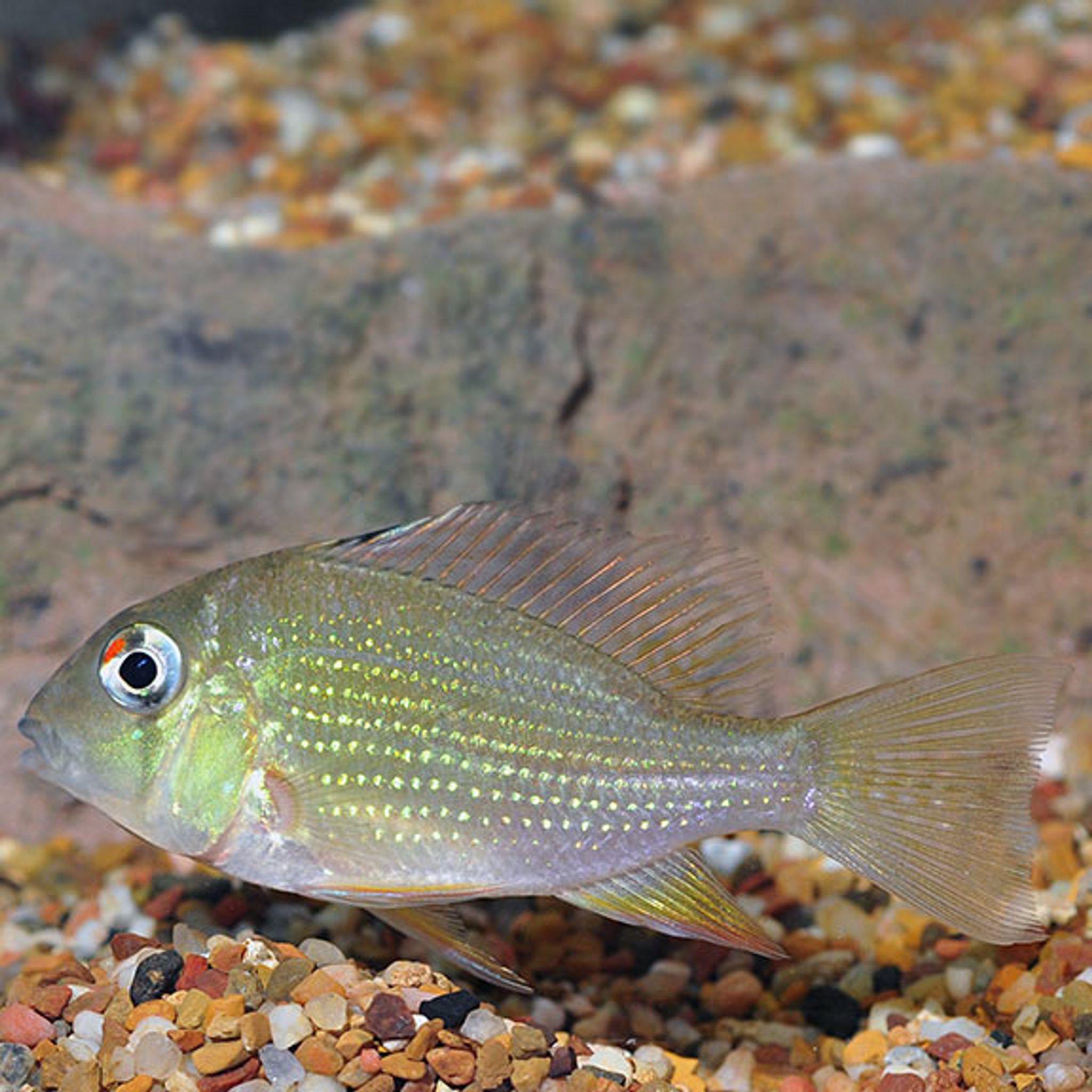

How Big Do Geophagus Get? Growth Rate, Adult Size and Tank Planning
Geophagus, the South American "eartheater" cichlids, typically reach 6 to 12 inches as adults, but the exact number depends heavily on which species you actually have. Most fish sold at 1-2 inches grow quickly in their first year and then keep filling out in body depth and finnage well into their second or third year, so the tank you buy at purchase time should already be sized for the adult, not the juvenile.
Geophagus Isn't One Fish — It's a Genus
"Geophagus" is a genus name covering dozens of South American cichlid species, all grouped together in the trade under the general label eartheater. That matters for the size question because a single blanket number is misleading — a Redstriped eartheater and a dwarf Paraguay eartheater sold under similar-looking labels can differ by 4-6 inches at maturity.
To add to the confusion, several closely related genera get lumped in with "Geophagus" at the store:
- Gymnogeophagus (Paraguay/South Brazilian eartheaters like balzanii and rhabdotus) — smaller and more compact, generally 6-8 inches.
- Satanoperca — true Geophagus relatives with a similar sifting lifestyle, often reaching 8-10+ inches.
- Mikrogeophagus (dwarf eartheaters, including ram cichlids) — a genus name that sounds related but describes genuinely dwarf fish, usually under 3 inches, and should not be planned around Geophagus-sized tanks at all.
If a tag simply says "assorted eartheater" or "assorted Geophagus," ask for (or research) the specific species before you commit to a tank size — mixed juvenile tanks at stores are common, and buyers are often surprised later by a much larger or more aggressive adult than they expected.
Adult Size by Species
Because size varies so much within the genus, it's more useful to look at species-specific numbers than a single average. Here's a quick reference for the fish most commonly sold in the US hobby.
| Species (common name) | Adult length | Minimum tank, single adult | Minimum tank, group of 5-6 |
|---|---|---|---|
| Redstriped/Surinamensis eartheater | 10-12 in (25-30 cm) | 75 gal | 125+ gal |
| Altifrons eartheater | 10-12 in (25-30 cm) | 75 gal | 125+ gal |
| Brasiliensis eartheater | 10-12 in (25-30 cm) | 75 gal | 125+ gal |
| Redhump eartheater | 8-10 in (20-25 cm) | 55-75 gal | 90-125 gal |
| Jurupari eartheater | 8-10 in (20-25 cm) | 55-75 gal | 90-125 gal |
| Tapajos/Winemilleri-type eartheater | 8-10 in (20-25 cm) | 55-75 gal | 90-125 gal |
| Gymnogeophagus (balzanii/rhabdotus) | 6-8 in (15-20 cm) | 40-55 gal | 55-75 gal |
These are general planning numbers, not hard ceilings — a fish given excellent care and generous space can land at the top of its range, while cramped conditions tend to keep fish smaller and shallower-bodied.
How Fast Do Geophagus Grow?
Fish sold small at around 1-2 inches grow fast when fed well and kept in clean, roomy water. A rough month-by-month expectation for a healthy juvenile:
| Age | Typical length |
|---|---|
| At purchase | 1-2 in (2.5-5 cm) |
| 6 months | 4-5 in (10-13 cm) |
| 12 months | 6-8 in (15-20 cm) |
| 18-24 months | Near full adult length |
| 2-3 years | Full body depth, hump, and coloration on larger species |
Length is mostly complete by 18-24 months, but body depth, nuchal humps, and finnage — the traits that make a mature eartheater look genuinely impressive — continue developing for another year or more on the larger species. Don't judge an 18-month-old fish's "final" look yet.
What Speeds Up or Stunts Growth
Growth rate isn't fixed — it responds directly to husbandry:
- Diet quality — a varied diet of sinking pellets or granules plus frozen or live foods (bloodworms, brine shrimp, daphnia) and some vegetable matter drives steady growth. Food that's too small or fed too infrequently slows growth noticeably.
- Water-change frequency — weekly 30-50% water changes support fast, healthy growth. Skipping changes is the single most common cause of stalled growth and disease, often showing up as pitting around the head and lateral line (commonly called "hole in the head").
- Tank size — a cramped tank limits growth and can permanently stunt a fish that never reaches its genetic potential, even after it's later moved to a bigger tank.
- Stocking density — overcrowding raises waste and competition for food, both of which slow growth across the whole group.
Tank Size by Life Stage
The single most common mistake with Geophagus is buying a 2-inch juvenile for a 20-29 gallon tank because that's what "looks right" for its current size — then needing a stressful re-home or a rushed upgrade six months later once the fish outgrows it.
Plan for the adult from day one. A juvenile can start out in a smaller grow-out tank only if you already own the adult-size tank it's heading to; otherwise, buy the final tank first:
- Single dwarf species (Gymnogeophagus): 40-55 gallon
- Single standard species (8-12 in): 55-75 gallon
- Group of 5-6 juveniles, standard species: 90-125+ gallon, with room to thin down as pairs form
Footprint matters more than total gallons. Geophagus are bottom-dwelling sand sifters that spend most of their time working the substrate, so floor space matters far more than tank height. A 48 x 18-inch footprint (a standard 75-gallon) gives noticeably more usable sifting area than a taller 55-gallon with a 48 x 13-inch footprint, even though the gallon totals look close. Aim for at least a 48-inch (4-foot) length whenever you're housing a standard-size species.
If you're mapping this to tanks actually sold in US stores: a 40-breeder or 55-gallon can work for a single dwarf Gymnogeophagus, a 55-75 gallon suits one standard-size adult, and a 90, 120, or 125-gallon is the realistic range for a growing group of 5-6. You can browse glass aquarium tanks in these footprints when planning the setup.
Group vs. Single-Fish Stocking
Geophagus are best kept as a group of 5-6 juveniles rather than a single fish or a mismatched pair. Growing them out together spreads aggression across several targets instead of concentrating it on one fish, and it lets natural pecking order and pairing behavior develop.
A lone adult or an uneven pair is a common source of trouble once the fish reach breeding size and hormones kick in — the weaker or unpaired fish can be relentlessly chased. As the group matures, true pairs often form naturally; many keepers then rehome the extra fish and let one or two established pairs take over the tank, since your tank size should already account for that endpoint rather than needing yet another upgrade.
Sexing and Size Differences
Sexing Geophagus is difficult until the fish approach adult size. As males mature, they typically:
- Grow larger overall than females of the same species and age
- Develop a more pronounced nuchal hump on the forehead (species-dependent)
- Show longer, more extended dorsal and anal fin points
Because these differences only show up close to maturity, growing out a group of juveniles is also the most reliable way to end up with confirmed pairs rather than guessing at sex from a young fish.
Substrate and Setup for Natural Sifting
Fine, rounded sand is essentially required, not optional. Geophagus feed by taking mouthfuls of substrate, sifting out food particles, and expelling the rest through their gills — it's core natural behavior, not an occasional quirk. Sharp or oversized gravel can injure the mouth and gill membranes during this constant sifting, leading to irritation and secondary infection over time. A play sand or fine aquarium sand designed for freshwater cichlids type setups gives them a substrate they can work safely, and keeping the sand bed shallow and open makes sifting easier to observe and keep clean.
Beyond substrate, keep the aquascape simple: driftwood and smooth rock for structure and sightline breaks, with open sand areas left clear for sifting. Because adult Geophagus produce heavy waste from near-constant substrate disturbance, oversized filtration with strong but not blasting flow is worth budgeting for alongside the tank itself.
Water Parameters and Diet
Most trade-raised Geophagus tolerate a fairly wide range but do best within:
- Temperature: 75-86°F (24-30°C)
- pH: roughly 6.0-7.5, slightly acidic to neutral, varying by species and origin
- Hardness: soft to moderately hard water is generally tolerated by trade-raised stock
- Water changes: 30-50% weekly, more important than exact parameter precision — Geophagus are sensitive to poor water quality regardless of pH or hardness numbers
Feed a varied, omnivorous diet: sinking pellets or granules as the base, with frozen or live bloodworms, brine shrimp, and daphnia plus occasional vegetable matter. Sinking foods matter since these fish naturally feed low in the water column.
Tankmates
Geophagus are semi-aggressive and generally do well with other robust South American cichlids, larger tetras, silver dollars, and plecos. Avoid:
- Small or slow fish that fit inside an adult Geophagus's mouth, which can end up eaten once the fish reaches adult size
- Overly aggressive New World cichlids that will bully and stress a Geophagus, which can also stunt its growth
Breeding Basics
Many Geophagus species are biparental mouthbrooders — both parents take turns holding eggs and fry in their mouths for protection. Some species, notably Brasiliensis, are substrate spawners instead, laying eggs on a flat surface rather than mouthbrooding. Either way, pairing typically only becomes clear once fish approach adult size, which is another reason a grow-out group works better than guessing at a pair while fish are still small.
With good care, Geophagus commonly live 8-10 years, sometimes longer, so the tank size decision you make now is a decade-long commitment, not a one-year one.
Frequently Asked Questions
How big does a Geophagus get in a home aquarium?
Most common trade species reach 6 to 12 inches as adults. Standard species like Surinamensis, Altifrons, and Brasiliensis top out around 10-12 inches, mid-size species like Redhump and Jurupari reach 8-10 inches, and compact Gymnogeophagus relatives stay closer to 6-8 inches.
How fast do Geophagus grow?
Juveniles bought at 1-2 inches commonly reach 4-5 inches by 6 months and 6-8 inches by 12 months with good food and regular water changes. Full adult length usually arrives by 18-24 months, with body depth and coloration continuing to develop for a year or more after that on larger species.
What size tank does one Geophagus need?
A single standard-size adult needs at least a 55-75 gallon tank, while a recommended group of 5-6 juveniles needs 90-125+ gallons as they grow. Compact Gymnogeophagus species can work in a 40-55 gallon tank instead.
Can Geophagus be kept in a 55-gallon tank?
A 55-gallon works for one adult of a mid-size species (8-10 inches) or one compact Gymnogeophagus, but it's too small for a full-size species like Surinamensis or for a group being grown out together. For a group, plan on 90-125+ gallons with a long footprint.
Do Geophagus need sand?
Yes. They're sand-sifting fish that take mouthfuls of substrate to feed, and sharp or oversized gravel can injure the mouth and gills during that constant sifting behavior. Fine, rounded sand is essentially a requirement, not a preference.
How many Geophagus can be kept together?
A group of 5-6 juveniles is recommended so aggression spreads across several fish and natural pairs can form as they mature. As pairs establish, many keepers thin the group down to one or two pairs, provided the tank was already sized for that group from the start.
What stunts a Geophagus's growth?
A tank that's too small, infrequent water changes, poor water quality, and undersized or infrequent feeding are the main causes. Any one of these can permanently limit how large and full-bodied the fish eventually becomes, even if conditions improve later.
Are Geophagus aggressive, and what can they live with?
They're semi-aggressive and generally compatible with other robust South American cichlids, larger tetras, silver dollars, and plecos. Avoid small fish that can be eaten once the Geophagus reaches adult size, and avoid overly aggressive cichlids that will bully and stress them.
Ready to plan a Geophagus setup that fits the adult, not just the juvenile? Browse freshwater cichlids on FishyHub to compare species before you buy.


