How Big Do Frontosa Get? Growth Rate, Adult Size and Tank Planning
A Frontosa at the fish store is usually 2-3 inches long and looks like it could live in almost anything. It won't stay that way. Cyphotilapia frontosa is a slow-growing, long-lived Lake Tanganyika cichlid that takes years to reach its full 12-14 inch adult size, which means the tank you buy on day one should be built for the fish you'll have five years from now, not the one in the bag.
What Is a Frontosa Cichlid?
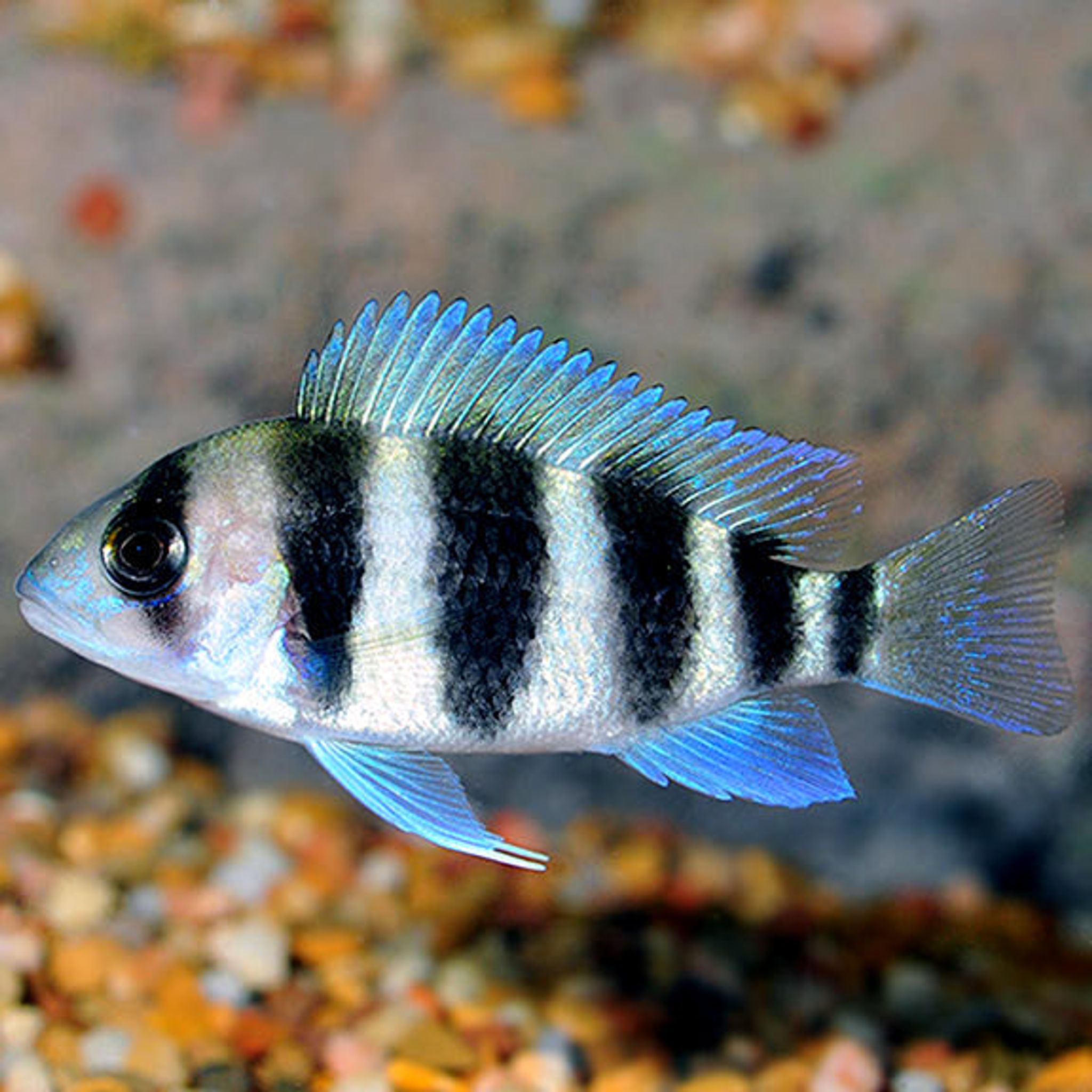
Frontosa is a deep-bodied cichlid endemic to Lake Tanganyika in East Africa. It's easy to recognize by its blue-white base color, dark vertical stripes running down the body, and a pronounced nuchal hump on the forehead of mature males — a fatty bump that grows more prominent as a male ages and asserts dominance in a group. It's one of the largest and most iconic Tanganyikan cichlids, and it's the fish many hobbyists end up building an entire biotope-style setup around.
How Big Do Frontosa Get?
Most adult Frontosa settle into a realistic range of 12 to 14 inches (30-36 cm), with exceptional dominant males occasionally approaching 15 inches (38 cm). Treat 12-14 inches as the expectation and 15 inches as the ceiling for a particularly large, well-cared-for male rather than the norm.
Males and females do not grow to the same size:
| Typical adult length | Notable features | |
|---|---|---|
| Males | 12-14", exceptional individuals to ~15" | Pronounced nuchal hump, more intense coloration |
| Females | 8-10" | Little to no hump, rounder body when holding eggs |
The spread in max-size claims across sources — some cap Frontosa at 12", others say up to 15" — comes down to genetics, geographic color variant, and quality of long-term care rather than one number being "correct." A fish from a smaller-bodied variant, kept in a cramped tank, will simply never reach the upper end of the range no matter how old it gets.
Do Color Variants Affect Size?
Frontosa are sold under several commercially available color/geographic variants, and while none of these differences are rigorously documented, keepers do report that some variants tend to run slightly larger or smaller than others on average. It's worth asking about the specific variant you're buying, but don't expect precise size guarantees — variant is one input among several, not a fixed formula.
Frontosa Growth Rate: A Year-by-Year Timeline
This is the piece most care sheets skip past. They describe "juvenile" and "adult" and leave a multi-year gap in between. Here's a fuller picture:
| Age | Approximate length | Notes |
|---|---|---|
| At purchase (juvenile) | 2-3" | Typical fish-store size; easy to underestimate final size |
| End of year 1 | 3-4" | Slow, steady growth; hump not yet developed |
| End of year 2 | 6-8" | Growth rate is still gradual compared to most popular cichlids |
| Year 3-4 | Nearing adult length | Hump becomes visible on males; coloration deepens |
| Year 3-6 | Full adult size and coloration | Sources split between 3-4 years and 5-6 years for full maturity — treat this as gradual, with real individual variation |
Frontosa are simply slow maturers, even by cichlid standards. Full adult size and coloration commonly isn't reached until 3 to 6 years old, and hump development in males continues well past that as a visible signal of dominance within the group.
Why Do Frontosa Grow So Slowly?
A few biological factors stack up here. Females are maternal mouthbrooders, carrying eggs and fry in their mouths for roughly 3-4 weeks (occasionally up to 6), which is metabolically costly and shapes a slower overall life-history strategy. Lake Tanganyika itself stays cool and remarkably stable year-round compared to shallower tropical habitats, and Frontosa evolved in deep, low-competition water where energy conservation matters more than rapid growth. The net result is a fish built to grow steadily over years, not weeks.
Lifespan reflects the same slow-and-steady biology: with good care, Frontosa commonly live 15-20+ years in captivity, and some keepers report individuals reaching 25 years. That longevity is exactly why tank planning matters so much — you're not housing a fish for a season, you're housing it for a decade or two.
Tank Size Planning: Build for the Adult, Not the Juvenile
Minimum tank size recommendations vary across sources, ranging from 70-75 gallons up to 100 gallons for "a pair." The safest way to read that spread is to treat the smaller numbers as bare minimums for a single fish, not as ideal targets for anything more ambitious.
| Setup | Minimum tank size | Notes |
|---|---|---|
| One juvenile-to-small-adult | 70-75 gallons | Absolute floor; upgrade as the fish grows |
| A true adult pair | 100 gallons minimum | Still tight for long-term comfort |
| Small breeding group/harem (1 male + several females) | 125-150 gallons | Commonly kept ratio; some sources set 130+ gallons as an absolute floor for any group |
Footprint Matters More Than Gallons Alone
Frontosa are more sedentary, mid-water fish than frantic swimmers, so tank length and depth matter more than height. A tall, narrow column of water wastes volume a Frontosa group will never use. In practical terms:
- A single adult or pair does reasonably well in a 4-foot-long tank (roughly 75-100 gallons).
- A small harem of 1 male and 3-5+ females is much better suited to a 6-foot-long tank in the 125-150+ gallon range, giving the dominant male room to patrol without constantly cornering females.
- Depth (front-to-back) of at least 18-24 inches gives the group room to spread out and break sightlines, reducing chasing.
A Staged Upgrade Plan
Because growth spans years, it's reasonable to plan tanks in stages rather than buying the final setup on day one:
- Starter tank (70-75 gallons): houses a juvenile through roughly year one to two.
- Intermediate tank (100 gallons): supports a maturing pair as the hump and full coloration develop.
- Final adult tank (125-150+ gallons, 6 feet long): the long-term home for a proper group, ideally set up before the fish outgrow the intermediate stage rather than after.
Planning the sequence up front avoids the most common and expensive mistake: buying a small juvenile, housing it "for now" in something undersized, and then facing a costly emergency upgrade once the hump and true size show up.
Water Parameters for a Lake Tanganyika Specialist
Frontosa need the same alkaline, hard-water chemistry that defines Lake Tanganyika:
- Temperature: 72-82°F (22-28°C), with most keepers aiming for a slightly cooler 74-79°F (23-26°C)
- pH: 7.8-9.0
- General hardness: roughly 10-25 dGH
- Ammonia/nitrite: zero, always
- Nitrate: under 20 ppm
- Water changes: weekly, 20-30%
Frontosa share a similar alkaline, hard-water profile with Malawi cichlids, but they prefer slightly cooler, more stable conditions and a gentler feeding approach — pairing them with fast, aggressive Malawi Mbuna-type species often backfires, since Mbuna outcompete Frontosa's calmer feeding style and stress them out. Other Tanganyikan species with similar temperament make far better tankmates. It's also worth remembering that alkaline, hard, stable water has to be maintained consistently as the tank matures, not just dialed in at setup.
Diet and Feeding
Frontosa are carnivorous but have a digestive system that doesn't tolerate high-fat, high-protein land-meat-based foods — the kind associated with bloat-type illness in African cichlids generally. Better options:
- A quality cichlid pellet as the staple
- Frozen or live meaty foods: mysis shrimp, krill, brine shrimp
- Feed modestly, 2-3 times per day rather than one large feeding
Overfeeding, feeding too often, or feeding inappropriate protein sources are directly linked to bloating and digestive distress in this species. When in doubt, feed less and feed more often with smaller portions — Frontosa's slow, deliberate feeding style doesn't need (or want) large meals.
Social Structure: Group vs. Pair
In the wild, Frontosa live in colonies with one dominant male and multiple females — not as isolated pairs. Keeping only a single pair in the home aquarium can backfire, since a lone female has nowhere to escape a persistent male. A skewed ratio of 1 male to 3-5+ females is more natural and spreads out the male's attention, reducing harassment of any one female.
That said, Frontosa can be kept singly or as a pair if tank size doesn't allow for a group — it's simply a compromise on natural behavior, not something the fish can't survive.
Common Mistakes to Avoid
- Buying small, planning small. A 2-3" pet-store juvenile gives no visual cue that it's heading toward 12-14 inches. Plan the adult tank before buying, not after.
- Feeding the wrong protein. High-fat land-meat-based foods and overfeeding are common causes of bloat in this species.
- Keeping too few females per male. A single pair concentrates aggression on one female; a proper group ratio spreads it out.
- Mismatched tankmates. Fast, aggressive Mbuna-type Malawi cichlids can outcompete Frontosa and cause chronic stress.
- Letting water quality slide over time. Alkaline, hard, stable parameters need to be maintained for the life of the tank, not just at setup.
- Blaming the fish for slow growth. A Frontosa that isn't growing is usually telling you something about its tank — see below.
Why Isn't My Frontosa Growing?
Stunted growth is almost always environmental rather than genetic. The usual suspects are an undersized tank, poor or inconsistent water quality, social stress from too few females per male, or an inadequate diet and feeding schedule. Correcting any one of these — more space, cleaner and more stable water, a better male-to-female ratio, or more appropriate feeding — is often enough to get growth back on track, though results take months to show given how slowly this species grows to begin with.
Tankmates: Julidochromis for Size Contrast
If you want a visual demonstration of just how large Frontosa get, stock them alongside Julidochromis ("Julie") cichlids, several small species from the same lake:
- Marlier's Julie: around 5"
- Masked Julie: around 2.8", one of the smallest cichlids in the hobby
- Brown/convict Julie: around 5"
Julies are cave-spawners that occupy rock crevices rather than open water, so they compete very little with Frontosa for space or food. They share a similar alkaline, hard-water range (pH 8.0-9.0) and thrive in a moderate 20-75 gallon footprint depending on group size — a fraction of what Frontosa need. One caveat: Julies are territorial toward their own genus, so avoid mixing multiple Julidochromis species together in the same tank.
The fact that Frontosa, Julies, and dozens of other Tanganyikan species all share a similar hard-alkaline chemistry profile comes down to the lake itself — one of the most stable, mineral-rich freshwater environments on the planet, which is part of why a dedicated Tanganyika biotope is such a popular long-term hobby project.
You can browse Frontosa and other African Cichlids on FishyHub, along with appropriately sized Glass Tanks for staging your setup as the fish grows.
Frequently Asked Questions
How big does a Frontosa cichlid get in a home aquarium?
Typically 12-14 inches for adult males, with exceptional dominant males occasionally approaching 15 inches. Females are noticeably smaller, generally topping out around 8-10 inches.
How fast do Frontosa grow?
Slowly compared to most popular cichlids — roughly 3-4 inches by the end of year one, 6-8 inches by year two, and full adult size and coloration typically not reached until somewhere between 3 and 6 years of age.
What size tank does one Frontosa need?
A 75-gallon tank is the realistic minimum for a single juvenile-to-adult fish. If you plan to add more fish later, size the tank for that goal from the start rather than upgrading twice.
Can you keep just one Frontosa, or do they need a group?
They can be kept singly or as a pair, but Frontosa are naturally colony fish. A small group with several females per dominant male is more natural and reduces stress and aggression toward any single female.
What tank size is needed for a group of Frontosa?
Plan for 125-150+ gallons for a small harem of one male and several females, in a tank at least 6 feet long. Length and depth matter more than height, since Frontosa are mid-water, sedentary swimmers rather than active jumpers or climbers.
Do Frontosa need different water than other African cichlids?
They share the same alkaline, hard-water profile as Malawi cichlids (pH 7.8-9.0, moderate to high hardness), but Frontosa prefer slightly cooler, more stable temperatures and a gentler, less competitive feeding approach.
Why is my Frontosa not growing?
The most common causes are an undersized tank, inconsistent water quality, social stress from too few females per male, or an inadequate feeding routine. Addressing these factors typically restores normal growth, though changes take months to become visible.
What do Frontosa eat, and can overfeeding hurt them?
A quality cichlid pellet paired with frozen or live meaty foods like mysis shrimp, krill, and brine shrimp works well, fed modestly 2-3 times a day. Overfeeding or feeding high-fat, land-meat-based foods can cause bloating and digestive distress in this species, so moderate, appropriate feeding matters as much as diet quality.
Ready to plan a Frontosa setup properly? Explore Freshwater Livestock on FishyHub to find Frontosa and compatible Tanganyikan tankmates sized for the tank you're building toward.


