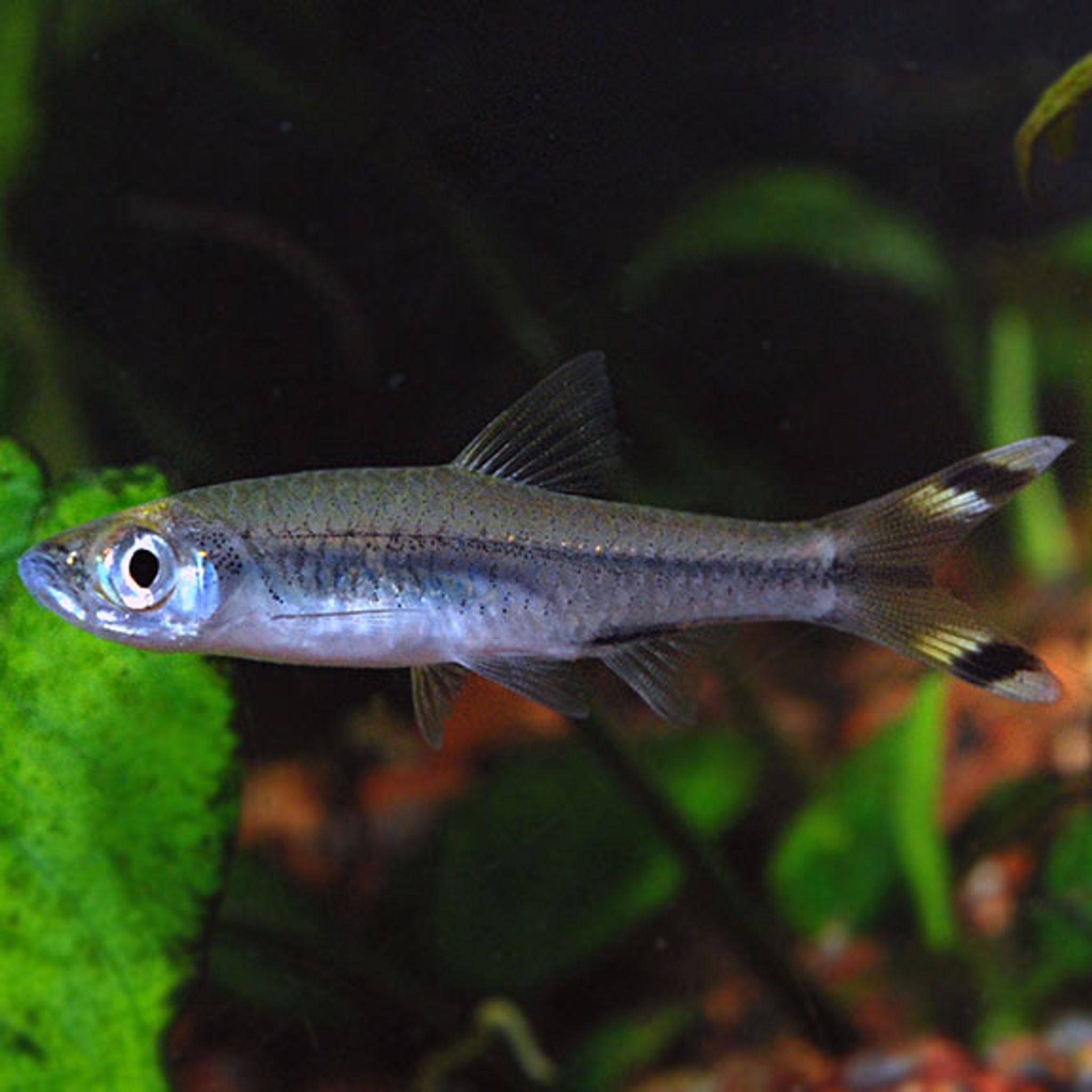

How Big Do Chili Rasbora Get? Growth Rate, Adult Size and Tank Planning
Chili rasbora (Boraras brigittae) max out at roughly 0.6–0.75 inches (15–20 mm), making them one of the smallest fish sold for home aquariums. That tiny adult size does not mean tiny tank requirements, though — schooling numbers and water stability matter far more for this species than raw body length.
Adult Size: How Big Do Chili Rasbora Really Get?
At full maturity, a chili rasbora measures about 0.6 to 0.75 inches (15–20 mm) in standard length. That places it among a small handful of species — alongside other Boraras species, the dwarf pygmy goby, ember tetra, and celestial pearl danio — that are consistently ranked as the smallest fish commonly available in the hobby.
Males and females look different by adulthood, which is the easiest way to sex a group:
- Males stay slightly smaller and slimmer, with more intensely saturated red coloring along the body.
- Females grow visibly rounder and deeper-bodied, especially once they are carrying eggs (gravid).
Some sources say this difference is visible as early as 6–8 weeks; others say it isn't reliable until closer to 3 months. In practice it depends on individual growth rate and feeding — well-fed fish in a stable tank tend to show sexual differences earlier than a stressed or underfed group.
Growth Rate and Timeline: From Fry to Adult
Chili rasbora grow fast relative to their short overall lifespan, but the total size gained is tiny in absolute terms — a few millimeters at most. Most of what looks like "growth" after the first couple of months is actually color intensifying and the body filling out, not the fish getting noticeably longer.
| Age | Size / development stage |
|---|---|
| Hatch | Near-microscopic fry, barely visible without magnification |
| 2 weeks | Free-swimming fry, still translucent, feeding on infusoria-sized foods |
| 4–6 weeks | Juvenile coloration appears; body shape starts to resemble an adult |
| 8–12 weeks (2–3 months) | Approaching full adult size and color/pattern |
| 3–4 months | Considered fully mature |
A common troubleshooting mistake: new keepers assume slow, subtle length gain means a fish isn't growing or is sick. For chili rasbora, deepening color and a filling-out body shape is the normal growth pattern — don't expect visible length increases week to week the way you might with a larger tetra or barb.
Lifespan
With stable, soft and slightly acidic water, chili rasbora typically live 4 to 8 years — considerably longer than most hobbyists expect from a fish under an inch long. Lifespan drops noticeably when water chemistry is wrong or swings frequently, even if temperature is otherwise fine.
Not a Beginner Fish, Despite the Small Size
Small body size gets mistaken for easy care, but chili rasbora need:
- Soft, acidic, stable water — a target range of roughly pH 6.0–6.5, with tolerance down toward pH 5.0 in well-established blackwater-style setups, and a wider absolute range of pH 4.0–7.0 reported across sources. Hardness (GH/KH) should run low to very low.
- A mature, fully cycled tank. Their small size makes them disproportionately sensitive to ammonia and nitrite spikes that a larger fish might tolerate briefly.
- Gentle water flow. Strong filter output can exhaust or stress them, pinning them against the glass or driving them to hide constantly — a frequently overlooked cause of poor growth and dull color. A sponge filter or a flow diffuser on a hang-on-back filter solves this.
Minimum Tank Size: Small Fish Does Not Mean Small Tank
This is where a lot of generic "nano fish" advice misleads people. A 1-gallon bowl or betta cup being marketed as fine for tiny fish does not apply to chili rasbora.
- 10 gallons is the sensible real-world minimum for keeping a proper school long-term.
- 5 gallons is an absolute bare floor, and only works for a smaller group in an otherwise excellent, stable, mature setup — it is not the recommended starting point.
The reasoning is simple: chili rasbora are an obligate schooling fish that needs numbers to feel secure, and small water volumes swing in temperature and chemistry far faster than large ones. A species this sensitive to instability needs the buffering that comes with more gallons, not less.
Fish for a 1-Gallon Tank
No fish — chili rasbora included — is genuinely suited to a 1-gallon container as a permanent home. That size is more realistic for a single split-fin betta, a shrimp-only setup, or as a temporary hospital or quarantine cup. Chili rasbora specifically need schooling numbers a 1-gallon simply cannot support, and they're too sensitive to bioload swings for such a small, unstable volume of water.
Schooling Numbers and Stocking Math
Keep chili rasbora in groups of at least 8–10, ideally 12 or more. Larger shoals aren't just aesthetically better — the fish show less stress, better color retention, and more natural behavior in bigger groups. A group under 6–8 individuals commonly leads to hiding, color fade, and higher mortality.
Because each fish carries such a tiny bioload, stocking works differently than typical gallons-per-inch rules of thumb:
| Tank size | Realistic chili rasbora stocking |
|---|---|
| 5 gallons (bare minimum, excellent stability only) | Small group, roughly 6–8 |
| 10 gallons, densely planted | 15–20+ is often workable |
| 20 gallons, densely planted community | 25–40+, mixed with compatible nano tankmates |
Water quality stability — not raw gallons alone — is the real ceiling. A heavily planted, well-filtered 10-gallon tank can often carry a larger school than the numbers above suggest, but an unstable or lightly-planted tank of the same size should be stocked more conservatively.
Tank Setup That Supports Growth and Color
Because chili rasbora originate from Borneo's peat-swamp blackwater habitats, replicating that environment noticeably improves both color intensity and long-term condition:
- Dense planting, especially fine-leaved and floating plants, for cover and to diffuse light.
- Dim, filtered lighting rather than bright, open water.
- Dark substrate, which tends to intensify red coloration.
- Driftwood and leaf litter (such as catappa/almond leaves) to add natural tannins and a soft blackwater tint.
Diet and Feeding for Proper Growth
Chili rasbora have genuinely tiny mouths, and food size is one of the most overlooked factors in stunted growth or poor condition:
- Micro or crushed dry foods sized for nano fish
- Baby brine shrimp
- Microworms
- Daphnia
Standard community flakes or pellets often go completely uneaten, especially in a mixed tank where larger fish reach the food first. Feed in a spot away from faster tankmates and choose foods explicitly sized for nano species — you can browse small community fish foods and livestock options sized appropriately for this kind of nano setup.
Tankmate Compatibility
Chili rasbora do best with other peaceful nano-scale species: other Boraras, small tetras, dwarf corydoras, and shrimp. A dedicated freshwater rasbora selection or a peaceful shrimp species makes a natural pairing in the same blackwater-style setup.
Avoid larger or boisterous fish. Beyond the obvious predation risk, bigger or faster tankmates routinely out-compete chili rasbora for food, which suppresses growth and condition even when the fish technically survive.
Common Mistakes and Troubleshooting
| Mistake | Consequence | Fix |
|---|---|---|
| Buying too few (under 6–8) | Stress, hiding, color fade, higher mortality | Stock a real school of 8–10+ from day one |
| Undersized or overstocked tank | Ammonia spikes the fish can't recover from | Use a cycled 10-gallon-plus tank with weekly partial water changes |
| Hard, alkaline water | Chronic stress, poor color, shortened lifespan | Test and adjust GH/KH/pH before purchase; soften with driftwood or leaf litter |
| Food too large | Slow growth or starvation, worse with larger tankmates | Use crushed/micro foods, feed away from faster fish |
| Strong filter flow | Fish hide or get pinned against glass | Switch to a sponge filter or add a flow diffuser |
Moving a Chili Rasbora Tank
Relocating an established setup takes extra care for a small, soft-water-dependent species like this one:
- Unplug and remove all electrical equipment first — filter, heater, and light.
- Lower the water level with a siphon before attempting to catch the fish.
- Bag fish with more air than water for better oxygen exchange during transit.
- Handle wet decor and rocks carefully to avoid dropping and cracking the glass.
- Transport substrate separately in buckets rather than leaving it in the tank.
- For longer trips, use an insulated cooler with a battery-powered air pump, and skip feeding beforehand and during transit.
- Refill with dechlorinated, temperature-matched water and re-acclimate fish slowly before release.
Because chili rasbora are especially sensitive to sudden parameter shifts, rushing the re-acclimation step is one of the most common causes of post-move losses.
Frequently Asked Questions
How big do chili rasbora actually get?
Roughly 0.6–0.75 inches (15–20 mm) at full maturity, making them one of the smallest common aquarium fish available.
How fast do chili rasbora grow?
Fry reach juvenile size and coloration in about 4–6 weeks, and full adult size and color typically arrive by 8–12 weeks (2–3 months), with full maturity around 3–4 months.
What is the minimum tank size for chili rasbora?
A cycled, planted 10-gallon tank is the realistic minimum for keeping a proper school. Smaller setups struggle with both schooling numbers and water stability, though 5 gallons can work as an absolute floor for a smaller group in an excellent, stable setup.
Can chili rasbora live in a 1-gallon or 2-gallon tank?
Not recommended. A volume that small can't support proper schooling numbers and is too chemically unstable for such a sensitive species.
How many chili rasbora should be kept together?
At least 8–10, ideally 12 or more, for natural behavior and reduced stress.
How can you tell males from females?
Females are rounder and larger-bodied, especially when carrying eggs; males stay slimmer with slightly more intense color. This difference can show as early as 6–8 weeks or take until closer to 3 months, depending on growth and feeding.
How long do chili rasbora live?
Typically 4 to 8 years in stable, well-maintained soft-water tanks — longer than most people expect from such a tiny fish.
Do chili rasbora need special water conditions to grow properly?
Yes. Soft, slightly acidic water (roughly pH 6.0–6.5, low hardness) supports normal growth and coloration, while harder, alkaline water often stunts color and shortens lifespan even at the right temperature.
If you're planning a blackwater-style nano tank, you can browse the full range of freshwater livestock on FishyHub to find chili rasbora and compatible tankmates suited to soft, acidic setups.


