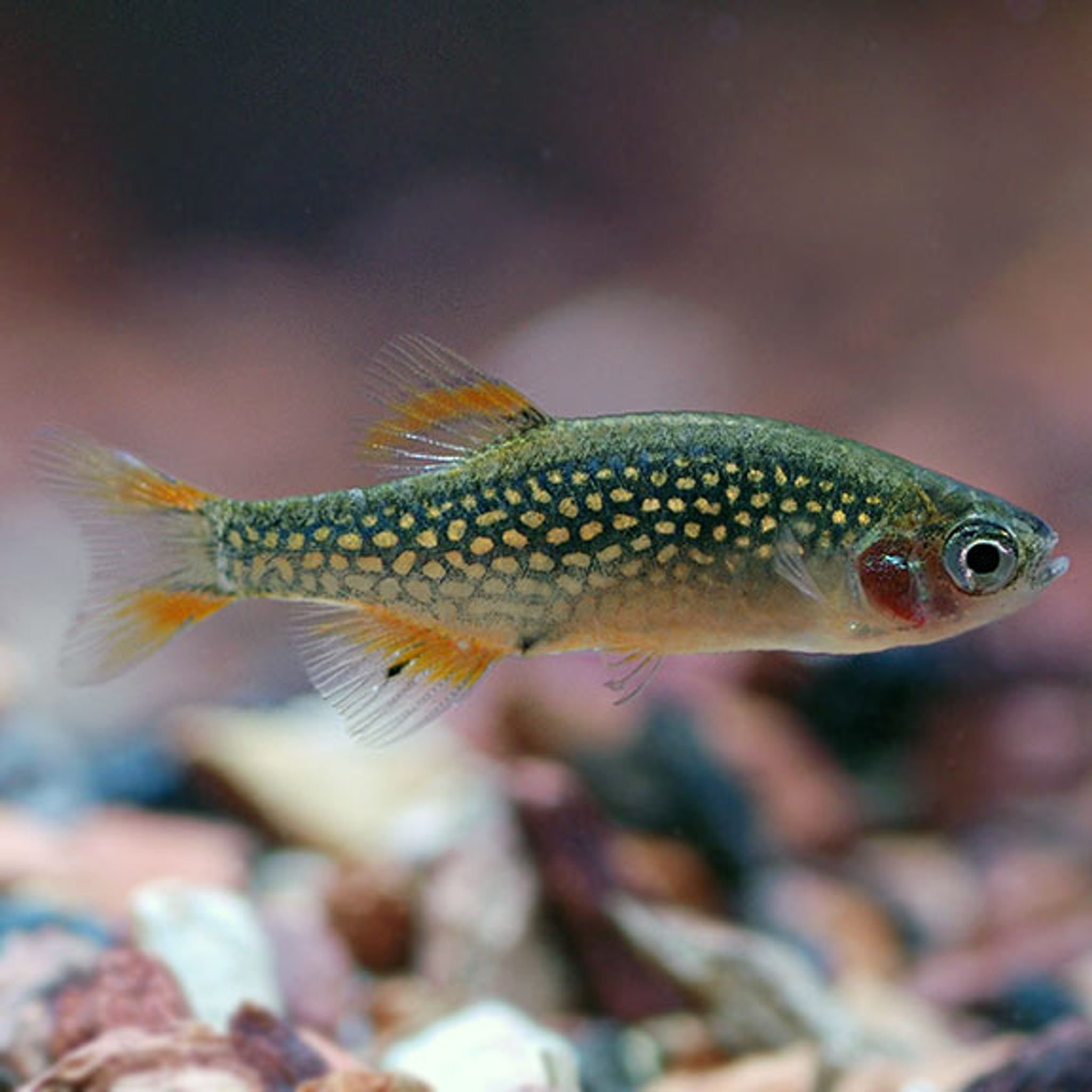

How Big Do Celestial Pearl Danio Get? Growth Rate, Adult Size and Tank Planning
Celestial pearl danios top out around 0.75 to 1 inch (2–2.5 cm), with an occasional large female stretching to about 1.5 inches (3.8 cm). They reach that size fast — usually by three months old — which matters more than it sounds, because most of the tank-planning mistakes with this species come from misjudging how small "small" really is.
Adult Size: What to Actually Expect
Treat 1 inch as the realistic average adult length and 1.5 inches as the ceiling, not the standard. Most fully grown celestial pearl danios (also sold as galaxy rasboras) land somewhere in the 0.75–1 inch range, measured nose to tail base.
Females run slightly larger and rounder-bodied, especially when carrying eggs, while males stay a touch slimmer but show far more intense red-orange color in the fins and a bolder black-and-white pattern overall. If you're sexing a group at the store, color intensity is a faster tell than size.
| Category | Length (inches) | Length (cm) | Notes |
|---|---|---|---|
| Store juvenile | 0.4–0.75 | 1–1.9 | Common size when purchased |
| Typical adult | 0.75–1 | 2–2.5 | Realistic average, both sexes |
| Large adult female | up to 1.5 | up to 3.8 | Occasional outlier, not the norm |
| Adult male | 0.75–1 | 2–2.5 | Slimmer body, brighter fin color |
One naming note worth clearing up while you're shopping: celestial pearl danio and galaxy rasbora are the same fish. It's scientifically classified as Danio margaritatus, though it was originally described as Celestichthys margaritatus before being folded into the Danio genus — so don't assume the two common names refer to different species when comparing listings.
Growth Rate: From Juvenile to Adult
Fish sold in stores are usually juveniles around 0.4–0.75 inch, not yet at full size. With stable water and consistent feeding, that changes quickly:
- Weeks 0–4: Fry and early juveniles, under 0.5 inch, still developing color and shape.
- Weeks 4–12: Steady grow-out phase; body fills out and fin coloration starts intensifying, especially in males.
- ~Week 12 onward: Most individuals reach adult size and sexual maturity, roughly 10–14 weeks (about 3 months) from a young juvenile.
This is a useful checkpoint if you bought young stock: a fish that still looks like a juvenile at 6 weeks is on schedule, not stunted. Diet plays a real role in hitting the upper end of that size and color range — a rotation of high-quality micro pellets or a gel food with live or frozen baby brine shrimp and daphnia supports better growth and richer color than dry flake alone.
Lifespan and Why Size Doesn't Mean Low Maintenance
Expect 3–5 years in captivity with stable water quality. The small adult size does mean each fish produces very little waste individually, but don't read that as "low maintenance":
- Their tiny size makes them more sensitive to ammonia, nitrite, and pH swings, not less — only add them to a tank that's been fully cycled for at least a few months, never a brand-new setup.
- Small water volumes still need routine partial water changes, roughly 25–30% weekly, regardless of how few fish are in the tank.
- Low bioload per fish is not the same as no bioload — a shoal of 8–10 still needs real filtration, not just a token sponge.
Tank Planning: Minimum Size and Stocking Math
10 gallons (38 L) is the sensible floor for a proper starter school of 5–7 celestial pearl danios. A 5-gallon (19 L) tank can technically hold a very small trio, but water parameters swing fast in that volume, and this species doesn't tolerate instability well — 10 gallons and up gives far more buffer.
For scaling beyond the starter group, two rough guides are commonly used:
- 1–2 gallons per fish, or
- About 10 gallons of added capacity per additional 5 fish
Both are rough approximations, not hard rules — filtration quality and water change frequency matter more than hitting an exact ratio for a fish this small. Applied to common US tank sizes:
| Tank size | Reasonable CPD group size | Notes |
|---|---|---|
| 5 gallons | 3–4 (bare minimum) | Needs excellent, frequent maintenance |
| 10 gallons | 6–8 | Sensible starting point for a real school |
| 20-long | 12–15 | Comfortable school with room for tank mates |
Group Size and Ratios
Celestial pearl danios are a shoaling species that needs at least 6–10 individuals. Groups smaller than that tend to hide more and show washed-out color, since a lot of their natural behavior and confidence comes from shoal security. Counterintuitively, larger groups reduce aggression between males because sparring gets diluted across more individuals rather than focused on one or two rivals.
Keep females equal to or outnumbering males to cut down on constant male-on-male competition over mates.
Tank Design That Fits Their Behavior
CPDs are shy, skittish fish by nature, and a bare, brightly lit tank tends to keep them hiding rather than showing off. They color up and act naturally with:
- Dense planting and floating plants for cover and diffused light
- Driftwood for additional hiding spots and visual breaks
- Dark substrate, which also makes their coloration pop by contrast
Water should stay soft, slightly acidic to neutral (roughly pH 6.5–7.5) and warm — 73–79°F (23–26°C). They can tolerate a range outside that, but do noticeably better with stable numbers than "textbook perfect" ones that swing around. A reliable heater is non-negotiable in most US homes, since room-temperature tap water typically runs cooler and less stable than this range.
Tank Mates: What Works and What Doesn't
Suitable tank mates are other small, peaceful nano species that won't outcompete CPDs at feeding time:
- Pygmy corydoras
- Sparkling or licorice gouramis
- Small rasboras or danios of similar size
- Endler's livebearers
- Neon-type tetras, kept as their own separate school
- Cherry or Amano shrimp, and nerite snails
You can browse compatible options in small community fishes or add cleanup crew like shrimp to round out a nano setup.
Avoid anything large, fast, or boisterous enough to intimidate them or beat them to food: barbs, larger gouramis, cichlids, and any active swimmer that grows past roughly 2–3 inches. A calm betta can occasionally work, but it's a gamble rather than a reliable pairing — generally skip it.
Fish That Don't Belong in a 2.5-Gallon Tank
No fish, celestial pearl danios included, genuinely thrives long-term in a 2.5-gallon tank — water quality swings too fast for any stable stocking. That volume is much better used for shrimp, snails, a breeding or quarantine setup, or plant propagation. If someone insists on fish anyway, only 1–3 individuals of a genuinely hardy, non-shoaling species belong there — not a shoaling nano fish like CPD that needs 6+ to behave normally.
Commonly Mistaken "Small Tank" Fish
CPDs get lumped in with other fish marketed as beginner or small-tank options, but the comparison usually doesn't hold up:
- Standard tetras need 8+ individuals for a real school and enough swimming room, not just a few gallons.
- Common and fancy goldfish need roughly 20+ gallons per fish due to their waste output and eventual size.
- Clown loaches grow 8–12+ inches over several years and need large groups in large tanks.
- Kissing gourami require 85+ gallons at full size.
Against that list, CPDs are one of the genuinely appropriate nano choices — their footprint and behavior actually match a 10-gallon setup.
Breeding Basics
Celestial pearl danios are egg-scatterers, not mouthbrooders or bubble-nesters. Adults will eat their own eggs given the chance, so a dedicated breeding or grow-out tank with dense moss or fine-leaved plants is needed to give eggs somewhere to fall out of reach. Eggs typically hatch in 2–4 days. Fry need infusoria or other micro foods at first before graduating to baby brine shrimp and crushed flake as they grow.
Common Mistakes to Avoid
- Buying too small a group (2–3 fish): leads to hiding and washed-out color; fix by building up to 8–10+.
- Adding CPDs to an uncycled or brand-new tank: ammonia and nitrite spikes hit small fish disproportionately hard.
- Assuming tiny fish means no bioload management needed: filtration and weekly water changes still matter.
- Mixing with fast or aggressive tank mates: CPDs can lose out at feeding time and slowly decline even while looking physically fine at first.
- Skipping acclimation on freshly shipped or wild-caught stock: raises the risk of early losses.
- Expecting a juvenile to stay its purchase size: it will roughly double in the following ~3 months, so plan the tank for adult size from day one.
Buying, Shipping, and Settling In
Celestial pearl danios travel and acclimate poorly if they're already stressed before they reach you, so source from a seller with a real track record in nano fish rather than the cheapest listing available. Expect a per-fish price in the mid-teens up to around $20 for wild-caught or well-bred stock; exact pricing varies by source and season.
Best Practices When Buying Fish Online
Look for sellers who specialize in nano fish and shrimp, follow quarantine and conditioning practices, offer clear live-arrival guarantees, and have recent, verifiable customer feedback. The wrong source is one of the leading causes of DOA or sick fish on arrival — cheapest isn't the same as best value here.
How Long Fish Can Stay in a Bag
In a sealed, oxygenated bag, most fish including CPDs are fine for roughly 7–9 hours. Beyond that window, oxygen depletion becomes a real risk unless the bag has an air stone or gets opened for fresh air. Always acclimate on arrival rather than releasing fish straight from the bag into the tank.
Drip Acclimation Method
- Float the sealed bag for 15–20 minutes so temperatures match.
- Open the bag and place it (or its contents) in a separate container.
- Run tank water into that container via airline tubing at a slow drip — roughly 2–4 drips per second — for 45–60+ minutes.
- Net the fish gently into the tank once acclimated, avoiding the original bag water.
This slower method matters more for CPDs than for hardier species, given how sensitive they are to sudden parameter shifts.
Safely Catching Your Fish
Use a net sized appropriately for a fish this small, and pull it out in one smooth vertical motion instead of chasing it around the tank, which causes unnecessary stress. Have the destination container or bag ready before you net the fish so out-of-water time stays minimal, and handle with wet hands or gloves to protect their slime coat.
Rehoming Unwanted Fish
Never release aquarium fish into local waterways or wild habitats — it's a genuine invasive species risk even for a fish this small. Instead, rehome through local aquarium clubs or online hobbyist communities, a local fish store's buy-back or trade-in program, or by donating to a school, office, or veterinary clinic with a display tank.
If you're setting up a dedicated nano habitat for this species, a properly sized enclosure makes the rest of this planning much easier — browse glass tanks sized for a 10-gallon or 20-long footprint before you bring fish home.
Frequently Asked Questions
How big do celestial pearl danios get?
About 0.75–1 inch (2–2.5 cm) is typical for a full-grown adult, with an occasional large female reaching up to 1.5 inches (3.8 cm). Females tend to be slightly larger and rounder-bodied than males.
How fast do celestial pearl danios grow?
Store-bought juveniles, often around 0.5 inch, typically reach full adult size and sexual maturity in about 3 months (roughly 10–14 weeks) with good food and stable water conditions.
What is the minimum tank size for celestial pearl danio?
10 gallons is the sensible floor for keeping a proper school of 6 or more. Smaller setups can technically house a few fish but struggle to hold stable water parameters.
How many celestial pearl danios should be kept together?
Keep at least 6, ideally 8–10, since this is a shoaling species that shows better color and less stress in larger groups. Keep females equal to or outnumbering males to reduce sparring.
Can celestial pearl danios live in a 5-gallon tank?
Only a very small group of 3–4 fish, and only with excellent, frequent maintenance to offset how quickly water quality can shift in that volume. A 10-gallon tank is a much safer starting point.
Do celestial pearl danios need a heater?
Yes. They're a tropical species that does best around 73–79°F (23–26°C), and unheated room-temperature setups in most US homes run cooler and less stable than that.
What fish can live with celestial pearl danios?
Other small, peaceful nano species work well, including pygmy corydoras, sparkling gouramis, small rasboras, Endler's livebearers, and shrimp or snails. Avoid large, fast, or boisterous tank mates that can outcompete them for food.
How long do celestial pearl danios live?
Typically 3–5 years in captivity, assuming stable water quality, a cycled tank, and a varied, protein-rich diet.
If you're ready to stock a nano tank properly, you can browse available stock and compatible species under danios on FishyHub.


