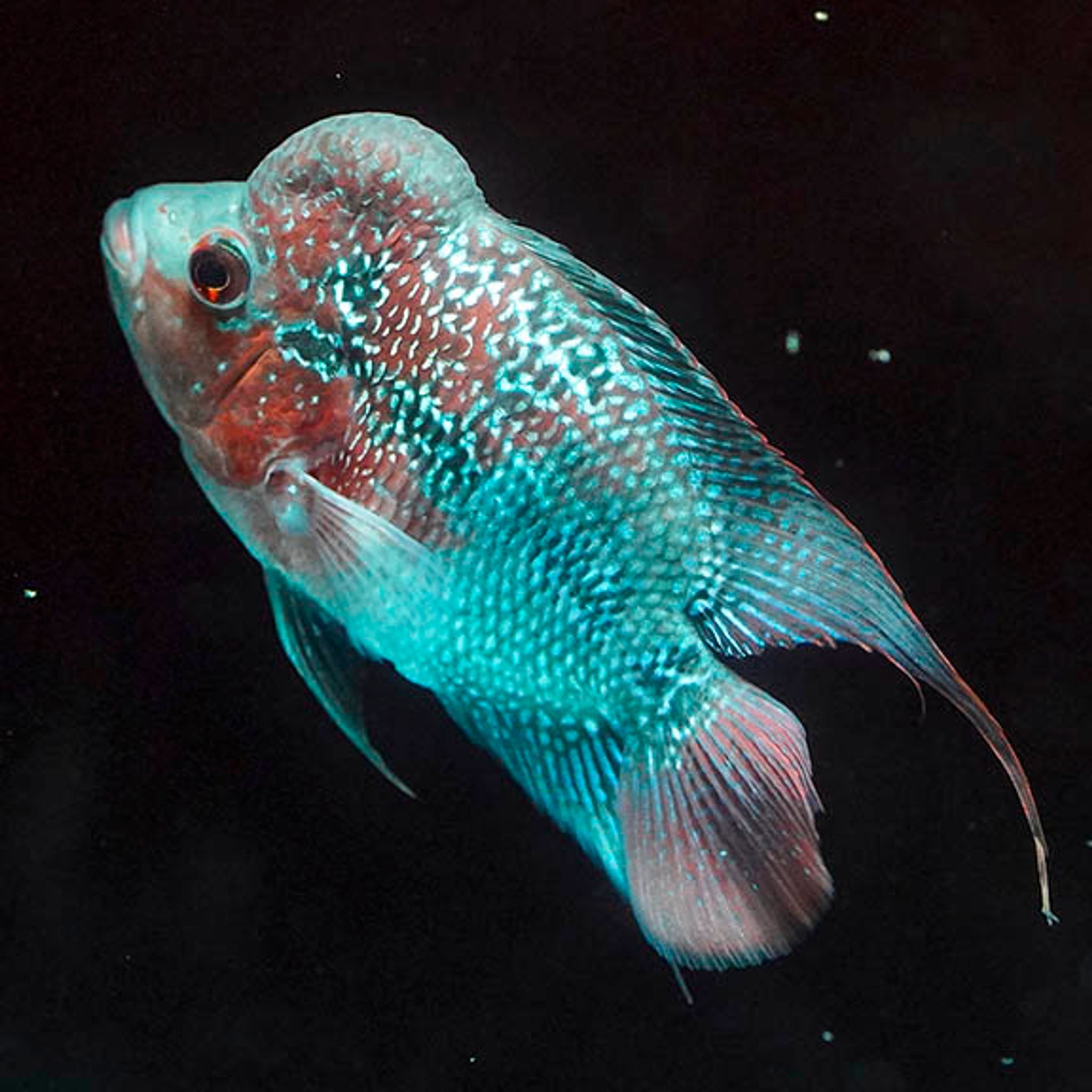

How Big Do Blood Parrot Cichlid Get? Growth Rate, Adult Size and Tank Planning
Most blood parrot cichlids settle at 7–8 inches (18–20 cm) as adults, with exceptional individuals reaching 8–10 inches (20–25 cm) under excellent genetics and care. Reaching that size takes roughly two to three years, and the fish's deep, round body means it needs considerably more tank volume than its length alone suggests. Here is the growth timeline, the tank-size math, and the factors that actually determine whether your fish reaches a healthy adult size.
Adult Size: What to Actually Expect
A typical, healthy blood parrot cichlid tops out around 7–8 inches long. Some fish, particularly those from strong breeding lines with consistent high-quality feeding, grow to 8–10 inches. Reports beyond 10 inches exist but are rare outliers rather than a realistic planning number — treat 7–8 inches as your baseline expectation and 10 inches as the ceiling, not the average.
Length is only half the story. Blood parrots have a deep, egg- or football-shaped body rather than a slender profile. A 7-inch blood parrot is noticeably bulkier and displaces far more water — and produces more waste — than a 7-inch fish with a slim body shape, like a tetra or a barb. When you're sizing a tank or a filter, think in terms of body mass and bioload, not just the number on a ruler.
Growth Rate: A Month-by-Month Timeline
Blood parrot cichlids grow quickly as juveniles, then slow down considerably as they approach maturity. Here's the consensus growth curve:
| Age | Approximate Length | Growth Stage |
|---|---|---|
| 0–3 months | 1–2 in (2.5–5 cm) | Fast juvenile growth |
| 3–6 months | 3–4 in (7.5–10 cm) | Fast juvenile growth continues |
| ~12 months | 5–6 in (13–15 cm) | Growth rate begins to slow |
| Year 2 | 6–7.5 in (15–19 cm) | Approaching adult size |
| Year 2–3 | 7–8 in (18–20 cm) | Adult size typically reached |
| Beyond year 3 | Slight further increase | Growth plateaus, minor creep possible |
Two practical takeaways follow from this curve. First, a fish that looks "done growing" at 12–18 months usually isn't — it can still add an inch or more over the following year, so don't finalize your tank plan around a one-year-old fish's current size. Second, because the fish's genetics vary hybrid to hybrid, your individual fish may track faster or slower than this table; use it as a guide, not a guarantee.
Why Genetics Cause So Much Size Variation
Blood parrot cichlids are a man-made hybrid, commonly attributed to a cross involving Amphilophus citrinellus and a Central American cichlid from the Vieja group (or a related genus, depending on the breeder). Because they are not a wild, genetically uniform species, growth potential and maximum size vary more from fish to fish than they would with a naturally occurring cichlid. This is part of why sources disagree on maximum size — two fish from different breeding lines, given identical care, can still land in different places on the 7–10 inch spectrum.
Male vs. Female: Does Sex Affect Size?
Sources disagree here, and neither view is wrong so much as reflecting different individual fish. One view holds that size differences between sexes are negligible. The other holds that males tend to grow larger — up to 8–10 inches — while females stay somewhat smaller and rounder, typically 6–7 inches, and are the ones capable of laying eggs (though blood parrot eggs are usually infertile due to the hybrid's altered anatomy).
Because the evidence is mixed, don't rely on size to sex your fish. Body shape and roundness are a more consistent clue than length: females often appear noticeably rounder and shorter-bodied at a given age, even when overall growth rates are similar. If sexing matters for your setup, watch shape and behavior over time rather than measuring length against a chart.
Tank Size Guidance by Fish Count
Because of their deep body and semi-aggressive, mid-water swimming style, blood parrots need floor space and swimming room more than tank height. A tall, narrow tank is a worse fit than a longer, wider footprint of the same volume.
| Number of Fish | Minimum Tank Size | Notes |
|---|---|---|
| 1 | 29–30 gal (110–115 L) | Absolute minimum for one adult |
| 2 | 45–50 gal (170–190 L) | Add roughly 20 gal per additional fish |
| 3 | 55 gal (210 L) | Common rule-of-thumb grouping |
| 5–6 | 75+ gal (285+ L) | Needs strong filtration and hiding spots |
For each additional fish beyond the first, plan on adding at least 10 gallons, though 20 gallons per fish is the safer, more forgiving increment. Blood parrots are bulky, semi-aggressive, and messy eaters — the extra volume gives them room to establish territory without constant conflict and dilutes waste between water changes. Favor tank length and width over height when comparing footprints of similar volume, since these fish rarely use vertical space the way many slender cichlids do.
For decor, choose smooth-edged rocks and driftwood and a fine, soft substrate. Their small, malformed "beak" mouth and altered swim mechanics make them clumsier swimmers than a standard cichlid, so sharp or jagged decor raises the risk of scrapes and collisions as the fish grows into a tighter layout. You can browse tank options sized for a growing cichlid, along with suitable filtration, in FishyHub's glass tank and filter selections.
Water Parameters That Support Healthy Growth
Stable water conditions matter more for growth than hitting an exact number. Aim for:
- Temperature: 74–82°F (23–28°C), with most keepers finding 76–80°F (24–27°C) ideal
- pH: 6.5–7.8, tolerating up to 8.0
- Hardness: roughly 5–15 dGH — the species tolerates moderate hardness swings as long as temperature and pH stay consistent
Sources vary more widely on hardness (some cite as low as 3 dGH, others up to 18 dGH), so treat the 5–15 dGH range as the practical middle ground rather than a hard limit.
Factors That Affect Growth Rate and Final Size
Diet
Blood parrots are omnivorous, but their small, deformed mouth limits what they can eat efficiently. Feed small or mini sinking or slow-sinking pellets sized for their mouth rather than standard large cichlid pellets or flakes, which they struggle to process. A diet of quality pellets supplemented two to three times a week with protein-rich foods like bloodworms or brine shrimp supports steady, healthy growth. Overfeeding low-quality flake or oversized pellets is a common cause of poor growth and bloat.
Water Quality
Poor water quality is the single biggest cause of stunted growth, and it's worth explaining why. In an undersized or poorly maintained tank, ammonia and nitrite accumulate faster than the fish can tolerate, triggering chronic stress. That stress raises cortisol-like stress hormones, suppresses appetite, and diverts the fish's energy toward coping rather than growing. The fish isn't "staying small because the tank is small" — it's being physiologically stunted by degraded water conditions that a small volume makes harder to control. Regular water changes and a properly cycled filter are what actually prevent this, not the glass dimensions themselves.
Tankmates and Stress
Housing a blood parrot with fast, nippy, or much larger tankmates suppresses growth through the same stress pathway. Their odd mouth shape and, in many individuals, a mildly curved spine from the hybridization process make them slower feeders and weaker competitors at a shared food source. Stick to peaceful or similarly semi-aggressive tankmates of comparable size, and avoid fast-moving fish that will out-compete them for food.
Genetics
As noted above, breeding-line variation means two fish given identical care can still reach different adult sizes. This is normal and not something you can fully control through husbandry alone.
Common Mistakes to Avoid
- Buying a juvenile for a 10–20 gallon tank, assuming it will "stay small." Blood parrots grow fast in their first year and will outgrow a small tank quickly, leading to stunting and rapid water quality decline.
- Feeding pellets sized for larger-mouthed cichlids. Their beak-shaped mouth can't process large pellets efficiently, leading to poor nutrition and uneven growth.
- Mistaking slow visible growth for "fully grown." Growth continues gradually for two to three years; stopping your tank planning at the one-year mark underestimates the fish's eventual footprint.
- Keeping them with fast or aggressive tankmates. Bullying suppresses appetite and growth over time.
- Skipping regular water changes. Given their above-average bioload for their length, infrequent maintenance in an undersized tank compounds both stunting and disease risk.
- Deliberately undersizing a tank to "keep the fish small." This is a welfare problem, not a legitimate technique — a stunted fish is a stressed, unhealthy fish, not a convenient one.
A useful, low-effort habit: informally track your fish's length every few months (even estimating against a ruler taped to the glass). A fish that suddenly stalls in growth or loses body condition is often flagging an illness or a water quality issue well before other symptoms appear, making growth tracking a simple early-warning tool.
Lifespan and Long-Term Size
Blood parrot cichlids typically live 10–15 years with good care. Because size can continue to creep upward slowly even after the fish reaches its "adult" range, plan your tank around the fish's long-term potential size rather than its size on the day you bring it home.
Frequently Asked Questions
How big does a blood parrot cichlid get in a 20-gallon tank?
A 20-gallon tank is undersized for a blood parrot long-term. The fish may appear smaller in such a tank, but this reflects stress-related stunting from poor water quality, not healthy restrained growth. Plan for a minimum of 29–30 gallons for a single adult.
How fast do blood parrot cichlids grow?
Growth is fast in the first year, typically reaching 5–6 inches by 12 months. It then slows through year two and three, with the fish reaching its typical adult size of 7–8 inches by around age two to three.
Do blood parrot cichlids stop growing?
Growth plateaus around age two to three once the fish reaches adult size, but a small, gradual size increase can continue slowly afterward. Growth rarely stops abruptly at a fixed date.
What is the biggest a blood parrot cichlid can get?
Typically 7–8 inches, with 8–10 inches achievable under excellent genetics and care. Sizes beyond 10 inches are reported but should be treated as exceptional outliers, not a realistic planning target.
Are male or female blood parrot cichlids bigger?
Sources disagree: some report negligible size differences, while others say males run larger (8–10 inches) and females stay smaller and rounder (6–7 inches). Body roundness is a more reliable clue for sexing than length, so don't rely on size alone.
What size tank do I need for one, two, or three blood parrot cichlids?
Plan for at least 29–30 gallons for one fish, roughly 45–50 gallons for two, and 55 gallons or more for a group of three. Add at least 10–20 gallons per additional fish beyond that.
Why is my blood parrot cichlid not growing?
Common causes include pellets that are too large for its mouth, poor water quality from an undersized or poorly maintained tank, chronic stress from aggressive tankmates, and individual genetic variation. Test your water parameters and review pellet size before assuming genetics are the sole cause.
Can blood parrot cichlids live with other cichlids or community fish?
Yes, but choose peaceful to semi-aggressive tankmates of a similar size. Fast, nippy, or much larger fish can out-compete a blood parrot for food and cause stress that suppresses both appetite and growth.
If you're planning a tank around a blood parrot cichlid's adult size, browse compatible tankmates in FishyHub's Angelfish, Discus, Rams & Cichlids category and pair your setup with appropriately sized freeze-dried food for steady, healthy growth.


