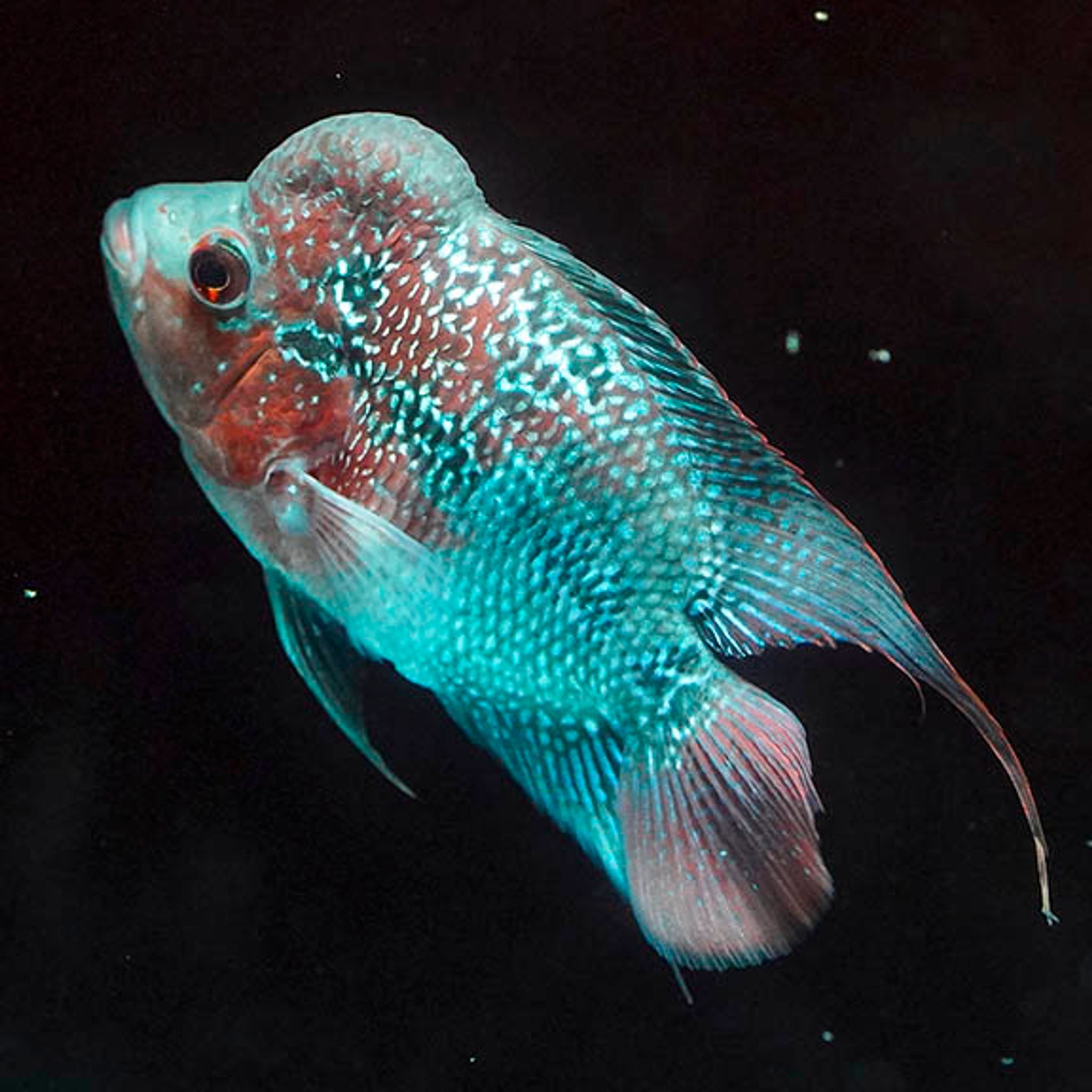
How Big Do African Peacock Cichlid Get? Growth Rate, Adult Size and Tank Planning
Most peacock cichlids top out at 4 to 6 inches (10-15 cm) as adults, with males running larger and more colorful than females. That number is only half the picture, though — how fast they get there and what tank you buy today determine whether the fish thrives or ends up stunted and stressed. Here's the growth timeline, adult size range, and the exact tank planning that avoids a mid-tank upgrade.
"Peacock Cichlid" Is a Group, Not One Fish
The name covers dozens of species and color morphs in the genus Aulonocara, all native to Lake Malawi. Because of that, size isn't a single fixed number — it's a range that shifts depending on which species or morph you actually bring home.
- Most common peacock morphs sold in the trade land in the 4-6 inch range at full maturity.
- Some of the smaller, slimmer-bodied morphs plateau around 3.5-4 inches.
- A handful of more robust species and hybrid lines can reach 6-7 inches.
If you want a predictable adult size, ask about the specific species or morph rather than assuming every "peacock" behaves the same. Browsing options in the African Cichlids selection is a good way to compare morphs before deciding on a tank.
Adult Size: Males vs. Females
Sexual dimorphism is pronounced in this group. Males develop the vivid blue, yellow, and orange coloration the fish is known for, and they also grow noticeably bigger.
| Typical adult length | Coloration | |
|---|---|---|
| Male | 4-6 in (10-15 cm), some morphs to 7 in | Bright blue/yellow/orange, intensifies with maturity |
| Female | 3-4 in (7.5-10 cm) | Silver-gray to olive, muted patterning |
This gap matters for stocking decisions later — a tank sized around "one male" numbers will be undersized once you add several same-size females, since bioload and territorial behavior scale with the group, not just the biggest fish.
Growth Rate: A Month-by-Month Timeline
This is the part most care sheets skip. Peacock cichlids grow quickly early on, then taper off as they approach adult size. Growth speed depends heavily on water temperature, water quality, and diet, so treat these as typical ranges under good conditions, not guarantees.
| Age | Approximate length | Notes |
|---|---|---|
| 1 month | 0.5-1 in (1.5-2.5 cm) | Fry stage, still developing color |
| 2 months | 1-1.5 in (2.5-4 cm) | Rapid tissue growth, needs frequent small feedings |
| 4 months | 2-2.5 in (5-6 cm) | Early color patches starting to show on males |
| 6 months | 2.5-3.5 in (6-9 cm) | Sex differences become visible |
| 8-10 months | 3.5-4.5 in (9-11 cm) | Approaching adult proportions |
| 12 months | 4-5 in (10-13 cm) | Near-adult size for most morphs |
| 12-18 months | Full adult length | Color and body depth continue to fill out |
Under warm, clean, well-fed conditions, expect roughly 0.5-1 inch of growth per month during the first several months. Growth then slows noticeably after the 8-12 month mark as the fish reaches its species' adult ceiling.
What Speeds Up or Slows Down Growth
- Water temperature: consistently within 76-82°F (24-28°C) supports faster, healthier growth than fluctuating or cooler water.
- Water quality: frequent partial water changes keep growth steady; poor water quality is one of the most common causes of stalled growth.
- Diet quality and frequency: young fish fed small portions several times a day on a quality diet grow faster and more evenly than those fed once daily.
- Tank size and stress: crowding or an undersized tank slows growth and can lead to permanent stunting rather than just a smaller, otherwise-healthy adult.
- Genetics: even under identical care, individual fish and specific morphs vary somewhat in maximum size.
The connection between the last two points deserves its own callout: fast early growth crammed into too small a tank isn't just a size problem later — it's a leading cause of the aggression and health issues owners report at 8-12 months, right when territorial behavior kicks in and the tank suddenly feels crowded.
Lifespan and Why It Matters for Tank Planning
With stable water quality and an appropriately sized tank, peacock cichlids typically live 6 to 10 years. That's a long-term commitment, which is exactly why tank size should be chosen for the adult fish you'll have in year two, not the 1.5-inch juvenile you bring home today.
Tank Size: Buy for the Adult, Not the Juvenile
The single most common mistake with this species is sizing the tank to the fish's current juvenile size rather than its 4-6+ inch adult size — which forces an early, avoidable upgrade once the fish matures and territorial behavior begins.
| Setup | Recommended tank size | Notes |
|---|---|---|
| Single male or small female group, short-term | 30 gallons (114 L) | Absolute floor; workable only for one fish or juveniles, not a long-term community |
| One species, proper ratio (1 male + 2-4 females) | 55 gallons (208 L) | Realistic minimum for a proper peacock setup |
| Multiple males or mixed Lake Malawi species | 75+ gallons (284+ L) | Needed once you're keeping 2-3 males of different species plus females |
Footprint beats depth. Peacocks are active, horizontal swimmers, so tank length matters more than height. A 48-inch-plus tank footprint gives them room to establish territories along the bottom and mid-water without constantly crossing paths — a tall, narrow tank with the same gallonage doesn't offer the same benefit.
Stocking Ratios That Actually Work
- Keep 1 male to 2-4 females per species to spread a male's courtship attention across multiple fish rather than fixating on one.
- Avoid housing 2 males of visually similar color or species in a small tank — the resulting rivalry is a common source of relentless chasing and fin damage.
- A practical starting point: 55 gallons = 1 male + 3-4 females of one species; 75 gallons = 2-3 males of different species plus their respective females.
Water Parameters for a Peacock/Malawi Setup
Peacocks come from Lake Malawi's alkaline, mineral-rich water, so their tank needs to mimic that rather than the soft, slightly acidic water many other tropical fish prefer.
- Temperature: 76-82°F (24-28°C)
- pH: 7.8-8.6 — consistency matters more than hitting an exact number
- Hardness: moderately hard to hard water (roughly 8-25 dGH)
- Water changes: 20-25% weekly
Diet and Feeding
Peacocks are omnivorous with a lean toward carnivorous. A varied diet supports both healthy growth and long-term digestive health.
- Base diet: a high-quality cichlid pellet formulated for the species' nutritional needs
- Supplement occasionally with frozen or live protein such as brine shrimp, mysis shrimp, or bloodworms
- Avoid fatty, high-protein foods (the beef-heart style diets some hobbyists use) as a regular staple — they're linked to bloat, a serious digestive illness in Malawi cichlids
- Feed young fish small portions several times daily rather than one large feeding to support even growth
Setting Up an African Cichlid Tank
A few sequencing steps make a real difference in how well the tank performs long-term:
- Lay down a sand or fine gravel substrate — peacocks sift through it naturally, and it's gentler on their mouths than sharp gravel.
- Build rock piles and caves using holey rock, lace rock, or aquarium-safe limestone, stacked against the back glass for stability so they can't topple.
- Fully cycle the tank before adding any fish — skipping this step is one of the more damaging mistakes given how much waste cichlids produce.
- Choose a filter rated for a larger tank than your actual gallonage to keep up with the heavy bioload; a canister filter or a substantial hang-on-back unit is worth the extra capacity on 55 gallons and up. You can compare options in Filters when planning the setup.
Décor should leave open swimming space toward the front of the tank while concentrating rockwork and hiding spots along the back and sides — this gives territorial fish sightlines to break, reducing constant confrontation. Fine-leaved live plants generally don't survive peacock cichlids' digging and grazing; hardy options like Anubias or Java fern anchored directly to rock (rather than planted in substrate) tend to hold up better.
Using Limestone to Buffer Water
Limestone is popular in African cichlid tanks because it slowly dissolves and raises pH and hardness, helping replicate Rift Lake conditions without constant manual dosing.
- Use aquarium-safe limestone, not construction-grade limestone, which can carry contaminants.
- Test a piece by dropping vinegar on it — if it fizzes, it contains enough calcium carbonate to buffer water.
- Monitor pH over the following weeks, since a large amount of limestone can push hardness and pH higher than intended, which matters if you keep any less alkaline-tolerant tankmates.
Note on coral-look décor: real marine coral and live rock are saltwater organisms and cannot be used in a freshwater tank — the parameters are entirely wrong for them, and they simply won't survive. Any "coral-look" aesthetic for a freshwater African cichlid tank should come from aquarium-safe rock, limestone, or resin replicas, not actual coral.
Mixing Peacocks With Other African Cichlids
Peacocks generally mix well with other Lake Malawi haps and mbuna, provided sizes and aggression levels are reasonably matched.
- Mbuna are typically more aggressive, and mbuna keepers sometimes deliberately overcrowd their tanks to diffuse aggression across many targets.
- Peacocks are calmer by comparison, so that overcrowding approach backfires with them — a moderate stocking level paired with strong rockwork for territory works better than sheer numbers.
- Mixing peacocks directly with true aggressive mbuna in an undersized tank tends to result in the calmer peacocks getting bullied; matching temperament and giving everyone enough space avoids this.
A Note on Cichlid Communication
Some Rift Lake cichlids, peacocks and haps included, are known to produce low-frequency sounds during courtship and territorial displays as part of their communication behavior. It's a reminder of how socially complex these fish are — and it ties directly back to tank size, since territory and space affect breeding success and the ability to display and communicate normally.
It's also worth remembering that "African cichlid" is a constantly expanding category — researchers continue describing new Rift Lake species, including newly identified Labeotropheus species from Lake Malawi in recent years. That ongoing taxonomic work is a good reason to research the specific species you're buying rather than assuming general "African cichlid" advice covers every detail.
Easy or Challenging for Beginners?
African cichlids are frequently marketed as beginner-friendly because they're hardy and tolerate typical tap water reasonably well, with interactive, engaging personalities. That marketing undersells two things a true beginner often underestimates: their territorial aggression and their need for a genuinely large tank from day one. Peacocks are better framed as a moderate-difficulty fish — a strong choice for someone stepping up from a first community tank rather than a true first aquarium.
Common Mistakes and How to Fix Them
| Mistake | Consequence | Fix |
|---|---|---|
| Sizing tank for juvenile, not adult | Forced upgrade mid-way | Buy for 55+ gallons from the start |
| 1 male : 1 female ratio | Female harassed, sometimes fatally | Add more females (1:2-4) or separate |
| Skipping the nitrogen cycle | Ammonia/nitrite spikes | Fully cycle before adding fish |
| Soft, acidic water or heavy driftwood/peat | Wrong pH for Rift Lake species | Use crushed coral, aragonite sand, or limestone |
| Overfeeding or high-fat diets | Bloat, a serious illness | Varied diet, portion control, some vegetable matter |
| Not enough rockwork/caves | Constant chasing, fin damage | Add more territories than the number of males |
| Mixing with true aggressive mbuna in a small tank | Peacocks get bullied | Match temperament or increase tank size |
| Ignoring hardness/pH drift over time | Slow parameter creep, stress | Test regularly, use a consistent buffering routine |
Frequently Asked Questions
How big does a peacock cichlid get in gallons terms — what size tank do I need?
Plan for 55 gallons minimum for a proper single-species setup with the right male-to-female ratio, and 75+ gallons if you're keeping multiple males or a mixed Lake Malawi community. A 30-gallon tank only works as a short-term or single-fish arrangement.
How fast do peacock cichlids grow?
Growth is fast early on, roughly 0.5-1 inch per month for the first several months given warm, clean water and good food. Most reach near-adult size by around 8-12 months, with full color and body depth filling out by 12-18 months.
Do male and female peacock cichlids grow to different sizes?
Yes. Males typically reach 4-6 inches and develop the species' signature bright coloration, while females usually stay smaller, around 3-4 inches, with duller gray-to-olive coloring.
Can I keep a peacock cichlid in a 20 or 29 gallon tank?
Only short-term, as a juvenile or a single specimen in a species-only setup. It's not recommended long-term because adult size and territorial needs quickly outgrow that footprint.
How long do peacock cichlids live?
With stable water quality and an appropriately sized tank, expect a lifespan of roughly 6-10 years.
What causes stunted growth in peacock cichlids?
Undersized tanks, poor or inconsistent water quality, and inadequate diet are the main culprits. Stunting isn't a harmless "compact" version of the fish — it typically comes with shortened lifespan and ongoing health problems.
Can peacock cichlids live with other African cichlids?
Generally yes, with similarly sized and similarly tempered Lake Malawi species such as calmer haps, given enough rockwork and space for everyone to establish a territory.
Do I need special rock or substrate for peacock cichlid tanks?
Aquarium-safe hard rock, such as limestone, helps buffer water toward the alkaline, hard conditions these fish need, while sand or fine gravel supports their natural substrate-sifting behavior and gives them digging space.
Ready to plan your own setup? Browse current peacock and other Lake Malawi options in African Cichlids to compare species and morphs before choosing your tank size.


