
How Big Do African Butterfly Fish Get? Growth Rate, Adult Size and Tank Planning
African butterfly fish (Pantodon buchholzi) typically top out at 4–5 inches (10–13 cm), occasionally reaching 6 inches under exceptional care. That number matters less than how they get there and where they spend their life: almost entirely at the surface. This guide covers their real growth timeline, adult size, and the tank footprint math that keeps this odd, jumpy predator alive and unstressed.
What Is an African Butterfly Fish?
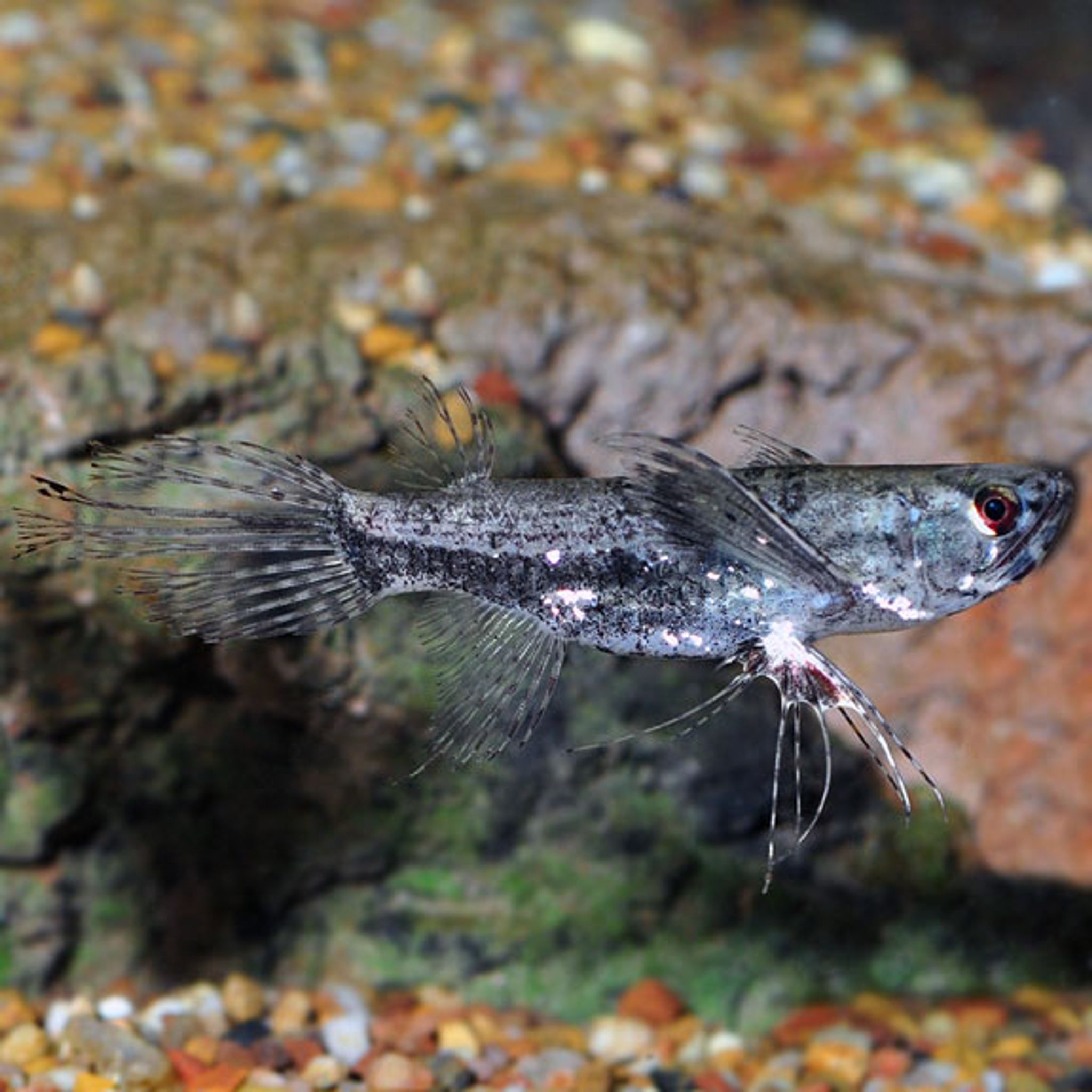
Pantodon buchholzi is a freshwater surface predator native to slow-moving swamps and backwaters of West and Central Africa. Despite the name, it has no relation to marine butterflyfish — this is a bony, air-gulping ambush hunter with broad, wing-like pectoral fins that let it glide short distances above the water when startled or hunting insects.
Those fins are also why the fish "reads" bigger than its length. A 4-inch African butterfly fish with fins spread can look nearly twice that wide from above, which is part of why new owners often overestimate how large the species will get.
Adult Size: What to Actually Plan For
- Typical adult length: 4–5 in (10–13 cm), measured body length (not fin span)
- Upper ceiling: some well-fed, mature specimens reach 5.5–6 in (14–15 cm), but this is the exception, not the rule
- Juvenile size at purchase: most pet-store specimens are sold at 1–2 in (2.5–5 cm)
Use 4–5 inches as your planning number. If your fish eventually measures closer to 6 inches, that's within the documented range for a well-fed individual — not a sign of a different species or a health issue.
Why the Body Shape Skews Perception
The pectoral "wings" plus the wide, flat head make the fish's visual footprint far larger than its standard length suggests. When judging tank fit, measure the body length, not the wingspan — but plan surface area generously anyway, since a resting or gliding butterfly fish does occupy more surface real estate than its length alone implies.
Growth Rate: A Size-by-Age Timeline
No single source lays out growth month by month, so here's a practical timeline built from the typical growth pattern reported for the species — treat it as a general guide, not a guarantee, since diet and water quality shift the pace.
| Age from purchase | Approximate size | Notes |
|---|---|---|
| At purchase | 1–1.5 in (2.5–4 cm) | Typical juvenile size sold in stores |
| 2–3 months | 2–2.5 in (5–6 cm) | Rapid early growth with consistent feeding |
| 4–6 months | 3–3.5 in (7.5–9 cm) | Growth still fast; fins broaden noticeably |
| 8–12 months | 4–5 in (10–13 cm) | Near-adult size for most individuals |
| Beyond 12 months | 4–6 in (10–15 cm) | Growth slows sharply; only marginal length gain |
Most of the fish's total growth happens in that first year. After 12 months, size increases become minor — so a fish that seems to have "stopped growing" at 15 months is behaving normally, not showing a health problem. A better early-warning sign of illness is appetite loss or clamped fins, not a size plateau.
Lifespan
Reported lifespans range from 5–8 years with good care, and some keepers report individuals reaching 9–10 years in exceptionally stable, well-fed setups. Treat 5–8 years as the realistic range and 9–10 as an achievable ceiling rather than the norm. Whether an individual is wild-caught or captive-bred, and its sex, may also influence longevity and max size, though this is not well documented and shouldn't be treated as a firm rule.
Tank Size: Footprint Matters More Than Gallons
- Absolute minimum: 30 gallons (114 L) for one adult
- Recommended standard: 40+ gallons (150+ L), especially if you want feeding room or plan to keep a pair
- Multiple butterfly fish: 75+ gallons (285+ L), with generous surface area to reduce territorial conflict
Why Footprint Beats Gallon Count
African butterfly fish live almost entirely in the top few inches of water. A tall, narrow "cube" tank wastes most of its volume on a fish that will never use the bottom two-thirds. This is why a 40-gallon long tank is a far better choice than a 40-gallon breeder of the same volume — the long tank has significantly more surface area, which is the resource this fish actually needs.
As a rule of thumb, aim for a footprint of at least 36 in (90 cm) of tank length, and prioritize width and length over height every time you're comparing two tanks with similar gallon counts. You can browse glass tanks sized by footprint rather than just gallon rating to find a shape that suits a surface-dwelling species like this one.
Water Parameters
| Parameter | Range |
|---|---|
| Temperature | 75–86°F (24–30°C) |
| pH | 6.0–7.5 |
| Hardness | Soft to moderately hard |
| Water flow | Still to gentle only |
Because the species comes from calm swamp water, avoid strong surface agitation. Airstones or filter returns aimed directly at the surface stress this fish; if your filter creates noticeable ripple, redirect the outflow or use a baffle so the top layer stays close to still.
Tank Setup Essentials
- Secure, gap-free lid: non-negotiable. This is a strong jumper that will find and exploit any opening.
- Lower water level: keep the surface a few inches below the rim to leave an air gap and reduce jump risk.
- Floating plants: provide cover and a sense of security for a fish that feels exposed in open water.
- Dim to moderate lighting: overly bright tanks can make this shy ambush predator retreat or refuse to feed near the surface.
- No strong surface flow: as above, redirect filter output away from the top layer.
Retrofitting a Lid for a Rimless or Open-Top Tank
Many rimless tanks aren't built with this fish in mind. Practical, product-agnostic fixes include:
- A mesh screen lid cut to the tank's exact dimensions, weighted or clipped at the corners
- Egg-crate light diffuser panels cut to size and framed with aquarium-safe silicone or clips
- Magnetic clip-style lids that seal against glass edges without needing a full frame
Whatever method you choose, check every gap — around cords, filter intakes, and heater openings — since a single half-inch gap is often all it takes.
Diet
African butterfly fish have upward-facing mouths built for snatching prey off the surface, so they largely ignore sinking pellets and flakes. Feed:
- Crickets and other small feeder insects
- Mealworms
- Fruit flies
- Frozen or live bloodworms
Some individuals can be slowly acclimated to floating pellets over time, but this isn't guaranteed for every fish. Feed small amounts multiple times a day rather than one large feeding — this matches their natural ambush-and-snack feeding style and reduces waste at the surface.
Behavior and Tankmates
This is an ambush predator that claims surface territory and can be aggressive toward other fish competing for that same space. It's generally peaceful toward fish that stay in the mid or bottom zones.
Good tankmate choices:
- Corydoras
- Loaches
- Plecos
- Small, peaceful characins or cichlids that stay low in the water column
- Nerite snails
Avoid:
- Other top-dwelling species (competition for surface space)
- Fin-nippers and long-finned fish (target for aggression)
- Any fish or shrimp small enough to be eaten
A Common Tankmate Mistake: Marbled Hatchetfish
Marbled hatchetfish are another surface-dwelling species sometimes considered as a companion, but they're a poor match here. Hatchetfish max out at roughly 1.5–2 in (4–5 cm) — small enough to be viewed as food by an adult African butterfly fish, not a tankmate. Hatchetfish also need their own dedicated setup: a 20-gallon-plus tank with wide surface area, soft acidic water, and — like the butterfly fish — a tight lid, since they're prone to jumping too. Keep the two species in separate tanks rather than pairing them.
Breeding
Breeding is rarely achieved outside of dedicated setups. It typically requires precise soft, acidic water, stable warm temperatures, and a large, mature, compatible pair. Eggs are laid and float at the surface. Consider this an advanced or expert-level project rather than something to plan around with a standard community setup.
Common Mistakes to Avoid
- Choosing a tall, narrow tank instead of a long, low-footprint one
- Skipping the lid or leaving gaps — the single most common cause of losing this fish
- Feeding only flakes or pellets, which can lead to a stunted or starving fish
- Filling water to the rim, removing the air gap and increasing jump risk
- Housing with other surface fish or long-finned species, inviting fin-nipping or aggression
- Adding small fish or shrimp, which will be treated as food
- Running strong surface flow or agitation, stressing a fish adapted to still water
- Mistaking a growth plateau for illness — slowing growth after year one is normal
Frequently Asked Questions
How big does an African butterfly fish get?
Most reach 4–5 in (10–13 cm) as adults. Occasionally, an exceptionally well-fed individual reaches around 6 in (15 cm), but that's an upper ceiling, not the typical outcome.
How fast do they grow?
Growth is fastest in the first 8–12 months, taking a fish from a 1–2 in juvenile to near-adult size. After that first year, growth slows dramatically and further size gains are minor.
What size tank do they need?
A 30-gallon tank is the absolute minimum for one adult, with 40+ gallons recommended for comfort or feeding room. Prioritize a long, low-footprint tank over a tall one, since this species lives almost entirely at the surface.
Can I keep more than one African butterfly fish together?
Yes, but it requires significantly more space — 75+ gallons is commonly recommended — along with generous surface area to reduce territorial clashes between individuals competing for the same zone.
What do African butterfly fish eat?
Primarily live or frozen insects such as crickets, mealworms, fruit flies, and bloodworms. Most won't eat sinking pellets or flakes because their upward-facing mouths are built for surface feeding, though some can adapt to floating pellets over time.
Are African butterfly fish jumpers?
Yes, and it's one of the top causes of losing this fish. A secure, completely gap-free lid is essential, along with keeping the water level a few inches below the rim.
What fish can live with African butterfly fish?
Peaceful bottom- and mid-water species that don't compete for surface space work best, including Corydoras, loaches, and plecos. Avoid other surface dwellers, fin-nippers, and any fish or shrimp small enough to be eaten.
How long do African butterfly fish live?
Typically 5–8 years with good care, though some well-maintained individuals have reportedly lived 9–10 years or more.
If you're planning a tank around this surface-dwelling predator, browse other tropical fish species on FishyHub to find compatible tankmates that suit its unique surface-territory needs.


