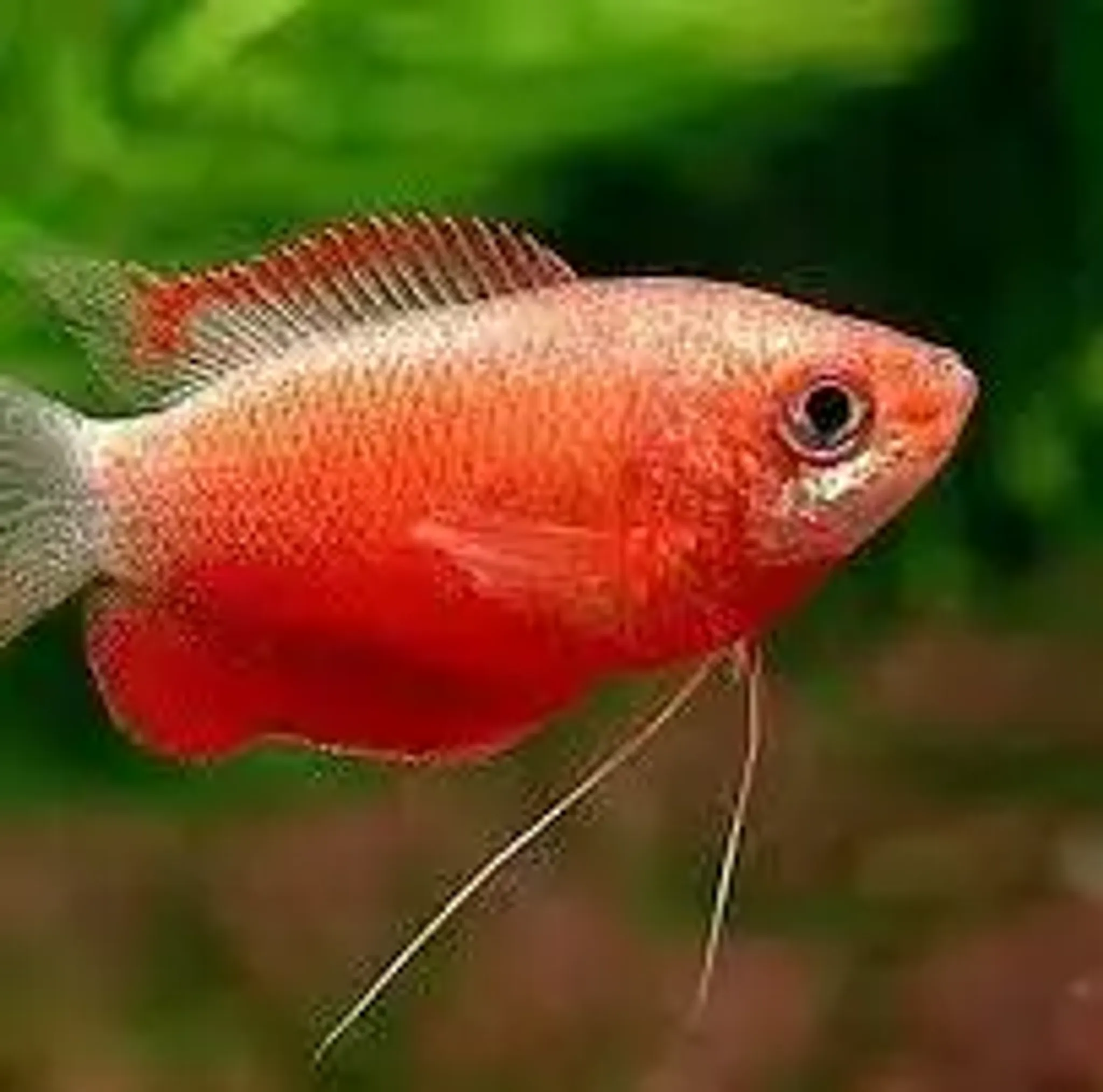

Honey Gourami Care Guide: Tank Size, Diet, Water Parameters and Temperament
The honey gourami is one of the calmest, smallest gouramis sold in US fish stores, and a strong centerpiece for a 10–20 gallon planted community tank. This guide covers exact tank size, temperature and pH targets, feeding, tankmates, and how to tell it apart from the dwarf gourami before you buy.
Quick Facts
| Trait | Detail |
|---|---|
| Scientific name | Trichogaster chuna (formerly Colisa chuna) |
| Origin | Slow, weedy waters of northeast India and Bangladesh |
| Adult size | 1.5–2 in typical; rarely near 2.75 in |
| Lifespan | 4–8 years, with 5–6 years typical under good care |
| Minimum tank | 10 gal for one fish; 20 gal (long) for a pair or trio |
| Temperature | 74–82°F (23–28°C); target 76–80°F (24–27°C) |
| pH | 6.0–7.5, stable is more important than exact number |
| Temperament | Peaceful, shy, easily bullied |
Tank Size and Setup
A single honey gourami is comfortable in a 10-gallon (38 L) tank. A 5-gallon (19 L) tank is technically possible but tight and leaves little margin for water quality swings. For a pair or a trio, 20 gallons is the realistic minimum, and a 20-long is a better shape than a 20-high because honey gouramis are surface-oriented labyrinth fish that spend most of their time in the upper half of the water column. Add roughly 5–10 gallons for each additional fish beyond that.
US Stocking Plans
| Tank | Setup | Notes |
|---|---|---|
| 10 gal | 1 honey gourami + a few small tankmates | Fine as a single, or a tight pair |
| 20 long | Trio (1M:2F) + a small schooling fish | Best all-around footprint |
| 29 gal | Small group (4–6, females majority) + varied community | Room for dither fish and plants |
A long, shallow tank beats a tall one — it gives more surface area for labyrinth breathing and territory, and it's easier to plant heavily near the top.
Filtration and Flow
Honey gouramis prefer gentle flow. Baffle a hang-on-back filter with a sponge or filter floss over the output, or use a sponge filter outright. Keep the surface fairly calm — strong ripples make it harder for the fish to gulp air and can discourage nest-building. At the same time, keep a lid on the tank: as a labyrinth fish, this species breathes warm, humid air from just above the waterline, and a drafty, open-top tank can chill that air layer and cause respiratory stress.
Aquascaping
- Dense planting with tall stem plants for cover in the middle and upper water column.
- Floating plants — frogbit, salvinia, or red root floaters — to diffuse light, provide shelter, and give a natural surface for a future bubble nest.
- Dark substrate, which tends to bring out the fish's natural color instead of washing it out.
- Open swimming space lower in the tank is optional; the real priority is cover near the top.
Water Parameters
| Parameter | Safe range | Target |
|---|---|---|
| Temperature | 74–82°F (23–28°C) | 76–80°F (24–27°C) |
| pH | 6.0–7.5 (up to 8.0 tolerated by captive-bred fish) | 6.5–7.5, kept stable |
| General hardness | 4–15 dGH (soft to moderately hard) | Mid-range |
| Ammonia / Nitrite | 0 ppm | 0 ppm |
| Nitrate | Under 20–40 ppm | Under 20 ppm |
Sources disagree at the edges of these ranges. Some list a temperature floor as low as 71°F, others put it at 75°F — 76–80°F is a safe target that avoids both extremes. Similarly, pH ceilings vary by source between 7.0, 7.5, and 8.0; captive-bred fish adapt reasonably well, so aim for 6.5–7.5 and prioritize stability over hitting an exact number. Honey gouramis are strictly a freshwater species — they do not tolerate brackish conditions at any life stage.
Because most US homes don't stay in the mid-to-upper 70s°F year-round, a heater is necessary in nearly all setups. For nano and small tanks, an appropriately sized, adjustable heater with a guard matters more than raw wattage:
| Tank size | Approximate heater wattage |
|---|---|
| 10 gal | 25–50 W |
| 20 gal | 50–75 W |
| 29 gal | 75–100 W |
Small volumes of water swing in temperature quickly, so pair any heater with a separate thermometer and choose one sized so it can't overheat the tank if the thermostat sticks in the "on" position.
Diet
Honey gouramis are best described as protein-focused omnivores, sometimes called micro-predators — not strict carnivores, despite how some sources label them.
- Staple: a quality micro pellet or flake sized for a small mouth.
- Protein boosts: frozen, live, or freeze-dried bloodworms, brine shrimp, and daphnia offered several times a week.
- Greens: optional and secondary to protein.
- Feeding schedule: adults once or twice daily; juveniles 2–3 smaller meals a day.
- Portion control: offer only what the group finishes in about two minutes to avoid bloat and nitrate spikes from uneaten flake.
You can browse a range of frozen and freeze-dried options in FishyHub's freeze dried food category to rotate into a honey gourami's diet.
Temperament and Tankmates
Honey gouramis are peaceful and genuinely shy, especially when first introduced. They're not a true schooling fish, but they do best as a single, a bonded pair, or a group of three or more with females outnumbering males (a 1M:2F ratio works well). Males become only mildly territorial while spawning; outside of breeding, aggression is rare. Keep no more than one male per 20-gallon tank to avoid squabbling over nest sites.
Good Tankmates
- Small tetras and other peaceful nano fish, available in FishyHub's small community fishes category
- Harlequin and other rasboras
- Cherry barbs and peaceful danios
- Corydoras and other peaceful bottom dwellers
- Kuhli or other small loaches
- Otocinclus
- Livebearers and snails
- Adult cherry or amano shrimp (adults are safe; shrimplets will be eaten)
Avoid
- Tiger barbs and other fin-nippers
- Cichlids and other large or hyperactive fish
- Other gouramis that bully, especially male dwarf gouramis
Sexing and Color Varieties
Males show off honey-orange bodies with a dark blue-black face, throat, and belly, and a yellow-edged dorsal fin when in breeding color. Females stay a plainer silvery-tan, often with a faint brown horizontal stripe, and have a rounder body shape. Keep in mind that color intensity shifts quickly with mood, lighting, and stress — a washed-out male isn't necessarily unhealthy.
Store stock includes the drabber, silvery-gold wild type alongside the common gold/yellow form and red or "sunset" morphs. Be aware that some fish sold as honey gouramis are dyed, hormone-treated, or hybridized with dwarf gouramis — see the checklist below before buying.
Honey vs. Dwarf vs. Thick-Lipped Gourami
These three are frequently confused at the store, and mislabeling is common.
| Species | Adult size | Minimum tank | Temperament | Notes |
|---|---|---|---|---|
| Honey gourami | 1.5–2 in | 10 gal | Peaceful, shy | Smallest and gentlest of the three |
| Dwarf gourami | Larger, more colorful males | 10–20 gal | Feistier males | Carries a higher reported risk of dwarf gourami iridovirus |
| Thick-lipped gourami | Up to ~3.5 in | 20–30 gal | Moderately peaceful | Larger, needs more room |
If peacefulness and small size are the priority, the honey gourami is the safer pick — and it avoids the disease concerns more often associated with dwarf gouramis.
Top Peaceful Gouramis for Small Tanks
If you're comparing gourami options for a nano or community setup, here's where honey gourami ranks against other small, calm species. Browse the full lineup in FishyHub's gourami category.
| Species | Adult size | Minimum tank | Notes |
|---|---|---|---|
| Sparkling gourami | ~1.5 in | 5 gal | Nano-friendly, very calm |
| Honey gourami | 1.5–2 in | 10 gal | Peaceful, easy, colorful males |
| Female powder blue dwarf gourami | ~2 in | 10 gal | Calmer than dwarf males |
| Chocolate gourami | ~2 in | 10 gal | Needs soft, acidic water; fussy |
| Pearl gourami | ~5 in | 29+ gal | Larger but still gentle |
Breeding
Honey gouramis are bubble nesters, using the same basic routine as their relative the betta, though far less injury-prone. The male builds a nest of bubbles at the surface, usually under a floating leaf, then embraces the female beneath it during spawning. She releases eggs that the male collects and places in the nest, and he guards it afterward while she is removed from the tank.
Breeding setup:
- Tank: 10–20 gal with only 6–8 inches of water depth
- Floating cover: a broad floating leaf or plant mat for the nest
- Temperature: 80–84°F (27–29°C)
- Water: softish and slightly acidic
After spawning, remove the female to prevent stress or aggression from the guarding male, and remove the male once the fry are free-swimming. Eggs hatch in about 24–36 hours, and fry become free-swimming around days 3–4. Feed infusoria at first, moving to baby brine shrimp at roughly 1–2 weeks old. A single spawn can range from a few dozen eggs up to about 300.
Honey pairs tend to bond and are gentler with each other than betta pairs, so females are rarely injured during the process — bettas are worth mentioning here only as a related labyrinth fish with a similar mating routine, not a tankmate option.
Common Health Issues
Honey gouramis are hardy once acclimated, but stress and poor water quality open the door to the same problems that affect most freshwater fish.
| Issue | Signs | Fix |
|---|---|---|
| Popeye | Cloudy, bulging eye(s) | Test and improve water quality; treat any injury |
| Fin rot | Ragged, fraying fin edges | Water change, check nitrate/ammonia, consider medication |
| Cotton wool (columnaris/fungus) | White, fuzzy tufts on body or fins | Water change, appropriate antifungal/antibacterial treatment |
| Velvet | Fine gold-dust coating on skin | Dim tank lights, use a copper-based treatment carefully |
| Dark or reddened gills | Discoloration around gill area | Check for ammonia/nitrite spikes; water change immediately |
In every case, start with a water test and a water change before reaching for medication — most of these issues trace back to water quality or stress rather than a random infection. Maintain weekly water changes of about 25%, and quarantine new arrivals for roughly two weeks before adding them to an established tank, since dyed or stressed import stock often carries ich or velvet.
Behavior Notes
- Nighttime rest: honey gouramis settle near plants at night and their color fades — this is normal, not illness.
- Shimmying or shaking: usually signals stress, cold water, or poor water quality, not a behavioral quirk.
- Hiding or dull color in a new fish: almost always acclimation stress or mild bullying, not "depression." Give a new fish time, cover, and calm tankmates before assuming something is wrong.
Common Mistakes to Avoid
- Bare, high-flow tanks: leads to constant hiding and washed-out color. Add floating plants and slow the current.
- Housing with dwarf gourami males or fin-nippers: results in torn fins and a fish that never comes out.
- Too many males: stick to one male per 20-gallon tank.
- Overfeeding flake food: causes bloat and nitrate spikes — feed only what's cleared in two minutes.
- Skipping quarantine: imported or dyed fish frequently carry ich or velvet that shows up days after purchase.
Buying Checklist
- Check for even color and full fins — avoid fish with unnaturally intense, uniform dye jobs or fin damage.
- Ask whether the stock is wild-type, gold, or a dyed/hybrid variant if color looks suspicious.
- Confirm it's actually a honey gourami and not a mislabeled dwarf gourami — check size and face coloration.
- Plan for a two-week quarantine tank before adding to your main setup.
- When introducing to a display tank, add the honey gourami before more active dither fish and provide floating cover immediately to ease acclimation.
Frequently Asked Questions
How many honey gouramis can I keep in a 10-gallon tank?
One comfortably, or possibly a tight pair. A trio or larger group needs a 20-gallon tank, ideally a 20-long, to give everyone enough space and surface area.
Can honey gouramis live with bettas?
It's possible but risky, since both are labyrinth fish that can be territorial around the surface, and it isn't generally recommended for a first attempt at a community tank.
Are honey gouramis aggressive?
Rarely. They're peaceful and shy overall, with only mild squabbling between males during breeding periods.
Do honey gouramis need a heater?
Yes, in nearly all US homes. Their preferred range of 76–80°F is warmer than typical unheated room temperature for most of the year.
Will honey gouramis eat shrimp?
Adult cherry or amano shrimp are generally safe tankmates, but honey gouramis will eat shrimplets, so a mixed-shrimp colony won't sustain itself in the same tank.
How can I tell a male from a female honey gourami?
Males display an orange body with a dark blue-black face, throat, and belly, especially in breeding color. Females stay silvery-tan, often with a faint horizontal stripe, and have a rounder body.
Why is my honey gourami pale?
Paleness is usually stress, a new or unfamiliar tank, normal nighttime resting color, or simply being female, since females are naturally less vivid than colored-up males.
How long do honey gouramis live?
Typically 4–8 years with good care, with 5–6 years being a realistic average for most home aquariums.
Ready to start a honey gourami tank or round out an existing one? Browse live stock in FishyHub's gourami category for wild-type and colored varieties, plus compatible tankmates in the small community fishes section.


