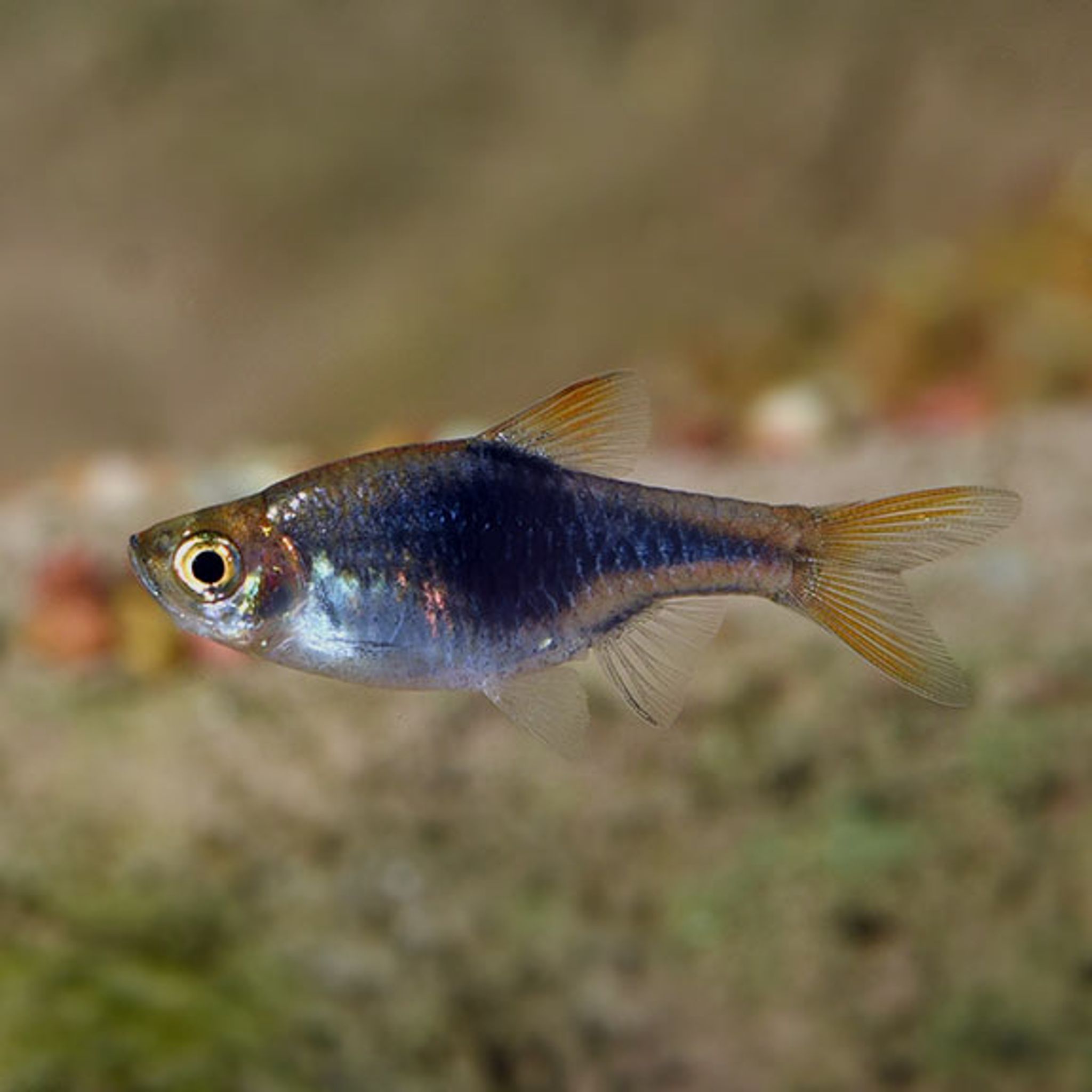

Harlequin Rasbora Care Guide: Tank Size, Diet, Water Parameters and Temperament
Harlequin rasbora care comes down to a few things: a group of 8 or more fish, a cycled 20 gallon long (or at least a 10 gallon for a small group), water at 75–78°F that stays stable, and small meals of micro-pellets with frozen foods mixed in. They're peaceful, hardy and easy to feed, which makes them one of the best schooling fish for a first planted community tank. The sections below give you the numbers, explain why each one matters, and help you avoid the lookalikes that US stores often mislabel.
Harlequin Rasbora Quick Specs
| Parameter | Recommendation | Why it matters |
|---|---|---|
| Scientific name | Trigonostigma heteromorpha | Helps you avoid mislabeled lookalikes |
| Adult size | 1.75–2 in. (4.5–5 cm) | Small enough to be eaten by big tankmates |
| Lifespan | 5–6 years on average, up to 8 | A long-term commitment for a small fish |
| Minimum tank | 10 gal (38 L) for 6–8 fish; 20 gal long (76 L) recommended | Active swimmers that need horizontal space |
| Group size | 8+ (6 is the bare minimum) | Bigger groups mean better color and less hiding |
| Temperature | 75–78°F (24–26°C); tolerates 72–80°F (22–27°C) | Stable warmth keeps the immune system strong |
| pH | 6.0–7.8 tolerated; 6.0–7.0 ideal | Stability matters more than a perfect number |
| Hardness | GH 2–15 dGH, KH 1–12 dKH | Softer water brings out color and aids breeding |
| Temperament | Very peaceful | Good in most small-fish communities |
| Care level | Beginner-friendly | Hardy once settled in a cycled tank |
Species Overview
The harlequin rasbora is a small cyprinid from Southeast Asia, found on the Malay Peninsula, in southern Thailand, and on Sumatra and Borneo. In the wild it lives in slow, tea-colored forest streams and peat swamps where fallen leaves stain the water with tannins. That habitat explains its preference for soft, slightly acidic water, dim light and plenty of cover.
Adults have a coppery-pink to orange body with a bold black triangular wedge on the back half. In a well-kept, planted tank the pink tones deepen and the fins pick up a reddish tint.
On lifespan, you'll see figures from 3–5 years to 5–8 years. A realistic average is 5–6 years, and 8 is possible with steady water quality and a good diet.
Tank Size and Setup
How big a tank do harlequin rasboras need?
Recommendations range from 10 to 20 gallons. The practical answer:
- 10 gallons (38 L): workable for 6–8 harlequins as the only school, as long as you keep up with maintenance.
- 20 gallon long (76 L) or larger: the better choice for a real school of 10–12 plus tankmates. The longer footprint gives these midwater swimmers room to cruise.
Aquascape and equipment
- Live plants: strongly preferred. Cryptocoryne, Java fern, Anubias and floating plants all work well. Leave an open swimming lane through the middle.
- Hardscape and substrate: driftwood and a dark substrate make their colors stand out. Dried leaf litter adds tannins, which is a cheap way to boost color and mimic their home waters.
- Lighting: keep it subdued, or use floaters to shade the surface. Harsh light washes out their pink tones.
- Filtration: gentle flow. A sponge filter or a hang-on-back filter with a baffled output is ideal.
- Heater: needed in most US homes to hold 75–78°F.
- Lid: harlequins can jump, so cover the tank.
Water Parameters
Temperature
Harlequins tolerate 72–80°F (22–27°C). For a community tank, aim for 75–78°F (24–26°C). Reserve 78–82°F (26–28°C) for breeding setups or for gradual ich treatment.
pH and hardness: stability over perfection
Sources disagree on the sweet spot, with some saying pH 6.5 and others 7.2. Harlequins adapt to roughly pH 6–8, and fish sold in most US cities are already acclimated to local tap water. Much US tap water is hard and alkaline, and that's fine for keeping (not breeding) harlequins. Chasing a lower pH with chemicals tends to cause swings, which are far more harmful than a steady 7.4.
Aim for GH 2–15 dGH and KH 1–12 dKH. Softer water gives better color, but you only need to blend in RO (reverse osmosis) water if you plan to breed them.
The nitrogen cycle and maintenance
- Add fish only to a fully cycled tank.
- Keep ammonia and nitrite at 0 ppm and nitrate below 20–40 ppm.
- Change 25–30% of the water weekly, matching temperature and using dechlorinator.
Diet and Feeding
Harlequins are omnivorous micropredators that pick small food from the water column. They don't graze on algae, so don't count on them to clean the glass.
- Staples: a quality micro-pellet and crushed flakes.
- Extras, 2–3 times a week: frozen or live baby brine shrimp, daphnia, cyclops, chopped bloodworms or mosquito larvae. These help with color and condition breeders.
- Portions: only what they finish in about 1–2 minutes.
- Frequency: once a day or two small meals both work if portions stay small. Skip one day a week.
- Vacations: healthy adults can go 3–5 days without food, so a short trip doesn't call for an automatic feeder or a block feeder.
Overfeeding is the most common way to cloud the water and spike nitrate. You can browse micro-pellets, flakes and frozen or freeze-dried treats in FishyHub's food and supplements section.
Temperament and Tankmates
Harlequins are very peaceful shoalers that occupy the middle and upper levels of the tank. They don't nip fins or bother bottom dwellers.
Good tankmates
- Small tetras such as neon, ember and rummy-nose (browse small tetras on FishyHub)
- Other small rasboras
- Corydoras, otocinclus and kuhli loaches
- Dwarf and honey gouramis
- Peaceful livebearers
- Adult neocaridina shrimp and nerite snails
- A calm betta in a planted 20 gallon or larger tank
Tankmates to avoid
- Anything big enough to swallow them: angelfish in small tanks, larger cichlids, big barbs
- Fin-nippers and bullies such as tiger barbs and some larger danios
Adult shrimp are safe, but harlequins will eat shrimplets. If you want a thriving shrimp colony, give the babies dense moss or keep the shrimp separately.
Sample stocking plans
These assume a cycled, planted tank with good filtration and weekly water changes.
| Tank | Sample community |
|---|---|
| 20 gal long (76 L) | 10 harlequins, 6 pygmy or panda-sized corydoras, 1 honey gourami, a few nerite snails |
| 29 gal (110 L) | 12 harlequins, 8 ember tetras, 6 corydoras, 3 otocinclus, 1 dwarf or honey gourami |
Loose shoal vs. tight school
A relaxed group spreads into a loose shoal. Tight, nervous schooling usually means the fish feel threatened, have just been added, or are being harassed.
Buying, Acclimating and Quarantine
Store fish often arrive stressed from shipping. Pick healthy stock by looking for:
- Full, rounded bellies, not pinched ones
- Open fins, not clamped
- No white patches or fuzzy spots, which can signal columnaris
- Active swimming with the rest of the group
To acclimate, float the bag to match temperature, then add small amounts of your tank water over 20–30 minutes before netting the fish in (don't pour store water into your tank). Quarantine new arrivals for 2–4 weeks in a separate tank, keep the lights dim and feed lightly for the first few days.
Health and Common Problems
Harlequins are tough, but ich, fin rot and columnaris are the main risks. All three are usually triggered by stress or poor water quality.
| Symptom | Likely cause | What to do |
|---|---|---|
| Sudden deaths within days of setup | Uncycled tank | Test for ammonia/nitrite; do water changes and cycle properly |
| Faded color | Stress, bright light, bare tank, hard water, bland diet | Add plants and floaters, dim the light, vary food, add leaf litter |
| Hiding near the bottom, clamped fins | Ammonia/nitrite or bullying | Test water; check for aggressive tankmates |
| Small white spots | Ich | Raise temperature gradually to 80–82°F (27–28°C) and treat; avoid swings |
| Cloudy water, high nitrate | Overfeeding | Cut portions; increase water changes |
| Fish found on the floor | No lid | Cover the tank |
| Constant hiding in a small group | Only 3–4 fish | Grow the group to 8+ |
Sexing and Breeding
Telling males from females
- Males: slimmer, with a wedge that extends further forward and is more rounded at its lower edge.
- Females: fuller-bodied, with a straighter, clean-edged wedge.
Breeding harlequins
Breeding is moderately difficult, mainly because of the soft water required.
- Setup: a separate 5–10 gallon (19–38 L) tank with very soft water (GH 1–3), pH about 5.5–6.5, 78–82°F (26–28°C), peat- or leaf-filtered water and broadleaf plants such as Cryptocoryne or Anubias.
- Conditioning: feed live foods heavily beforehand.
- Spawning: pairs flip upside down and stick eggs to the underside of leaves, which is unusual among cyprinids. Expect roughly 80–100 eggs over a spawn.
- Afterward: remove the adults. Eggs hatch in about 24 hours and fry swim a few days later. Feed infusoria or paramecium first, then baby brine shrimp or microworms after about 1–2 weeks.
Harlequin vs. Lambchop vs. Hengel's: ID Guide
US stores often mix up these three Trigonostigma species. Care is nearly identical, but knowing which one you have helps.
| Feature | Harlequin (T. heteromorpha) | Lambchop / espei (T. espei) | Hengel's (T. hengeli) |
|---|---|---|---|
| Adult size | 1.75–2 in. (4.5–5 cm) | Slightly slimmer than harlequin | About 1.2 in. (3 cm) |
| Body color | Coppery pink to orange | More orange | Pinkish-orange |
| Black marking | Broad triangular wedge | Thinner crescent (the "lambchop" or "porkchop") | Thin wedge with a glowing orange edge |
| Best fit | 10–20 gal+ communities | Same as harlequin | Nano tanks; softer, slightly cooler water |
Other Rasbora Types Worth Knowing
The word "rasbora" covers many species with very different needs.
| Species | Max size | Minimum tank | Difficulty |
|---|---|---|---|
| Chili rasbora (Boraras) | Under 1 in. | Nano | Easy–moderate |
| Exclamation-point rasbora | Under 1 in. | Nano | Moderate |
| Blue neon rasbora (Sundadanio axelrodi) | Under 1 in. | Nano, blackwater | Difficult |
| Hengel's rasbora | ~1.2 in. | Nano | Easy–moderate |
| Glowlight rasbora (T. somphongsi) | 1–1.5 in. | Small, soft water | Moderate; rare and pricier |
| Emerald eye rasbora (Brevibora dorsiocellata) | ~1.5 in. | 10–20 gal | Easy |
| Harlequin / lambchop | ~2 in. | 10–20 gal | Easy |
| Red-line, brilliant and other Rasbora spp. | 1.5–3 in. | Varies by size | Easy |
| Scissortail (Rasbora trilineata) | 3–4 in. | 20–30 gal+ | Easy but skittish |
| Giant scissortail / three-lined types | 5–6 in. | 55 gal+ | Moderate |
A few notes:
- Emerald eye rasbora has a bright green-blue eye and a dark-tipped dorsal fin and is very peaceful.
- Blue neon rasbora needs very soft, acidic water and isn't hardy enough for beginners.
- Scissortails have a black-and-white forked tail, spook easily and jump, so a lid is a must.
- Galaxy / celestial pearl danios are often sold as "galaxy rasboras," but they aren't true rasboras.
Frequently Asked Questions
How many harlequin rasboras can go in a 10 gallon tank?
About 6–8 at most, and only if they're the main school. A 20 gallon long lets you keep 10–12 harlequins plus tankmates, which is a far better setup.
Can harlequin rasboras live with a betta?
Often yes, in a planted 20 gallon or larger tank with a mellow betta. Watch for fin-nipping in either direction, and have a backup tank in case the betta turns aggressive.
Are harlequin rasboras good for beginners?
Yes. They're hardy, peaceful and eat almost anything, as long as you add them to a fully cycled tank and keep the water stable.
Do harlequin rasboras need a heater?
In most US homes, yes. Set it to 75–78°F (24–26°C) so the temperature doesn't drift overnight or in winter.
Harlequin or lambchop rasbora: which should I buy?
Care is the same, so choose by look. Lambchops are slimmer and more orange with a crescent-shaped mark, while harlequins have a broader wedge and a pinker body.
Will harlequin rasboras eat my shrimp?
Adult shrimp are safe, but baby shrimp are not. Dense moss gives shrimplets somewhere to hide, but don't expect harlequins to leave them alone.
Build Your Harlequin School
A well-kept group of harlequins in a planted, dimly lit tank is one of the easiest ways to get a peaceful, colorful community going. When your tank is cycled and ready, browse rasboras on FishyHub to start your school.


