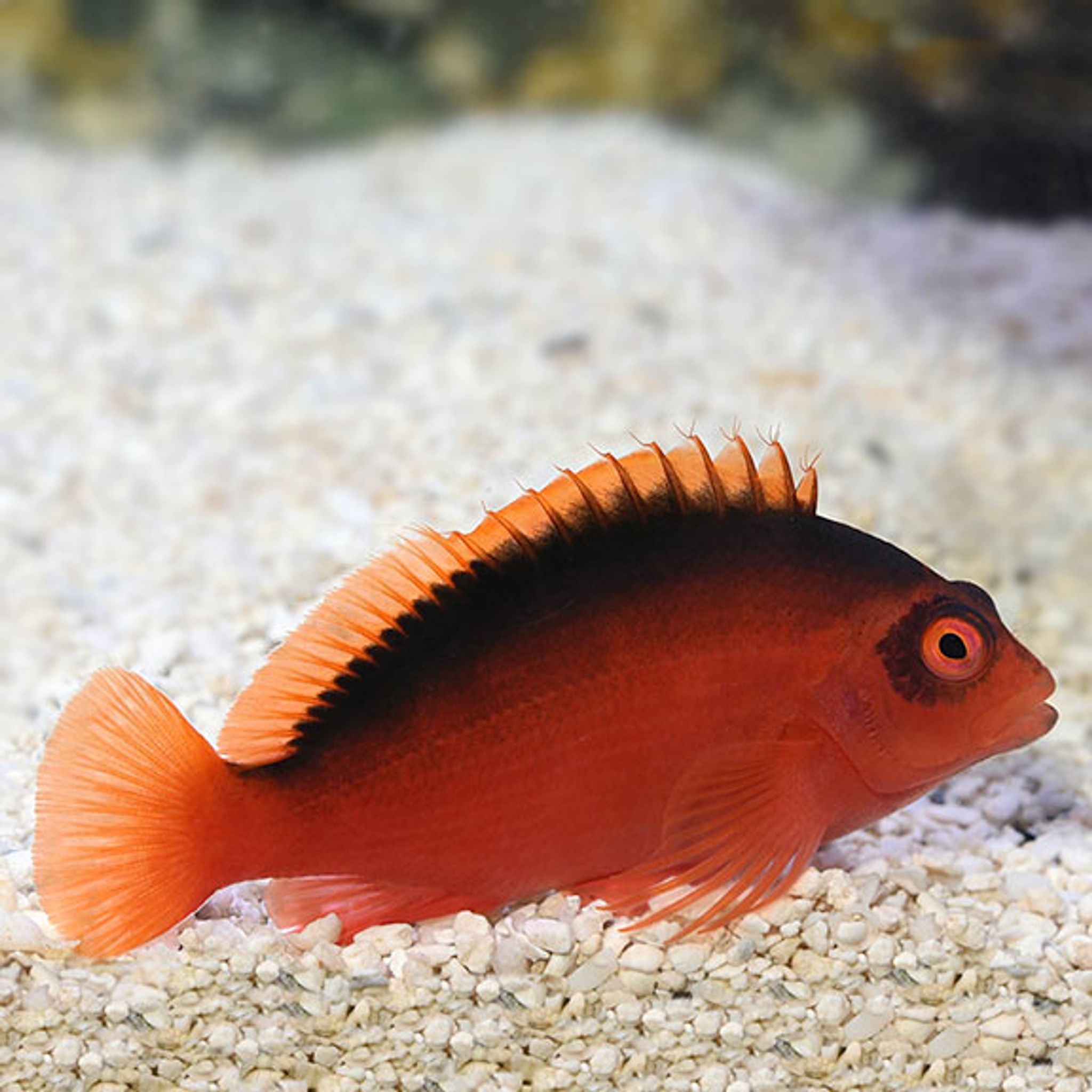
Flame Hawkfish Care Guide: Tank Size, Diet, Compatibility and Reef Safety
The Flame Hawkfish (Neocirrhites armatus) is one of the most popular perching predators in the saltwater hobby, prized for its bold orange-red color and its habit of watching the tank from a favorite rock ledge. This guide covers the tank size, water parameters, diet, and compatibility rules you need before buying one, plus the reef-safety nuance that most quick-answer sources skip.
Species Snapshot
The Flame Hawkfish belongs to the family Cirrhitidae and comes from Indo-Pacific reef flats and lagoons, where it perches on branching coral and rock rather than swimming in open water. It is also sold as the "Flame" or "Scarlet" Hawkfish.
| Trait | Detail |
|---|---|
| Scientific name | Neocirrhites armatus |
| Adult size | 3–4 in (7.5–10 cm) |
| Lifespan | 5–10 years with good care |
| Minimum tank size | 30 gal (114 L) |
| Temperament | Semi-aggressive, bold, territorial |
| Diet | Carnivore (meaty foods only) |
| Reef safety | Safe for coral tissue; unsafe for small motile inverts |
Most retail specimens are wild-caught, since captive breeding of this species isn't commercially available. That fact matters twice over: it's part of why individuals can be pricier than tank-raised fish, and it's the main reason quarantine (covered below) is non-negotiable rather than optional.
Flame Hawkfish Size and Growth
Flame Hawkfish reach their adult length of about 3–4 inches within roughly 1–2 years. Growth slows noticeably once they hit territorial maturity, after which most of the change you'll see is filling out rather than lengthening. Dominant males tend to run at the larger end of that range, while females are often slightly smaller — consistent with the species' harem-based social structure in the wild.
Tank Size and Setup
30 gallons (114 L) is the minimum tank size, and footprint matters more than height. Because Flame Hawkfish perch and ambush rather than cruise, a wide, low tank with lots of rockwork gives them more usable territory than a tall, narrow one of the same volume. If you're planning to keep a pair, or a busier reef community with other semi-aggressive fish, size up to 75–100+ gallons so territories don't overlap.
Setup essentials:
- Live rock with ledges and caves — the fish needs a clear vantage point to survey the tank and dart out at food.
- A tight-fitting lid or mesh screen. Flame Hawkfish are notorious jumpers, especially in the first days after introduction or when startled. A lid with gaps is the single most common way hobbyists lose this fish.
- Adequate flow and biological filtration, since a well-stocked reef tank with a carnivorous feeder needs steady nutrient export.
Water Parameters
Keep parameters at reef-standard levels and change roughly 10–25% of the water weekly to hold them steady.
| Parameter | Target range |
|---|---|
| Temperature | 72–78°F (22–26°C); tolerates up to 80°F (27°C), but not ideal long-term |
| pH | 8.1–8.4 |
| Specific gravity | 1.023–1.026 |
| dKH | 8–12 |
| Nitrates | Low |
A digital refractometer is worth the upgrade over a swing-arm hydrometer for measuring specific gravity. It reads more precisely, which matters in a mixed fish-and-invertebrate reef tank where both the hawkfish and any inverts you keep are sensitive to salinity swings. Calibrate it periodically with calibration fluid or RO/DI water, which should read 1.000.
Diet and Feeding
Flame Hawkfish are strict carnivores and not picky eaters. They readily accept:
- Frozen mysis shrimp
- Krill
- Brine shrimp
- Chopped fresh or frozen seafood ("fish flesh")
- Quality marine pellets or carnivore formulas
Feed 2–3 small meals a day. These are active, high-metabolism predators, and skipping days is tolerated worse than with many other reef fish — underfeeding shows up quickly as weight loss. Target or spot feeding with a feeding stick or turkey baster also helps make sure shier tankmates get their share before the hawkfish claims the food. They won't touch algae-based or herbivore foods, so no separate greens are needed for this species.
Temperament and Compatibility
Flame Hawkfish are bold, curious, and interactive — many keepers find they learn to recognize the person who feeds them and will beg at the glass at feeding time. That said, they are also territorial and semi-aggressive, particularly toward similarly shaped bottom-dwelling fish.
Keep only one Flame Hawkfish per tank unless the tank is large and the pair is introduced together as an established male/female pair. Two males in a modest tank will fight persistently.
Good Tankmates
Mid-size to boisterous fish that can hold their own generally do well alongside a Flame Hawkfish:
- Tangs and surgeonfish
- Angelfish
- Larger dottybacks
- Wrasses
- Dartfish
- Clownfish
- Rabbitfish
You can browse a range of compatible options in FishyHub's wrasse and tangs and surgeons selections when planning a community around this fish.
Risky or Avoid
- Small ornamental shrimp (cleaner, peppermint, skunk)
- Small crabs
- Small gobies and blennies (direct territory competitors)
- Tiny or juvenile fish
- Pistol shrimp/goby pairs and other small, exposed invertebrates
Reef Safety, Explained Properly
The short answer is that Flame Hawkfish are reef safe with invertebrate caution. They do not eat coral tissue and won't directly harm large-polyp stony (LPS) or small-polyp stony (SPS) corals. But "reef safe" only tells half the story, because this fish's favorite behavior — perching — has real consequences for a reef layout, and it will actively hunt small motile invertebrates.
The Perching Problem
A Flame Hawkfish picks a favorite vantage point and returns to it constantly. If that spot happens to be a prized coral head, the coral can show prolonged polyp retraction from the repeated contact, and a frag can occasionally get knocked loose. The practical fix is simple: place delicate or expensive frags away from the rock formations your hawkfish has claimed as a perch, and give it plenty of bare rock ledges as an alternative.
A Graded Risk List for Invertebrates
Rather than a blanket "avoid all inverts" warning, it's more useful to think in three tiers:
| Risk level | Invertebrates | Notes |
|---|---|---|
| Definitely unsafe | Small shrimp (cleaner, peppermint, skunk), small crabs | Will be hunted and eaten |
| Occasionally at risk | Bristleworms, small hermit crabs | May be picked at opportunistically |
| Usually safe | Large snails, mature feather dusters | Generally left alone in a well-fed tank, though very small snails can occasionally get picked at |
If you want to keep any of the invertebrates in the "unsafe" or "at risk" categories, add them to the tank before the Flame Hawkfish, not after. A hawkfish that's already settled and territorial will treat any newly introduced small invert as food; the reverse order gives the invertebrates a chance to establish and hide. You can check current stock in the marine invertebrates and shrimp section before deciding on a stocking order.
Acclimation and Quarantine
Because most Flame Hawkfish are wild-caught and prone to jumping and stress, a slow drip acclimation followed by a dedicated 2–4 week quarantine is strongly advised before adding one to a display tank. Use the quarantine period to watch for marine ich or flukes and to confirm the fish is eating well. Skipping quarantine on a wild-caught predator is one of the more common ways an outbreak reaches an otherwise stable reef tank.
Sexuality and Breeding
Flame Hawkfish are protogynous sequential hermaphrodites, meaning an individual can change sex, and in the wild they form male-dominated harems of one male with several females. Home breeding is rare and considered advanced: spawning happens in the evening, the pelagic eggs hatch in about 2–3 weeks under ideal conditions, and the resulting fry need copepods and rotifers before graduating to baby brine shrimp. For essentially all home aquarists, this is not a realistic breeding project.
Other Hawkfish Species to Consider
If a 30-gallon minimum is more than your setup allows, two related species are worth a look:
- Geometric Pygmy Hawkfish (Cirrhitichthys falco or similar dwarf species): tops out around 2 inches or less, making it a good fit for nano reef tanks. It perches on rock and coral in the same way as the Flame Hawkfish but needs far less floor space.
- Dwarf Spotted Hawkfish (Cirrhitichthys aprinus): also compact and similarly semi-aggressive, useful as an alternative perching predator if you want the hawkfish look and behavior without committing to a full 30-gallon-plus setup.
Both share the same core caution: safe around coral, risky around small shrimp and crabs.
Common Mistakes to Avoid
- No lid, or a lid with gaps. Losing a Flame Hawkfish to a jump is the single most common complaint from new keepers — secure every opening.
- Undersized or bare tank. Without enough rockwork, the fish stays stressed and hides instead of behaving naturally.
- Adding delicate shrimp or crabs after the hawkfish is settled. Stock those inverts first, or skip them entirely.
- Keeping two males together. This leads to persistent fighting in anything short of a large tank.
- Underfeeding. Skipped meals show up as weight loss faster than with most reef fish.
- Skipping quarantine. Wild-caught stock can carry parasites that spread quickly once added to a display.
- Letting salinity or temperature drift during water changes. Always match new saltwater to the display tank before adding it.
Getting Started in the Saltwater Hobby
If a Flame Hawkfish will be your first saltwater fish, a few fundamentals make the difference between a stable tank and a stressful one:
- Cycle the tank before adding any fish. Run a fishless cycle and test for ammonia, nitrite, and nitrate until ammonia and nitrite both read zero.
- Start with hardy species before adding a semi-aggressive predator like a hawkfish.
- Invest in quality test kits and a protein skimmer early rather than after a water quality problem shows up.
- Go slow with stocking, especially in a reef tank where you're balancing fish, corals, and invertebrates.
How to Change Saltwater Tank Water
- Mix synthetic sea salt with RO/DI water to match your display tank's salinity.
- Match the new water's temperature to the display before adding it.
- Remove about 10–20% weekly (or 20–25% biweekly) using a siphon that also vacuums detritus from the substrate.
- Avoid excessively disturbing live rock or sand while siphoning.
- Let the new saltwater aerate and mix fully before pouring it into the tank.
Saltwater Aquarium Cost
Budget for test kits, a refractometer or hydrometer, a protein skimmer, live rock and sand, lighting, and ongoing salt mix and food. A small reef-capable setup can start modestly — a few hundred dollars for the basics — but costs rise quickly as tank size, lighting quality, and coral or livestock choices increase.
Frequently Asked Questions
Is a Flame Hawkfish reef safe?
Generally yes for corals — it won't eat coral tissue and rarely damages LPS or SPS directly. It will, however, eat small ornamental shrimp, crabs, and other small invertebrates, so it's best described as reef safe with invertebrate caution.
What is the minimum tank size for a Flame Hawkfish?
30 gallons (114 L) is the accepted minimum. Rockwork, perches, and a secure lid matter more to this fish's wellbeing than raw water volume.
Can I keep two Flame Hawkfish together?
Only in a larger tank, and ideally as a male/female pair introduced at the same time. Two males housed together will fight persistently.
What do Flame Hawkfish eat?
Meaty carnivore foods: frozen mysis shrimp, krill, chopped seafood, and quality marine pellets, fed in 2–3 small meals daily.
Will a Flame Hawkfish eat my cleaner shrimp or snails?
Small shrimp and crabs are at real risk of being hunted. Snails are generally left alone, though very small ones can occasionally be picked at.
Why does my Flame Hawkfish keep jumping out of the tank?
It's almost always insufficient lid coverage combined with the species' natural startle-and-jump response, especially soon after introduction. A well-sealed lid or mesh screen solves it.
How big do Flame Hawkfish get and how long do they live?
They reach about 3–4 inches in length, usually within 1–2 years, and can live 5–10 years in a well-maintained tank.
What fish make good tankmates for a Flame Hawkfish?
Tangs, angelfish, wrasses, clownfish, dartfish, and other medium semi-aggressive fish generally coexist well. Avoid small bottom-dwelling competitors like gobies and blennies, along with any tiny or juvenile fish.
If you're ready to stock one, FishyHub's hawkfish selection is a good place to compare available individuals before setting up quarantine.

