
Firefish Goby Care Guide: Tank Size, Diet, Compatibility and Reef Safety
The fish most hobbyists call a "firefish goby" isn't a goby at all — it's a dartfish, and that distinction actually matters for how you set up its tank. This guide covers realistic tank size numbers, a feeding schedule, reef safety, and which tankmates will and won't work, so you can decide if this fish fits your setup before you buy one.
Wait, Is a Firefish Goby Really a Goby?
No. The fish sold under this name is Nemateleotris magnifica, commonly called the fire dartfish or firefish. It belongs to the dartfish family (Microdesmidae), not the true goby family (Gobiidae). The "goby" label stuck in the aquarium trade because firefish share a similar body shape and burrow-dwelling habit with true gobies, but they're not closely related.
True gobies — clown gobies, shrimp gobies, watchman gobies — are a much larger family. Some, like shrimp gobies, form a symbiotic burrow-sharing partnership with pistol shrimp. Firefish do not do this; they dig their own bolt-hole or simply claim a crevice in the live rock.
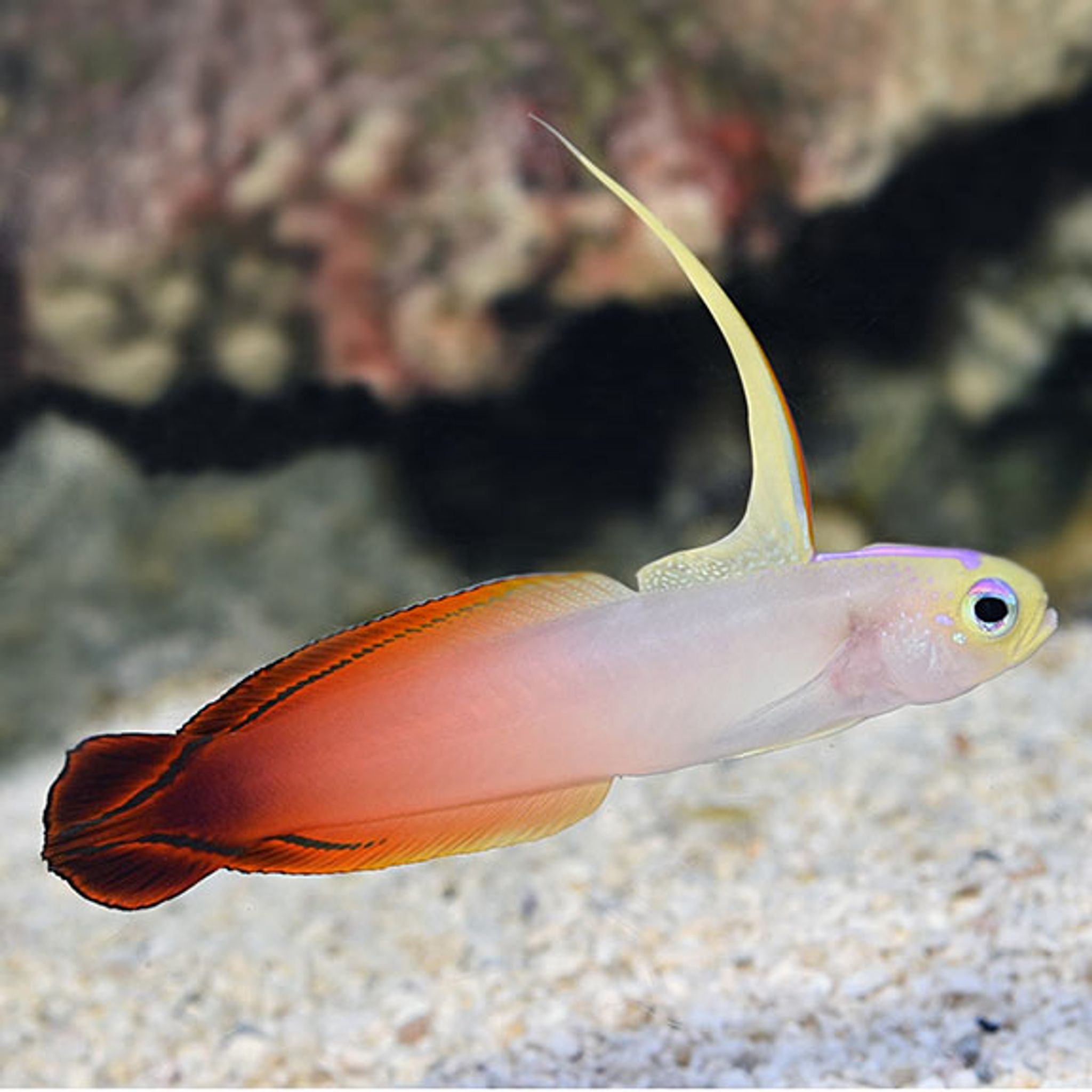
Appearance: Firefish have a pearly white-to-pale-blue front half that fades into a vivid orange-red rear half, growing to about 3 inches (7.5 cm). Their standout feature is a tall, flag-like first dorsal fin, often black-tipped, which they raise and flick as an alarm or communication signal — not a sign of illness.
Firefish vs. Related Dartfish: A Quick Comparison
Several closely related species get lumped into "firefish" searches. Here's how they actually differ:
| Species | Body Color | Adult Size | Temperament | Min. Tank Size |
|---|---|---|---|---|
| Firefish (N. magnifica) | White/blue front, orange-red rear | ~3 in (7.5 cm) | Peaceful, shy | 20 gal (76 L) |
| Purple firefish (N. decora) | Purple-magenta with orange accents | ~3 in (7.5 cm) | Peaceful, slightly more delicate | 20 gal (76 L) |
| Helfrich's firefish (N. helfrichi) | Lavender/pink body, yellow head | ~2 in (5 cm) | Peaceful, shyer, pricier | 20 gal (76 L), calmer mix |
| Scissortail dartfish (Ptereleotris spp.) | Pale gray-blue, forked tail | ~4–5 in (10–13 cm) | Active, more open-water swimmer | 30 gal (114 L) |
The purple firefish (N. decora) is a genuinely different species that lives slightly deeper on the reef and is a bit more sensitive to shipping stress. Helfrich's firefish is smaller and more colorful but generally shyer, so it does best with even calmer tankmates than the standard firefish. Scissortail dartfish hover higher in the water column and swim more actively, which is why they're happier in a larger footprint.
Tank Size and Setup
Sources vary on the bare minimum, and here's the practical read: 10 gallons (38 L) is the absolute floor, and only for a single small juvenile in a nano reef with no other fish. For a healthy adult kept long-term, 20 gallons (76 L) is the real starting point. If you're keeping a bonded pair or adding tankmates, plan for 30+ gallons (114+ L). Bigger is always better given how much these fish patrol their territory.
Aquascape essentials:
- Plenty of live rock with caves and crevices — firefish retreat tail-first into rockwork when startled.
- A burrow or sand/rubble pocket at the base of the rock; they'll dig their own bolt-hole if given loose substrate near the rockwork.
- Moderate water flow. Firefish are weak swimmers compared to fish built for strong current, so avoid pointing powerheads directly at their favored hovering spot.
- A tight-fitting mesh or glass lid with no gaps. This is non-negotiable — see the jump-prevention section below.
Water Parameters
| Parameter | Target Range |
|---|---|
| Temperature | 72–80°F (22–27°C) |
| pH | 8.1–8.4 |
| Specific gravity | 1.020–1.025 |
| dKH | 8–12 |
These are standard stable reef parameters. Firefish tolerate normal fluctuations reasonably well once established, but they do poorly in immature or uncycled tanks — always add them to a fully cycled system.
Diet and Feeding Schedule
In the wild, firefish are carnivorous zooplanktivores, picking tiny prey out of the water column. In captivity, offer:
- Mysis shrimp
- Frozen brine shrimp (enriched)
- Finely chopped meaty seafood
- Quality marine flake or pellet, once the fish is acclimated
Feed 2–3 small meals a day. Their stomach capacity is tiny, and the exact number matters less than avoiding overfeeding that fouls water quality. Underfeeding is actually the more common problem — firefish are slow, deliberate feeders that get outcompeted by faster fish, and chronic underfeeding is a leading cause of decline. Watch that your firefish is actually getting food at each feeding, not just watching it disappear.
Reef Safety
Firefish are fully reef safe. They won't touch corals, clams, or sessile invertebrates, and they're compatible with a cleanup crew of snails and most shrimp. There's a small, rarely-realized risk to very tiny ornamental shrimp, but this is a minor exception rather than a real concern for typical reef stocking.
Compatibility and Tankmates
Firefish are peaceful and do best in a calm community. Good tankmates include:
- Small, peaceful clownfish
- Chromis
- Cardinalfish
- Non-territorial gobies
- Blennies
- Dwarf or pygmy angelfish
Avoid large or aggressive fish — lionfish, moray eels, groupers, large hawkfish, aggressive dottybacks, and triggerfish can bully or outright eat a firefish. Browsing FishyHub's dartfish and gobies selections is a good way to see what similarly-sized, similarly-tempered nano fish are currently available to pair with a firefish.
Keeping More Than One
Keep firefish singly unless you're introducing an already-bonded, mated pair at the same time. Adding two unrelated firefish separately almost always ends badly — they will fight, sometimes fatally, since neither recognizes the other as a mate. In larger tanks (55+ gallons), some hobbyists successfully keep small groups of firefish as a shoaling display, but this only works when several juveniles are introduced simultaneously, never added one at a time.
Stocking Order Matters
Add your firefish early, before more boisterous fish go in. This lets it establish a territory and feeding rhythm undisturbed. Introducing a firefish into a tank that already has confident, established fish makes it far more likely to hide constantly and lose out at feeding time.
Behavior: What's Normal vs. What's Not
Firefish are shy by nature. Expect them to hover near their burrow and dart tail-first into the rocks at sudden movement, shadows, or loud noises. Dorsal fin flicking is a communication and stress signal, not a symptom of illness — it's how firefish "talk" to each other and react to their surroundings.
True illness looks different: labored breathing, visible white spots (a sign of marine ich), clamped fins, or fading color. Don't confuse normal caution with sickness — reacting to fin flicking as an emergency (with unnecessary medication, for instance) causes more harm than the flicking itself.
Common Mistakes to Avoid
- Leaving the tank uncovered. Firefish are prolific jumpers, especially in their first weeks in a new tank or when startled. Use a secured mesh or glass lid with zero gaps — check overflow boxes and cord cutouts too, since even a small gap is an escape route.
- Pairing unrelated firefish and hoping they bond. This usually ends with one fish harassed to death. Only add a pre-bonded pair, or keep just one.
- Housing with fast, aggressive feeders. A firefish that can't get to the food during feeding time will slowly starve even in a well-stocked tank.
- Mistaking normal behavior for disease. Hiding and fin-flicking are default firefish behavior, not a red flag on their own.
- Adding firefish to an uncycled tank. They're sensitive to ammonia and nitrite spikes in immature systems — wait until your tank is fully cycled and stable.
- Skipping quarantine on wild-caught fish. This is the most common route to a marine ich outbreak in the display tank.
Health and Quarantine
Firefish are susceptible to marine ich (white spot) and other common marine parasites, usually triggered by stress or introduced via an improperly quarantined wild-caught import. Quarantine new arrivals for 2–4 weeks before adding them to your display tank, and drip acclimate on introduction day regardless of source.
Lifespan
With good care, firefish typically live 3–4 years in captivity, with some individuals reported living longer. Shorter lifespans usually trace back to chronic stress, poor diet, or being consistently outcompeted for food rather than old age.
Breeding
Breeding firefish in a home aquarium is very difficult and not something most hobbyists should plan for. Sexing them isn't reliably possible by external appearance, and the eggs hatch into planktonic larvae that need infusoria or rotifers followed by baby brine shrimp — a feeding progression that's realistic in specialized commercial setups but impractical in a typical home tank. Captive breeding does happen at that commercial level, which brings us to sourcing.
Wild-Caught vs. Captive-Bred: A Sourcing Note
Firefish are widely available wild-caught and relatively inexpensive, but captive-bred (tank-raised) stock is increasingly common. Captive-bred individuals tend to acclimate faster, accept prepared foods more readily right out of the bag, and often have better disease resistance since they skip the stress of wild collection and long-distance shipping. For a beginner, paying a bit more for a captive-bred firefish is often worth it for the smoother start.
A Few Related Fish Worth Knowing About
Blue-spotted jawfish and jawfish in general are sometimes cross-shopped alongside firefish as "similarly peaceful nano fish," but they're unrelated burrowers that need a deep sand bed of 4+ inches to build a proper burrow. They also jump, so the same lid rules apply, but their care and substrate needs differ substantially from a dartfish's.
Dragon goby (violet goby), despite the name overlap, is a completely different animal — a much larger (20+ inch), brackish/freshwater-tolerant fish with nothing in common with firefish care requirements. If you've seen this name in a search alongside "firefish goby," it's worth knowing they're unrelated so you don't accidentally shop for the wrong fish.
Rare cryptic gobies like Eviota or Discordipinna species are prized by advanced reefers for their tiny size and secretive habits, but they're a specialist interest, not something a typical firefish buyer needs to consider.
Frequently Asked Questions
Is a firefish goby actually a goby?
No. It's a dartfish in the family Microdesmidae, not a true goby (Gobiidae). "Goby" is a common-name holdover from the aquarium trade, not a taxonomic fact.
What is the minimum tank size for one firefish?
Ten gallons (38 L) is the bare minimum for a single small juvenile in a nano setup. For a healthy adult kept long-term, 20 gallons (76 L) is the recommended real-world minimum.
Are firefish reef safe?
Yes, firefish are fully reef safe. They leave corals, clams, and most sessile invertebrates completely alone and are compatible with typical cleanup crew snails and shrimp.
Can you keep two firefish together?
Only if they're introduced together as an already-bonded pair. Adding two unrelated firefish separately typically leads to fighting, sometimes fatal, since a lone new firefish is treated as an intruder rather than a mate.
What do firefish eat?
Meaty foods like mysis shrimp and enriched frozen brine shrimp, plus a quality marine pellet or flake once acclimated. Feed 2–3 small portions daily rather than one large one, since they have small stomachs and slow feeding habits.
Why does my firefish keep hiding?
This is normal, shy behavior, not a sign of a problem. Make sure there's adequate rockwork with caves for retreating, and check that tankmates aren't boisterous enough to be driving the hiding behavior further than usual.
How long do firefish live?
Roughly 3–4 years in captivity with good care, with some individuals living somewhat longer. Stress, poor diet, and food competition from tankmates are the usual causes of a shorter lifespan.
What's the difference between a firefish and a purple firefish?
They're related but distinct species. The standard firefish (N. magnifica) has a white-to-blue front fading to orange-red, while the purple firefish (N. decora) has a more purple-magenta body and tends to be slightly more delicate and pricier.
If you're ready to stock a peaceful nano reef, browse FishyHub's full marine fish selection to find a firefish and calm tankmates that match the setup described above.


