
Fighting Conch Care Guide: Tank Requirements, Feeding and Compatibility
Fighting conchs are one of the more interesting cleanup-crew snails a reef keeper can add, but they're often mislabeled as a "set it and forget it" algae eater. This guide breaks down real tank size and sand bed requirements, water chemistry targets, feeding needs that change as a tank matures, and exactly which tankmates are safe. Get these basics right and a fighting conch can live for close to a decade.
What Is a Fighting Conch?
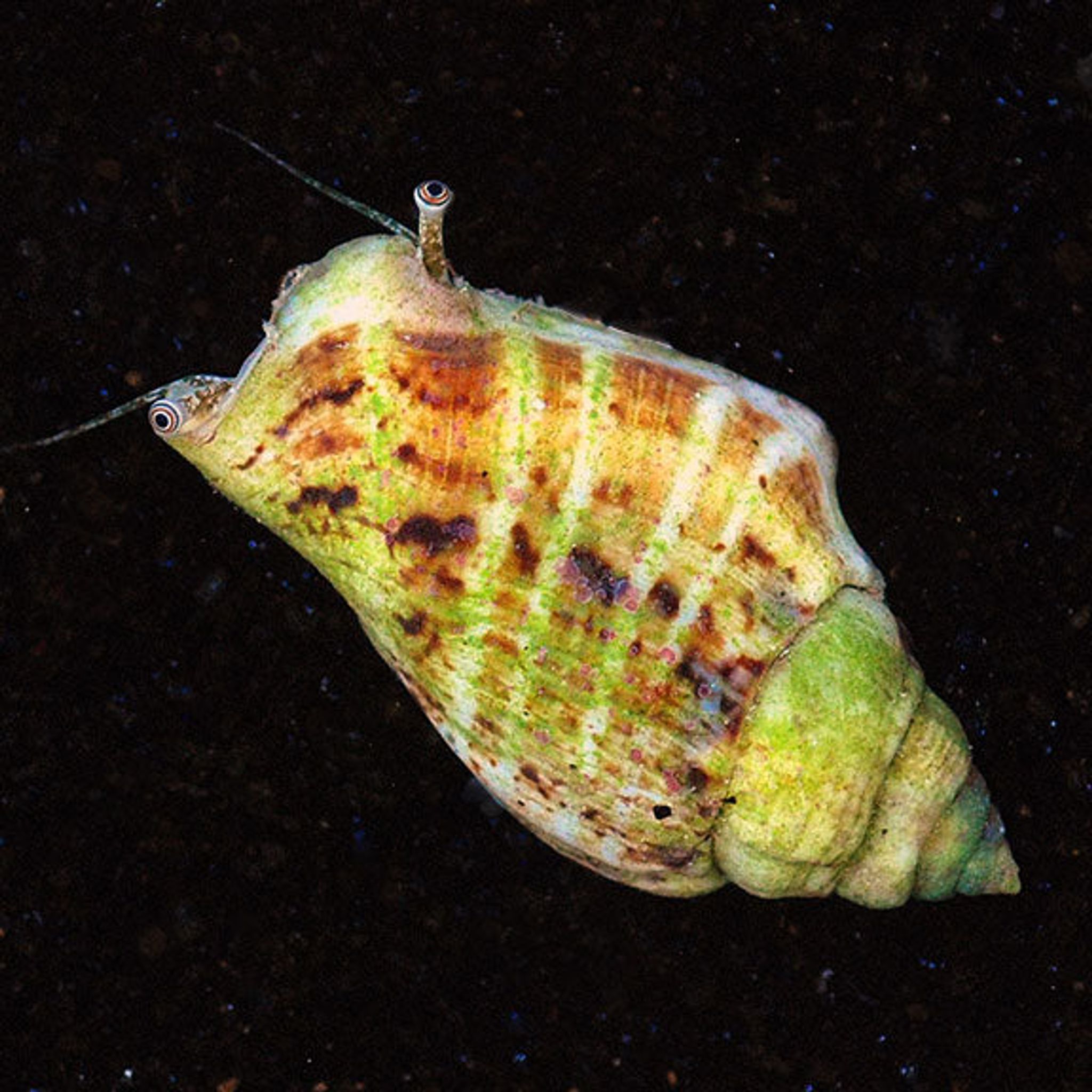
The fighting conch (Strombus alatus and related Strombus species) is a marine gastropod that looks nothing like a typical aquarium snail. Its shell is pointed and knobby, often flared at the lip, and two long eyestalks extend from the body when it's active. Adults typically reach 3 to 4 inches in shell length, with some variation between species and individuals sold under the "fighting conch" name.
Two features set it apart from ordinary snails:
- Locomotion: rather than gliding on a flat foot, a fighting conch "hops" across the substrate using a sickle-shaped operculum — a claw-like structure it plants into the sand and uses to push and flip itself forward. This is different from the flat, blade-like operculum of a typical reef snail's foot, and it's a useful way to confirm you actually have a fighting conch rather than a look-alike species.
- Activity pattern: hopping is also a health indicator. A conch that stops moving and stays buried for many consecutive days may simply be resting or foraging, but a prolonged lack of any hopping or response can signal stress, cold water, or a dying animal.
Because retailers in the US trade sometimes use "fighting conch" loosely for several similar Strombus species (and occasionally confuse them with true queen conch, which grows far larger and is a different animal entirely), it's worth asking about adult size and shell shape before buying if precise identification matters to you.
Tank Size and Setup
A single fighting conch needs a minimum 20-gallon tank (about 75 liters). What matters more than raw volume is footprint: these animals roam and burrow across the tank floor, so a long, shallow "20-long" style tank gives far more usable space than a tall tank of the same volume.
Stocking Density
Keep just one conch per smaller tank. If you want to keep several:
| Tank Size | Recommended Fighting Conch Count |
|---|---|
| 20 gal (75 L) | 1 |
| 50 gal (190 L) | 1–2 |
| 100 gal (380 L) | ~2 |
| 150+ gal (570+ L) | 3, spaced generously |
A rough guideline of two conchs per 100 gallons avoids overcrowding. Males can spar with each other using their proboscis, pushing and shoving over territory, and in cramped tanks this occasionally proves fatal. More space and more food availability both reduce this friction.
The Sand Bed Is Not Optional
This is the single most important setup requirement. Fighting conchs need at least 2 to 3 inches of fine sand or "sugar-sized" sand to burrow into and forage through. A bare-bottom tank or shallow gravel layer isn't a minor inconvenience for this animal — it's a setup that will cause it to struggle constantly, since burrowing and sifting through sand is core to how it feeds and rests. Expect a healthy conch to disappear under the sand for days at a stretch; that's normal behavior, not illness.
For hobbyists building or refreshing a system around this requirement, a fine aragonite or oolitic sand from Substrate works well as a base layer.
Water Parameters
Fighting conchs are hardy once established, but they're sensitive to slow chemistry drift more than sudden fish-style stress. Stable reef parameters matter as much as temperature.
| Parameter | Range | Notes |
|---|---|---|
| Temperature | 72–84°F (22–29°C) | Target the middle band, 76–80°F (24–27°C), for day-to-day stability |
| Specific gravity | 1.023–1.026 | Match to acclimation water slowly |
| pH | 8.0–8.4 | Low or swinging pH pits and thins the shell over time |
| Alkalinity | 8–12 dKH | Keep stable, not just "in range" |
| Calcium | 420–440 ppm | Ongoing supplementation supports shell growth |
| Magnesium | 1280–1350 ppm | Supports calcium/alkalinity stability |
| Nitrate | Under 20 ppm | |
| Copper medication | None, ever | Lethal to conchs and other invertebrates |
Two things deserve emphasis. First, temperature recommendations vary a bit between sources — some list 75–84°F, others 72–82°F — so 72–84°F is the full tolerated range, with 76–80°F as the safer target when you're also balancing fish and coral needs in a mixed reef tank. Second, low or unstable pH and alkalinity don't just stress a conch the way they'd stress a fish — they actively erode and pit the shell over months, which is a slower and easier-to-miss problem than a sudden water quality crash.
Feeding: Where Most Mistakes Happen
Fighting conchs are omnivorous but functionally herbivore-detritivores. They graze diatoms, hair algae, cyanobacteria, biofilm, and detritus off sand and glass surfaces.
The feeding reality that trips people up: how much supplemental food a conch needs depends heavily on tank maturity. A well-established, algae-rich reef tank can support a conch on natural grazing alone for a while. A newer tank, an ultra-clean tank, or a tank with aggressive algae control (skimming, UV, herbivorous fish already competing for the same food) will not — and the conch will slowly starve without you noticing, since it hides under the sand rather than obviously begging for food.
Feed regularly, and increase feeding as tank nutrients drop:
- Sinking algae wafers or pellets
- Dried seaweed sheets, weighted or clipped near the substrate
- Occasional sinking meaty pellet for variety
Products like sinking algae wafers and dried seaweed can be found under Food & Supplements, including options in the Freeze Dried Food range.
Shell health also depends on more than dosing calcium and alkalinity into the water column. Treat calcium/alkalinity maintenance as an ongoing part of husbandry, checked and adjusted regularly, rather than a one-time setup task.
Compatibility
Fighting conchs are reef-safe — they do not eat corals or other sessile invertebrates, which makes them one of the safer cleanup-crew choices for a mixed reef tank.
Generally Safe Tankmates
- Peaceful community fish: clownfish, gobies, damsels, butterflyfish
- Other cleanup-crew snails: nassarius, cerith, astrea, turbo
- Shrimp: cleaner shrimp, peppermint shrimp, fire shrimp
Clownfish and other peaceful reef fish available through Marine Fish make solid tankmates for a conch-based cleanup crew.
Risky or Avoid
- Hermit crabs: the most common area of disagreement among hobbyists. Some keep them together without issue, but hermit crabs are opportunistic shell scavengers and may harass or evict a conch from its shell when the soft body is exposed at the aperture. Treat "avoid, or supervise closely" as the safer default rather than assuming full compatibility.
- Puffers, triggerfish, hawkfish, wrasses: known snail-shell predators or harassers
- Coral banded shrimp: can be aggressive toward vulnerable, exposed conchs
Reproduction
Fighting conchs are dioecious (separate sexes), so breeding requires a true male-female pair. Spawning is triggered by near-ideal, stable parameters and often benefits from elevated temperature around 82–84°F. Females lay long, sticky egg strands containing an enormous number of eggs — reported as high as roughly 180,000 per mass.
Larvae hatch into a free-swimming veliger stage lasting roughly 18 to 24 days before settling to the substrate, with high natural mortality during that planktonic window. Because of this, captive breeding is considered difficult and uncommon among home hobbyists, even when adults are thriving.
How Fighting Conchs Compare to Other Marine Invertebrates
Not every "interesting" marine invertebrate is beginner-friendly the way a fighting conch is. For context:
- Octopuses need a species-only, fully cycled tank with heavy filtration and skimming, and no fish tankmates — an octopus will eventually predate them. Daily feeding of shrimp or crab is required, along with occasional live food. Common mistakes include overly bright lighting, unsecured lids (octopuses escape through remarkably small gaps), and uneaten food fouling the water.
- Cuttlefish are similarly advanced and short-lived, needing dedicated species tanks, live or frozen meaty food, and close water quality management.
- Nautilus are an extreme-difficulty option: deep-water animals that need large tanks, cold and very stable temperatures, and specialist feeding most home systems can't reliably provide.
- Nudibranchs and other sea slugs are frequently sold as generic "cleanup crew" but most species are highly specialized feeders that eat one specific coral, sponge, or algae type. Dropped into a general reef tank, they typically starve.
Against all of these, a fighting conch is genuinely easy — hardy, reef-safe, and forgiving of normal reef parameters — as long as its sand bed and food supply are actually planned for.
Common Mistakes and Troubleshooting
- Bare-bottom or shallow-sand tanks: without 2–3+ inches of fine sand, a conch cannot burrow or forage and will struggle.
- Assuming algae alone feeds it forever: thinning shells and lethargy are early starvation signs, easy to miss since the conch is usually buried.
- Letting pH or alkalinity swing or drop: pits and thins the shell over months, even if the animal doesn't act obviously sick.
- Using copper-based medication in the display tank: immediately lethal to conchs and other invertebrates — treat sick fish in a separate quarantine tank instead.
- Overstocking multiple conchs in a small footprint: leads to territorial pushing and, occasionally, fatal fights.
- Mixing with hermit crabs or predatory wrasses/shrimp without monitoring: risks shell-eviction attacks on a vulnerable conch.
- Assuming a buried conch has died: normal burrowing can last for days. Check gently for shell movement or a retraction response before assuming the worst.
- Skipping slow acclimation: sudden salinity or pH swings shock these chemistry-sensitive animals despite their overall toughness.
Acclimation and Buying-Day Notes
Because fighting conchs are more sensitive to chemistry swings than to general handling, use a slow drip acclimation of 60 minutes or more, matching salinity and pH gradually rather than a quick float-and-dump. It's also worth knowing that conchs are often shipped buried in the bag and can look completely inactive or "dead" on arrival purely from shipping stress — give a new arrival time in a dark, quiet acclimation container before judging its condition. While acclimating, visually check the shell for hitchhiking pests, since most hobbyists skip formal quarantine for snails and this is the easiest opportunity to catch a problem before it reaches the display tank.
If the shell gets chipped or damaged later, location matters: minor damage above the growth edge can often heal over with stable calcium and alkalinity, while damage near the aperture (the opening where the body extends) is riskier and worth monitoring closely.
Frequently Asked Questions
How big does a fighting conch get?
Adults typically reach roughly 3 to 4 inches in shell length, with some variation between individual animals and the specific Strombus species sold under this name.
Do fighting conches need sand?
Yes. At least 2 to 3 inches of fine sand or sugar-sized substrate is essential for burrowing and feeding — it isn't an optional upgrade, and a bare-bottom tank will cause ongoing problems.
What do fighting conches eat?
They naturally graze algae, biofilm, diatoms, and detritus off sand and glass. In newer or very clean tanks, supplement with sinking algae wafers, pellets, or dried seaweed, since natural food alone may not be enough.
Are fighting conches reef safe?
Yes. They don't eat corals or other sessile invertebrates, making them one of the safer cleanup-crew choices for a mixed reef tank.
Can you keep more than one fighting conch together?
Yes, but keep stocking light — roughly two conchs per 100 gallons is a reasonable guideline, since males can spar with their proboscis and injure or kill each other in cramped conditions.
Why is my fighting conch not moving or buried all the time?
This is usually normal foraging or resting behavior, and conchs can stay buried for days. Check occasionally for a response, such as gentle shell movement or retraction, rather than assuming it has died.
How long do fighting conches live?
Up to about 10 years with stable, good-quality water, though captive lifespans are often shorter than that maximum, especially with inconsistent parameters.
Can fighting conches breed in a home aquarium?
Technically yes, but it's rare and difficult. It requires a genuine male-female pair, very stable near-ideal parameters, and often elevated temperature to trigger spawning, and the resulting larvae face a long, high-mortality planktonic stage before settling.
A fighting conch can be one of the easiest, longest-lived members of a reef cleanup crew, provided the sand bed and feeding schedule are planned before it arrives. Browse Marine Invertebrates on FishyHub to compare fighting conchs alongside other reef-safe cleanup crew options.


