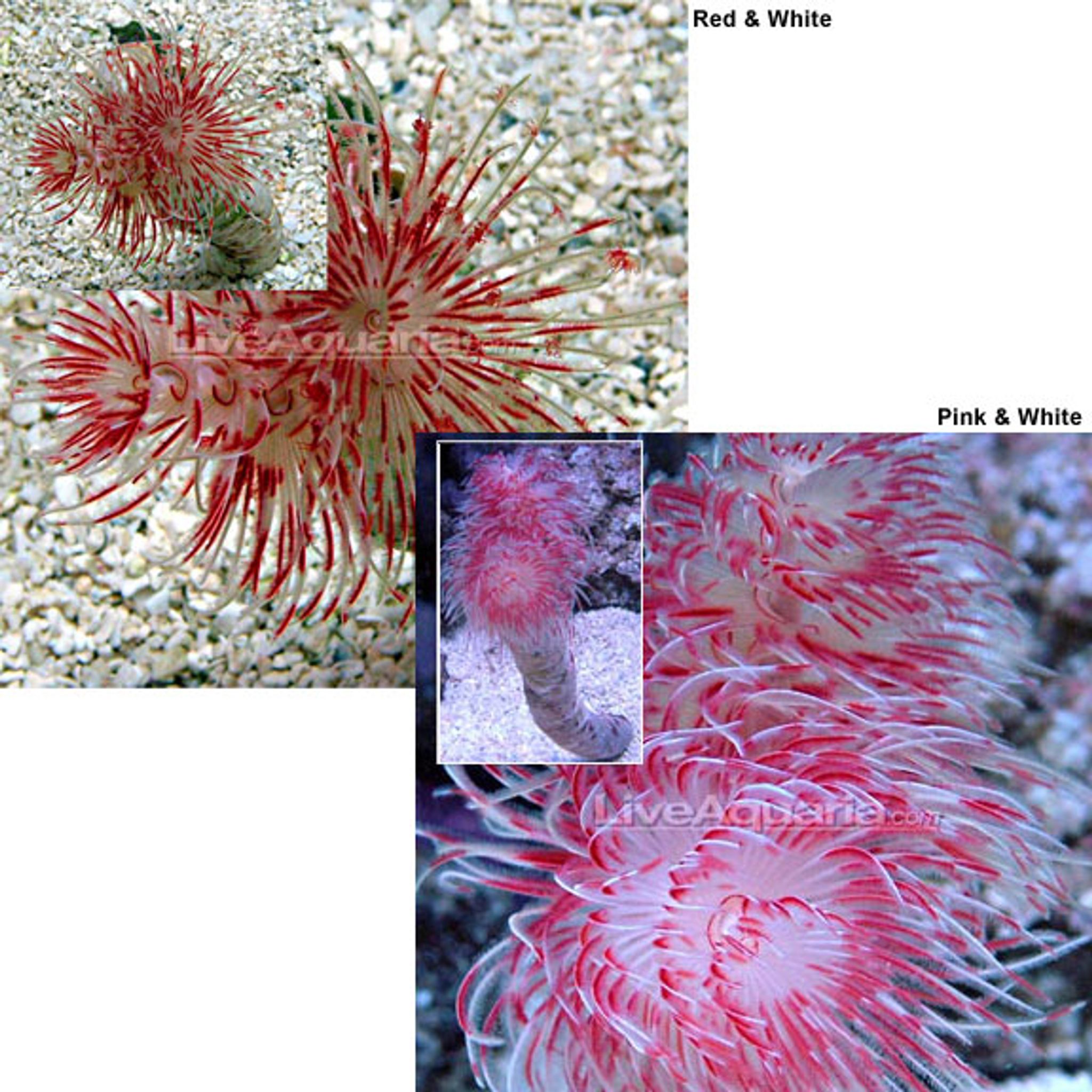

Feather Duster Worm Care Guide: Tank Requirements, Feeding and Compatibility
Feather duster worms bring slow, hypnotic motion to a reef tank without needing special lighting or heavy equipment, but they are far less forgiving of an immature system than most corals or fish. This guide covers exactly what water conditions, flow, and feeding routine keep them alive, plus which tankmates will leave them alone and which ones will eat the crown overnight.
What Feather Duster Worms Actually Are
Feather dusters are sedentary polychaete (segmented) worms in the family Sabellidae. Each worm builds and lives inside a soft, parchment-like tube made of mucus, sand grains, and detritus that it never leaves voluntarily. The showy part hobbyists buy them for — the spiral "feather" — is actually a crown of radioles: feathery gill filaments that handle both respiration and food capture.
Common trade species include:
- Sabellastarte indica and S. fallax — the classic large Indo-Pacific and Caribbean "feather dusters"
- Bispira species — often sold as "fan worms," typically smaller and more colorful
- Hawaiian feather dusters — a hardy, frequently imported variety
How the Feeding Mechanism Works
The radioles create a gentle feeding current that pulls water toward the crown. Tiny cilia along each filament sort particles by size, moving fine organic matter and plankton toward a groove that channels food to the mouth at the crown's center. Only very small particles make it through this sorting system — the worm has no functional gut for large food items. This is exactly why blasting the crown with strong flow, or dosing large chunks of food, doesn't work: the sorting mechanism is built for suspended fines, not bulk feeding.
Tank Size and Maturity Requirements
There's no strict minimum footprint a feather duster needs — the animal itself is small. In practice, though, a 10-gallon (38 L) tank or larger is a more realistic starting point, because smaller volumes swing in temperature and chemistry much faster than larger ones, and feather dusters have very little tolerance for sudden parameter changes.
Far more important than gallons is tank maturity. Feather dusters need an established, fully cycled system — ideally 6 to 12 months old — with a developed population of microfauna: rotifers, copepods, and the bacterial film that helps process waste and supply incidental food. Adding one to a brand-new cycle is a common and usually fatal mistake, since there's neither stable water chemistry nor enough natural plankton to sustain it.
Water Parameters
Feather dusters need standard reef-quality water, not anything exotic:
| Parameter | Range | Notes |
|---|---|---|
| Temperature | 72–83°F (22–28°C) | 75–80°F (24–27°C) is ideal |
| pH | 8.1–8.4 | Avoid swings |
| Specific gravity | 1.023–1.026 | Match to display consistently |
| Calcium | 380–430 ppm | Same as most reef inverts |
| Alkalinity | 8–12 dKH (2.5–4 meq/L) | Stability matters more than the exact number |
| Ammonia / Nitrite | 0 ppm | Zero tolerance |
| Nitrate | As low as practical | Tolerates more than SPS corals (see below) |
One point worth clarifying that's often skipped: feather dusters are noticeably more tolerant of elevated nitrate and phosphate than SPS corals are. That makes them a reasonable pick for fish-heavier systems or soft-coral-dominant tanks where nutrient levels run a bit higher than an SPS-focused aquarist would want.
Flow, Placement, and Lighting
Feather dusters want low-to-moderate, indirect water movement. Direct flow from a powerhead disrupts feeding and can physically damage or tear the crown, causing the worm to retract repeatedly out of stress. Good placement options include:
- A rock crevice or nook, mid-to-lower in the water column
- Near (not directly in front of) a sand bed where fine detritus settles
- A spot shielded from the main return or powerhead stream
Because feather dusters aren't photosynthetic and carry no zooxanthellae, lighting is flexible. Standard reef lighting is perfectly fine, but the animal doesn't require it — some hobbyists deliberately place them in shadier corners with good success.
Feeding Feather Duster Worms
Feather dusters are filter feeders that consume phytoplankton, zooplankton, bacteria, and fine particulate matter suspended in the water column. In a mature, well-stocked reef, ambient plankton and detritus can be enough to sustain them. Target feeding, however, improves growth, coloration, and longevity.
How to Target Feed
- Turn off return pumps and powerheads briefly so food doesn't blow away before the worm can capture it.
- Load a turkey baster, syringe, or pipette with a small amount of bottled phytoplankton, rotifers, or fine zooplankton.
- Release the food slowly, directly at the crown.
- Restart flow after a few minutes once the worm has had a chance to feed.
Frequency: aim for 2–4 times per week in a mature reef system with decent natural plankton levels. Newer or lower-bioload tanks may benefit from smaller, near-daily feedings, paired with close nutrient monitoring. The right frequency depends on how much food the system is already producing on its own — watch nitrate and phosphate and back off if they climb.
A note on brine shrimp: larger feather duster species sometimes appear to "accept" newly hatched brine shrimp nauplii, but this isn't active predation — the worm cannot capture free-swimming prey. It's incidental capture of slow-settling, tiny particles, so treat it as a minor occasional supplement rather than a real food source.
Don't overfeed. Excess liquid food that isn't captured just dissolves into the water column, fouling water quality and feeding nuisance algae. It is much safer to underfeed slightly than to overload the tank chasing faster growth.
Culturing Phytoplankton at Home
For anyone keeping multiple filter feeders, a small home phytoplankton culture — a starter culture, a light source, and gentle aeration — is significantly cheaper long-term than bottled products once it's established. It takes a bit of routine maintenance (regular harvesting and topping off), but it scales well if you're feeding several feather dusters, sponges, or other filter feeders at once. Pairing a display with a refugium or algae scrubber is another practical option — it passively boosts plankton supply to the display over time and can meaningfully reduce how much manual target feeding is needed.
Compatibility: Good Tankmates and Threats
Feather dusters do well alongside most peaceful reef community members:
Generally safe:
- Peaceful reef fish — clownfish, gobies, blennies, basslets, dartfish
- Most corals and anemones
- Reef-safe shrimp, snails, and non-predatory hermit crabs
- Sponges, bristle worms, and tunicates (same peaceful filter-feeder/detritivore niche)
Avoid keeping with:
- Triggerfish and puffers
- Large angelfish and butterflyfish
- Wrasses (many species actively pick at and eat feather duster crowns)
- Arrow crabs and other crabs or shrimp known to nip at radioles
You can browse reef-safe options in the marine invertebrates category, and if you're stocking soft corals alongside your feather dusters, the soft corals selection pairs well with their nutrient tolerance. If you're considering a wrasse for algae or pest control, research the specific species first — many are exactly the fish that pick apart feather duster crowns.
Medication Sensitivity
Feather dusters, like most invertebrates, are extremely intolerant of copper-based medications and most invert-unsafe treatments. If a fish in the display gets sick, treat it in a separate hospital tank — never dose the display itself, or you risk killing every feather duster, sponge, and shrimp in the tank along with the pathogen.
Crown Loss, Acclimation, and Lifespan
It's common for feather dusters to autotomize (voluntarily drop) their crown in response to stress, poor water quality, physical contact, or a predation attempt. This looks alarming but usually isn't fatal — the worm retreats into its tube and can regrow a full crown over roughly 2 to 6 weeks once conditions improve. Repeated shedding with progressively smaller regrowth each time is a bad sign, pointing to chronic stress or underfeeding rather than a one-off scare.
When acclimating a new arrival, drip acclimate slowly and handle the tube gently. Never pull the worm out of its tube to move or "rescue" it — a detached worm will not survive. Move the entire tube and position it the way it was originally oriented.
A quick quarantine step most fish-focused advice skips: before adding a tube to the display, inspect it closely under good light for hitchhiking pests (bristle worms, small crabs, aiptasia) riding along on the tube's exterior. A brief, slow acclimation drip specific to sessile inverts — rather than a fast fish-style dunk — reduces shock significantly.
With stable, well-fed conditions, feather dusters commonly live several years, with larger species reaching close to a decade.
Related Reef Oddities Worth Knowing
Bristle Worms: Helpful or Harmful?
Most bristle worms are beneficial scavengers that clean up uneaten food and detritus, and small populations are best left alone. Only a few large "fireworm" types carry venomous bristles that can sting on contact and occasionally nibble coral tissue. If a bloom gets out of hand, reduce feeding and consider predators rather than trying for full eradication — and always use gloves when handling any bristle worm.
The Bobbit Worm: Not All Tube Worms Are Harmless
Not every tube-dwelling worm is a passive filter feeder. The bobbit worm is a much larger ambush predator that can hitchhike in on live rock and grow to several feet long, striking at fish and inverts at night. It shares a superficial resemblance to feather dusters but is an entirely different animal in lifestyle and risk. Nighttime flashlight checks and baited traps are the standard way to spot and remove one.
Sponges and Tunicates
Marine sponges are filter feeders with needs similar to feather dusters: a mature, stable system and good flow to deliver food without smothering them. They're sensitive to copper and nutrient swings, and exposing them to air during handling can introduce lethal air bubbles into their tissue. Tunicates (sea squirts) are colonial or solitary filter feeders that attach to rock or glass; they need continuous fine particulate feeding and are generally hardy once established, though some species are short-lived after import stress or can spread aggressively.
A Note on Moon Jellyfish
Moon jellyfish are sometimes lumped in with "other passive filter feeders" in casual conversation, but they require a completely different setup — a specialized kreisel tank with circular flow to keep them from settling against surfaces and damaging their bell. It's a distinct care track entirely, not an extension of feather duster or sponge keeping.
Frequently Asked Questions
Do feather duster worms need special lighting?
No. They aren't photosynthetic, so standard reef lighting is fine, and some keepers place them in shadier spots with no issue.
Can feather dusters sting or hurt me?
No, they're harmless filter feeders with no stinging cells. It's safe to handle the tube carefully, though you should never touch or pull on the worm itself.
Why did my feather duster lose its crown?
Usually stress, poor water quality, physical disturbance, or a predation attempt. It's often not fatal — the worm can regrow the crown within a few weeks once conditions stabilize.
What eats feather duster worms?
Certain wrasses, triggerfish, puffers, large angelfish, and butterflyfish will pick at or eat the crown, as will some crabs and shrimp.
Do I need to feed my feather duster directly, or will it survive on tank scraps?
In a mature, well-stocked reef it may get enough from ambient plankton and bacteria, but supplemental target feeding two to four times a week improves growth, coloration, and lifespan.
Can feather duster worms multiply in my tank?
Yes. Many species reproduce through fragmentation or broadcast spawning and can form small colonies over time in stable conditions.
Is it safe to keep feather dusters with bristle worms, sponges, or tunicates?
Generally yes. They occupy the same peaceful filter-feeder or detritivore niche and don't compete aggressively or harm one another.
How long do feather duster worms live?
Several years under stable, well-fed care, with some larger species approaching a decade.
Once your tank has the maturity and water stability to support one, feather dusters make a distinctive, low-maintenance addition to a reef system. Browse current marine invertebrates on FishyHub to find feather dusters and compatible tankmates for your setup.


