
Emperor Angelfish Care Guide: Tank Size, Diet, Compatibility and Reef Safety
The Emperor Angelfish (Pomacanthus imperator) is one of the most photographed fish in the hobby, and one of the most likely to outgrow an underprepared tank. This guide lays out the honest numbers on tank size, growth speed, diet, tankmates, and reef compatibility so you can plan the whole multi-year journey before you buy a juvenile.
Species Snapshot
The Emperor Angelfish is a reef-associated species native to the Indo-Pacific, the Red Sea, East Africa, and out to the Great Barrier Reef, where it's typically found in caves and along ledges at depths of roughly 100–330 ft. It's a large, long-lived, semi-aggressive angel — not a casual community fish, and not reef safe as an adult.
- Adult size: 12–15 in (30–38 cm) in the wild; captive specimens often plateau just under 12 in.
- Lifespan: commonly 10–20+ years with stable water and a good diet; well-run systems can push toward the higher end.
- Temperament: territorial, semi-aggressive, especially toward other angelfish.
Tank Size: Floors vs. Targets
Sources disagree on the minimum adult tank, with numbers ranging from 180 to 220 gallons. Treat 220 gallons as the sensible adult minimum, with 250–300+ gallons as the better long-term target, especially if you plan to keep other large angels or robust tankmates alongside it. Anything in the 125–180 gallon range should be understood as juvenile or short-term housing only — a floor, not a place to stop.
| Life stage | Approx. size | Minimum tank | Notes |
|---|---|---|---|
| Juvenile | 3–6 in | 75–125 gal (284–473 L) | Short-term only; must not become permanent |
| Young adult | 6–8 in | 180 gal (681 L) | Transitional coloring, still growing |
| Full adult | 12–15 in | 220 gal (833 L) minimum | 250–300+ gal ideal, especially with tankmates |
A staged upgrade plan — roughly 120 gallons for the juvenile, 180 gallons for the young adult, and 220–300+ gallons for the full adult — lets you buy the fish honestly instead of hoping it stays small. Decide on this path before purchase, not after the fish has outgrown three tanks.
Watch for these signs a tank is already too small: persistent pacing along the glass, rising aggression toward tankmates, and growth that seems to stall despite good feeding. All three mean the upgrade is overdue, not optional.
Growth Timeline and Color Change
Juveniles are typically sold at 3–6 in and can reach 5–7 in within the first year under good feeding and water quality. Reaching the full 12+ in adult size generally takes about 3–5 years.
The color transformation is dramatic and gradual:
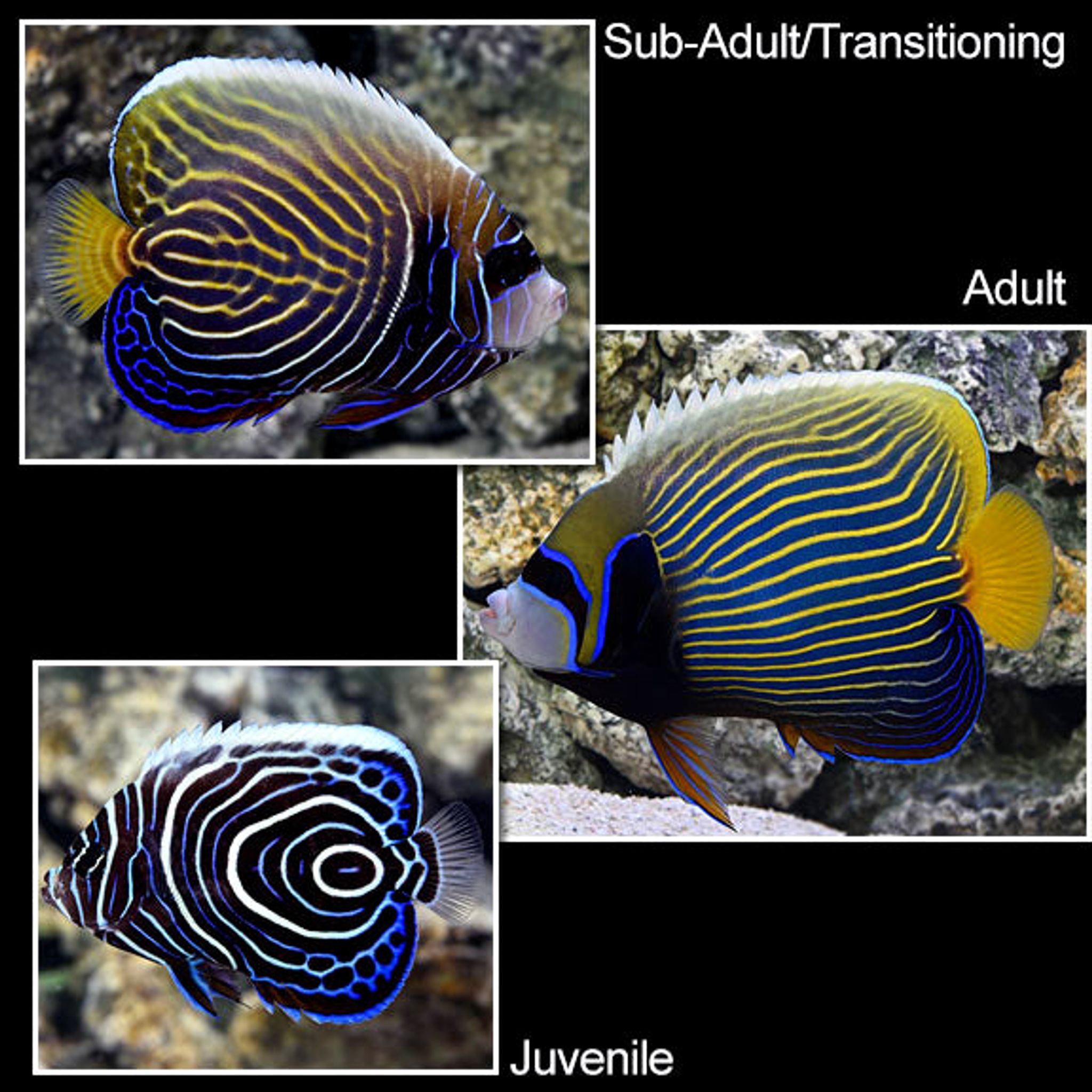
- Juveniles are black or navy with concentric white and electric-blue rings and arcs — a pattern often mistaken for a totally different species.
- Adults develop a blue body with horizontal yellow stripes, a dark blue-black "mask" across the eyes, and a yellow-orange tail.
- The transition starts around 4 in and is mostly complete by 6 in, roughly 2–3 years of age. Captive juveniles can sometimes hold their juvenile pattern longer than wild-caught fish.
Water Parameters and Stability
| Parameter | Target range |
|---|---|
| Temperature | 74–78°F (23–26°C), wider outer range 72–82°F (22–28°C) |
| pH | 8.1–8.4 |
| Specific gravity | 1.020–1.025 (aim 1.023–1.025) |
| dKH | 8–12 |
Stability matters more than chasing an exact number. Sudden swings — during a water change, a heater failure, or acclimation — are the real risk, not being at 76°F instead of 78°F.
Acclimation and Sourcing
Emperor Angelfish have a reputation for being difficult to ship and settle in. Use a slow drip acclimation over an hour or more, and expect a stressed, non-eating fish for the first several days to weeks. Before buying, check for:
- Clamped fins or a hollow-looking belly
- Rapid breathing — over roughly 80 breaths per minute is a red flag
- Any signs consistent with cyanide-catch damage (erratic behavior, disorientation)
Captive-bred vs. wild-caught: where available, captive-bred juveniles acclimate faster and take to prepared foods more readily than wild-caught fish. This is a genuine sourcing consideration for a species this prone to shipping stress — prefer captive-bred stock when you can find it.
Don't confuse a stressed new arrival for a sick one. A fish that isn't eating in the first few days, hiding in live rock, and breathing normally otherwise usually just needs a calm, well-hidden setup and time. Watch closely for actual disease signs rather than panicking and medicating prematurely.
Diet and Feeding
Emperor Angelfish are omnivores that need a genuinely broad, sponge-inclusive diet to stay healthy and hold their color:
- Prepared angelfish or sponge-based frozen formulas
- Spirulina, marine algae, and nori
- Mysis and brine shrimp
- Chopped squid, shrimp, scallop, or clam
- Vegetables such as spinach and zucchini
- Ongoing grazing on live rock biofilm
Vitamin-C or garlic-soaked foods are frequently recommended to support immune function, particularly during the settling-in period.
Feeding frequency: a settled adult does well on 2–3 feedings a day; juveniles or fish still adjusting after purchase may need up to 5 smaller feedings. Feed only what clears in about 5 minutes and remove leftovers promptly to protect water quality.
Avoid leaning too heavily on fatty foods like straight mysis shrimp long-term — a diet that's too rich and too narrow can contribute to fatty liver issues over time. Variety, not volume, is the goal.
Bioload and Filtration as the Fish Grows
A 4-inch juvenile and a 14-inch adult are not the same bioload. Filtration and export capacity need to scale alongside the tank upgrades:
- Size the protein skimmer for the eventual adult tank volume, not the starting tank — undersizing early means a costly re-buy later.
- Increase water-change frequency and volume as feeding volume grows; a heavy eater on a varied diet produces more waste than a picky flake-fed fish.
- Live rock and mature biological filtration should be established well before the fish reaches subadult size, since a system playing catch-up on cycling while feeding a growing angel is a common way water quality slips.
Compatibility and Stocking Order
Emperor Angelfish are territorial and semi-aggressive, especially toward other angelfish or fish of similar shape and color. Two rules matter most:
- Add it last to an established tank. Adding it early lets it claim territory and become more aggressive toward everything introduced afterward.
- Never house two adult males together. A single specimen, or one male with females or juveniles, can work — but only in very large systems.
Good tankmates include tangs, wrasses, larger butterflyfish, dottybacks, groupers, lionfish, puffers, and other robust semi-aggressive fish. Some keepers report mixed success combining it with queen or majestic angelfish, but this is inconsistent and works best in very large tanks.
Poor or risky tankmates include other large angelfish (unless the tank exceeds 300 gallons), and small or shy species such as gobies, clownfish, dwarf/pygmy angels, seahorses, and mandarins. Most ornamental invertebrates — shrimp, crabs, snails, anemones, and clams — are at real risk of being eaten.
If you're introducing an Emperor into an existing aggressive-fish community rather than starting fresh, rearrange the live rock at the same time you add it. Resetting the rockwork disrupts established territories for everyone, which reduces the odds of the new arrival being singled out — or of it bullying fish that were there first.
Reef Safety
The Emperor Angelfish is not reef safe as an adult. It will pick at and eventually consume LPS and soft corals, clams, and other sessile invertebrates. Juveniles are sometimes reported as more coral-tolerant, but this is inconsistent and not something to plan around — treat the species as non-reef-safe overall and best suited to a fish-only-with-live-rock (FOWLR) system.
This isn't unique to the Emperor. Across the family Pomacanthidae, most large angels are more adaptable to aquarium life than their delicate reputation suggests — but virtually none of the large species are reef-safe. Only true dwarf pygmy angels, such as Centropyge argi, come close to reef-compatible, and even that comes with caveats.
Tank Setup
Provide extensive live rock with caves, overhangs, and swim-throughs for security, along with open water for active swimming. Flow should be strong but not excessive, and biological filtration needs to be mature and stable well ahead of the fish's adult bioload and appetite. A cleaner shrimp can help manage external parasites in a non-reef FOWLR setup specifically — but only where the angel won't simply eat it.
Disease and Quarantine
Emperor Angelfish are prone to standard marine ich (white spot), marine velvet, and head-and-lateral-line erosion (HLLE). A quarantine protocol tailored to a fish this large and disease-prone should include:
- QT tank size: large enough for a growing juvenile to swim and hide — a bare 20–40 gallon setup with PVC or rock caves works for the early stages, sized up as the fish grows.
- Copper treatment: dose in the separate quarantine tank only, never the display, following the product's labeled duration for ich or velvet.
- Observation period: watch for at least 2–4 weeks of normal eating and behavior before considering the fish ready for the display.
HLLE typically responds to improved water quality and diet, combined with anti-parasitic treatment if warranted. Skipping quarantine and slow acclimation is one of the most common causes of stress-related disease outbreaks right after purchase.
Related and Comparable Angelfish
- Scribbled Angelfish: a similar large Pomacanthus-type angel needing around 78°F, pH 8.0–8.4, SG 1.021–1.023, and dKH 8–12. Not reef safe; omnivore diet built around macroalgae and sponge-based angel food. Captive-bred individuals are noticeably hardier and more disease-resistant than wild-caught.
- Majestic Angelfish: one of the more delicate large angels during acclimation, needing 2–3 feedings a day of premium angel pellets and frozen angel or butterfly formulas.
- Blueface Angelfish: needs a similarly large tank (220+ gal cited), a heavy sponge- and algae-based diet, and shares the same striking blue-and-yellow facial pattern.
- Koran Angelfish: also transitions dramatically from a juvenile scrollwork pattern to adult coloring, and is regarded as one of the hardier, easier-to-feed large angels. Needs the same cave-plus-open-water tank layout.
- Bluelined (Bluestripe) Angelfish: rarely available and doesn't always adapt well to captivity as an adult — worth knowing so it isn't confused with the hardier, more commonly available blue ring (annularis) angelfish.
- Captive-bred Regal Angelfish: a useful contrast point. It's smaller than the Emperor, needing "only" around 125 gallons minimum and topping out near 10 in, but reinforces the same lesson — captive-bred large angels adapt faster to prepared foods and are less prone to fatty-liver issues when fed a varied diet instead of heavy mysis.
Compatibility and Stocking Notes: Non-Angel Species Worth Knowing
The Pinnatus Batfish often comes up in the same stocking conversations as large angels. It needs 200+ gallons in a tall or deep tank, is notoriously hard to keep alive past the juvenile stage, and is an omnivore requiring meaty foods plus macroalgae. It's not safe with most invertebrates or corals, and juveniles are vulnerable to bullying by aggressive tankmates like triggerfish — worth factoring in if you're planning a large mixed system around your Emperor.
Across large saltwater angelfish generally, diets mirror the Emperor's — sponges, algae, zooplankton, and frozen sponge-based cubes — and cost runs high, often $50–$100 or more per fish. A long, careful drip-acclimation process is standard practice across this entire group, not just this species.
Breeding
Breeding Emperor Angelfish at home is essentially not achievable. They're broadcast spawners that require open-ocean-scale conditions to reproduce naturally. A handful of advanced or commercial breeders have reported limited success, but this sits well outside typical hobbyist scope. Where captive-bred juveniles are available, they tend to acclimate and accept prepared foods more readily than wild-caught fish — one more reason to seek them out when possible.
Common Mistakes to Avoid
- Buying a juvenile into a juvenile-sized tank with no upgrade plan — the single biggest long-term welfare failure with this species.
- Skipping quarantine and slow acclimation, which invites stress-related ich or velvet outbreaks right after purchase.
- Assuming "reef-safe as a juvenile" will hold — it typically doesn't once the fish matures.
- Feeding a narrow diet (mostly flake, or mostly mysis) — leads to poor color, HLLE, or fatty liver over time.
- Adding the Emperor early in the stocking order, which raises its territorial aggression toward everything added later.
- Housing two male angels together, or adding a second similarly shaped or colored angel without adequate space.
Frequently Asked Questions
Is the Emperor Angelfish reef safe?
No, not as an adult. It will pick at and eventually eat LPS and soft corals, clams, and other sessile invertebrates. Juvenile coral tolerance is sometimes reported but too inconsistent to plan a reef tank around.
What size tank does an Emperor Angelfish need?
Plan for 220 gallons minimum for a full adult, ideally 250–300+ gallons for long-term health. A 75–125 gallon tank works only as temporary juvenile housing with a firm, pre-planned upgrade path.
How fast do Emperor Angelfish grow?
Juveniles typically start at 3 in and reach 5–7 in within the first year under good conditions. Full 12+ in adult size usually takes about 3–5 years, with the dramatic color change largely finished around the 6-inch, 2–3-year mark.
What do Emperor Angelfish eat?
A broad omnivore diet: sponge-based frozen angel formulas, marine algae and spirulina, mysis and brine shrimp, chopped meaty seafood, vegetables, and ongoing grazing on live rock biofilm.
Can I keep two Emperor Angelfish together?
Not two males — they will fight. A single specimen, or one male with females or juveniles, can work, but only in very large systems well above the standard adult minimum.
How long do Emperor Angelfish live?
Typically 10–20+ years in captivity with stable water parameters and a varied diet; genuinely well-run systems can push toward the higher end of that range.
Can Emperor Angelfish be bred at home?
Essentially no. They're open-water broadcast spawners requiring ocean-scale conditions, which puts breeding well outside realistic home aquarium scope.
If you're planning a large-angel system, you can browse available specimens in FishyHub's large marine angelfish category to compare current stock before committing to a tank size and upgrade plan.


