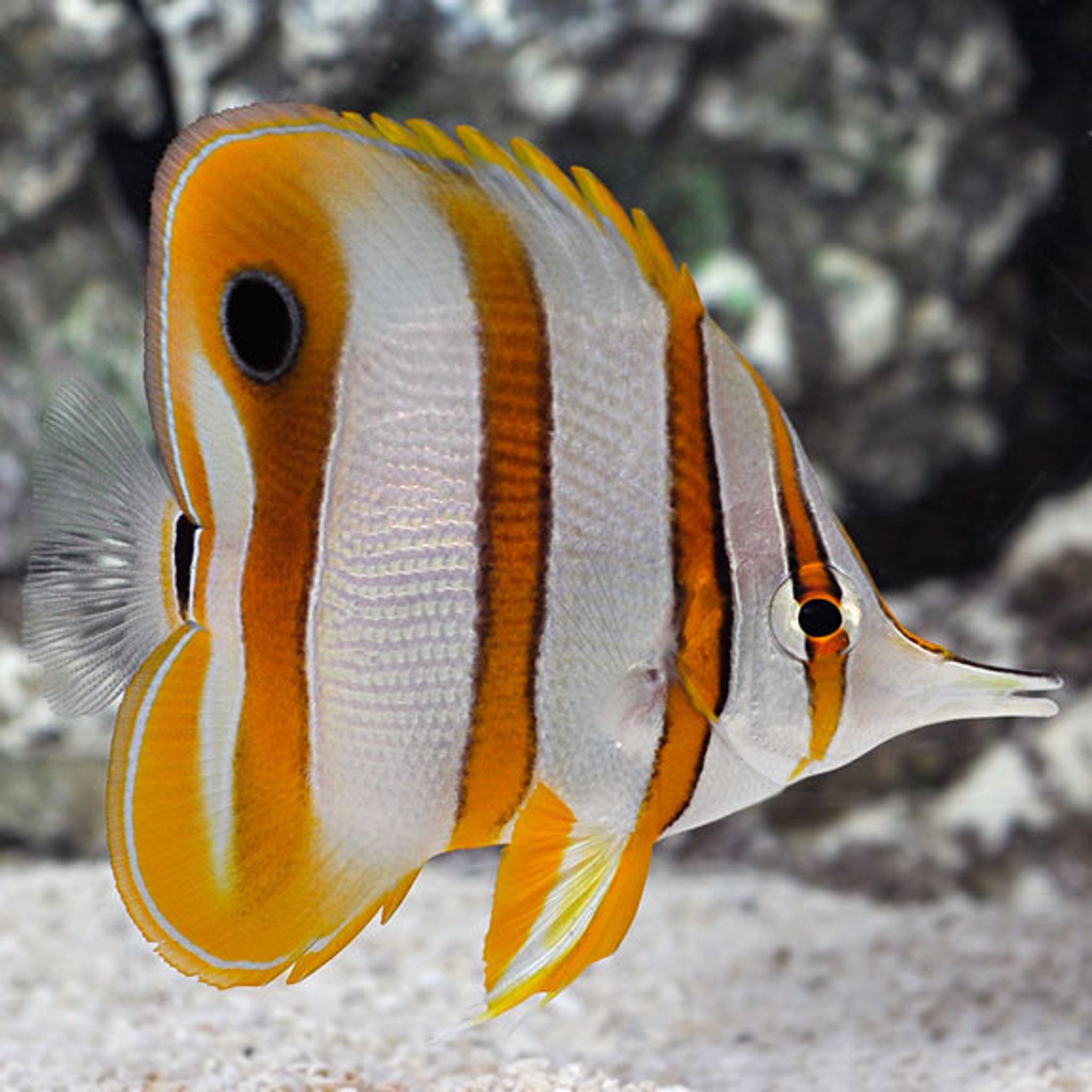

Copperband Butterflyfish Care Guide: Tank Size, Diet, Compatibility and Reef Safety
The Copperband Butterflyfish (Chelmon rostratus) is sold constantly to beginners, but it is not a beginner fish — its biggest killer isn't disease, it's starvation. This guide covers the tank size, water parameters, feeding-training steps and reef-safety tradeoffs you need to decide whether you can actually keep one alive, and how to source and settle a healthy specimen if you do.
Species Snapshot
Chelmon rostratus is native to Indo-Pacific reefs and estuaries, including Indonesia, the Philippines, Australia, and Singapore, where it forages in shallow water down to about 80 feet. Adults reach up to 8 inches, with a laterally compressed white body banded in orange-gold and edged in black, plus a long, tweezer-like snout built for probing crevices for hidden prey.
Honest difficulty rating: advanced/expert-only. It is routinely stocked and sold as a "starter" marine fish because of its calm temperament and striking pattern, but its feeding biology makes it one of the more failure-prone fish in the trade. If you're building your first reef tank, this should not be your first fish — see the beginner fundamentals section below.
Lifespan: Most sources land on 5–7 years in captivity, with some reports of up to a decade in a mature, expertly maintained system. Treat 5–7 years as the realistic expectation and a decade as the ceiling, not the norm.
Tank Size and Setup
| Scenario | Minimum tank size |
|---|---|
| Single fish (typical Indonesian/Philippine import) | 75 gallons (284 L) |
| Single fish, smaller import | 65 gallons (246 L), workable but tight |
| Single fish, large Australian-caught adult | 130 gallons (492 L) |
| Bonded pair | 125 gallons (473 L) minimum |
Use 75 gallons as the realistic floor for one fish. The size range exists because import origin matters: Australian-collected adults run noticeably larger and bulkier than Indonesian or Philippine specimens, so ask about origin before assuming a flat number applies.
The tank itself should be mature — running at least 6 months — with abundant live rock and plenty of crevices. A young tank with a sparse pod population gives this fish nothing to graze between meals, which compounds the feeding risk covered later. Live rock and reef-safe fish for stocking a system like this can be browsed in FishyHub's marine livestock selection.
Water Parameters
Sources vary slightly in exact numbers and even units (dKH vs. dGH), so here's a reconciled band:
| Parameter | Recommended range | Notes |
|---|---|---|
| Temperature | 75–78°F (24–26°C) | Wider tolerance to 72–80°F exists, but stability matters more than hitting an exact number |
| pH | 8.1–8.4 | Standard reef range |
| Specific gravity | 1.020–1.025 | Full marine salinity |
| Alkalinity (dKH) | 8–12 dKH | Use dKH, not dGH, as your working unit |
| Water flow | Moderate to strong | Enough to keep water quality high without exhausting a fish that grazes in crevices, not open water |
Beyond the numbers, prioritize clean, well-oxygenated, high-redox water. In practice that means a properly sized protein skimmer running continuously and a flow pump or powerhead positioned to avoid dead spots, rather than chasing a vague "highly oxygenated" ideal with no equipment behind it.
Diet and the Feeding-Training Problem
In the wild, Copperbands pick small invertebrates — worms, tiny crustaceans, tubeworms — out of crevices, along with some coral polyps and Aiptasia anemones. In captivity, that specialized picking behavior is exactly what makes feeding difficult.
Feeding difficulty is the single biggest risk factor with this species. Many wild-caught specimens arrive emaciated and stressed and refuse food for days to weeks; a meaningful fraction never start eating at all. This is a bigger threat to long-term survival than any water parameter.
Diet Progression
- Days 1–7 (trigger feeding response): live foods — brine shrimp, blackworms, live Aiptasia if available.
- Weeks 2–3 (transition): frozen mysis shrimp, frozen brine shrimp, chopped clam, bloodworms, glassworms.
- Established, long-term: a rotation of frozen mysis/brine shrimp, chopped clam or seafood, and high-quality marine pellets or flakes.
Feed 3–4 small meals a day rather than one large feeding — this matches natural grazing behavior and keeps a thin, stressed new fish from going long stretches without food.
Sourcing: Wild-Caught vs. Tank-Bred
Most Copperbands sold are still wild-caught, which is why the starvation problem is so common. Tank-bred or aquacultured specimens, where available, are a meaningful upgrade: they're raised eating prepared foods from birth and largely sidestep the feeding-refusal risk entirely. When shopping, ask about origin — an aquacultured fish already trained onto frozen food is worth seeking out even if it costs more or takes longer to source than a wild import.
Selection Checklist: What to Look For at the Store
Buying on looks alone, without watching the fish eat, is the single most common mistake. Use this checklist standing at the tank:
- Watch it feed before buying, if the store allows it. A fish already taking frozen or prepared food in-store is a strong buy signal.
- Reject a pinched head — a concave area above the eyes is a starvation sign.
- Reject sunken or bulging flanks.
- Reject clamped, frayed, or torn fins, or fins with exposed rays.
- Skip the smallest juveniles (1–2 inches); mid-sized specimens acclimate and start eating more reliably.
If a fish fails more than one of these checks, walk away rather than buying it "to save it" — a fish already this stressed has a low survival probability even with excellent care.
Quarantine and Feeding-Training Timeline
Run this in a standalone quarantine tank — bare-bottom or minimal substrate, a sponge filter or hang-on-back filter, heater, and dim lighting. Avoid copper-based medication on this species; its stress tolerance is poor, and copper is one of the more common quarantine mistakes made with Copperbands specifically.
- Day 0: Select a robust, already-eating specimen. Drip-acclimate or float for 15–20 minutes before release.
- Days 1–2: Dim light, gentle flow, frequent small feedings of nutrient-soaked frozen foods.
- Days 3–4: A brief (~5 minute) freshwater dip with methylene blue to knock off external parasites and gauge overall health.
- Weeks 1–4: A 2–4 week course of medicated or fortified foods (praziquantel- or metronidazole-type dewormers) to address internal parasites without the added stress of copper.
- Weeks 3–4: Progressively size up foods and simulate a normal display-tank feeding routine.
- Move to display only once the fish is eating consistently, holding weight, and behaving confidently under normal lighting — typically after a full 3–4 week quarantine.
Appropriate quarantine treatments and gentler medicated-food options can be found in FishyHub's treatment and medication category.
Disease Watch List
Copperbands are prone to marine ich, marine velvet, lymphocystis (a viral condition), and Uronema marinum. Because they tolerate harsh treatment poorly, favor quarantine, freshwater dips, and medicated food over copper whenever possible.
Compatibility
Copperbands are generally peaceful with most reef fish but intolerant of their own kind and other butterflyfish. Keep a single fish, or an already-bonded, tank-raised pair only — two unrelated individuals housed together will fight.
Good tankmates: clownfish, chromis, dartfish, dottybacks, gobies, dwarf angels, cardinalfish, dragonets.
Avoid: boisterous or aggressive tankmates such as large tangs and angelfish, especially around feeding time, since a slow, careful eater will lose out to fast competitors. Add the Copperband early to a peaceful community, or before more assertive species are established — not after.
Reef Safety: The Qualified Answer
The honest answer is "reef-safe with caution," not a flat yes. Copperbands are broadly reef-safe with corals — they don't deliberately eat coral tissue, and they're popularly kept specifically to hunt down pest Aiptasia anemones. They are not, however, invertebrate-safe: they will eat or harass ornamental shrimp, small clams and other mollusks, feather dusters, and bristleworms.
If your system leans heavily on ornamental shrimp or clams, treat this fish as a compatibility risk, not a safe addition. Livestock that pairs well with a coral-focused, invert-light system is browsable under marine invertebrates so you can gauge what's realistically at risk before stocking.
Choosing the Right Butterflyfish
Not every butterflyfish belongs in a home aquarium. Some species are obligate corallivores that eat only coral polyps in the wild and simply cannot be sustained in captivity — these should never be purchased, regardless of price or appearance. Generalist feeders like the Copperband and the Pyramid Butterflyfish sit at the reef-compatible end of the family. Within that spectrum, think of the Copperband as "moderate difficulty, but not beginner" — harder than a generalist community fish, but far more viable long-term than a corallivore.
Easier Alternatives to Consider
- Orange-spot filefish: sometimes marketed as a substitute Aiptasia-eater with an easier feeding reputation than the Copperband.
- Sunburst (Kleinii) Butterflyfish: a hardier, more adaptable butterflyfish for reefers who want the look and function of the family without the same feeding risk.
- Bannerfish (Heniochus species): closely related and often visually confused with true butterflyfish, bannerfish are generally easier to feed and worth a look if you want a similar profile with fewer headaches.
You can compare available butterflyfish and their relatives directly in FishyHub's butterflyfish category before deciding which species fits your experience level.
Beginner Reef-Tank Fundamentals
If you're newer to reef keeping, a few fundamentals matter more than any single number in this guide: stable parameters beat "perfect" parameters, test water before dosing anything, and do a water change when in doubt rather than guessing. Use calcium-based sand in a reef system to support long-term stability. Most importantly, accept that the Copperband is explicitly not a good first reef fish, despite how often it's sold as one.
Common Mistakes to Avoid
- Buying on looks alone without watching the fish eat first, or buying the smallest, cheapest juvenile.
- Adding it to a tank under 6 months old with too little live rock or pod population to graze on.
- Skipping quarantine, or quarantining with copper medication this species can't tolerate.
- Offering only dry pellets or flakes from day one instead of live or frozen foods to trigger feeding.
- Underfeeding a thin, stressed new arrival — it needs frequent small meals, not a fasting period "until it settles."
- Housing two unrelated Copperbands together, or with other butterflyfish species.
- Adding aggressive, food-competitive tankmates before the Copperband is established and confidently eating.
- Assuming "reef safe" means "invert safe" and losing ornamental shrimp or clams as a result.
- Giving up on a non-eating fish too soon instead of allowing a full settling-in period with live foods.
Frequently Asked Questions
Is the Copperband Butterflyfish reef safe?
Yes with corals — it won't eat coral tissue, and it's often kept specifically to hunt Aiptasia anemones. It is not safe with ornamental shrimp, clams, or feather dusters, so treat it as reef-safe but invert-risky.
Why won't my Copperband Butterflyfish eat?
This is common in wild-caught, stressed, or newly shipped fish. Try live foods like brine shrimp, blackworms, or live Aiptasia, keep lighting dim, minimize tankmate competition, and give it 1–3 weeks of patience. Buying a pre-conditioned, already-eating specimen avoids most of this risk from the start.
Can you keep two Copperband Butterflyfish together?
Only as an already-bonded, tank-raised pair in a large system of 125+ gallons. Unrelated individuals placed together will fight.
What size tank does a Copperband Butterflyfish need?
Plan for 75 gallons minimum for a single fish, and 125+ gallons for a bonded pair. Larger, Australian-caught adults need more room, up to around 130 gallons.
Do Copperband Butterflyfish eat Aiptasia?
Yes — they're one of the more reliable fish predators of Aiptasia anemones, though results aren't guaranteed for every individual and they shouldn't be your only Aiptasia control method.
How long do Copperband Butterflyfish live?
Typically 5–7 years in captivity, with up to about a decade possible in a mature, expertly maintained system.
Are Copperband Butterflyfish good for beginners?
No. Despite frequently being sold as a starter marine fish, their feeding difficulty and low stress tolerance make them better suited to advanced hobbyists with a mature, established tank.
What do Copperband Butterflyfish eat long-term?
Once established, a varied rotation of frozen mysis shrimp, frozen brine shrimp, chopped clam or seafood, and high-quality marine pellets fed in several small meals a day.
Ready to evaluate one in person or compare it against easier alternatives? Browse current stock in FishyHub's marine fish category and use the selection checklist above before you buy.


