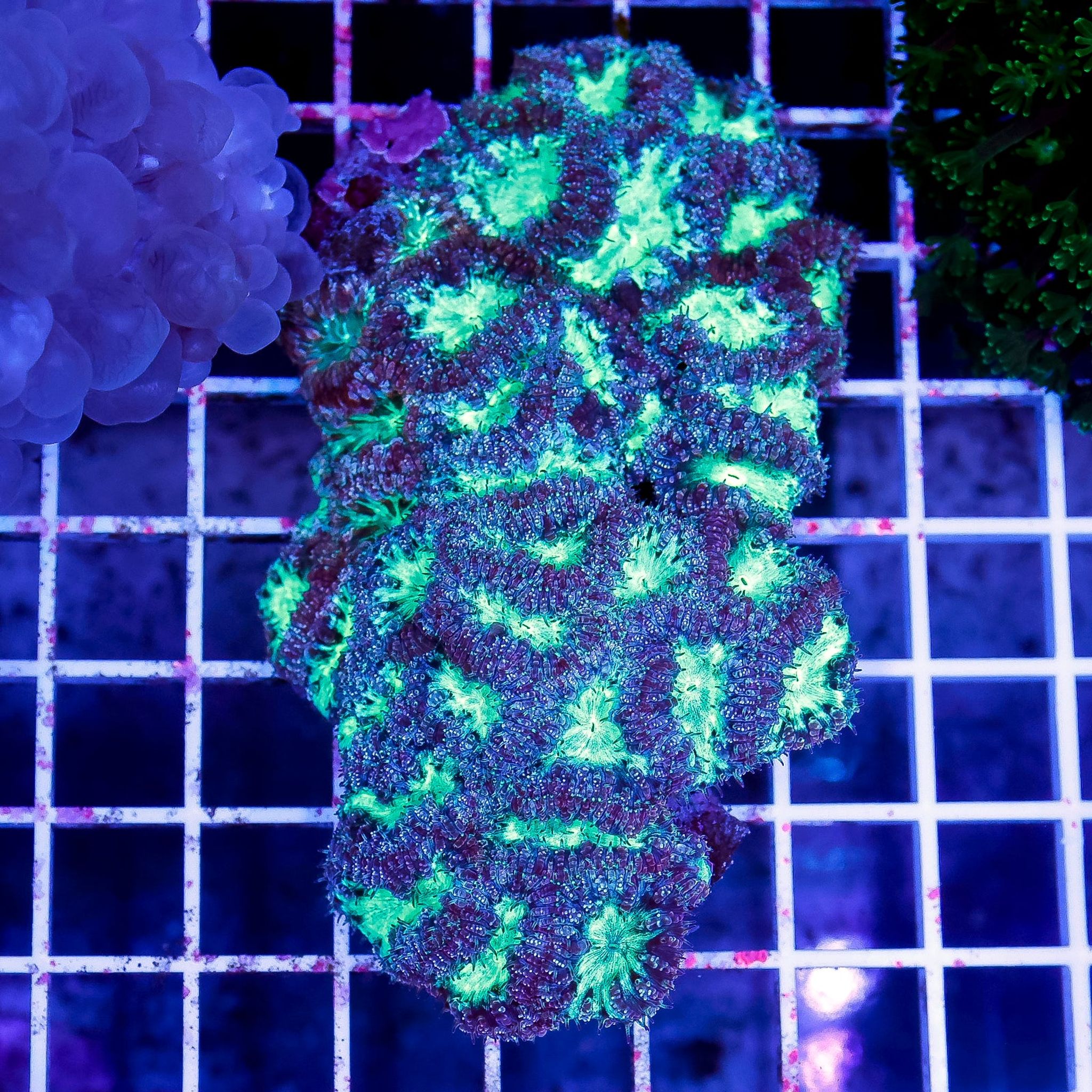

Common Blastomussa Problems: Tissue Loss, Fading, Pests and Recovery
Blastomussa is often sold as a beginner-friendly LPS coral, but its fleshy polyps punish light and flow mistakes quickly. This guide walks through the most common symptoms — receding tissue, bleaching, browning, and pests — and gives a concrete recovery action for each, not just theory.
Know Your Blasto First: Merletti vs. Wellsi
Before troubleshooting, confirm which species you have, since growth form affects both risk and recovery.
| Trait | B. merletti | B. wellsi |
|---|---|---|
| Polyp size | Small, ~0.5–1 in (1–2.5 cm) | Large, fleshy, up to 4–5 in (10–13 cm) |
| Growth form | Individual stalks, does not encrust | Encrusts over rock as a connected mat |
| Tissue connection | Each polyp/stalk is largely independent | Tissue is shared across the colony |
| Damage spread | Localized loss often stays contained to one stalk | Infection or recession can travel across shared tissue faster |
This distinction matters for recovery: if one stalk of a merletti recedes or dies, the neighboring stalks can often be left completely unaffected. On a wellsi, the same problem can creep across the mat because the tissue is physically continuous, so faster intervention is warranted.
Ideal Conditions (So You Know What "Off" Looks Like)
Blastomussa tolerates a normal reef range but reacts badly to sudden swings, especially in calcium, alkalinity, and salinity.
- Salinity: 1.024–1.026
- Temperature: 76–80°F (24–27°C)
- pH: 8.0–8.4
- Alkalinity: 8–11 dKH
- Calcium: 380–450 ppm
- Magnesium: 1,250–1,350 ppm
- Lighting: low-to-moderate, roughly 50–150 PAR. Guides disagree on the upper end — some call 50–100 PAR ideal, others say up to 150 PAR is acceptable. A sensible middle ground is to start new frags at 50–75 PAR and cap established colonies around 100–120 PAR unless a specific coral is already thriving brighter. Photoinhibition and bleaching risk outweigh the benefit of faster growth from extra light.
- Flow: low to gentle and indirect, not the turbulent flow meant for SPS corals.
Because the polyps are large and fleshy, they're efficient light collectors, which also makes them easy to overload. Strong or sudden light typically shows up as retraction, pale patches, or swollen "puffy" polyps well before real damage sets in.
Placement Checklist to Avoid Problems
Most Blastomussa issues trace back to placement, so get this right up front:
- Position in the lower third of the tank or on low rockwork/sandbed, not high on the rockscape.
- Choose a spot with indirect, gentle flow — enough to prevent detritus buildup, not enough to visibly move the polyps.
- Leave a few inches of spacing from neighboring corals to avoid sweeper tentacles and chemical aggression.
- Avoid high-traffic fish zones where crabs, wrasses, or angelfish regularly pass and may nip at exposed tissue.
- Once settled, don't rearrange — repeated relocation stresses the tissue and delays acclimation.
If you're shopping for compatible LPS neighbors or want to compare growth forms before buying, you can browse LPS hard corals on FishyHub.
Symptom-to-Cause Troubleshooting Table
Use this as a first pass before digging into any single problem below.
| Symptom | Most likely cause | Immediate action |
|---|---|---|
| Polyps stay closed for days | New-frag stress, too much light/flow, or poor water quality | Move to lower light/flow; test parameters; wait 3–5 days before further changes |
| Tissue peeling back, white skeleton showing | Unstable Ca/Alk/salinity, excess flow, injury, or infection | Test and correct parameters, reduce flow, isolate if spreading |
| Pale, translucent, or "bleached" tissue | Too much light, rapid light change, or heat spike | Reduce/relocate light, verify temperature, be patient for recoloring |
| Uniform dull brown color | Too little light OR excess nutrients (opposite fixes) | Check nitrate/phosphate first, then reassess light if nutrients are fine |
| Gelatinous brown/tan slime, foul smell | Brown jelly disease following injury or necrotic tissue | Siphon out immediately, cut back tissue, isolate, dip |
| Small bite marks or torn tissue edges, worse at night | Nipping tankmates (crabs, some wrasses/angelfish) or generic flatworms | Observe at night with a flashlight; relocate coral or address tankmate |
| Worms crawling on/near dead tissue only | Bristleworms scavenging, not the primary cause | Leave alone unless population is large; they're not usually the disease source |
Tissue Loss and Recession
Recession — tissue peeling back to expose white skeleton — is rarely caused by one single thing. It's usually a combination of unstable parameters (especially a calcium or alkalinity swing), poor water quality (either elevated nitrate/phosphate or, less intuitively, water that's too nutrient-poor to sustain the coral), excess flow physically abrading the tissue, pest bites, or a bacterial/fungal infection that moved in after an injury. It often starts on a single polyp and spreads if the underlying cause isn't addressed.
Recovery steps, in order:
- Test and correct parameters immediately — calcium, alkalinity, magnesium, and salinity first, since instability here is the most common trigger.
- Reduce flow directed at the coral; move it to a gentler spot if needed.
- Cut away dead tissue with a clean frag cut past the recession line if the loss is actively spreading — this stops the margin from continuing to erode.
- Dip the coral (an iodine-based or coral-specific dip) to rule out or eliminate pests as a contributing factor.
- Improve water quality through nutrient export and regular water changes.
- Move to a quarantine or hospital container if the spread is rapid, especially if it looks like brown jelly.
Caught early, recession that's addressed at the parameter and flow level can stop within days. Left alone, it can escalate into a full colony loss.
Fading: Bleaching vs. Browning
These two symptoms look like opposites but both come down to zooxanthellae balance.
Bleaching (white, pale, translucent tissue)
Bleaching happens when the coral expels its zooxanthellae, usually from too much light, a too-rapid light change, or a temperature spike. The skeleton shows through a thin, pale layer of living tissue. If the polyp still extends or responds to touch, the tissue is alive — bare white skeleton with no tissue response is dead. Recovery means correcting the light or heat problem first, then waiting weeks to a couple of months for color to return, sometimes helped along with extra target feeding during the recovery window.
Browning ("going brown")
Browning is often the opposite root cause: either too little light, or excess nutrients causing an overgrowth of zooxanthellae that masks the coral's natural pigment. It can also appear temporarily as a coral rebuilds its algae population after a stress event, before true color returns. This is worth calling out because it's easy to assume "browning always means low light" — check nitrate and phosphate first, since excess nutrients causing dulling has the opposite fix (nutrient export, not more light).
| Bleaching | Browning | |
|---|---|---|
| Appearance | Pale, white, translucent | Dull, uniform brown |
| Cause | Too much light, rapid light change, or heat | Too little light, OR excess nutrients |
| Fix | Reduce/relocate light, stabilize temperature | Test nutrients first; adjust light only if nutrients are fine |
| Recovery time | Weeks to months | Weeks to months, faster once cause is corrected |
Brown Jelly Disease Deep Dive
Brown jelly disease (BJD) is one of the most aggressive infections an LPS coral can face, capable of killing a colony in 24–48 hours. It's an opportunistic bacterial or ciliate infection that moves in after physical injury, stress, or necrotic tissue — it's a secondary infection, not usually the original cause of damage.
What it looks like: a gelatinous, brown-to-tan slime spreading rapidly over dying tissue, often with a strong, foul smell.
Why it spreads fast: the slime itself carries the infectious material. If it drifts in tank flow and touches healthy coral, or gets siphoned carelessly near other corals, it can transmit the infection.
Treatment protocol:
- Siphon out the jelly immediately — never let it drift into the display or touch neighboring corals.
- Cut away affected tissue, taking a margin into clearly healthy tissue.
- Dip the remaining fragment to knock back any residual pathogens.
- Isolate the piece in a separate quarantine container away from the main display.
- As a last resort, some hobbyists use a broad-spectrum antibiotic in isolation only — this is not reef safe and should never go in the display tank.
Prevention is far more reliable than treatment: avoid injuring the coral during handling or aquascaping, keep flow and water quality stable, and quarantine and dip every new coral before it goes in the display.
Pests and Physical Aggression
Blastomussa isn't a magnet for the pest list that plagues Acropora — Acropora-eating flatworms are specific to that genus and rarely relevant here. What blasto does encounter:
- Generic flatworms, which can irritate tissue without being species-specific pests.
- Nudibranchs that eat coral tissue (rare on Blastomussa specifically).
- Nighttime nipping from tankmates — crabs, and occasionally aggressive wrasses, angelfish, or shrimp — biting the fleshy polyps after lights-out. This is easy to mistake for disease, so check for it before assuming an infection.
- Bristleworms, which are usually scavengers cleaning up already-dead tissue rather than the cause of damage — don't treat their presence alone as proof of a problem.
Pest control approach:
- Manually remove visible pests with tweezers or a turkey baster.
- Dip every new coral before introduction, and periodically dip established corals if you suspect a pest issue.
- Quarantine new corals for 2–4 weeks before adding them to the display.
If nipping is suspected, check the tank at night with a flashlight — bite marks that appear only after lights-out point to a tankmate, not a pathogen.
Acclimating New Frags the Right Way
New arrivals are the most common source of both light stress and introduced pests, so this stage deserves care:
- Drip acclimate to match your tank's water parameters before the frag ever touches display water.
- Dip before introduction to catch hitchhiking pests early.
- Start at low light (50–75 PAR) and ramp up gradually over 2–4 weeks rather than placing it at target brightness immediately.
- Watch for polyp extension in the first 24–72 hours — a frag that extends its polyps within that window is a good early sign; one that stays closed longer may need lower light or flow, or simply more time.
For feeding supplies to support a newly settled frag, FishyHub carries freeze dried food suited to target-feeding small meaty items.
Do You Need to Feed It?
Blastomussa gets most of its nutrition from its zooxanthellae and doesn't require feeding to survive. That said, target-feeding small meaty foods — mysis, chopped shrimp, or coral-specific pellets — 1–3 times per week improves color, polyp extension, and growth rate over time. Frequency matters less than consistency and using an appropriately small particle size; feed when polyps are extended, ideally with the lights off or dim.
Common Mistakes to Avoid
- Overlighting a new frag by placing it high in the tank or under a high-PAR fixture without acclimation, leading to bleaching or chronic retraction.
- Using SPS-level flow on a coral that needs gentle, indirect movement — this causes chronic tissue irritation and recession.
- Ignoring early localized paling or recession, assuming it will resolve on its own — small issues can escalate to brown jelly or full colony loss within days.
- Placing it too close to aggressive corals or in a fish's territory, causing repeated physical damage that gets misread as disease.
- Skipping quarantine and dipping on new corals, which can introduce pests or pathogens to the entire tank.
- Assuming all browning means low light without checking nitrate and phosphate first.
- Confusing normal nighttime or feeding-response retraction with an actual health problem — polyps naturally close at various times and this alone isn't cause for concern.
Frequently Asked Questions
Why is my Blastomussa not opening/extending its polyps?
This is usually new-frag stress, too much light or flow, or a water quality issue rather than a serious problem. Give it several days to settle in stable, low-light, low-flow conditions before assuming something is wrong.
Is brown jelly disease contagious to other corals?
Yes — if the jelly or detritus drifts in tank flow and touches or gets siphoned near other corals, it can spread the infection. Isolate the affected coral immediately and avoid letting flow carry material through the display.
Can a Blastomussa recover from bleaching?
Yes, as long as the tissue is still alive and the underlying stressor — usually light or heat — is corrected. Recoloring is gradual and can take anywhere from a few weeks to a couple of months.
How do I know if my coral is dead vs. just stressed?
Bare white skeleton with no tissue and no response after 24–48 hours of corrected conditions usually indicates that section is dead. Living but stressed tissue will still show some polyp movement or response even if it looks pale or retracted.
What's the best way to dip a Blastomussa?
Follow the specific dip product's dilution and timing instructions, gently agitate the coral to dislodge any hidden pests, and rinse it in clean saltwater before returning it to the tank or quarantine container.
Do I need to feed my Blastomussa?
No, it isn't required for survival since it gets most of its nutrition from zooxanthellae. Occasional target feeding of small meaty foods does noticeably improve color and growth over time.
Why does my Blastomussa look different colors on different days?
Polyp expansion and contraction, feeding response, and the angle of your lighting can all change how the color appears from day to day. True color loss from bleaching or browning is different — it persists consistently regardless of these normal daily variations.
Can I frag a diseased Blastomussa to save it?
Yes, cutting well past the recession or infection line into clearly healthy tissue, then dipping the resulting fragment, is a standard rescue technique. It's especially useful for stopping the spread of brown jelly disease before it consumes the whole colony.
Once you've diagnosed the issue and stabilized your coral, browse corals on FishyHub if you're ready to add a healthy Blastomussa frag or explore other LPS options for your reef.


