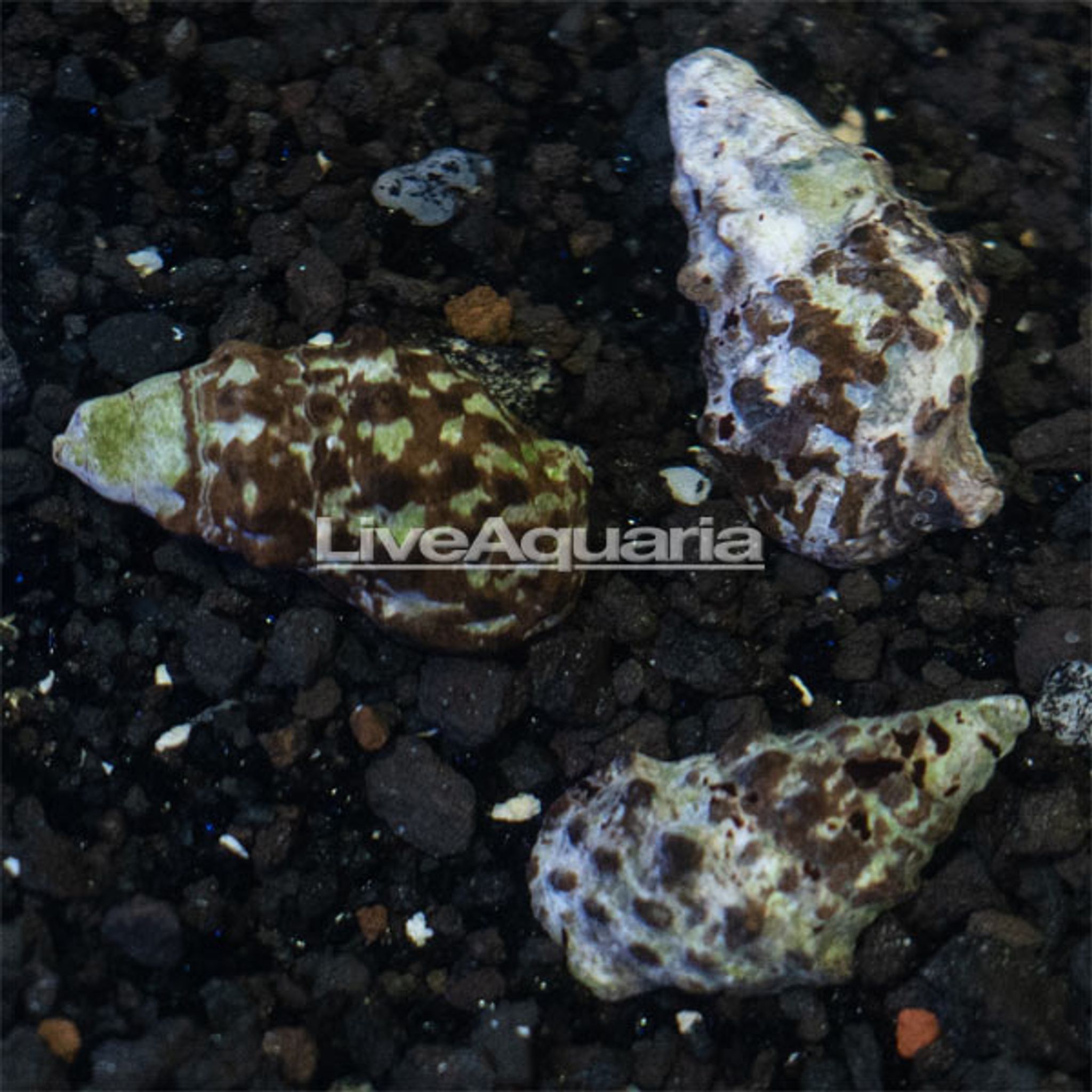

Cerith Snail Care Guide: Tank Requirements, Feeding and Compatibility
Cerith snails are small, spiral-shelled grazers that quietly do work most other cleanup-crew snails skip — eating diatoms and cyanobacteria off the glass, rock, and sand. This guide covers exactly what they need to thrive: tank size, water parameters, substrate, feeding, and which tankmates to avoid, plus how to troubleshoot the algae problems that usually send hobbyists searching for this snail in the first place.
What Is a Cerith Snail?
"Cerith snail" is the trade name for several species in the genus Cerithium, all sharing a similar look: a slender, spiral or turret-shaped shell, usually under 1–1.5 inches (2.5–4 cm) long, in mottled brown, tan, or gray tones. They're most active after dark, burrowing through sand during the day and surfacing to graze at night.
Unlike surface-grazing snails that mainly clean glass and rock faces, cerith snails split their time between the substrate and hard surfaces, which makes them one of the more functionally useful additions to a saltwater cleanup crew.
Tank Requirements
Tank Size
Cerith snails are adaptable enough to survive in tiny volumes — technically, anything holding a stable cycled saltwater system will do. But survival isn't the same as a good setup. A tank of 5–10 gallons as a practical minimum makes it far easier to keep parameters stable, since small volumes swing in temperature, salinity, and nitrate far faster than larger ones. The snail itself isn't the limiting factor; water stability is.
Substrate
This is the one requirement that's easy to overlook. Cerith snails need sand or a muddy substrate at least 1–2 inches (2.5–5 cm) deep to burrow and forage through during the day. Without it, they're stuck on hard surfaces they're not really built for, and a bare-bottom or gravel-only tank will shorten their lives and reduce their usefulness. A fine to medium sand bed also lets them do a job that surface grazers like nerite snails can't: aerating the sand and disturbing waste before it compacts into anaerobic pockets that can produce hydrogen sulfide. That burrowing behavior is a real functional benefit, not just a feeding habit — it's part of what keeps a deep sand bed healthy.
Browse sand and gravel substrate options sized for reef tanks if you're setting up a bed specifically to support burrowing inverts.
Water Parameters
Cerith snails are reef-standard animals — they don't need anything exotic, but they are sensitive to swings. Use this table as your target range:
| Parameter | Target Range |
|---|---|
| Temperature | 74–80°F (23–27°C) |
| pH | 8.0–8.4 |
| Specific gravity (salinity) | 1.023–1.025 |
| Alkalinity (dKH) | 8–12 dKH (tolerates up to ~16 dKH, but 8–12 is the target, not the ceiling) |
| Ammonia / Nitrite | 0 ppm |
| Nitrate | Under 20 ppm |
| Calcium | ~380–450 ppm |
The tank must be fully cycled before adding cerith snails — ammonia and nitrite need to read zero. Because these snails are sensitive to sudden salinity or temperature shifts, drip-acclimate for 30–60 minutes or longer rather than a quick float-and-dump. Stable calcium and carbonate hardness also matter beyond the cycle: they support shell integrity and steady shell growth over the snail's life.
Diet and Feeding
Cerith snails are omnivorous detritivores and algae grazers. Their menu includes:
- Diatoms (brown algae film)
- Cyanobacteria (blue-green algae mats)
- Film and hair algae
- Uneaten fish food and fish waste
- Decaying organic matter, including dead tankmates
They're one of the few common cleanup-crew snails that will reliably eat both diatoms and cyanobacteria — most other snails ignore one or both.
Stocking Rate
A general reef cleanup-crew guideline is 1–2 snails per gallon, adjusted downward for larger or more heavily stocked tanks where more natural food (fish waste, uneaten food) is already available. Overstocking relative to the algae and detritus actually present is a common mistake — it leads to starvation once the tank gets "too clean."
When the Tank Is Too Clean
Watch for these starvation signs:
- Shell growth stalling
- Snails clustering near the surface or waterline
- Empty shells turning up with no clear predator
If you see any of these, supplement with a sinking algae wafer, dried nori or seaweed, or occasional blanched vegetables. Freeze-dried foods also work well as an occasional top-up without overloading the water column the way flake food can.
Compatibility
Cerith snails are considered reef-safe — they don't eat coral tissue — and are peaceful with fish, shrimp, other snails, and most invertebrates.
Avoid housing them with:
- Triggerfish
- Puffers
- Certain wrasses, especially six-line and four-line types
- Arrow crabs
- Other predatory or mollusk-eating species that crack or eat snails
Use caution with hermit crabs. As cerith snails grow, or as a crab looks for a bigger shell, hermit crabs may evict — or "shell-jack" — a cerith snail from its shell, which is usually fatal for the snail. If you already keep hermit crabs, add extra empty shells to the tank so the crabs have alternatives.
Lifespan and Reproduction
With stable parameters and adequate food, cerith snails typically live 1–3 years in a home aquarium. They have separate sexes, and courtship involves mucus trails that let potential mates find each other. Females can lay large numbers of eggs — hundreds to thousands — in strings or capsules on rock or sand.
Breeding success in a standard reef tank, however, is rare. The larvae are planktonic and need specific plankton-rich or brackish-influenced conditions to develop past the larval stage, conditions a typical closed reef system doesn't provide. Occasional accounts of surviving offspring exist, usually tied to refugiums or unusual setups, but it's not something to plan on. In practice, population control isn't a concern with this species.
Handling and Acclimation
Cerith snails right themselves slowly if flipped onto their backs, and they can seal into their shell with a hard plate called an operculum when stressed or removed from water. This is a normal defense, not death — a snail with the operculum closed may simply need time, water, and quiet to reopen. They can be handled briefly and safely for repositioning during acclimation or maintenance.
Your First Two Weeks After Adding Cerith Snails
- Day 1: Drip-acclimate over 30–60+ minutes, then place snails near the sand bed, not directly on glass or rock.
- Days 2–3: Leave lights on a normal schedule and avoid disturbing the sand; let snails settle into a burrowing pattern.
- First week: Check for activity at night with a flashlight — foot extended, moving through sand or grazing rock.
- Second week: Watch for early starvation or stress signs (surface clustering, retracted foot for extended periods) and adjust feeding or stocking if needed.
What to Look For When Buying
A healthy cerith snail should show:
- An active foot partially extended, not fully retracted for long periods while still in water
- A shell free of cracks, heavy erosion, or missing spirals
- No foul odor, which usually signals a dead animal inside the shell
It's worth giving new arrivals a brief quarantine or acclimation dip before introducing them to an established reef, reducing the risk of introducing pests or parasites alongside the snails. You can view live marine invertebrates and snails available on FishyHub when you're ready to build out a cleanup crew.
Diatoms, Cyanobacteria, and Where Cerith Snails Fit In
Why Brown Diatom Algae Appears
Diatoms are a near-universal early-tank bloom, driven by silicates and excess nutrients in new setups. They show up as a brown, dusty film on glass, sand, and rock. The good news: this phase is largely temporary. Blooms typically fade within 4–8 weeks as a tank matures, biological filtration establishes, and silicate levels drop. In the meantime, control comes from a mix of time, reduced silicate and phosphate inputs (RO/DI water, low-silicate substrate), manual siphoning, and grazers like cerith snails.
What Cyanobacteria Actually Is
Despite the nickname "blue-green algae," cyanobacteria is a photosynthetic bacteria, not a true algae. It forms slimy sheets — often red, purple, or dark green — that peel off in mats and can carry a musty smell. It thrives on excess nitrate and phosphate, poor flow with dead spots, and aging lighting.
Removing Cyanobacteria: The Consensus Approach
- Improve flow throughout the tank to eliminate dead spots
- Increase water change frequency and reduce feeding/nutrient input
- Run nutrient export: GFO media, a macroalgae refugium, or a protein skimmer
- Manually siphon out mats during water changes
- For severe outbreaks, consider a short 2–3 day blackout period
- Use grazers such as cerith snails as an ongoing maintenance layer
Chemical cyanobacteria treatments exist but should be a last resort, used with careful dosing, since they can crash tank oxygen levels if overused.
The Honest Takeaway
Cerith snails are a genuinely useful maintenance tool for both diatoms and cyanobacteria — but they are not a standalone fix. If you're battling a serious outbreak of either, address the underlying cause (nutrients, flow, light) first and let the snails do ongoing cleanup, not the heavy lifting.
Common Mistakes to Avoid
- Adding snails to an uncycled tank. Wait until the nitrogen cycle finishes and diatoms have started appearing — that's their natural food source.
- Overstocking relative to available food, leading to starvation once the tank is too clean.
- Skipping drip acclimation. Sudden salinity or pH swings are a common cause of early snail death.
- Housing with incompatible predators — wrasses, puffers, triggerfish, or arrow crabs.
- Mistaking a sealed, dormant snail for dead. Check for smell and gently test for responsiveness before removing it.
- Relying on snails alone to fix a diatom or cyanobacteria outbreak instead of addressing the root cause.
- No rockwork or sand to grip. A snail flipped on smooth glass or decor may not be able to right itself.
Frequently Asked Questions
How many cerith snails should I add to my tank?
Start with roughly 1–2 snails per gallon as a cleanup-crew ratio, then adjust based on your bioload and how much algae or detritus is actually present. Heavily stocked tanks with more natural food available can support fewer snails per gallon.
Are cerith snails reef safe?
Yes. Cerith snails don't eat coral tissue and are considered one of the safest cleanup crew members for a reef tank.
Do cerith snails eat cyanobacteria and diatoms?
Yes, and that's part of what makes them valuable. They're among the few common snails that graze both readily, which is especially useful during a new tank's early algae phases.
What do I feed cerith snails if my tank is too clean?
Offer a sinking algae wafer, dried nori or seaweed, or blanched vegetables occasionally. Watch for shell growth stalling or snails clustering at the surface as signs they need supplemental feeding.
Can cerith snails breed in my tank?
Rarely with success. Females lay eggs readily, but the planktonic larvae seldom survive to adulthood in a typical closed reef system, so captive breeding isn't something to plan around.
Why did my cerith snail die suddenly?
The most common causes are acclimation shock from a salinity or temperature swing, predation by an incompatible tankmate, or shell-jacking by an aggressive hermit crab. Always drip-acclimate new snails and double-check tankmate compatibility.
What fish or invertebrates should I avoid keeping with cerith snails?
Avoid triggerfish, puffers, certain wrasses (especially six-line and four-line types), arrow crabs, and aggressive hermit crabs, all of which may prey on or evict cerith snails.
How long do cerith snails live?
Typically 1–3 years with stable water parameters and adequate food available.
Ready to add cerith snails to your cleanup crew? You can browse available marine invertebrates on FishyHub and pair them with the right substrate and feeding routine outlined above.


