Celestial Pearl Danio Care Guide: Tank Size, Diet, Water Parameters and Temperament
Celestial pearl danios do best in a mature, densely planted tank of at least 10 gallons, kept at 72–76°F with gentle flow and a group of six or more that includes more females than males. They are hardy and peaceful, but they are also shy, have tiny mouths and rarely feed at the surface, so small, frequent meals of sinking micro foods matter more than almost anything else. Here is everything you need to set them up well.
Quick Stats
| Trait | Recommendation |
|---|---|
| Scientific name | Danio margaritatus (formerly Celestichthys margaritatus) |
| Common names | Celestial pearl danio (CPD), galaxy rasbora, fireworks rasbora |
| Adult size | About 0.75–1 in (2–2.5 cm) |
| Lifespan | 3–5 years |
| Minimum tank | 10 gal (38 L) for 6–8 fish; 20 gal long (76 L) for 10–15 |
| Temperature | 72–76°F (22–24°C) ideal; tolerates about 70–79°F (21–26°C) |
| pH | 6.5–7.5 (tolerates up to about 8.0) |
| Hardness | GH about 2–10, KH about 2–10 dKH |
| Group size | 6 minimum, 8–10+ preferred, about 2 females per male |
| Temperament | Peaceful with other species; males spar with each other |
| Diet | Micro-predator/omnivore; small sinking foods plus live or frozen foods |
What Is a Celestial Pearl Danio?
Despite the popular "galaxy rasbora" label, this fish is a true danio, not a rasbora. It was first sold under trade names before scientists placed it in the genus Danio. You will still see all three names on store tanks and online listings.
Origin and the 2006 Discovery Hype
The species comes from shallow, spring-fed, heavily vegetated ponds on the Shan Plateau around Hopong, Myanmar, at roughly 3,000+ ft (900+ m) elevation. That high, cool, weedy habitat explains most of its care needs.
It reached the hobby in 2006 and was formally described in 2007. Its sudden popularity triggered heavy collection, and rumors spread in 2007 that the wild population had been wiped out. Those reports turned out to be overstated, since the fish lives in many ponds in the region. Today, most US stock is captive-bred, which is good news: tank-raised fish are usually better adjusted to aquarium life and foods.
Appearance and Sexing
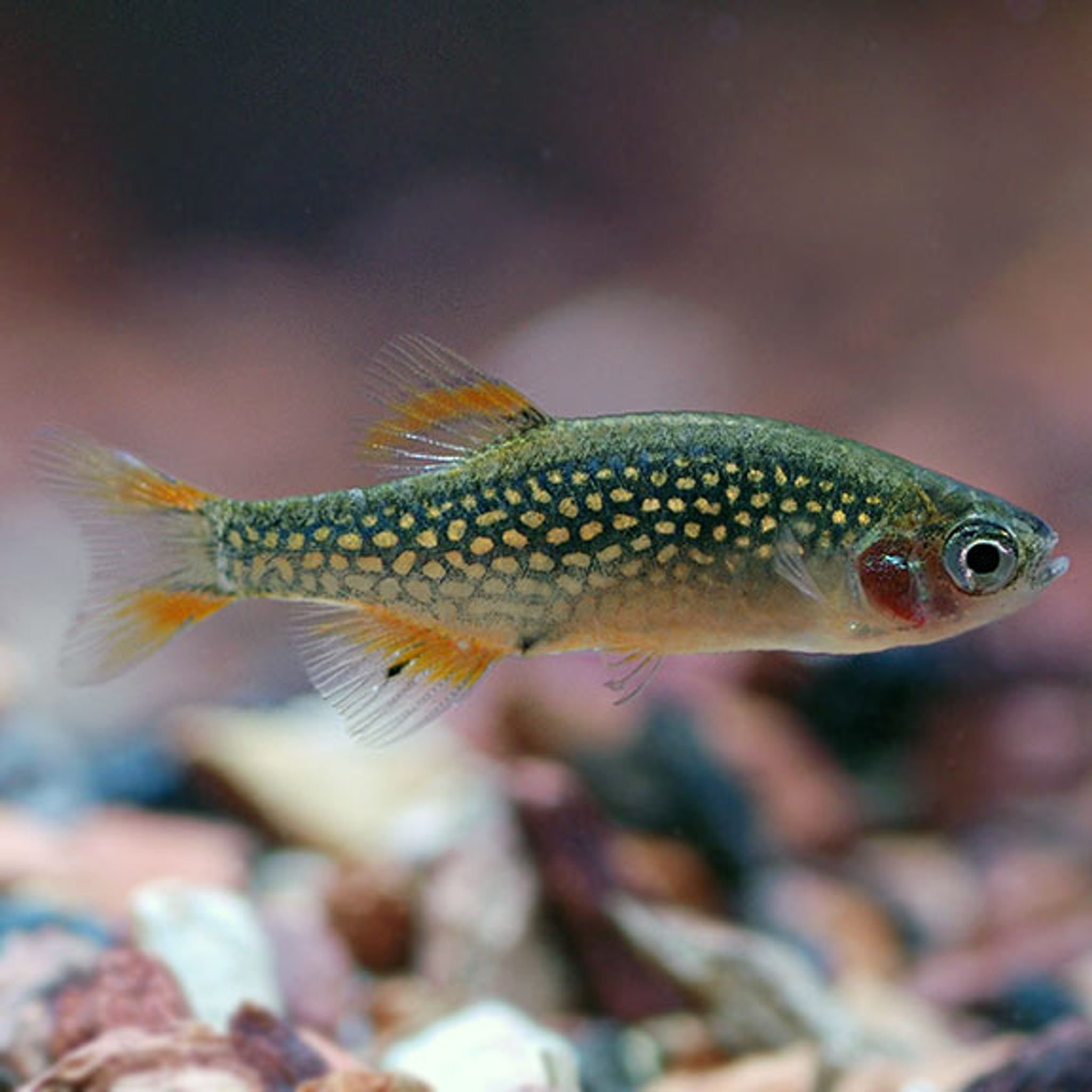
- Body: steel blue with scattered gold "pearl" spots
- Fins: barred red or orange and black
- Males: slimmer, more intense blue and deeper red fins
- Females: rounder, duller, with a dark spot near the vent when full of eggs
They reach sexual maturity at about three months, so even young fish can often be sexed with a little patience.
Tank Size and Setup
How Big a Tank Do You Need?
Recommendations range from 5 to 20 gallons. A practical answer:
- 10 gallons (38 L): a starter group of 6–8
- 20 gallon long (76 L): a proper group of 10–15, which is where their colors and behavior really show
- Scaling: add roughly 10 gallons per extra five fish
Tiny tanks under 10 gallons swing in temperature and water quality faster, and they give sparring males nowhere to retreat.
Filtration and Flow
Some keepers say "strong filtration," others say "low flow." Both are right in part: you want strong biological capacity with gentle water movement. A sponge filter is ideal. A baffled hang-on-back filter works too, as long as the intake is covered with a sponge or guard so small fish and fry are not pulled in.
Plants, Substrate and Lighting
Match the pond they came from:
- Dense planting: moss, fine-leaved stem plants and floating plants
- Dark substrate and background: these bring out the blue and gold
- Cover: driftwood, rock caves and plant thickets where males can break line of sight
- Dim to moderate light: floaters help soften it
A bright, bare tank leads to pale fish that hide constantly.
A Note on Decorative Crystals
Crystals and gemstones are a popular aesthetic, but most are not recommended. Many minerals can leach metals or shift hardness and pH. If you want the look, stick to inert, aquarium-safe quartz, and skip anything you cannot confirm is safe.
Water Parameters
Temperature
These are cool-tropical fish. Published ranges run from 71 to 79°F; aim for 72–76°F (22–24°C) and avoid long stretches above 78°F (26°C). Water at 80°F (27°C) or higher over the long term stresses them and shortens their lives.
pH and Hardness
Sources differ, quoting pH 6.5–7.5 or 6.6–8.0 and hardness anywhere from 1–5 dGH up to 10 dKH. The takeaway: neutral-ish, soft to moderately hard water, kept stable. Stability matters more than chasing an exact number, so most US tap water works once dechlorinated.
Cycling and Maintenance
- Add CPDs only to a fully cycled, mature tank
- Ammonia and nitrite: 0 ppm
- Nitrate: under about 20 ppm
- Water changes: 20–30% weekly, temperature-matched
New tanks are the number-one cause of fast losses with this species.
Running a Tank Without a Heater
CPDs are one of the best candidates for an unheated tank in a home that stays around 70–75°F (21–24°C). The catch in many US houses is seasonal swings:
- Summer: air conditioning usually keeps rooms in range, but a tank near a sunny window or in an unairconditioned room can creep above 78°F.
- Winter: thermostats set back overnight, drafty rooms and basements can drop water below 70°F.
To keep things steady without a heater, use a lid to hold in warmth, keep the tank away from exterior doors, vents and windows, and check a thermometer daily at first. Sudden drops matter more than a slightly cool but steady temperature. A low-set heater (around 72°F) is inexpensive insurance that only switches on when the room gets cold.
Temperament and Behavior
CPDs are peaceful toward other species. Rather than schooling tightly, they form loose groups and spend most of their time in the lower and middle levels, weaving through plants.
Males are a different story with each other. They flare and spar, circling with fins spread. This is normal display behavior and rarely causes injury when there is enough space and cover.
Group Size and Sex Ratio
Keep at least 6, ideally 8–10 or more, with about two females per male. Small or male-heavy groups mean nonstop chasing, stressed females and fish that never come out.
Diet and Feeding
CPDs are micro-predators with very small mouths. In the wild they pick tiny invertebrates off plants and the bottom.
What to Feed
- Staples: crushed flakes, micro pellets and nano granules
- Live or frozen: baby brine shrimp, daphnia, cyclops, microworms and grindal worms
- Freeze-dried: crumbled finely as an occasional extra
Slow-sinking foods beat floating ones. Many CPDs will not rise to the surface to feed, and a tank fed only floating flakes can slowly starve them while the food looks eaten by others. Browse live-food alternatives and micro foods in Freeze Dried Food for variety.
How Often
Advice ranges from two to four meals per day. Offer small portions 2–3 times daily, an amount the group finishes in a couple of minutes, and remove leftovers so they do not foul the water.
Tankmates
| Good companions | Use caution | Avoid |
|---|---|---|
| Ember and neon tetras | Bettas | Anything large enough to swallow them |
| Pygmy and panda corys | Shrimplets in a shrimp colony | Fin-nippers |
| Kuhli loaches | Boisterous or fast, pushy feeders | |
| Chili and emerald dwarf rasboras | ||
| White cloud minnows, otocinclus | ||
| Adult cherry or amano shrimp |
Emerald Dwarf Rasbora and Hybrids
The emerald dwarf rasbora (D. erythromicron) is a close cousin from Lake Inle, about 1 in (2.5 cm) long with green bars over orange. Care is nearly identical, and it makes an excellent tankmate. However, the two can cross and produce tank-bred hybrids, so keep them in separate tanks if you plan to breed pure lines.
Glowlight Danio
The glowlight danio (D. choprae) is another tiny Myanmar danio, orange with blue-green bars. It is more active and slightly more tolerant of warmth, and it fits well in a similar planted nano setup.
Why Bettas Are an Uneasy Match
Some keepers report success with a calm betta in a large, planted tank held at about 77–78°F. The problem is that this sits at the top of the CPD range and the bottom of the betta range; bettas generally want 78–82°F. Long-finned veiltails and other domestic bettas may also hunt small fish, and wild types such as Betta hendra need soft blackwater conditions that differ from a CPD setup. Proceed with caution, or keep them apart.
Shrimp
Adult cherry and amano shrimp are safe. CPDs will pick off some shrimplets, so a shrimp colony will still grow, just more slowly, especially with plenty of moss for cover. You can find suitable species in our Shrimps section.
Example Stocking Plan and Shopping Checklist
A balanced 20 gallon long (76 L) could hold:
- 12 celestial pearl danios (about 4 males, 8 females)
- 6 pygmy corys
- A starter colony of cherry shrimp
Checklist:
- 20 gallon long tank with a lid
- Sponge filter (or baffled HOB with intake guard)
- Low-wattage adjustable heater and a thermometer
- Dark substrate and background
- Moss, stem plants, floaters and driftwood
- Water test kit and dechlorinator
- Crushed flake, micro pellets and a frozen or live baby food
- A small quarantine tank
Acclimation and Quarantine for Shipped Fish
Shipped CPDs often arrive stressed, thin and pale. To give them the best start:
- Dim the lights before opening the bag.
- Float the bag to match temperature, then add small amounts of tank water over 30–45 minutes.
- Net the fish into the tank or quarantine tank; discard the bag water.
- Quarantine for a few weeks in a planted or moss-filled tank with a sponge filter.
- Feed baby brine shrimp first; most reluctant fish accept it.
- Keep the lights low for a few days and watch for white spots.
Breeding
CPDs are easy egg scatterers. In a well-fed, mature tank they spawn almost daily in moss or fine-leaved plants, but adults eat the eggs.
- Move moss clumps with eggs to a separate container, or use a dense moss-filled breeding tank
- Eggs hatch in about 3–4 days, up to a week in cooler water
- Fry become free-swimming a few days after hatching
- Feed infusoria or vinegar eels first, then baby brine shrimp once they grow
Health and Common Problems
CPDs are generally hardy. Most problems trace back to poor water quality or fighting, which shows up as fin rot, ich or chronic stress.
Ich
They are prone to ich after shipping or temperature swings. Raise the temperature gradually to no more than about 80°F (27°C), their upper limit, rather than the higher temperatures sometimes suggested for other fish. Treat with a medication at the dose the label lists as safe for small fish, and quarantine all new arrivals to prevent it.
Common Mistakes and Fixes
- Uncycled tank: fast losses. Only add fish to a mature, cycled tank.
- Small or male-heavy group: constant chasing and hiding. Add females and more plants.
- Bright, bare tank: pale, hidden fish. Add plants, floaters and a dark background.
- Floating flakes only: slow starvation. Switch to sinking micro foods and live or frozen foods.
- Thin arrivals that will not eat: quarantine, dim the lights and offer baby brine shrimp.
- Water 80°F+ for long periods: stress and shorter lifespan. Cool the room or move the tank.
- Split or ragged fins: test water quality and check your male-to-female ratio.
Frequently Asked Questions
Are celestial pearl danios danios or rasboras?
They are true danios, classified as Danio margaritatus. "Galaxy rasbora" and "fireworks rasbora" are trade names that stuck from the fish's early days in the hobby.
How many celestial pearl danios should I keep?
Keep at least six, and ideally ten or more. Aim for roughly two females per male so the males' sparring is spread out and females are not harassed.
Do celestial pearl danios need a heater?
Often not, if your home stays between about 70 and 75°F year-round. Because US homes can swing with winter heating and summer AC, a low-set heater is cheap insurance against sudden drops.
Can celestial pearl danios live with shrimp?
Yes. Adult cherry and amano shrimp are safe, though CPDs will eat some shrimplets. Dense moss gives baby shrimp enough cover for a colony to keep growing.
Can celestial pearl danios live with a betta?
It is risky. Bettas prefer warmer water than CPDs, so the overlap is narrow, and a betta may hunt fish this small. If you try it, use a large, heavily planted tank and a calm betta, and be ready to separate them.
Why do my male celestial pearl danios fight?
Flaring and sparring are normal display behavior between males. Adding more females and more plants or other visual barriers usually reduces it, and serious injuries are rare with enough space.
Build Your Nano Community
With a cycled, planted tank, cool and stable water, and small sinking meals, celestial pearl danios reward you with years of color and fascinating behavior. When you are ready to start or grow your group, browse our danio selection and other peaceful nano companions in Small Community Fishes on FishyHub.


