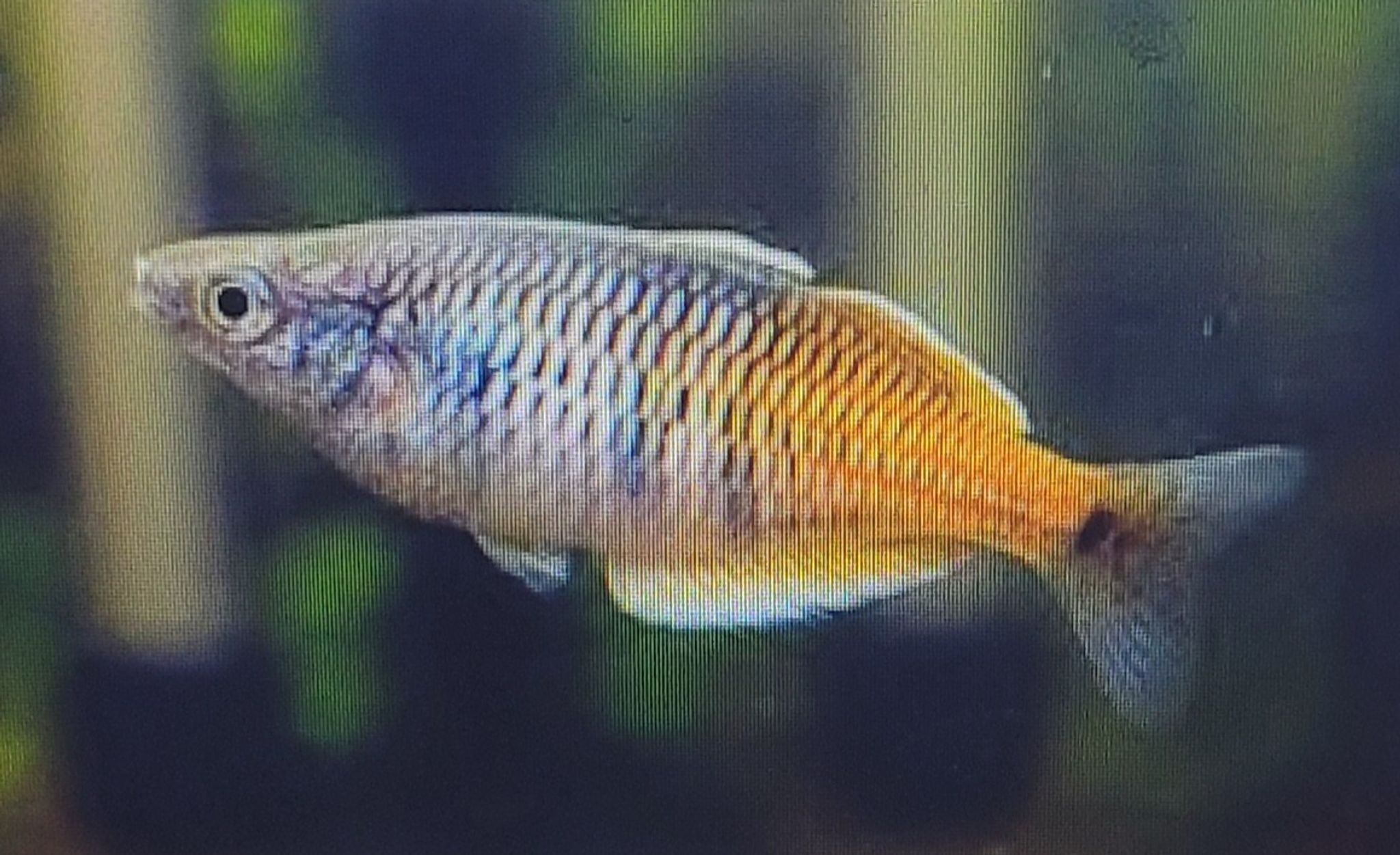

Boesemani Rainbowfish Care Guide: Tank Size, Diet, Water Parameters and Temperament
Boesemani rainbowfish are one of the most rewarding freshwater fish to grow out, but the drab silver juveniles sold in most stores rarely hint at the two-tone blue-and-orange adults they become. This guide covers exactly how big a tank they need, what water chemistry keeps them healthy and colorful, what to feed them, and whether they're actually as peaceful as people claim.
Species Overview
Melanotaenia boesemani, commonly called the Boeseman's or bicolor rainbowfish, comes from an unusually small native range: the Ajamaru (Ayamaru) Lakes system and connecting streams on the Bird's Head Peninsula of West Papua, Indonesia. That restricted origin matters for care — a fish evolved in a handful of stable lakes doesn't tolerate wildly swinging water chemistry the way a species spread across an entire continent might.
Adult males reach about 4–4.5 inches (10–11 cm), with a deep, laterally compressed body, a distinctive humped nuchal profile above the head, and a two-part dorsal fin. Females stay smaller, around 3–3.5 inches (7.5–9 cm), with a slimmer, more streamlined shape.
With consistent care, boesemani rainbowfish typically live 5–8 years, and well-documented individuals in excellent conditions have reached 10, even 13–15 years.
Why the Juvenile Looks So Plain
Fish sold at pet stores are usually only 1–2 inches long and dressed in dull silver-olive — not the striking bicolor pattern the species is named for. Full color develops over roughly 8–12 months as the fish matures, and it depends on good nutrition and stable water quality along the way. New owners who expect vivid color from day one often assume they've bought a sick or mislabeled fish, when in reality patience is the missing ingredient. As the fish grows, the body gradually splits into a cooler blue-purple-silver front half and a warm orange-red-yellow rear half, with males eventually showing the most saturated contrast.
Tank Size and Setup
Sources disagree sharply on minimum tank size, ranging from 30 to 75 gallons for a school of six. The honest answer: 30 gallons is a bare-minimum floor for young fish, not a comfortable long-term home. A more realistic starting point is 40–55 gallons, and 75+ gallons is genuinely ideal for a full, colorful group.
Length matters more than raw volume here. Boesemani are fast, horizontal swimmers that cruise the length of a tank rather than hovering in place, so aim for at least 4 feet of tank length, even if that means choosing a shallower, longer tank over a tall one with the same gallon count.
| Setup Goal | Tank Size | Length |
|---|---|---|
| Absolute minimum (school of 6, young fish) | 30 gal (114 L) | 3 ft |
| Realistic comfortable minimum | 40–55 gal (150–210 L) | 4 ft |
| Ideal for a full, colorful group | 75+ gal (285+ L) | 4–5 ft+ |
Use a dark substrate to make the fish's colors pop against it, and plant densely along the back and sides while leaving open water down the middle — boesemani need a clear runway for schooling and sprinting, not a tank packed wall-to-wall with décor.
Water Parameters
This is the section where beginners most often go wrong, usually because they treat boesemani like a typical soft-water tetra or betta.
- Temperature: The overall consensus spans 74–86°F (23–30°C), but 75–80°F (24–27°C) is the safer long-term display range. Sustained heat near the top of the tolerated range can shorten lifespan, so reserve the low 80s°F for short-term breeding conditioning only, not everyday keeping.
- pH: Target 7.0–8.0, slightly alkaline. A few outlier sources cite tolerance down to 6.5 or up to 9.0, but don't keep the fish at either extreme long-term — mild excursions are fine, chronic extremes are not.
- Hardness (GH/KH): This is the parameter most beginners miss entirely. Boesemani prefer moderately hard to hard water, roughly 8–20 dGH, with KH in the high single digits to high teens to keep pH stable. That's noticeably harder than what most soft-water community fish want, and it's the single biggest reason store-bought rainbowfish sometimes struggle after being moved into a typical soft, neutral home aquarium.
GH and KH, Explained Simply
GH (general hardness) measures dissolved calcium and magnesium in the water — think of it as a measure of mineral content. KH (carbonate hardness) measures the water's buffering capacity, essentially its ability to resist pH swings. For a harder-water species like boesemani, both matter: insufficient GH means the fish isn't getting the mineral profile it evolved with, and low KH risks a sudden pH crash that can shock or kill fish with no warning. Test both with a liquid test kit rather than guessing, and raise them gradually with a buffering product formulated for freshwater tanks if your tap water runs soft — sudden swings are more dangerous than a slightly-off number held steady. Water conditioners and hardness buffers made for this purpose can be browsed in FishyHub's water treatment section.
If you're moving fish from a typical big-box store's soft, near-neutral holding water into a harder home setup, don't do it in one step. Drip-acclimate over an hour or more, and consider raising GH/KH gradually over the following one to two weeks rather than dosing to target on day one.
Filtration and maintenance: Run efficient filtration with moderate current, and perform weekly partial water changes of about 20–25% to keep nitrates low — this directly supports color intensity, not just general health. A sponge filter or hang-on-back unit with decent flow works well for this species.
Diet
Boesemani are omnivores that lean meatier than their size suggests, because their mouths and throats are relatively small and narrow for a fish this length. A good feeding plan looks like:
- A high-quality flake or small pellet as the daily staple
- Frozen or live bloodworms, brine shrimp, and daphnia several times a week
- Occasional blanched vegetables like zucchini or spinach
Feed small portions 2–3 times daily, offering only what the fish clear in a couple of minutes. Relying on dry food alone is a common mistake — it dulls color over time and can lead to nutritional deficiencies, since the protein and variety from frozen or live foods play a real role in bringing out full pigmentation.
Temperament and Tankmates
Boesemani rainbowfish are generally described as peaceful, active schoolers — but a meaningful number of sources call them one of the nippier rainbowfish species, and both claims are true depending on setup. The deciding factors are group size and sex ratio, not a fixed personality trait.
Keep at least 6 boesemani together, and lean the ratio toward females — roughly 2–3 females per male — to spread out male display behavior and reduce squabbling over any single female. Fish kept in groups of 2–3, or in tanks with too many males, are far more likely to nip fins or chase tankmates. Correct the group size and ratio, and most aggression complaints resolve on their own.
Good tankmates are other robust, similarly fast-moving community fish: larger-bodied tetras, danios, barbs, rasboras, corydoras and other bottom-dwelling catfish, loaches, gouramis, and other peaceful rainbowfish. Avoid shrimp, very small fry, and slow or long-finned fish like bettas or fancy guppies — boesemani are quick, opportunistic feeders that will outcompete or nip slower tankmates, and shrimp in particular are at real risk of being eaten outright.
Sexing at a Glance
| Trait | Male | Female |
|---|---|---|
| Body depth | Deeper, laterally compressed | Slimmer, streamlined |
| Coloration | Saturated blue-to-orange contrast | Paler silvery-olive |
| Dorsal fin | Taller, extended | Shorter, less pronounced |
| Overall size | Up to 4–4.5 in (10–11 cm) | Up to 3–3.5 in (7.5–9 cm) |
The Wider Rainbowfish Family
Melanotaenia boesemani is just one of more than 50 described rainbowfish species native to Australia, New Guinea, and Indonesia. A few popular relatives give useful context: the banded rainbowfish, threadfin rainbowfish, and neon rainbowfish each bring slightly different sizes and color patterns, but share the same general schooling, water-quality-sensitive lifestyle.
Red Rainbowfish (Glossolepis incisus)
If you like the boesemani look but want something larger, the red rainbowfish grows to about 6 inches, needs an even bigger tank, and prefers similarly moderately hard, slightly basic water. It's a mostly carnivorous, greedy feeder — a useful comparison point, and a reminder that not every rainbowfish shares boesemani's exact care specs.
Australian Rainbowfish
Australian rainbowfish species follow the same pattern seen in boesemani: generally peaceful, but capable of turning into bullies with mismatched tankmates or the wrong male-to-female ratio. The school-of-6-or-more rule applies across the genus, which shows that boesemani's occasional nippiness isn't an outlier trait — it's a family-wide pattern tied to group dynamics.
How Many Rainbowfish Should You Keep?
Single-species schools of 6 or more show the most natural shoaling behavior. Mixed-species rainbowfish tanks can work, but each species should still have at least 4 of its own kind in the mix — otherwise individual fish may not display full natural schooling and courtship behavior.
New Species Keep Turning Up
New Guinea's isolated lake systems continue to yield newly described rainbowfish, including regional populations like the Sentani rainbowfish and Lake Wanam rainbowfish. This ongoing discovery underscores just how geographically restricted and habitat-sensitive the whole rainbowfish family is — which loops back to why stable hardness and pH matter more for these fish than for species with wide, adaptable native ranges.
Breeding Basics
Boesemani are egg scatterers of moderate breeding difficulty. Condition adults with live or frozen foods, then provide fine-leaved plants or a spawning mop for the fish to scatter eggs into. Spawning can continue over several days to weeks, and eggs typically hatch in 7–12 days.
Fry are tiny at hatching and need infusoria or a commercial fry powder before graduating to baby brine shrimp or vinegar eels. Feed fry small amounts 3–5 times a day, and keep up with small, frequent water changes to control uneaten food — fry grow-out is notably slower in this species than in many other easy-breeding community fish, so patience matters here too.
Common Mistakes to Avoid
- Buying only 2–3 fish because unimpressive juveniles don't seem worth a full school — this stresses the fish and suppresses both color and normal behavior.
- Keeping them in soft, acidic water suited to tetras or bettas, which leads to poor coloration and long-term health decline.
- Expecting full adult color immediately from juveniles instead of allowing 8–12 months of growth.
- Feeding dry food exclusively, which dulls color and risks nutritional gaps.
- Choosing an undersized or too-short tank that doesn't give this active swimmer enough linear distance, leading to stress and glass-surfing.
- Mixing with slow, long-finned, or timid tankmates that get outcompeted or nipped.
- Skipping quarantine for new fish before adding them to an established school.
- Letting nitrates build up between water changes, which dulls color even when temperature and pH look fine on paper.
Normal Dullness vs. Illness — A Quick Check
| Sign | Likely Cause |
|---|---|
| Uniform silvery-olive color, active, eating well | Normal juvenile stage — give it months, not days |
| Dark vertical "stress stripes," clamped fins | Stress — check parameters and tankmates |
| Patchy color loss, lethargy, refusing food | Possible illness — quarantine and observe closely |
| Faded color with cloudy eyes or spots | Disease — treat and isolate promptly |
Plant Pairing for Harder Water
Because boesemani need pH 7.5–8 and GH in the mid-teens or higher, many classic "soft water" aquarium plants struggle in their tanks. Look instead for plants that tolerate harder, more alkaline conditions — hardier stem and rosette plants and mineral-tolerant species generally do better than delicate soft-water specialists. Pairing plant choice to water chemistry, rather than picking plants first and adjusting water later, saves a lot of trial and error.
Frequently Asked Questions
Why does my boesemani rainbowfish look plain gray instead of blue-and-orange?
Juveniles are naturally drab silver-olive, and full two-tone color develops gradually over about 8–12 months as the fish matures, assuming good diet and stable water quality. It's not a sign of illness or a mislabeled fish — it just takes time.
What is the minimum tank size for boesemani rainbowfish?
A school of six can technically survive in 30 gallons, but 40–55 gallons with about 4 feet of length is the realistic comfortable minimum. Bigger is always better for this fast, horizontal swimmer.
Are boesemani rainbowfish aggressive?
Generally they're peaceful community fish, but males can nip or chase when kept in too-small groups or with a skewed sex ratio. Correcting the group size to 6+ with more females than males resolves most aggression issues.
What do boesemani rainbowfish eat?
They're omnivores that do best on a varied diet: a quality flake or pellet staple plus frequent frozen or live bloodworms, brine shrimp, and daphnia, with occasional blanched vegetables. Feed small amounts 2–3 times daily.
Can boesemani rainbowfish live with shrimp?
Not reliably. They're fast, opportunistic feeders that will eat small shrimp and shrimp fry, so it's best to keep them in a separate tank from a dedicated shrimp colony.
How many boesemani rainbowfish should I keep together?
At least 6, ideally with more females than males, to reduce aggression and encourage natural schooling and display behavior. Larger groups generally show even better color and confidence.
What water hardness do boesemani rainbowfish need?
Moderately hard to hard water, roughly 8–20 dGH, which is harder than what most popular soft-water community fish need. Test your tap water and adjust GH/KH gradually with a buffer if it runs too soft.
How long do boesemani rainbowfish live?
Typically 5–8 years with consistent care, and well-cared-for individuals have been reported living well beyond a decade in excellent conditions.
Ready to start or expand a school? Browse available rainbowfish on FishyHub, along with compatible tankmates like corydoras and the filtration and water hardness treatments that keep their parameters stable.


