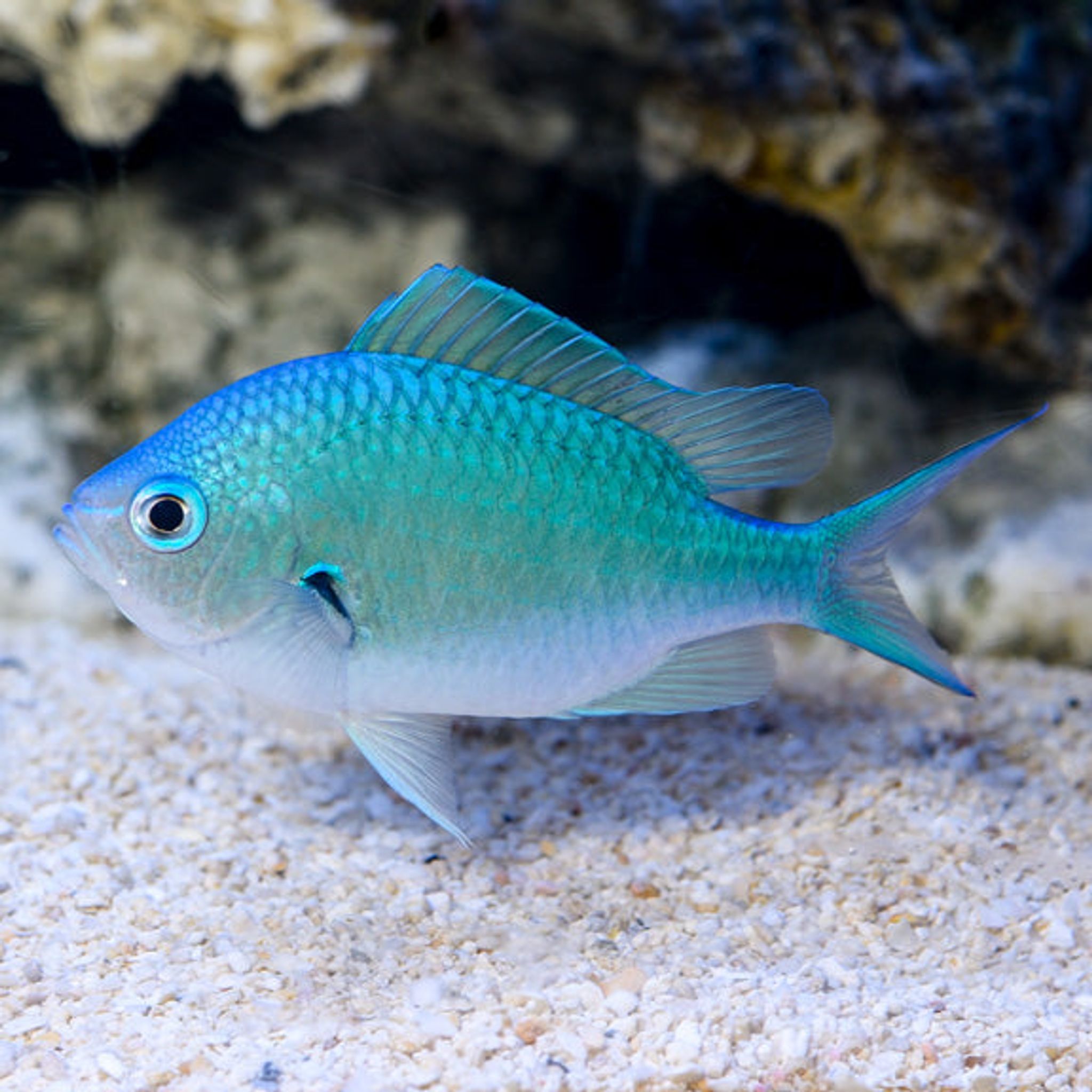
Blue-Green Chromis Care Guide: Tank Size, Diet, Compatibility and Reef Safety
Blue-green chromis (Chromis viridis) are one of the easiest schooling fish to add to a reef tank, but the majority of failures with this species trace back to one avoidable mistake: buying too few fish or adding them in dribs and drabs. This guide covers the tank size, group size, diet, and compatibility details you need to stock chromis correctly the first time.
Species ID: Chromis viridis vs. "Blue Chromis"
The blue-green chromis is a small member of the damselfish family, prized for its shimmering blue-green body and peaceful, schooling temperament. Confusingly, the common name "blue chromis" is used two different ways in the trade:
- Chromis viridis — the Indo-Pacific green/blue-green chromis most commonly sold for reef tanks and the subject of this guide.
- Chromis cyanea — a distinct Caribbean/Atlantic species also marketed as "blue chromis," with a deeper blue coloration and slightly different care profile.
Always check the scientific name before buying, since sellers use these labels interchangeably. If you're shopping FishyHub's chromis selection, confirm which species is listed so your group matches your stocking plan.
Size, Lifespan and Basic Stats
| Trait | Detail |
|---|---|
| Adult size | 2–4 in (5–10 cm), most settle around 3 in |
| Lifespan | Commonly 5–8 years; well-kept specimens reach 8–15 years |
| Temperament | Peaceful schooling fish (mild for a damselfish) |
| Diet | Omnivorous planktivore/grazer |
| Reef safety | Fully reef safe |
| Care level | Easy, beginner-friendly |
Tank Size and Group Size: The Two Details That Matter Most
Tank size and group size are linked, and getting either one wrong is the leading cause of dead or bullied chromis.
Minimum Tank Size
- 30 gallons (114 L) minimum — suitable only for a bonded pair or trio, not a full school.
- 55–75+ gallons (208–284+ L) recommended for a proper school of 6 or more; 75 gallons is the safer standard when you're stocking for the long term.
- 100+ gallons (378+ L) is better for larger groups of 8–10+, since more open water gives aggression room to dissipate instead of concentrating on one fish.
Tank shape matters too: a long, shallow, open-water reef tank supports schooling far better than a tall, narrow tank of the same volume, because chromis need horizontal swimming room in the mid-water column, not just rockwork to hide in.
Group Size: Avoid the Middle Zone
Keep blue-green chromis singly or in a group of at least 6. The range in between — 2 to 5 fish — is the single riskiest stocking choice, because that group size concentrates aggression onto the weakest individual instead of spreading it across the school. Bigger groups of 8–12 fish, given enough tank volume, spread out aggression further and school more naturally.
| Group size | Outcome |
|---|---|
| 1 fish | Fine — no schooling pressure |
| 2–5 fish | Avoid — aggression concentrates on the weakest fish |
| 6–7 fish | Practical minimum for real schooling behavior |
| 8–12 fish | Best schooling and aggression dispersal (needs 75–100+ gal) |
Add the Whole Group at Once
This is the practical rule that determines success or failure: add all your chromis to the tank at the same time, or as close together as logistics allow. Fish added first claim territory and will attack newcomers introduced later. If you're expanding an existing group, expect a renewed round of aggression as the pecking order resets — a smaller, calmer group of add-ins doesn't avoid this problem.
Water Parameters
Blue-green chromis are undemanding and thrive in standard reef parameters — no special requirements beyond stability.
| Parameter | Range |
|---|---|
| Temperature | 72–82°F (22–28°C), ideally 75–78°F (24–26°C) |
| pH | 8.1–8.4 |
| Specific gravity | 1.020–1.025 |
| dKH | ~8–12 |
Diet and Feeding
Blue-green chromis are omnivorous planktivores that graze constantly in the wild. Feed a varied diet built around:
- A high-quality marine flake or pellet as the base
- Frozen mysis shrimp and enriched brine shrimp
- Copepods, zooplankton, or an algae-based food added periodically for variety
Feed small amounts 2–3 times daily rather than one large feeding. Sources disagree here — some suggest once-daily feeding is enough in smaller tanks, while others recommend up to 4 feedings — but 2–3 small feedings is the practical consensus, and it mimics their natural constant grazing habit better than a single large meal. A single big feeding also tends to favor dominant fish, leaving subordinate schoolmates chronically underfed.
Reef Safety and Tankmates
Blue-green chromis are fully reef safe. They don't eat or nip coral and are compatible with clams, shrimp, and most other invertebrates as long as they're adequately fed — a hungry fish of almost any species is more likely to test food-like tentacles or clam mantles.
Good tankmates include:
- Clownfish
- Gobies and blennies
- Basslets
- Dwarf angelfish
- Butterflyfish
Avoid pairing chromis with large predatory fish, eels, or genuinely aggressive damsels and triggers that will bully or eat them outright.
Chromis and Other Damselfish
Chromis are the mild exception in a family known for aggression, but "damselfish" covers a wide range of temperaments. A brief comparison helps clarify why species choice matters as much as chromis-specific care:
| Species | Aggression level | Notes |
|---|---|---|
| Blue-green chromis | Low (mild for the family) | Peaceful schooler, reef safe |
| Azure damselfish | Moderate–high | Hardy, best kept singly, territorial toward its own kind |
| Springer's damsel | Moderate | Small, reef safe, less schooling-dependent |
| Fusilier damselfish | Moderate | Reef safe, adaptable alternate for damsel fans |
| Starck's damsel | Moderate–high | Reef safe, territorial as it settles in |
| Domino damselfish | High | Notably aggressive as it matures, poor community fish |
| Blue/Fiji blue devil damselfish | High | Classic beginner damsel that turns territorial with age |
A few points worth expanding on:
- Domino and blue devil damsels are commonly recommended against for reef community tanks unless kept singly — they become significantly more aggressive than chromis as they mature.
- Stocking order matters. Add peaceful, schooling fish like chromis before adding any territorial damsel species, and save the most aggressive damsel for last, since damsels claim and defend territory against whoever arrives after them.
- Aggression increases with age across almost the whole damselfish family, chromis included. Even a mild species can become noticeably more territorial as it grows and settles in, so a peaceful tank at six months isn't a guarantee at two years.
- Keeping chromis with other damsels generally works if the chromis school is established first (or added simultaneously) and only one, less pugnacious damsel species is introduced afterward. Adding multiple territorial damsels is much riskier, since they'll claim rockwork and harass the school. You can browse other options in FishyHub's damselfish category if you're comparing species before you buy.
Sexing and Breeding
Blue-green chromis are difficult to sex visually outside of spawning periods. During spawning, males may show a yellowish tint and a darker tail, and can become territorial while guarding eggs — behavior that mirrors other damselfish species. Breeding in home aquaria is uncommon but has been documented, typically following the same egg-guarding pattern seen throughout the family.
Why Chromis Stop Schooling
A tight school that later scatters is a common troubleshooting question, and it usually comes down to one of these:
- Group size dropped below the safety threshold (through death or rehoming), leaving too few fish to school cohesively.
- Insufficient open swimming space — an over-aquascaped tank with heavy rockwork restricts the mid-water column chromis need to school.
- One dominant fish suppressing the others, breaking up group cohesion.
- Natural pairing-off as fish mature, where some individuals form breeding pairs and drift away from the main school.
Best Chromis Choices for Different Tank Sizes
Blue-green chromis remain the classic choice for a large, cohesive school and scale well from 75-gallon tanks up to much larger systems. Some related "blue reef chromis" species school less predictably in smaller volumes, often doing better in subgroups of 4–6 in tanks under 75 gallons and only forming larger schools in 120+ gallon systems. If your goal is a big, visible school, Chromis viridis in a 75-gallon-or-larger tank is the more reliable option.
Common Mistakes and Troubleshooting
- Buying only 2–3 chromis "to start." This is the single most common mistake and reliably causes bullying deaths — buy the full group at once.
- Adding chromis one or two at a time over several weeks. This triggers territorial attacks on each newcomer.
- Undersized tank for the group size chosen, leading to chronic stress, hidden mortality in the rockwork, and stunted or skinny individuals.
- Not enough open swimming space, which suppresses schooling even when the numbers are correct.
- Assuming all "chromis" or damselfish are peaceful. Some fish sold under similar names — domino or blue devil damsels — are far more aggressive; verify the species before buying.
- One large feeding instead of several small ones, which lets subordinate fish go hungry while dominant fish eat their fill.
- Ignoring rising aggression as fish mature. A peaceful school at purchase can develop pecking-order problems months later; monitor behavior and rearrange rockwork or feeding patterns if needed.
Quarantine and New-Tank Considerations
Chromis are prone to ich and velvet outbreaks tied to shipping and group-transfer stress, so a dedicated quarantine period before adding them to the display tank is worth the extra step, especially for a school-sized group arriving together. Where possible, source a same-sized group from a single shipment — uniform sizing at day one reduces the size-based pecking order that can develop when a few larger fish dominate smaller tankmates from the start.
Chromis are also frequently used as early, hardy schooling fish during a tank's cycling period, sometimes functioning as unintentional "dither" fish. If you're adding them to a new system, tie their feeding schedule and quantity closely to your tank's cycling status — unstable parameters during cycling are a common, underappreciated cause of losses that get blamed on the fish rather than the tank.
If you already have a small, aggressive group of 2–4 chromis, two options exist: add enough additional fish simultaneously to dilute the existing hierarchy and reach a safer group size, or rehome the remaining fish if the aggression has already caused lasting injury. Diluting the hierarchy tends to work better when done early, before one fish becomes chronically dominant.
Frequently Asked Questions
How many blue-green chromis should I keep together?
Keep at least 6, and ideally more if your tank is large enough to support it. Avoid group sizes of 2–5, since that range concentrates aggression on the weakest fish rather than spreading it out.
What is the minimum tank size for chromis?
A 30-gallon tank works for a bonded pair or trio only. For a proper school of 6 or more, plan for 55–75+ gallons, with 75 gallons as the safer long-term standard.
Are blue-green chromis reef safe?
Yes. They don't eat or nip coral and are compatible with clams, shrimp, and most other invertebrates, provided they're fed adequately.
What do blue-green chromis eat?
A varied diet of marine flake or pellet, frozen mysis shrimp, and enriched brine shrimp, supplemented with copepods or zooplankton. Feed small portions 2–3 times daily.
Can I keep chromis with damselfish?
Yes, if the chromis are established as a group first (or added at the same time) and only one milder damsel species is introduced afterward. Adding multiple aggressive damsels alongside chromis is much riskier.
Why did my chromis school stop swimming together?
The usual causes are insufficient numbers, cramped or overly aquascaped swimming space, or individual fish pairing off and forming breeding pairs as they mature.
How long do blue-green chromis live?
Typically 5–8 years, with well-kept specimens reaching 8–15 years under stable conditions.
Is blue chromis the same fish as green chromis?
Often, yes — "blue chromis" and "green chromis" are both used for Chromis viridis. But the name is also applied to Chromis cyanea, a distinct Caribbean species, so check the scientific name before buying to avoid a mismatch with your stocking plan.
If you're ready to stock a school, browse FishyHub's full range of marine fish to plan tankmates alongside your chromis order, and pick up a varied food and supplement rotation to keep multiple small feedings on hand from day one.

