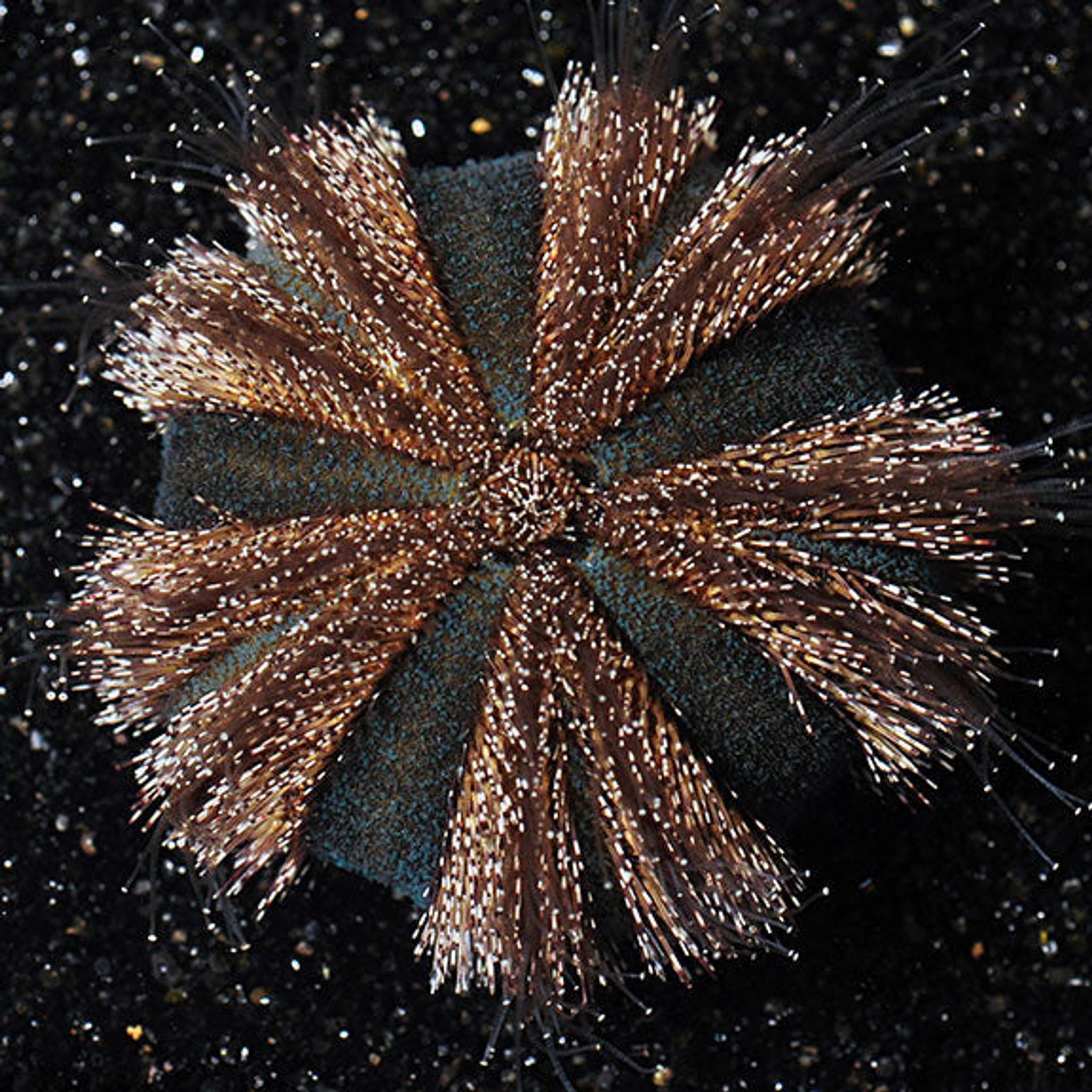
Best Tank Mates for Tuxedo Urchin in a Reef Aquarium
A tuxedo urchin (Mespilia globulus) is one of the more forgiving reef cleanup crew members, but "reef safe" doesn't mean "roommate safe" with everything in the tank. This guide covers which fish, invertebrates, and corals actually pair well with a tuxedo urchin, which animals pose a real predation risk, and how to set up the tank so the urchin doesn't bulldoze your frag rack.
Tuxedo Urchin Basics: What You're Housing
The tuxedo urchin, also sold as the blue tuxedo urchin (with a less common red color morph), is a grazing echinoderm — not a predator. It spends its time working over rock and glass for algae film rather than hunting anything.
Key facts to know before stocking around it:
- Adult size: roughly 2–3 inches (5–7.5 cm) across, though most are sold small at about 0.5–1 inch (1.3–2.5 cm).
- Lifespan: reports vary, but a realistic range is 1–3 years in home systems, with longer lifespans tied to stable, mature setups rather than any single "correct" number.
- Diet: hair algae, film algae, coralline algae, diatoms, and detritus, supplemented with nori, algae wafers, or veggie clippings when natural grazing isn't enough.
- Reef safety: it does not eat coral tissue, but it is a physical hazard — more on that below.
Water Parameters
| Parameter | Target range | Notes |
|---|---|---|
| Temperature | 72–78°F (22–26°C) | Stable is more important than exact |
| Specific gravity | 1.023–1.025 | Some keepers run as low as 1.021 |
| pH | 8.1–8.4 | Standard reef range |
| Alkalinity | 8–12 dKH | Standard reef range |
| Nitrate | Under ~20 ppm | Echinoderms are notably sensitive |
| Copper | None, ever | Lethal to urchins at treatment doses |
Echinoderms as a group are unusually sensitive to nitrate creep and to copper, so a tank that's otherwise "fine" for fish can still stress or kill a tuxedo urchin.
Best Tank Mates for a Tuxedo Urchin
Fish That Pair Well
Most peaceful, non-predatory reef fish coexist with a tuxedo urchin without issue, since it never competes for food or territory in a way that bothers fish. Good options include:
- Clownfish
- Gobies and blennies
- Cardinalfish
- Most wrasses
- Firefish
- Tangs
- Dwarf angelfish
You can browse a wide range of these community-friendly options among marine fish suited to a peaceful reef stocking list.
Invertebrates That Pair Well
The tuxedo urchin generally ignores other motile and sessile invertebrates, making it easy to combine with a typical reef cleanup crew:
- Cleaner shrimp (skunk, fire, peppermint, Pederson's)
- Most snails (turbo, trochus, cerith, nassarius)
- Most hermit crabs — with a caveat below
- Other urchin species, space and algae permitting
Corals That Pair Well
Since the urchin doesn't eat coral tissue, soft corals, LPS, SPS, zoanthids, and mushrooms are all compatible as long as they're firmly attached with epoxy or coral putty rather than just set on the rock. An unglued frag isn't a food item to the urchin, but it is an obstacle, a foothold, or camouflage material, and it will be treated accordingly.
Tank Mates and Situations to Avoid
Predators to Keep Out
Some fish are known urchin predators, both in the wild and in captivity:
- Large triggerfish
- Pufferfish and boxfish
- Some large or hard-mouthed wrasses, including harlequin tuskfish-type species
The general rule: anything with a strong, beak-like mouth built for crushing shells is a red flag, even if the exact species isn't on a published predator list. Standard "reef safe" fish lists are built around coral tissue, not echinoderms, so a fish rated reef safe for corals can still pick apart an urchin.
Hermit Crabs Need a Closer Look
Small, reef-safe hermit crab species are generally fine tank mates. Larger, more aggressive species — the type often sold as "Halloween" hermits — can harass an urchin or pick at its spines and shell fragments, particularly if the tank is short on other food sources. Watch behavior after introduction rather than assuming size alone rules a species out.
Overcrowding Multiple Urchins
Multiple tuxedo urchins can coexist in the same system if there's enough rock surface and algae to go around. The risk isn't aggression between urchins — it's starvation competition when several urchins are crammed into a small or low-algae tank and there isn't enough grazing surface to support all of them.
Tank Setup Requirements
A tuxedo urchin does best in a mature, established system rather than a freshly cycled tank, because it depends on an existing algae film to graze.
- Minimum tank size: 15+ gallons (57+ liters) is the safer minimum. Some sources allow 10 gallons (38 liters) for a single specimen, but only in an already mature, algae-rich system — not as a general starting point.
- Live rock: should be established with visible algae film and biofilm, not brand-new dry rock.
- Glass vs. acrylic: glass tanks hold up better long-term; the urchin's spines can scratch acrylic panels over time as it grazes across the walls.
- System maturity: let the tank run and stabilize before adding the urchin — it's not a good first inhabitant for a new cycle.
Securing Corals and Rockwork Before Adding an Urchin
Because the tuxedo urchin bulldozes across rock while foraging and also picks up shells, rubble, and loose frags to wear as camouflage — a behavior often called "covering" — anything not secured is at risk of being knocked over or relocated.
Before introducing the urchin:
- Glue or epoxy every frag to the rockwork rather than resting it in a crevice.
- Stabilize loose rockwork so a shifted rock doesn't topple a coral or crush the urchin itself.
- Elevate prized frags on a frag rack raised above the substrate, out of the urchin's usual travel path.
- If you need to place a new frag near the urchin's territory, temporarily relocate the urchin to another part of the tank (or a container of tank water) while the epoxy sets, then return it once the frag is secure.
A surprising number of "the urchin ate my coral" reports are actually unglued frags that got knocked over or grabbed for camouflage — not tissue predation.
How to Introduce and Acclimate a Tuxedo Urchin
Echinoderms are far less tolerant of sudden parameter swings than most reef fish, so acclimation deserves extra care.
- Drip acclimate slowly — 45 to 90+ minutes minimum. Sudden salinity or temperature swings are a leading cause of spine loss and death shortly after introduction.
- Confirm no copper exposure, past or present. Copper-based medications are lethal to echinoderms, and copper can leach from rock or equipment previously used in a treated system.
- Skip formal quarantine for the urchin itself. Most hobbyists add urchins directly to the display rather than running them through QT, since the stress and instability of a bare quarantine tank is often harder on an echinoderm than the disease risk it's meant to prevent. This is a tradeoff, not a guarantee — it means any pest or disease risk the urchin carries goes straight to the display, so it's worth quarantining fish and coral additions more rigorously to compensate.
Feeding and Preventing Starvation
In a very clean, low-algae tank — often the result of good filtration and low nutrients — natural grazing may not be enough to sustain the urchin.
Watch for signs of hunger:
- Roaming more actively and more often, searching wider areas of the tank
- Thinning or sparse spine coverage
- Spending more time on the glass or on rockwork than tucked into crevices
If you see these signs, supplement two or three times a week with:
- Nori or dried seaweed sheets, clipped to the rock
- Algae wafers
- Refugium macroalgae, if you run one
Signs of Stress or Illness
Because echinoderms react quickly to water quality problems, they're a useful early warning system for the rest of the tank. Watch for:
- Spine loss or balding patches — most often tied to nitrate stress, poor acclimation, or parasites
- Lethargy — reduced movement or grazing activity
- Tube feet not gripping — a sign the animal is struggling to hold onto rock or glass
Any of these warrants an immediate water test, particularly for nitrate, salinity, and temperature stability.
Common Mistakes to Avoid
- Adding an urchin to a brand-new tank with no algae film, forcing immediate heavy supplemental feeding or risking starvation.
- Fast-drip or skipped acclimation, causing shock, spine loss, or death within days.
- Leaving coral frags unglued, then blaming the urchin for "eating" coral it actually just knocked over or picked up.
- Letting nitrates creep up — even moderate levels are a common cause of spine loss and shortened lifespan.
- Assuming standard reef-safe fish lists apply to invertebrates the same way they apply to corals, and housing the urchin with large wrasses, triggers, or puffers as a result.
- Using acrylic tanks or copper-based treatments in the same system — both damage or kill echinoderms over time.
Frequently Asked Questions
Will a tuxedo urchin eat my coral?
No. It grazes algae, not coral tissue. It can, however, knock over or physically damage unsecured frags while foraging or while picking up debris to "cover" itself for camouflage.
What fish will eat or hurt a tuxedo urchin?
Large triggerfish, pufferfish, and some large or hard-mouthed wrasses are the main risks. As a general rule, avoid any fish with a strong, beak-like mouth built for crushing shells.
Can I keep a tuxedo urchin with hermit crabs?
Usually, yes, with small reef-safe hermit species. Larger, more aggressive hermit crabs may pick at the urchin's spines or shell fragments, so monitor behavior closely after introduction.
How big a tank does a tuxedo urchin need?
A mature 15-gallon-plus (57+ liter) reef with established live rock and algae film is the safer minimum. Smaller systems risk running out of algae for the urchin to graze.
Do I need to feed my tuxedo urchin?
Only if natural algae growth isn't keeping up. In very clean or newer tanks, supplement with nori, algae wafers, or macroalgae two or three times a week.
Why is my urchin losing spines?
Spine loss is usually linked to elevated nitrates, poor acclimation, water quality swings, or parasites causing bald patches. Test water parameters right away if you notice thinning spines.
Can I keep more than one urchin in the same tank?
Yes, as long as there's enough rock surface and algae to support them. Crowding several urchins into a small or low-algae tank invites competition and eventual starvation.
Is a tuxedo urchin reef safe with clams and other filter feeders?
Generally yes, since the urchin targets algae and detritus rather than living tissue. Keep an eye on physical contact, though, since its slow bulldozing movement can still disturb delicate sessile invertebrates nearby.
If you're planning a reef stocking list around a tuxedo urchin, browse compatible options across marine invertebrates and soft corals on FishyHub to build out a tank that's both algae-controlled and urchin-safe.


